
[Continued from Part 3]
As the largest gathering of World’s Fair visitors to date began flowing into Jackson Park for the Fourth of July ceremony, members of the platform party met in downtown Chicago for a parade to the fairgrounds.
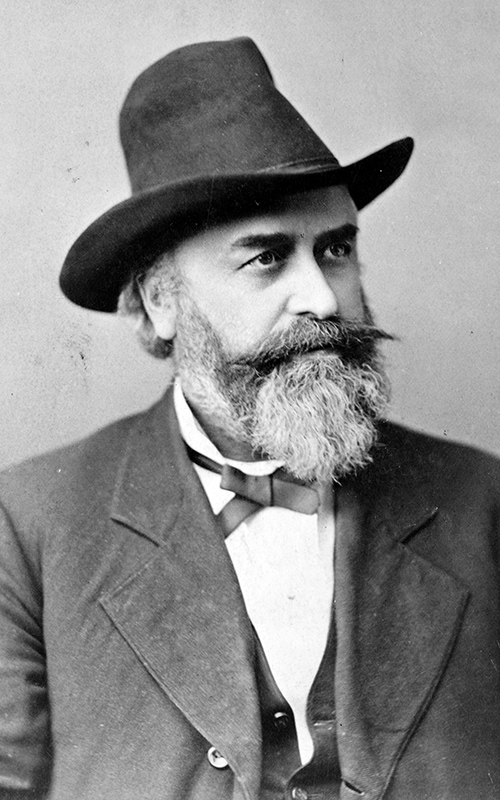
Mayor Carter H. Harrison in his trademark slouch hat. [Image from the Library of Congress.]
“Pelted with torpedoes”
Mayor Carter H. Harrison was the first to reach City Hall on the morning of the July 4th. He was so early that he encountered an elevator with no operator and the doors to his office locked. Corporation Counsel Adolf Kraus arrived by 8:15 am. Kraus, former president of the Chicago Board of Education and a prominent member of Chicago’s Jewish community, had served as Carter’s campaign manager in the spring 1893 election that secured his fifth win. The mayor’s brand-new lightweight straw hat caught Mr. Kraus’ attention.
“I hope you’re not going to wear it to the Fair today,” advised Kraus.
“No,” replied Carter. “I’m not going to wear this Panama.”
The mayor had become a bit shy about any alternative to his trademark slouch hat after making headlines around the country a month earlier for wearing a snazzy silk top hat when Princess Eulalia of Spain had visited the Fair. Also gathering at City Hall this morning were members of City Council and other officials who would be traveling together to the fairgrounds for the morning ceremony. The mayor distributed cigars to his troupe of city leaders to enjoy on their ride to the fairgrounds; smoking was strictly prohibited once inside the park.
Alderman Martin B. Madden, head of the Municipal Fourth of July Committee, made sure everyone got into the right carriages for the procession to Jackson Park. Today was the culmination of at least six weeks of planning and preparation on his part. He had told the Inter Ocean (Jun. 24, 1893) that the celebration “will illustrate the fulfillment in power and grandeur of the hopes and prophecy of our revered ancestors and prove their wisdom and devotion for the cause of universal freedom.”
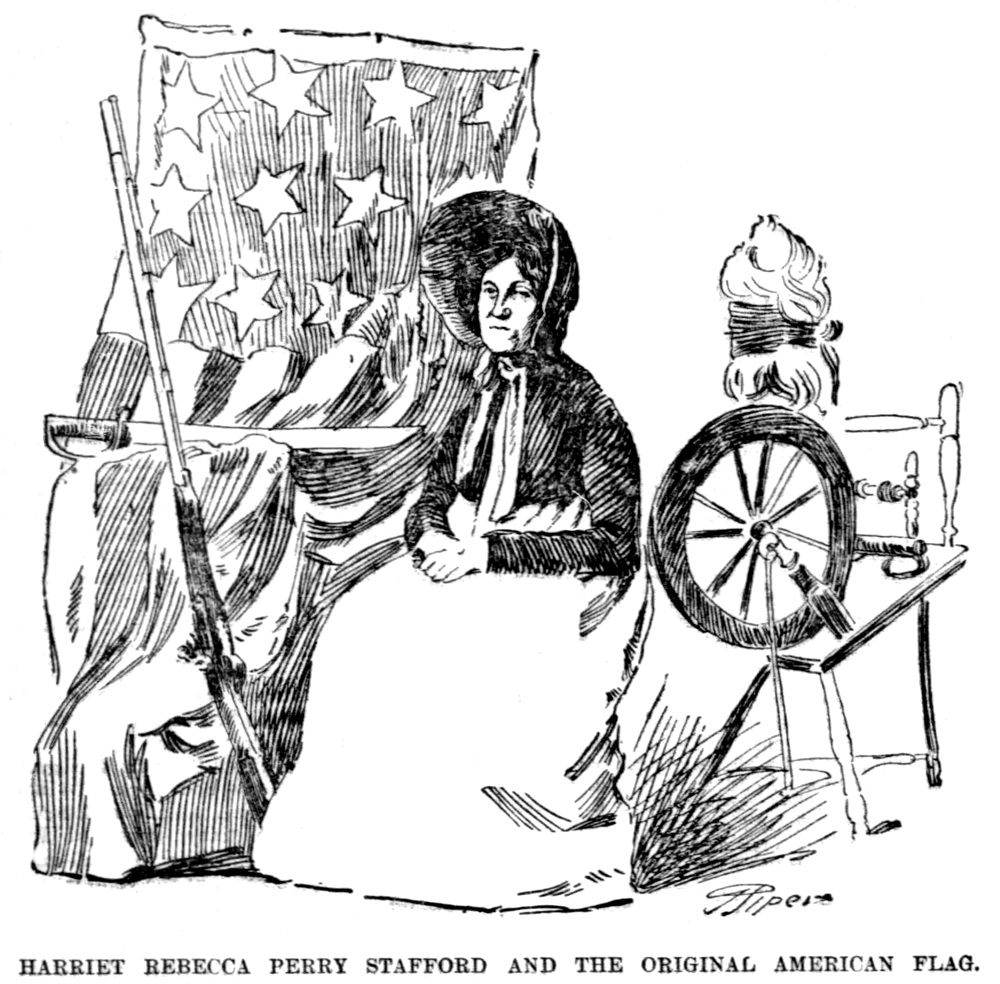
Mrs. Harriet Rebecca Perry Stafford and the original American flag. [Image from the Chicago Tribune July 5, 1893.]
Before departing, each member of the platform party received a large silk handkerchief in the national colors, which they all wore conspicuously. A mounted squad of Chicago’s finest, forming a phalanx four deep and stretching from curb to curb, led the parade as they departed City Hall around 9 am. Joining the police at the head of the procession was the Second Regiment Band, which played all the way along the nine-mile route. Spectators cheered as the band performed “Army Life,” “The Connaughtman’s Rambles,” “The Devil’s Dream,” “The Wind that Blew the Barley Down,” and “Killarney.” Spectators accompanied the band’s percussion section with firecrackers. The choking smoke added to the perpetually grey air of the city. Several small bombs went off along the parade route close to the mayor. “It is a wonder the horses that drew Carter’s carriage were not blown into kingdom come by the artillery that was exploded under them,” reported the Tribune. “Carter was pelted with torpedoes, and folks cheered him until they could not cheer anymore.”
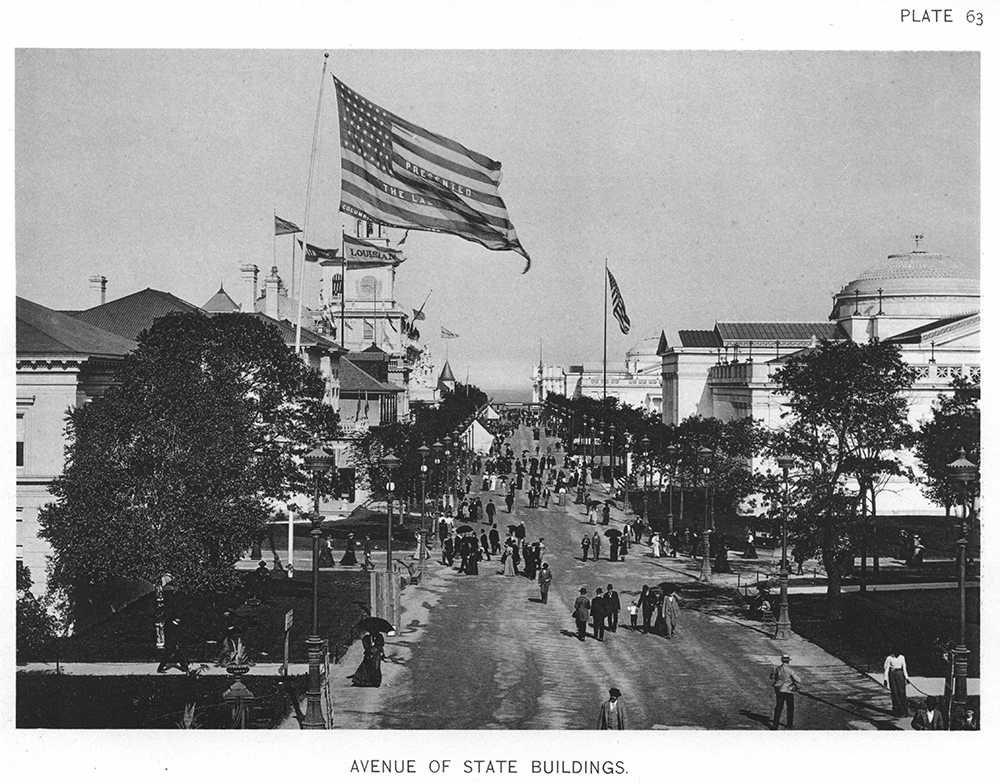
A view looking east from the 57th Street entrance along the “Avenue of State Buildings.” The large American flag flew in front of the Nebraska State Building (left). [Image from Arnold, C. D.; Higinbotham, H. D. Official Views of the World’s Columbian Exposition. Press Chicago Photo-gravure Co., 1893.]
“Plunged into the crowd”
The procession reached the fairgrounds entrance at 57th Street and Stony Island Avenue shortly after 10 am. From here, only the carriages carrying the ladies continued to Administration Plaza. The mayor and aldermen would need to traverse a nearly mile-long path southward on foot and through a dense mass of visitors. They looked around for their expected escort but, finding no one, launched themselves into the thick stream of humanity. “It did really seem as if every man, woman, and child knew him,” wrote the Chicago Tribune about the mayor’s trek, “and he was cheered from the time he left the 57th Street gate until he clambered onto the grandstand.”
The civic leaders were supposed to have been greeted at the entry gate by an escort of the American Exhibitors Association. The newly formed Exposition union had arranged for thousands of their members and some bands to be lined up with military precision and waving American flags, ready to accompany the mayor on his march. “It will be a remarkable procession,” they had promised the Chicago Evening Post a few days earlier, “for in the ranks will be found the great merchants and manufacturers, inventors and builders who have made the title of American famous for its skill in handicraft the world over.” Things did not go as planned. Earlier, a group of exhibitors from Washington State had come marching along with a stuffed eagle perched on a banner. Cheers greeted the bird of freedom. Other exhibitors, impatient to get started, followed them on an impromptu tramp through the fairgrounds singing “Yankee Doodle.” Their ranks swelled as they picked up additional exhibitors when passing through other buildings. When the marchers emerged from the Mines and Mining Building, the mayor and aldermen were passing by. The exhibitors cut them off in their march toward Administration Plaza. The Chicago Herald reported that Mayor Harrison and Mr. Kraus “put their shoulders forward and, like veteran football players, plunged into the crowd.” After pushing hard for more than fifteen minutes, the two officials reached the platform. The aldermen, on the other hand, had scattered like lost sheep though eventually regrouped and made their way to the stage.
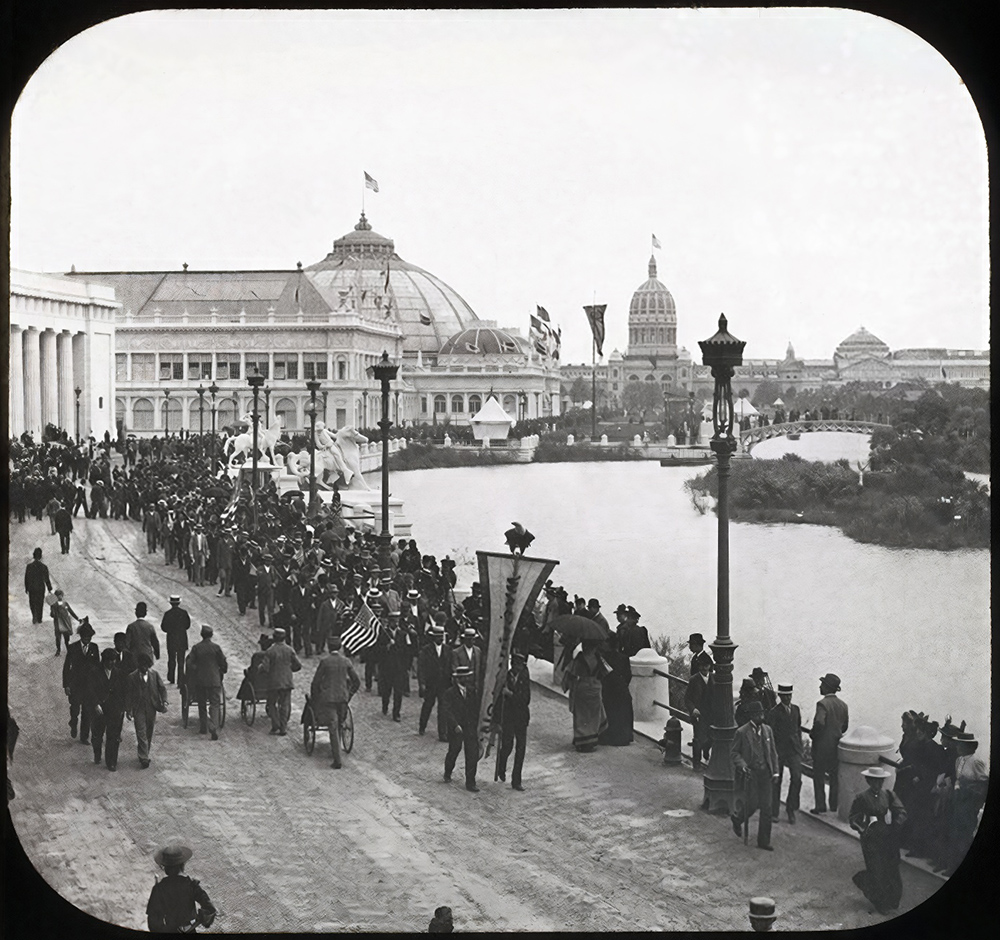
A parade of the American Exhibitors Association, carrying a stuffed eagle perched on a banner, marches past the Transportation Building on its way to the Administration Plaza. [Image from the Brooklyn Museum, S03i2184l01_SL1.jpg]
“Hooray for Carter!”
At 11 am the mass band came to the platform and opened the Fourth of July ceremonies with a medley of American airs, beginning with “Hail Columbia” followed by “Dixie” (which garnered the expected yells from southerners in the crowd) and “The Star-Spangled Banner.” This musical prelude ended with “Yankee Doodle,” eliciting shouts from many and driving one young woman positioned on the balcony of Terminal Station to dance a jig.
Following the band’s last note, someone shouted “Hooray for Carter!” A crescendo of cheers filled the plaza as locals saw the famous City Hall slouch hat thread its way through the throng. When the mayor turned to wave from the stage, all could see the silk American flag poking out of the left breast pocket of his coat. Ald. Madden and members of the Municipal Fourth of July Committee took their seats on the bleachers behind the speakers’ stand. The alderman “beamed with satisfaction as he saw his men distributing several thousand little flags to the people.” There weren’t nearly enough.
Col. George R. Davis, Director-General of the World’s Columbian Exposition, and several national commissioners and department chiefs, exited the Administration Building and had to force their way through the thick crowd blocking their path to the platform. There, Director of Works Daniel Burnham, his coat and tails covered in dust, instructed workmen in final arrangements of the furniture on stage. Buzzing about to assist was Frank Millet in his final act as Director of Color for the Exposition; he resigned the position today.
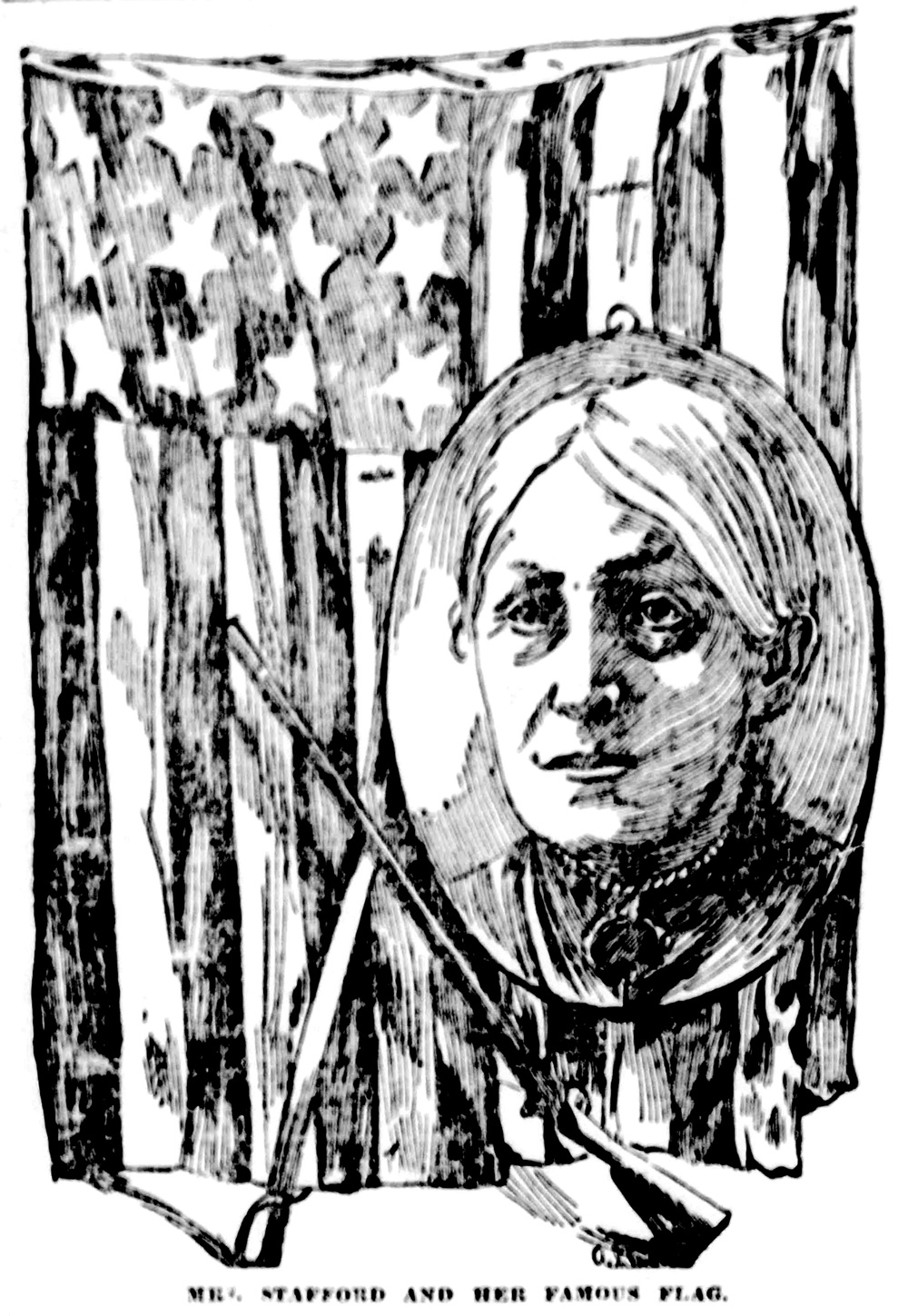
Mrs. Harriet Rebecca Perry Stafford with her famous “John Paul Jones’” flag. [Image from the New Bedford (MA) Evening Standard Jul. 5, 1893.]
“Don’t take my flag”
An elderly woman—“a trembling mother whose hair was as white as unfallen snow,” according to the Chicago Herald—walked slowly toward the platform with an uncertain gait. She wore a heavy black silk gown having an old-fashioned cut. Her hands trembled with emotion as she clutched a large paper box against her breast, looking fearful that someone might try to snatch it away. The cover of the box was loose, and through the gap could be seen the red, white, and blue folds of an American flag. Someone in the crowd cried out “It’s the flag—Paul Jones’ old flag.” The sea of spectators parted to let her through. As the mayor climbed the steps to the speakers’ stand, he saw the old woman and rushed back to assist, offering to take the parcel. She gripped the precious box even tighter, admonishing: “No, no! You may help me, but don’t take my flag.” Mayor Harrison and Director-General Davis escorted her to a chair. “She brings the original Paul Jones flag,” Col. Davis explained to the audience, “the first American flag that ever fluttered in the breeze.” Mrs. Stafford acknowledged the crowd’s rousing recognition with a smile, then crossed to the south end of the platform where a young man dressed in blue helped her fasten the flag to the halyards of the flagpole.[1]
Next to reach the stage was the Vice President of the United States. Adlai E. Stevenson apparently had remembered his Exposition pass this day and was allowed to enter the fairgrounds without the same embarrassing incident that had occurred several weeks earlier. The crowd greeted their home-state politician with an enthusiastic welcome. Once seated, he removed his straw hat. “Stevenson,” said the mayor, still wearing his trademark slouch, “put on your hat; be comfortable.” The vice president obeyed.
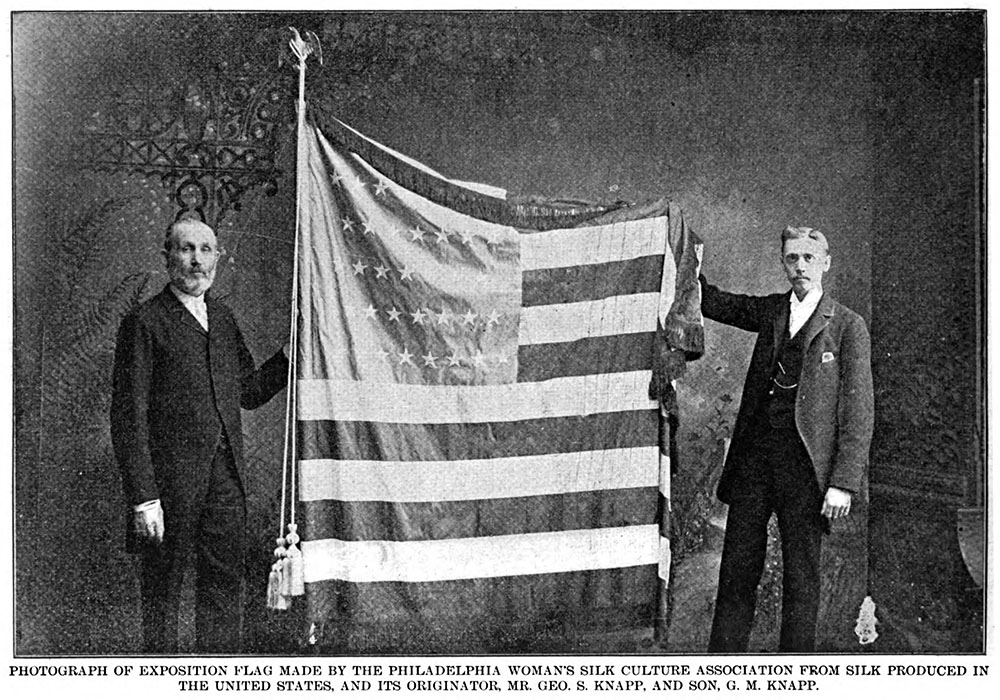
George S. Knapp and his son George M. Knapp display the Exposition Flag. [Image from World’s Columbian Exposition Illustrated Nov. 1893.]
The Exposition Flag
George S. Knapp of Chicago arrived on stage carrying different national standard, a rich silk American flag fringed with heavy bullion. This was the “Exposition Flag,” and Mr. Knapp served as its caretaker when it was carried at the head of the civic procession on Dedication Day the previous October and when it accompanied the old Liberty Bell on its journey from Philadelphia to Chicago in late April. Mr. Knapp soon would also take on the responsibility of being the caretaker of the Columbian Liberty Bell on the fairgrounds.
Rounding out the platform party was a large contingent of visiting guests of honor. Representing the Universal Peace Union and carrying the “Flag of Human Freedom and Universal Peace” were Mrs. Mary Frost Ormsby of Rhode Island, and Mrs. Nettie Bringhurst of Texas, daughter of Gen. Sam Houston. Mrs. H. G. Hollenberg of Little Rock, Arkansas, and Mrs. D. R. Dorris of Nashville, Tennessee, represented the Hermitage Association, President Andrew Jackson’s home and estate in Nashville. The women brought with them Andrew Jackson’s sword, given to the hero of the 1815 Battle of New Orleans by the State of Tennessee in 1825. With “New Orleans” inscribed on its blade and a hilt and scabbard wrought in gold, the handsome relic would have its moment to shine later, at the noon climax of the ceremony.
The Columbian Liberty Bell Committee was well represented in Chicago. Chairman William O. McDowell led his contingent to their seats at the north end of the platform. Among the representatives were Miss Mary Desha of the Daughters of the American Revolution; Mrs. Madge Morris Wagner of California, whose patriotic poem “Liberty’s Bell” inspired the creation of the Columbian Liberty Bell; her daughter, Miss Pearl Wagner; and Miss Minnie F. Mickley of Pennsylvania, who helped launch the project and served as secretary of the Committee; and several others.[2]
When the last members of the platform party finally took their seats, telegraph operator Frank A. Hemphill sent a message to Albany and was answered with an “O. K.” from Operator Thomas F. Gary. Everything was ready for the ceremony to begin.

Col. George R. Davis, Director-General of the World’s Columbian Exposition [Image from Picturesque World’s Fair. W.B. Conkey, 1894; digitally edited.]
The Call to Order by Director-General George R. Davis
It was almost 11:30 am before Director-General Davis rose to begin the exercises. Colonel Charles H. Clarke of Milwaukee stepped forward and presented Col. Davis with a gavel having an ivory hammer and bone handle, announcing:
“Director-General Davis: 118 years ago today, Washington arrived at Cambridge, Mass., drew his sword and took command of the Continental Army under the tree known as the ‘Washington Elm.’ I take pleasure in presenting you with a gavel for this morning’s services, made from the wood of that now famous tree.” [3] Col. Davis loudly pounded the historic gavel on the flag-covered table, announcing: “The ceremonies will commence with prayer by Rev. Dr. Canfield.”
As with other major assemblies in the era before amplification, few in the audience could hear much of anything. “Voices of the speakers varied greatly, some carried far out over the crowd, but most of the speeches could not be heard beyond the first twenty ranks,” wrote the Chicago Times. The Chicago Record added that “it would have taken a hundred rostrums and a regiment of orators to reach the entire multitude.” Only a few hundred spectators nearest the lectern would have heard the words spoken, though the band’s music spread out a bit farther. Even attendees in the farthest corners of the plaza could see the minister step up to the lectern. A hush descended across the multitude.
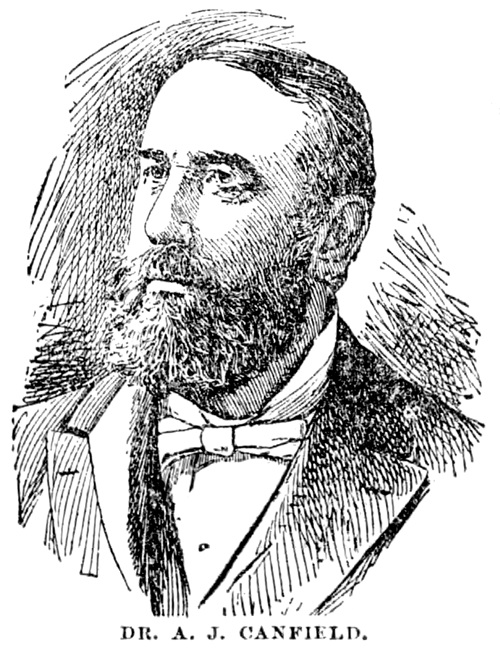
Rev. Andrew J. Canfield, pastor of St. Paul’s Universalist Church in Chicago, delivered the Opening Prayer. [Image from the Kewanee (IL) Daily Courier Dec. 8, 1896.]
Opening Prayer by Rev. Andrew J. Canfield
The Opening Prayer for the outdoor ceremony was originally assigned to Dr. Rev. John Henry Burrows, pastor of the First Presbyterian Church in Chicago and Chairman of the Committee on Religious Congresses of the World’s Columbian Exposition. Without explanation, he was replaced at last minute by Rev. Andrew Jackson Canfield, D. D. From 1890 to 1900, Rev. Canfield served as the pastor of St. Paul’s Universalist Church, located at Prairie Avenue and 30th Street. (Coincidentally, that location currently is the site of a city park named for Paul Laurence Dunbar, who worked at the Columbian Exposition before becoming one of the nation’s first critically acclaimed African-American authors.) Rev. Canfield was one of several clergy members who spoke in favor of Sunday openings of the Exposition. The Chicago Inter Ocean (Jul. 13, 1890) described him as “one of the most eloquent pulpit orators” and “a powerful speaker.” Needless to say, his audience today was many hundreds of times larger than his usual Sunday congregation. Most in the vast assemblage reverently preserved silence during his invocation, though shouts of “louder!” from some unfortunates on the outskirts interrupted his words.
Rev. Canfield said:
“Almighty and eternal God, Thou art the author and the giver of life, the ruler of nations and of men, the refuge and the hope of all our fleeting generations. We would acknowledge Thee in all our ways. We would lift a devout and reverent thought to thee, that we may hallow the memories, the thoughts, the exercises and the enjoyments of this day. Thou wert the God of our fathers. Their strength and their fidelity came alike from their faith in God, from their reverent obedience to Thy will, from their earnest piety, from their regard for us, their children to a late posterity. We thank Thee for all these guiding and protecting providences of Thine over these passing centuries of time while these scenes have changed from a wilderness to civilization, to the marts of industry, thrift and prosperity, and the homes and altars of domestic peace.
Inheriting the achievements of a wise and successful ancestry, we desire also to live and act in the reverence of God, in the love and obedience of all Christian truth, in filial regard to Thy holy will in all things. May we leave this fair heritage to those that shall come after us more and more privileged, secure and happy under Thy continued guidance and favor. To that end we pray for Thy blessing upon the President of the United States and all others in authority, and now we would all as dependent and trusting children join in the filial prayer :
“Our Father, Who art in heaven ….’”
With a ringing “Amen,” Rev. Canfield closed his prayer “with a hope that the services might inspire a nobler love of country in every church and school-house and home, east and west, north and south,” according to the Chicago Herald. Following the representative of Church came the representative of State.
[Continued in Part 5]
NOTES
[1] The ‘young man dressed in blue” may have been James (“Jimmy”) Hunt, General Foreman of Painters and Sailors and the man in charge of raising and lowering flags on the fairground each day.
[2] Other members of the Columbian Liberty Bell Committee on stage were Mrs. Jessie Burdett of Vermont; Mrs. Elizabeth Churchman of Delaware; Miss Floride Cunningham of South Carolina, lineal descendant of Gen. Andrew Pickens of Revolutionary War fame; Mrs. Loulie (“Lulu”) M. Gordon of Georgia; Miss Anne S. Greene of Charlottesville, Virginia; Miss Hattie Felix Harris of Idaho; Mrs. William Lindsay of Kentucky; Miss Pauline McDowell of New Jersey; Mrs. Donald McLean of New York; and Mrs. Frank Stewart Osborn of Chicago.
[3] Like so many stories in American history, the legend of the “Washington Elm” grew from shaky ground. Historical evidence indicates that George Washington took command of the Continental Army on July 2, 1775, in Cambridge, but likely not near the elm tree later dedicated to the event. “The story of the Washington Elm is a myth, but the tree was a reality,” concludes researcher Robert A. Briggs. The famous tree, which stood for several hundred years in Cambridge Common, a large public park next to historic Harvard Yard, was accidentally pulled down on October 26, 1923. Within hours, a horde of souvenir hunters swarmed over the remains, notes Briggs. Small remnants “were fashioned into gavels, striking blocks and the like and distributed to patriotic organizations” In 1925, Vice President Charles Dawes planted a sapling of the original tree; this new Washington Elm and an historic marker stand today on the site.
The gavel that Col. Davis used to call to order this 1893 Fourth of July celebration was one of many mementos made from pieces of the original Washington Elm well before it fell in 1923. While Col. Clarke was in Cambridge in 1857, a storm broke a large branch off the tree. The city’s mayor gave him the wood, from which he fashioned a gavel. Its first use was on April 30, 1889, in the Long Room Tavern in New York, for an assembly commemorating the centennial of Washington’s first inauguration. The gavel sounded to open the organizational meetings of the Sons of the Revolution and the Society of the Daughters of the Revolution, and again at the formation of the League of Human Freedom in Independence Hall, Philadelphia, and at the June 7, 1893, meeting of the Columbian Liberty Bell Committee.
SOURCES
“Brevities” Chicago Inter Ocean Jul. 13, 1890, p. 7.
Briggs, Robert A. “The Washington Elm” The SAR Magazine Fall 1988, pp. 10–11.
“Carter H. En Route” Chicago Tribune Jul. 5, 1893, p. 10.
“Cheering the Flag” Chicago Herald Jul. 5, 1893, p. 9.
“Fair’s Best Day” Chicago Times Jul. 5, 1893, p. 1.
“For a Grand Chorus” Chicago Inter Ocean Jun. 24, 1893, p. 9.
“His Birthday Party” Chicago Tribune Jul. 5, 1893, p. 1.
“Historic Mementos of Interest” Chicago Tribune Jul. 5, 1893, p. 9.
“Old Glory’s Big Day” Chicago Evening Post Jul. 3, 1893, p. 1.
“World’s Fair Fourth” Chicago Record Jul. 5, 1893, p. 1.

Leave A Comment