
[Continued from Part 16]
The “grand climax” of the Fourth of July at the 1893 World’s Fair came in the evening “during a display of fireworks of unequaled grandeur on land and lake,” wrote historian Rossiter Johnson. “All the resources of the pyrotechnic art were lavished.” The Chicago Tribune called it “a night of Titans … the crowning event of a day which has set a new standard for the world.” The titanic light show attracted record-breaking crowds.
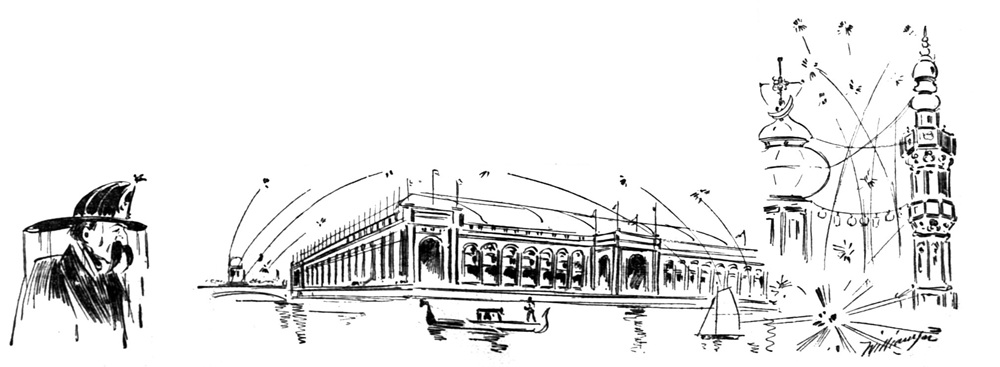
The Columbian Fire Department kept close watch on the evening firework display at the 1893 World’s Fair. [Image from the Chicago Inter Ocean Jul. 5, 1893.]
“It is proper that we should make a noise”
During the day, Jackson Park was simultaneously the liveliest and quietest plot of land in the City of Chicago. Exposition President Harlow Higinbotham issued an order on July 3 stating that individuals were absolutely prohibited from exploding firecrackers and torpedoes on the fairgrounds. The Columbian Guard were authorized to apprehend any person found violating the rule, but ended up making not one arrest for failure to obey. Marshal Edward W. Murphy of the Columbian Fire Department was duly prepared. As a precaution, he had every one of his men across all eleven companies on duty to prevent or extinguish fires. They inspected every bucket, hose, and fire plug. Murphy stationed firemen on top of the Manufactures and Liberal Arts Building, Agricultural Building, and Peristyle during the evening pyrotechnics.
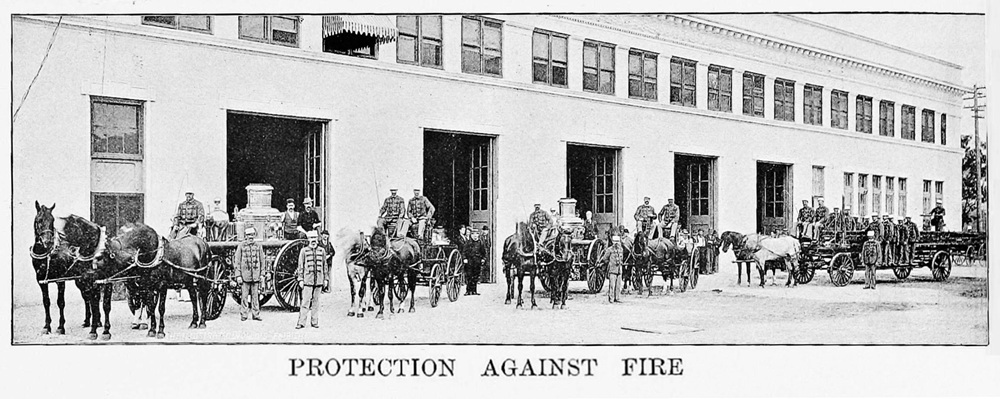
The full force of the Columbian Fire Department was at work on July 4th. [Image from Illustrated World’s Fair Sept. 1892]
The sounds of Chinese firecrackers, squibs, and toy cannons detonating, as well as revolver reports, filled the air of every street and alley across the city. “Chicago might, judging by the amount of noise that was made, have been besieged by an invading army of large proportions,” commented English tourist Ralph E. Hoyt. A Kansas visitor reported to the Dodge City Globe-Republican that:
For several days previous to the Fourth, the interest in the coming event had been waxing greater and greater as the expected treat drew near, and the pent-up enthusiasm of the patriotic spirits burst forth and found momentary relief in the surreptitious discharge of something with a bang to it, and the louder the bang the greater the relief.
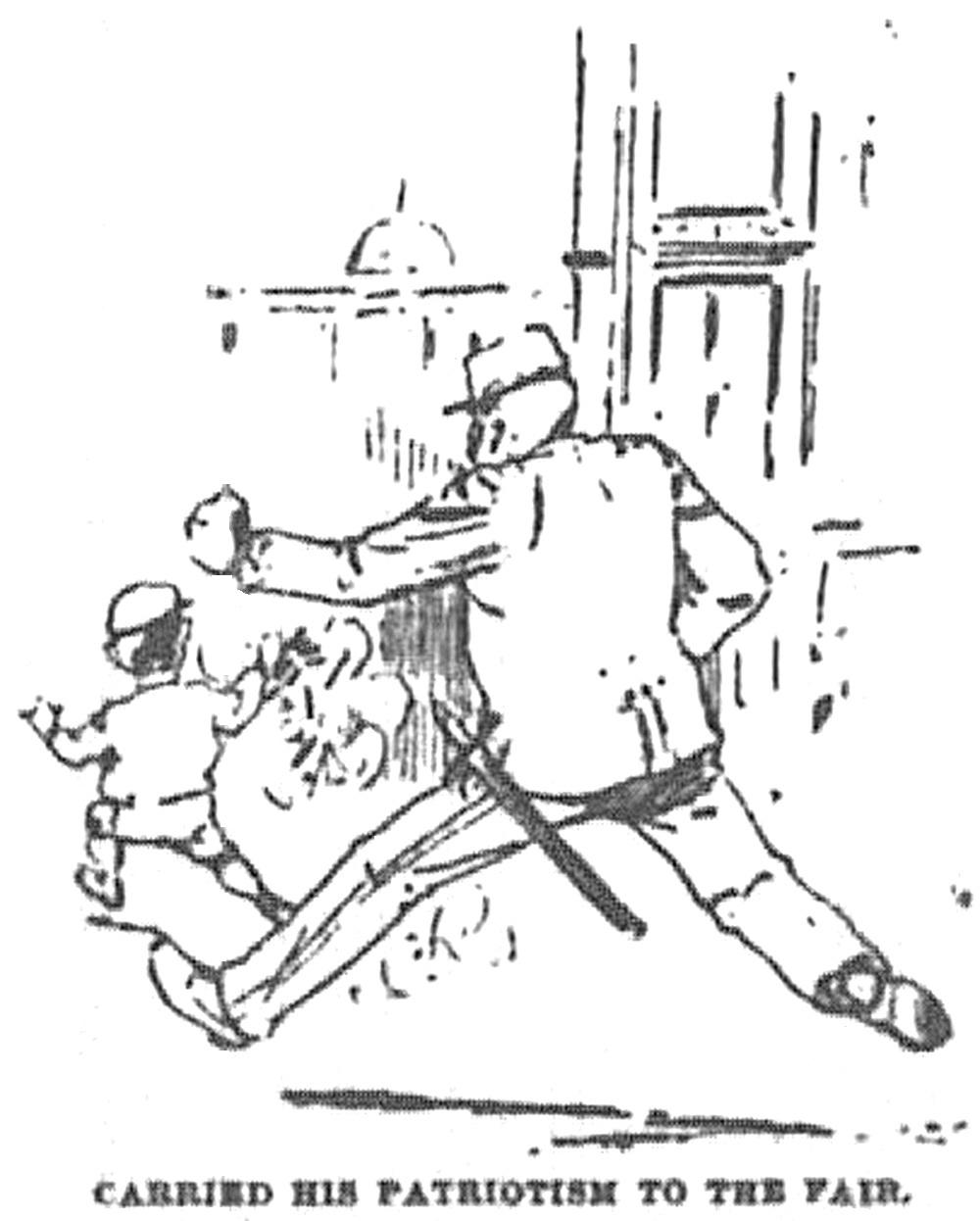
The Columbian Guard apprehended a few rogue firecrackers smuggled into the fairgrounds, but made no arrests. [Image from the Chicago Record July 5, 1893.]
Planning the fireworks program
Contracted to produce firework shows throughout the six months of the Columbian Exposition was James Pain & Sons of London, New York, and Chicago. One of the oldest firework companies in the United Kingdom, Pain had been in the pyrotechnic business for three hundred years already, and the firm still operates today as Pains Fireworks.
Artist Frank Millet served as the Columbian Exposition’s Director of Decorations until July 4th, when he officially retired from that post to become head of a new Department of Functions. Bridging these two roles, he acted as a design consultant to Pain & Sons as they assembled the fireworks program. This included planning a novel pyrotechnic picture as a highlight of the evening. Although the press widely announced that the July 4th show cost $10,000, Millet’s final report to Director of Works Daniel Burnham states a cost of $5,000, still about twice what the Exposition spent on typical displays given twice a week. By July, Exposition officials understood very well that fireworks were a solid investment, drawing crowds into the fairgrounds like nothing else but a celebrity visitor could. Spectators poured into Jackson Park for the Independence Day light show.
President Higinbotham ordered that all fireworks, firecrackers, and other explosives must be under the absolute control of the Department of Decoration and Functions. On July 10th, a tragic fire would offer a gruesome reminder of the dangerous flammability of the White City.[2] Because of safety concerns, fireworks were launched only from Lake Michigan, and not in the Grand Basin. A platform constructed in the lake, east of the Manufactures and Liberal Arts building, served as the launching pad. Spectators seeking the best views headed toward the lakefront.
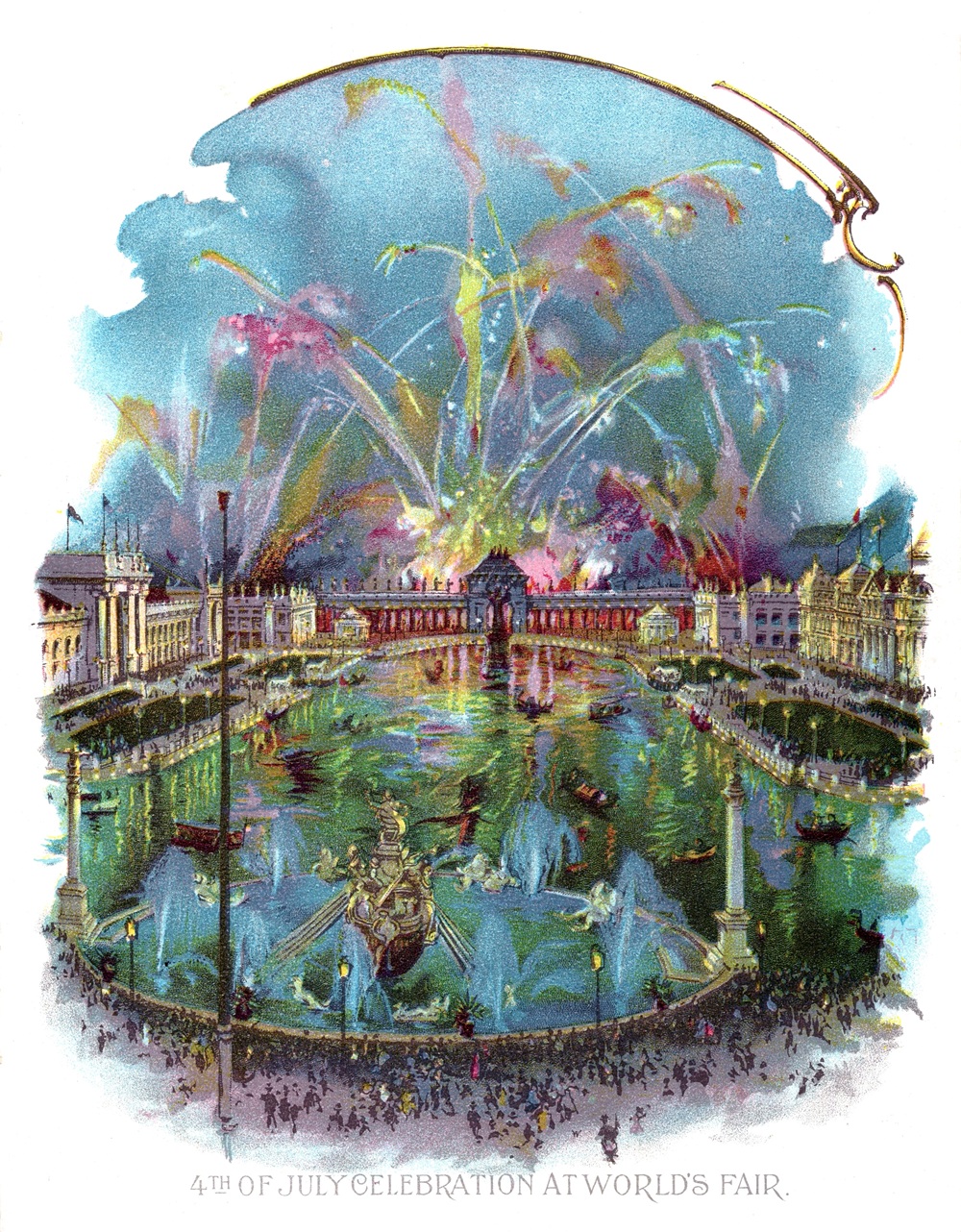
A depiction of the Fourth of July fireworks used in a McLaughlin’s Coffee advertisement. [Image from collection of worldsfairchicago1893.com.]
“A black jam of people”
Exposition officials were giddy to hear the constant click-click-click of the turnstiles all day long. They estimated that well over 100,000 visitors had entered by noon, and that number would double and even triple by the time the fireworks show began. The Fourth of July reigned as the biggest day for the World’s Fair yet.
Crowds gathered along the beach on the east side of the Manufactures and Liberal Arts Building, amassed a hundred deep and stretching for half a mile along the lakeshore between the Peristyle on the south and the battleship USS Illinois on the north. Packed so densely on its deck, they violated the capacity rules (despite it being a dock designed to look like a ship). Spectators also filled the great yard north of the U.S. Government Building. The rooftop promenade of the Manufactures and Liberal Arts Building offered some of the best views for spectators willing to take a 185-foot ride up in one of world’s tallest elevators.
A Nebraska visitor wrote to the Saint Paul Phonograph describing the multitude on the ground as “a sea of faces in solid phalanx” packed so tightly that “sardines in a box were not ‘in it’ compared to this vast army.” William E. Cameron, former governor of Virginia and chronicler of the Columbian Exposition, described the scene:
The people filled twenty acres between the building and the sandy beach. At each end they spread out. One end of the multitude filled the court of honor, which was in full illumination. The other packed the plaza before the Government Building. From a high perch on the corner of the peristyle the main plaza seemed alive with people until the eye was turned northward. There was a black jam of people as far as could be seen through the gathering dusk. The edge next the lake was as trim and straight as the border of a grain field. It was a compact, orderly and enthusiastic crowd, filled with the spirit of the occasion.
Back from the guard-chain and away off, for a mile it seemed, there was nothing but people, people, people. They made simply a patch of dark color, but the surface was restless with moving heads. Hemmed in by the myriad of patriots was a band-stand, from which came music, somewhat lost in the buzz and roar of the multitude.
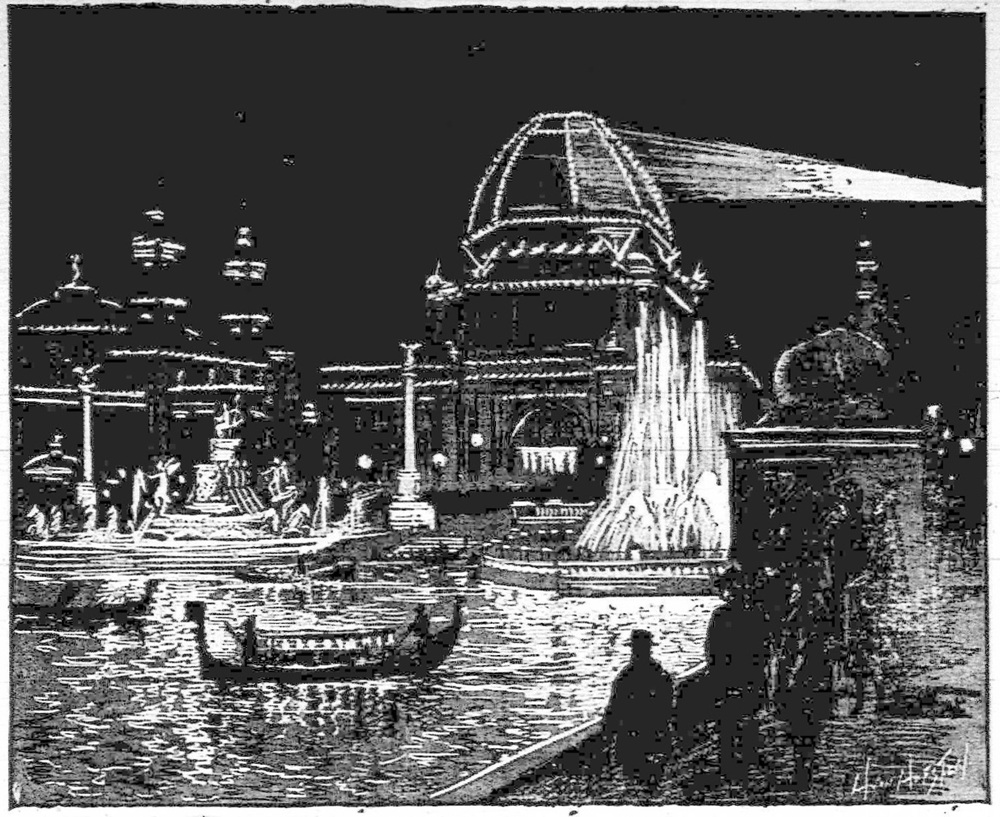
The Court of Honor at night offered a dazzling illumination display each night. Additional pyrotechnics for the Fourth of July added to the magic. [Image from the Chicago Evening Post July 3, 1893.]
Still more spectators watched from yachts and launches on Lake Michigan, either anchored or maneuvering between the piers. The Chicago Times reported on “hundreds of steam craft, large and small, all brilliantly illuminated, their color starboard and port lights mingling beautifully with the bright white of their deck and massed headlights.” Cameron recorded that: “Each boat carried lights, and these shifting sparks against the low, dark clouds helped to make a picture such as Jackson Park, with all its triumphs of spectacle, had not seen before.”
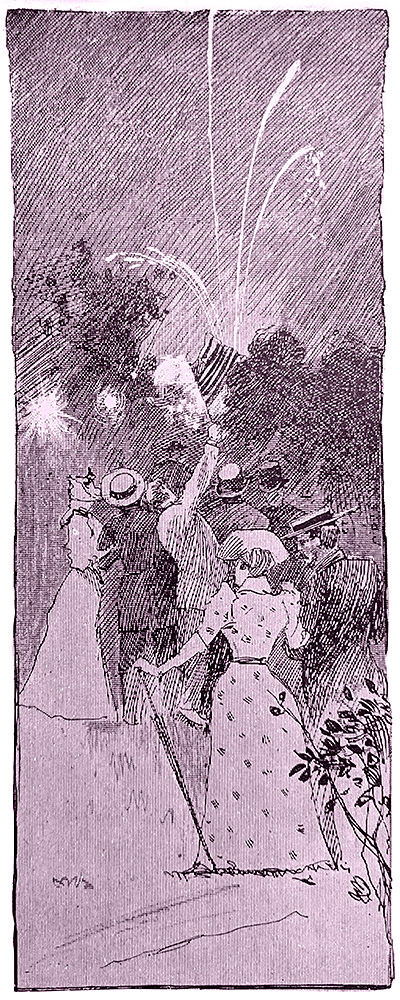
Visitors found viewing spots all around the fairgrounds for the Fourth of July fireworks display. [Image from The Graphic Chicago July 8, 1893.]
“The swaying multitude started a song”
While they waited, the mass of spectators burst into spontaneous song, as described by Cameron:
This marvelous view down beyond the golden Republic and broken by the fiery outlines of the Administration Building is an incident of each illumination. But the monster assemblage to the north was something new. Here were 150,000 people to be seen in one compact body, gathered in the early dusk and waiting patiently for something to cheer for. While they waited they sung.
Some man in the wilderness of hats, lifted his voice, and it was a strong voice. Clear as a bell rung out the strain:
“My country, ’tis of thee,
Sweet land of liberty.”
One hundred other voices took up the familiar lines and then a volume of sound lifted itself as the wave of enthusiasm spread its circle. There must have been 10,000 people helping. They did not keep good time, but the sound was mighty, and every one cheered when the verse was finished. Down next to the lapping waves of the lake some men were running around with torches, getting ready for the fireworks. One of them came in from a barge pulling a small boat, and a sympathetic man in the crowd started:
“Pull for the shore, sailor,
Pull for the shore.”
Once more the chorus helped him out.
The Chicago Tribune also reported that “a single voice in the swaying multitude started a song. Thousands caught the strain and faintly up through the din rose the tender melody of ‘Nearer, My God, to Thee.’”
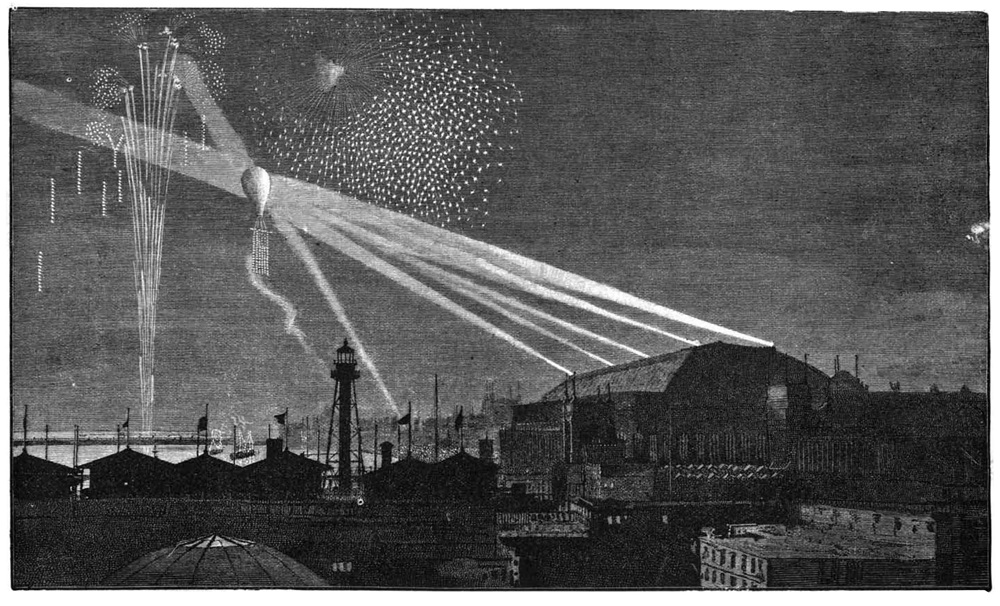
Searchlights from the roof of the Manufacturers and Liberal Arts Building illuminate the fire balloon, from which hung Old Glory in glorious colored lights. [Image from Scientific American Dec. 2, 1893.]
“Startling and magnificent”
The firework show began just before 9 o’clock, when the monster searchlight on the roof of the Manufacturers and Liberal Arts Building suddenly flashed on. The great beam invaded the dark sky and then “swept over to the shore and followed the blur of heads for a half mile without finding an empty spot.” The illuminated crowd erupted in cheers. From the deck of the battleship Illinois on the north pier, another searchlight flashed skyward. This bright needle waved in the air above the lake before descending to shine across many small boats floating offshore. The searchlights danced across the surfaces of white palaces and gold statues in the Court of Honor.
A loud explosion announced the commencement of the pyrotechnics. At the same moment, the searchlight’s great eye revealed an enormous fire balloon slowly rising and sailing out over the lake. Two bright-green fires clung to a framework suspended from it. “Hanging from the guide ropes was a ball of white fire that shone down on the crowd below like the headlight of a locomotive,” reported the Chicago Herald. “The globe of light changed to blue and then red.” The eyes of a quarter of a million spectators followed its path, and shouts of huzzah! greeted its flight. “Everyone in the huge crowd was cheering him and herself hoarse,” an English visitor told the Los Angeles Evening Express. “It was a perfect pandemonium.” Scientific American reported on the fiery revelation:
Just as the balloon reached a height immediately over the heads of the crowd there was a flash of light, a shower of sparks and the American flag was revealed in brilliant flame suspended in midair. The balloon which supported the flag was sixty feet high and nearly thirty feet across, made entirely of cloth. It was inflated with hot air, several hours being required to complete the operation.[4]
Spectators could follow the upward path of the balloon by a white magnesium light burning until it reached a time fuse at the proper altitude. Then, with a salvo of sharp explosions, a curtain of bright lights, made of one-hundred-yard-long chains carefully rolled up on a framework, unfurled to reveal the Stars and Stripes made of fireworks. The Chicago Herald described the sparking scene:
Suddenly a muffled report struck the ears of the eager gazers. As if in response to the salute, the fire ball burst and the pieces at once took shape. Long parallel streamers of red and white rolled downward. In the upper left-hand corner appeared a blue field of light in which glistened forty-four white stars. It took but an instant for the fire wizard to unfurl the starry banner in all its glorious beauty. There suspended from the fire balloon in midair hung the stars and stripes in colored lights. Higher and higher mounted the banner of light until the blazing candles were exhausted. But the balloon itself floated away steadily seeking a more lofty pathway over the waters of the lake, and long after all fire was extinct its white cover was brightly illuminated by the all-pervading search lights.
“Old Glory” floated out across the lake, burning itself into the night as the giant searchlight followed its escape from the White City. “A mighty shout greeted the emblem of freedom, thus pinned to the robe of night by hundreds of brilliant stars,” reported the Chicago Times. “Did you ever hear 150,000 people join in a shout?” Cameron asks. “The buildings seemed to rock a little. There was a certain something in the noise which cannot be produced by bombs and cannon.” The Herald reported that “this beautiful representation of the national flag was received with a perfect storm of toots and whistles from boats on the lake.” The Inter Ocean claimed that it was “one of the most startling and magnificent firework conceptions that have ever been given in the world.”
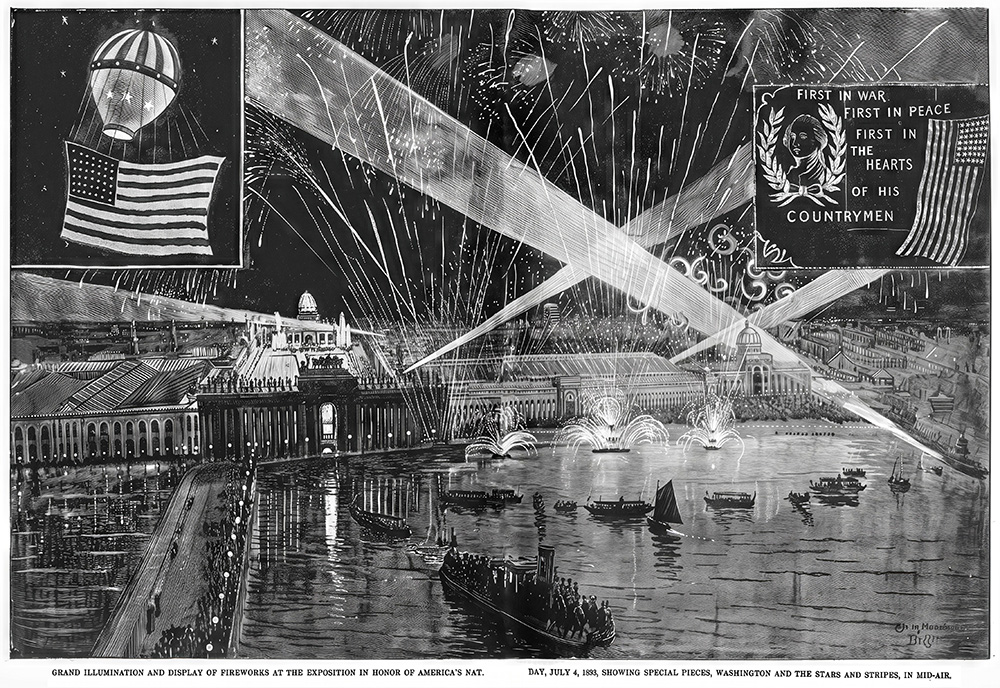
The grand illumination and display of fireworks at the Exposition in honor of America’s natal day, July 4, 1893, showing special pieces, Washington and the Stars and Stripes, in mid-air. [Image from World’s Columbian Exposition Illustrated Aug. 1893.]
“A row of infernal machines blew up”
No sooner did the colors of the Star-Spangled Banner burn away than twenty-one bombs—the largest shells ever made—exploded along the lakefront, followed by several rockets launched into the heavens. “The display along shore and on the barges became delirious,” records Cameron, who described the scene:
The rockets swished upward a dozen at a time. With mighty coughing a row of infernal machines blew up along the shore, shooting missiles which exploded into colored lights and fiery rain. The firing came from the beach, from the end of the peristyle and from the floats in the lake all at the same time—rockets, bombs and shells. Some of the shells were 150 inches in circumference. When one of them went to pieces the dark-blue firmament became spotted with jumping fire. And the noise—it was somewhat like that which people in New York heard on the day of the Naval Review.
A mortar report near the Peristyle announced a glaring red light that broke out at the Casino Pier and extended into a glittering crescent of red fire buoys extending all the way to the North Pier.
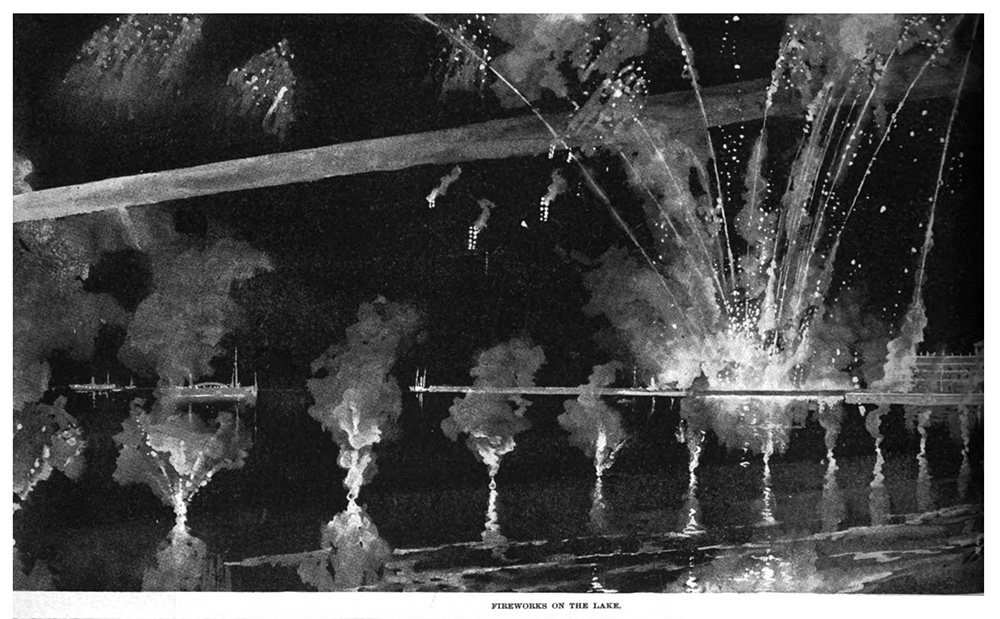
A string of fire buoys, extending from the Peristyle to the North Pier, dazzled spectators. [Image from Frank Leslie’s Weekly July 20, 1893.]
“Floating festoons of fire”
Advance programs for the show listed more than forty distinct pyrotechnic displays, including enticements described as “magical illumination of the park,” “writhing fiery cobras,” and “floating festoons of fire.”[3] The gorgeous and deafening show went on for an hour, with rockets exploding in the sky above the lake and stationary set pieces burning in the Grand Basin. Cameron describes people’s reactions to the incomparable spectacle:
At one time the lake shore for half a mile was fringed with intense magnesium fires, which threw a white, unnatural light over the dense, immovable thousands. When the people looked at the fires the press of humanity had a dark, somber shade. When a rocket went up and the faces were lifted, a sudden pallor spread itself over the great area, a weird transformation, seen only by those who looked down from the lofty rail of the peristyle. Chicago has seen fireworks before, but never anything like those of the Fourth.
The Times reported that “jagged torrents of fire were scratched in the black dome of heaven” and that “the shrill report of the exploding maroons was preceded by the sudden radiance of thousands of flying bits of light, amethyst, purple, green, blue, white, and blood red.” From floats on the lake came a “roar and a sputter” as “huge discs, throwing off blue, red, and white globules as they revived, spun like the wheels of chariots of the sun god,” explained the Tribune.
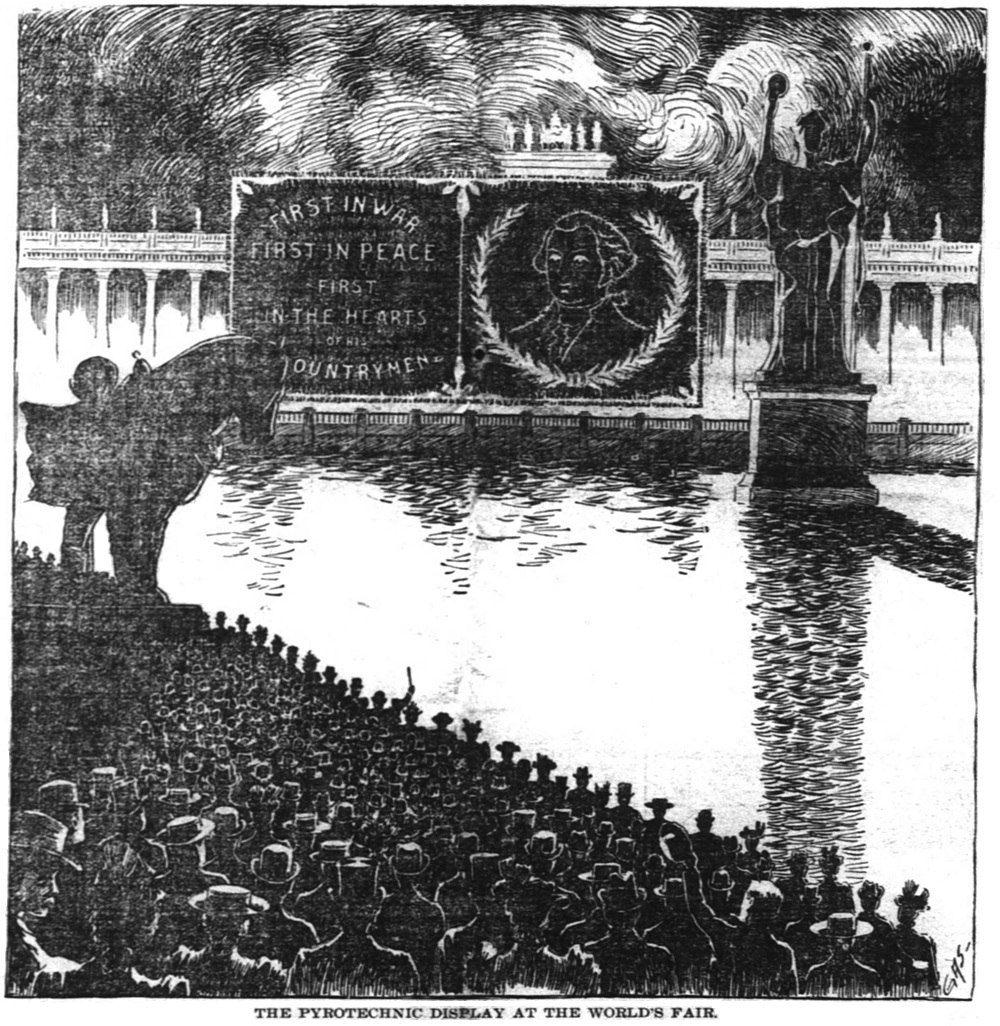
Pyrotechnic display in the Grand Basin, showing the George Washington set piece in front of the Peristyle. [Image from the Chicago Inter Ocean July 5, 1893.]
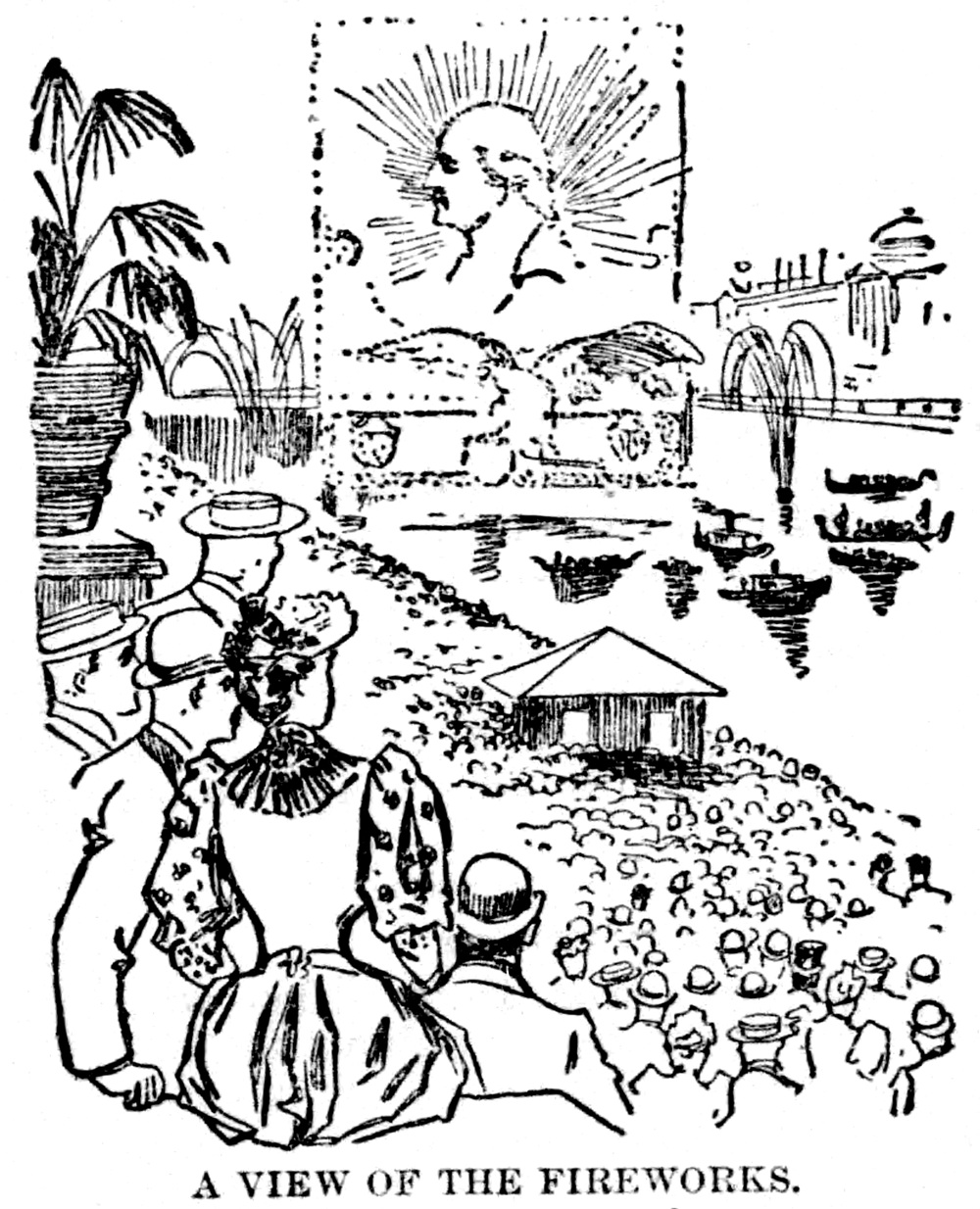
Spectators in the Grand Basin watched a set piece of George Washington drawn in fire. [Image from the Kalamazoo (MI) Gazette July 6, 1893.]
“Bubbling showers of molten flame”
Along the lakefront, a school of fire-fish effects intermixed with sundry serpents “began to dart about over the waters,” the Herald described, with “some of the bigger and more daring of the snakes swimming out to the vessels anchored nearest in shore, only to dive suddenly and disappear beneath the waves.” Scientific American noted that “probably the most eccentric of all fireworks is the ‘water devil,’” and explained that “each piece consists of two distinct parts, the propelling power, which is represented by the cylinder, which is the foot, and the effect, which is the head. These two parts are set at an angle to each other, as shown, so as to propel the piece in a zigzag path.” The magazine also described the tourbillion as “another interesting piece” that “hisses like a rocket and sends out showers of stars which assume the form of an umbrella. In the large size, the stars fill an area from twenty to thirty feet in diameter.”
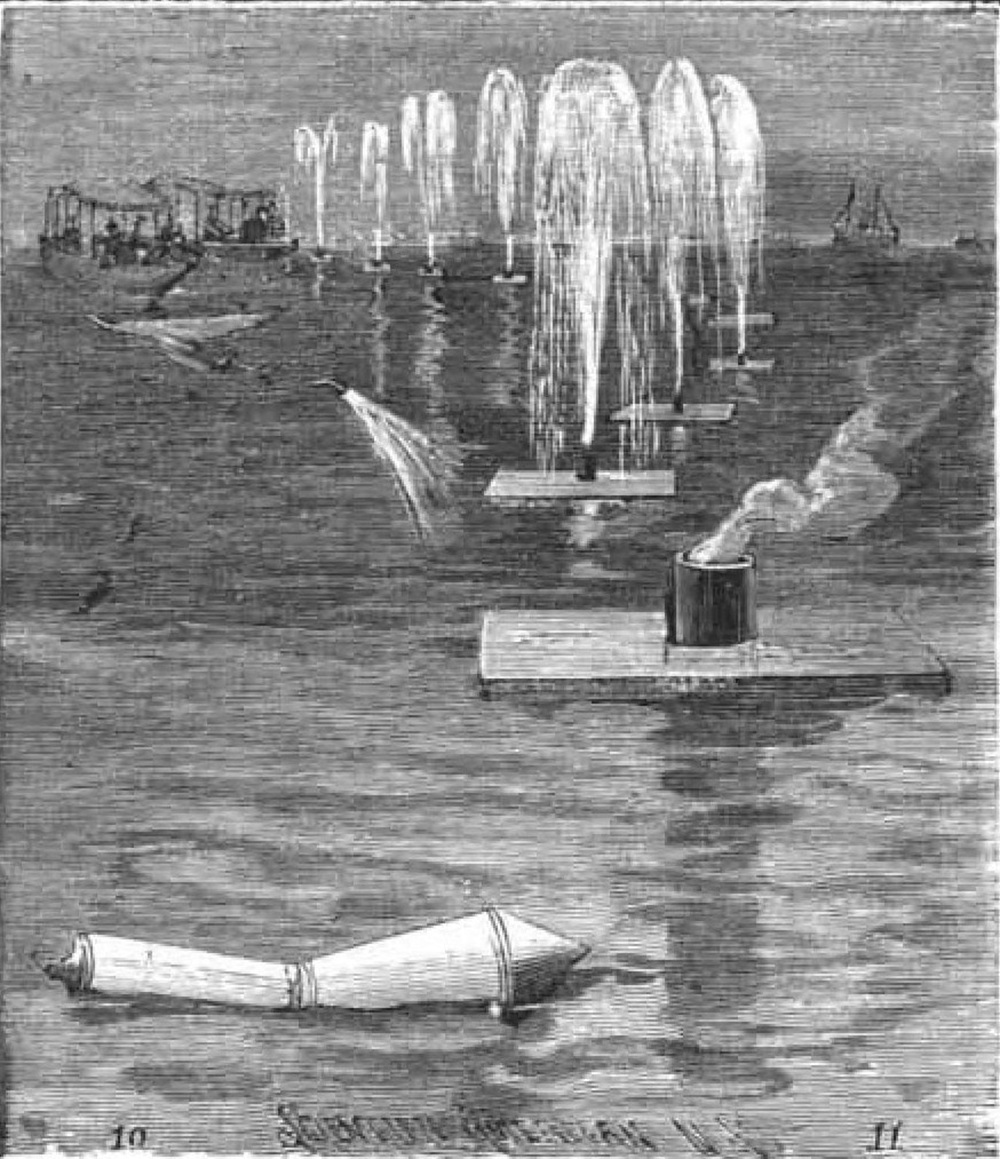
The “water devil” propels through the water along a zigzag path. The floating “jerbs” were simple floating receptacles from which Roman candles, golden fountains, fiery geysers, and other fireworks were sent off, giving the effect that they shot out of the water. [Image from Scientific American Dec. 2, 1893.]
Without warning, a huge mass of water was thrown into the air, as if upheaved by some submarine earthquake. A whole section of the waterfront “seemed to be blown up in chunks of fire that flew up over the heads of the people,” wrote the Times. A shower of silver spray fell to the surface, mixing with glistening particles of golden fire. Magnesium rockets, aquatic fireworks, and several more set designs held the constant gaze of the throng. Cameron described the impact of the show:
Some people thought they saw the clouds shiver and the stars jolt in their courses. The whole sky was full of wheeling sparks. The explosions followed each other like salutes from a mighty gun. Even the waves of the lake caught fire and rose in bubbling showers of molten flame.
The biggest and most attractive exhibition of fireworks ever given in Chicago closed in a fitting manner with a “Columbian Bouquet” of rockets. This final piece included 2,500 bursting rockets, filling the night sky with a rainbow of more than 100,000 glittering stars. As the bouquet finale spread over the sky, it outshined “the wonders revealed by Aladdin’s lamp,” the Times claimed.
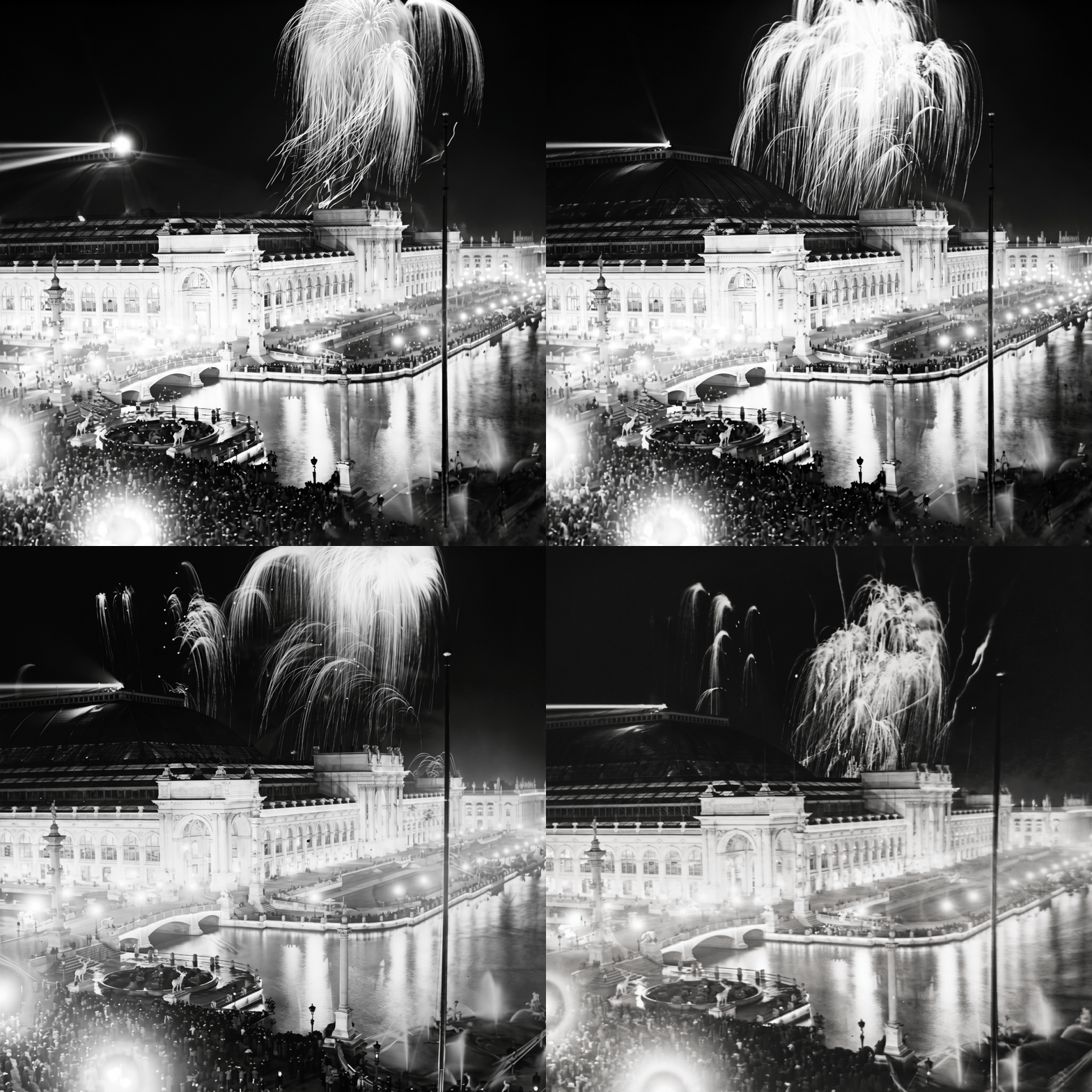
The “Grand display of fireworks, evening of July 4th.” [Images from variants of Kilburn stereoscope cards.]
“A bankruptcy of adjectives”
“Probably no city in this country ever had such elaborate pyrotechnic displays as Chicago had in connection with the Exposition,” asserted Scientific American. A writer for Chicago’s Figaro magazine gushed about the Fourth fireworks:
To attempt to describe the splendid pyrotechnical display that flashed skywards from Lake Michigan east of the White City, would be to risk a bankruptcy of adjectives. The scene from the lake, the electrically lit buildings, from the Peristyle to the New York State Building; the fire-colored circle of the Ferris wheel in the background; and the scintillant, showering, fireworks exacting long-drawn sighs of wonderment from the black crowd that lined every inch of ground that gave a view of the display,—was one never to be forgotten.
Spectators around the fairgrounds enjoyed the “brilliant surprises sufficient to last a lifetime,” according to a reporter for World’s Columbian Exposition Illustrated. “Combine all the adjectives in the English language that express beauty, loveliness, grace and perfection, even then you will fail to describe a gala night at the Exposition.”
After the last of the fiery rain fell, spectators lowered their gaze to the earth and began heading out of Jackson Park. With picture of fire “graven on their minds, and the mighty refrain of the songs of freedom still ringing in their ears,” noted Cameron, “the great throngs of people turned from the scene, weary but full of exultation. It had been a day of pure, unsullied enjoyment, of lofty aspirations, of peace and brotherhood.” While these hundreds of thousands of fairgoers had streamed into the fairgrounds continuously all day, they desired to depart at exactly the same time. Exposition and city officials, along with transportation providers, were about to be tested like never before.
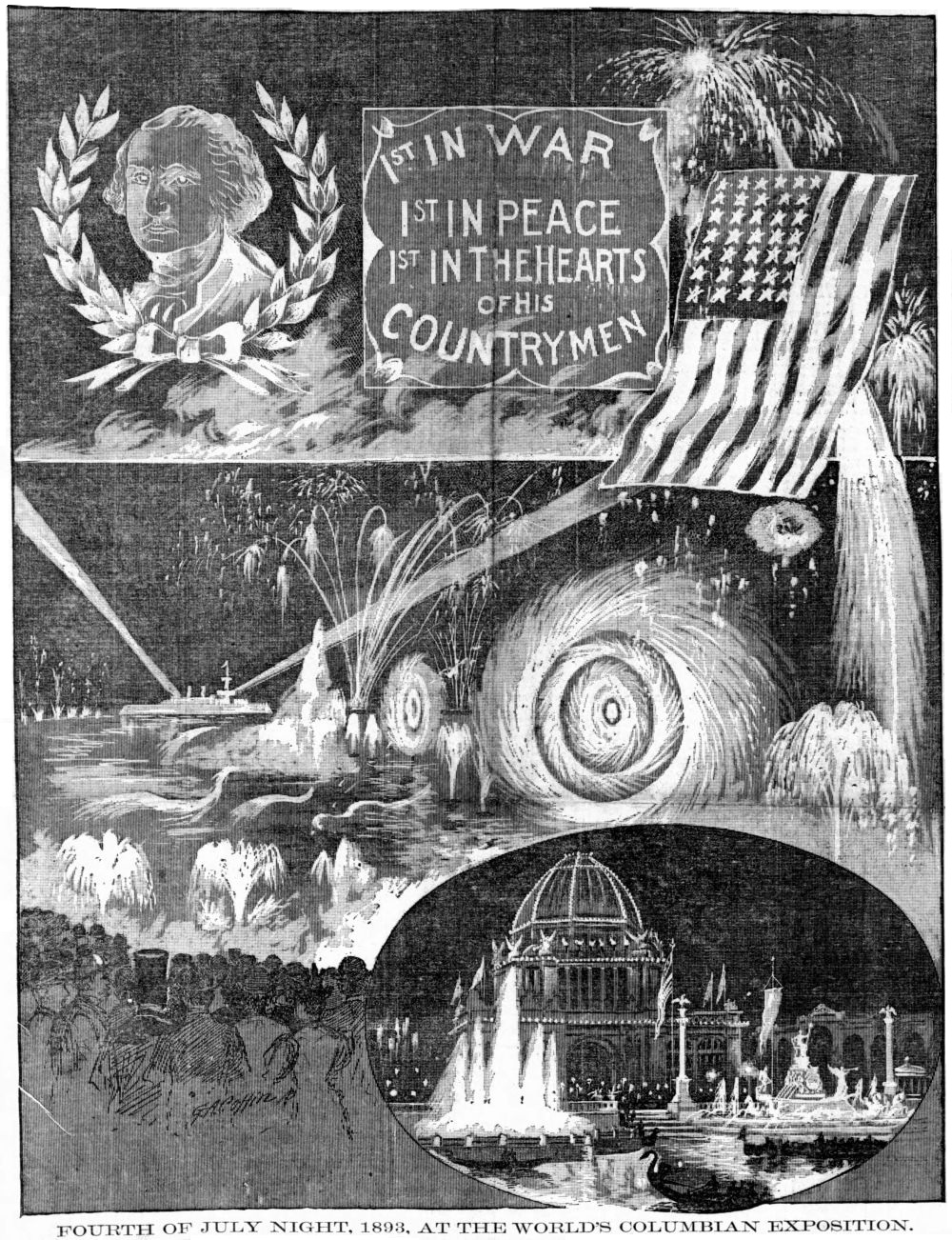
A crowd of several hundred thousand spectators watched in awe as the sky and waters of the Columbian Exposition were painted in colorful fire for America’s birthday celebration. [Image from the Chicago Tribune July 5, 1893.]
NOTES[1] Mayor Harrison issued the following announcement and proclamation [“Fireworks and the Fourth of July” Chicago Tribune Jul. 1, 1893, p. 9.]:
In this Columbian year we are to celebrate the 117th anniversary of American independence in the presence of visitors of the whole world. It is appropriate, therefore, that we let them see, hear, and understand the meaning of “Fourth of July celebration.”
It is proper that we should make a noise, for we have something to make a noise about: A great Nation, a great State, and Chicago, the greatest city of its age the world ever saw, with its marvelous growth, wonderful progress, today holding its head above all the cities of the world, and where is being held the most magnificent exhibition of arts, sciences, and industries the nations of the earth ever had the opportunity to look upon, with its palaces rivaling in grandeur the most picturesque features of the Orient, unequaled in architectural beauty and design.
To make noise in heralding these things to the world is appropriate. Americans have always used fireworks to celebrate the day. This is eminently a year when Chicago can afford to make a noise, but it should do so in a rational manner, protecting alike life and property and placing no one’s life in jeopardy by reason of a surplus of patriotism.
Under the ordinances of the City of Chicago the Mayor is vested with discretion in regard to allowing the use and display of fireworks in its streets, alleys, and public places.
Now, therefore, I, Carter H. Harrison, Mayor of the City of Chicago, by virtue of the authority vested in me, hereby issue the following proclamation in regard to the use of fireworks July 4, 1893:
The proper use of fireworks will be allowed, including firecrackers, squibs, rockets, Roman candles, torpedoes, serpents, and such other displays as will not endanger life and property when they are properly handled. These may be used on vacant lots, in and upon the streets and public grounds under the control of the city authorities between 4 o’clock in the morning and 12 midnight July 4th, subject to restrictions as follows:
No firecrackers, fireworks of any character, gunpowder, etc., shall be exploded in any alley, back yard, or confined space on any street. The use of cannons, guns, revolvers, pistols, or firearms of any description is absolutely prohibited, and any violation of this ordinance will subject the violator to a fine of $10 for each offense.
It is imperative that no fireworks of any kind or description be exploded near or in the vicinity of the Exposition grounds and buildings at Jackson Park, as the combustible nature of the structures and the great value of their contents would make it extremely dangerous to use fireworks in that locality.
The selling or the giving away of any toy pistols and caps to children is absolutely prohibited. A violation of this ordinance will subject the offender to arrest and imprisonment and a fine of $50 for each offense. I desire especially to warn parents that toy pistols are often dangerous in the hands of the inexperienced, and should not be placed in the possession of children.
The police of the City of Chicago are especially notified to see to it that this proclamation is enforced. It is especially desired that the boys shall have a good time on the Fourth of July of this year and that they shall have the opportunity to make all the noise they can, but it is also necessary that they should be careful of themselves and of the property surrounding them; that they be careful in the use of firecrackers and explosives generally, and that they comply strictly with this proclamation.
Given under my hand and the seal of the City of Chicago, this 30th day of June A.D. 1893.
Carter H. Harrison, Mayor
[2] One year and one day after fireworks filled the skies above the fairgrounds at the climax of the Columbian Fourth, Jackson Park was ablaze again. Arsonists set fires in the western end of the Court of Honor on July 5, 1894. The inferno swept away the four palaces that formed the plaza where the Fourth of July ceremony had been held (Terminal Station, the Administration Building, the Mines and Mining Building, and Machinery Hall) along with the Electricity, Manufactures and Liberal Arts, and Agricultural buildings.
[3] A program of fireworks was published in several newspapers in the days before July 4th. These components seem to have been in the final show, though in a somewhat different order.
1) Salute of fifty fifteen-inch aerial maroons, or guns, fired from steel mortars and exploding at an altitude of 1,600 feet.
2) Magical illumination of the park with 250 prismatic lights, changing color five times, fired by electricity.
3) Display of 250 four-pound colored rockets fired from three positions, so as to blend the continuous varied tints.
4) Display of fifty twenty-four-inch shells—rose streamers, silver torrent, emeralds, rubies, golden spangles, etc.
5) Nest of writhing fiery cobras.
6) Display of twenty-five rockets, each detaching twelve parachutes of different hues.
7) Salvos of thirty-inch shells—lilac, silver, heliotrope, mauve and turquois, forming clouds studded with jewels of every hue.
8) Triple aquatic fountain, including revolving horizontal fountain, discharging into the water batteries of roman candles, jeweled fountains, faufaronades, rockets and jeweled mines.
9) Flight of twenty-five magnesium rockets.
10) Flight of twenty-five rockets, each detaching floating lines of constantly changing fires.
11) Discharge of twenty-five fifteen-inch bombs, red and yellow, Spanish colors.
12) Fire portrait of George Washington, with motto: “First in War, First in Peace and First in the Hearts of His Countrymen.”
13) Swarm 500 fireflies.
14) Flight of twenty-five rockets.
15) Salvos of twenty-five thirty-six-inch shells—showing prismatic torrent, Venetian, national colors, etc.
16) Flight of twenty-five shells—red, white and blue.
17) Fifty rayonet tourbillions.
18) Fountains of fire fifty feet high and ninety feet in circumference, from which hundreds of balls of fire will be thrown in all directions.
19) Submarine explosions, throwing columns of water 200 feet high, illuminated by bursting bombs thrown up at the same time, introducing dolphins, swans, water devils, flying fish, gold and silver fountains.
20) Ascent of twenty-five rockets, throwing liquid fires which have the appearance of going out and then lighting up again.
21) Flight of twenty-five twenty-four-inch shells, discharging in midair thousands of orange blossoms.
22) Bursts of 500 aerial saucissons, sending silver fire darts through the air.
23) Ascent of twenty-five rockets, with changing lights up and down.
24) Bouquet of rockets will burst into golden hail and form a wheat sheaf while descending.
25) Device—Coats of arms, Spain, 1492; United States, 1893.
26) Flight of fifty fifteen-inch bombs, red, white and green.
27) Ascent of twenty-five rockets, floating festoons of fire.
28) Salvos of twenty-five forty-two-inch shells, latest novelties and effects.
29) The “Union Forever,” the floating star-spangled banner, surrounded by “old glory.”
30) Ascent of twenty-five sextuple rockets, each rocket on reaching its altitude discharging six other complete rockets.
31) Bouquet of fifty passion-flower rockets.
32) Bouquet of fifty musical rockets.
33) Bouquet of fifty rockets sending out a cluster of stars that go out and then flare up in brilliant passion flowers in midair, cornucopias and weeping willows forming in the same way.
34) Bouquet of fifty weeping-willow rockets.
35) Illumination of the park with 100 magnesium torches.
36) Silver fire-wheel in six mutations with intersecting centers. When it commences to revolve it will be sixty feet in diameter, but will increase in size until, at the close it will reach 150 feet in diameter, or 450 feet in circumference.
37) Explosion of fifty cracker mines.
38) Salvos of five mammoth sixty-inch bombs, the largest ever fired, each shell discharging fifty small shells, and small shells, in turn, bursting into 300 magnesium stars.
39) Flight of 125 bombs, forming the star-spangled banner, fired by electricity.
40) Forest of fire, being an exact reproduction of a night forest conflagration.
41) The “Columbian Bouquet,” produced by the discharge of 250 large rockets and filling the heavens with blossoms of fire in every hue.
[4] This fire balloon, of course, employed hot air as its lifting gas and not the highly flammable hydrogen used in the Captive Balloon on the Midway.
SOURCES
Cameron, William E. The World’s Fair Being a Pictorial History of the Columbian Exposition. P.D. Farrell, 1893.
“Crowd Behaves Well” Chicago Herald Jul. 5, 1893, p. 11.
“Display of Fire Works at the Columbian Exposition” Scientific American Dec. 2, 1893, p. 359.
“Fireworks and the Fourth of July” Chicago Tribune Jul. 1, 1893, p. 9.
Hoyt, Ralph E. “From the World’s Fair” Los Angeles Evening Express Jul. 15, 1893, p. 3.
“In Letters of Light” Chicago Herald Jul. 5, 1893, p. 1
“Its Climax at Night” Chicago Tribune Jul. 5, 1893, p. 1.
Johnson, Rossiter A History of the World’s Columbian Exposition Held in Chicago in 1893, Volume 1: Narrative. D. Appleton and Co., 1897.
“A Night at the Exposition” World’s Columbian Exposition Illustrated Jan. 1894, p. 287.
“The Night Display” Chicago Times Jul. 5, 1893, p. 1.
Millet, Francis “Report of the Director of Decoration & Functions” in Daniel H. Burnham, Final Official Report of the Director of Works of the World’s Columbian Exposition, Vol. IV. Garland Pub., 1989, pp. 57–119.
“Old Glory” St. Louis Post-Dispatch Jul. 4, 1893, pp. 1–2.
“White City Gossip” Dodge City (KS) Globe-Republican Jul. 21, 1893, p. 7.
“World’s Fair Letter” Saint Paul (NE) Phonograph Jul. 14, 1893, p. 4.

Leave A Comment