Fourth at the Fair, Part 3: A Sea of Patriots Floods the Fairgrounds
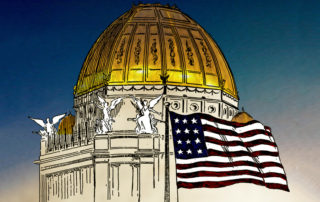
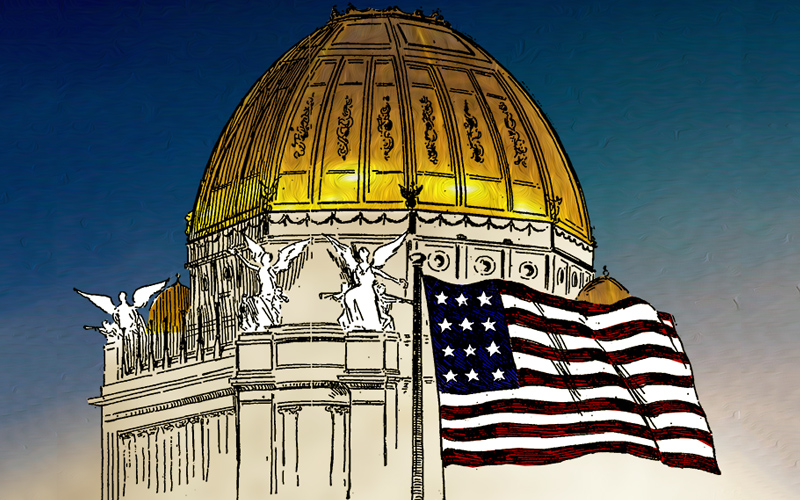
The Fourth of July at the 1893 World's Columbian Exposition in Chicago was the biggest day yet at the Fair.

The Fourth of July at the 1893 World's Columbian Exposition in Chicago was the biggest day yet at the Fair.
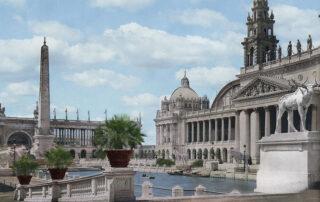
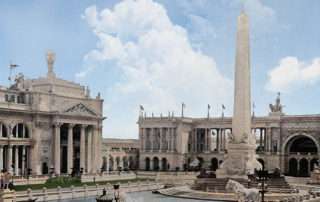
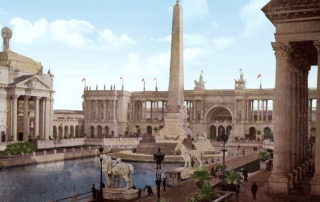
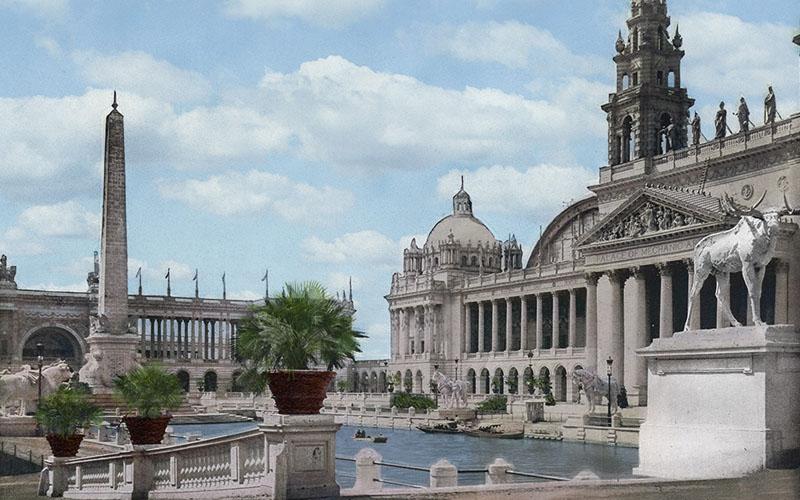
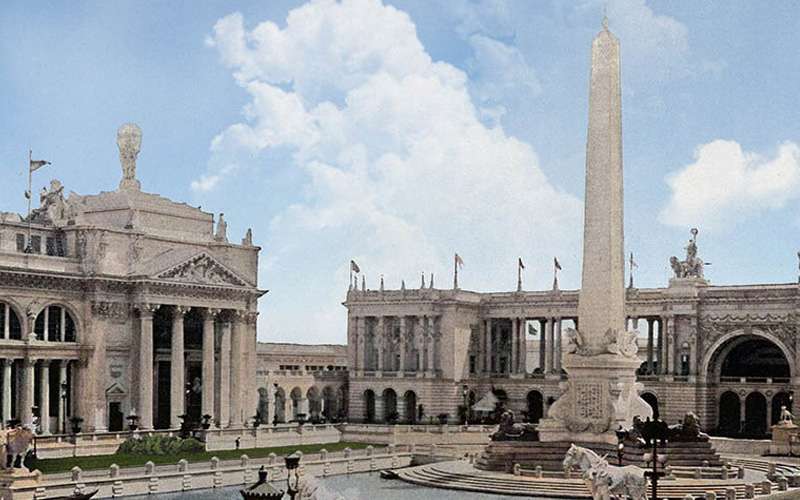
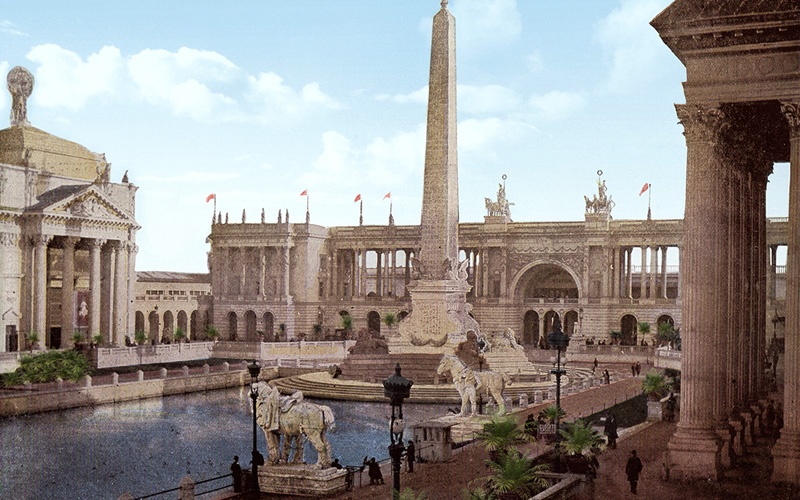
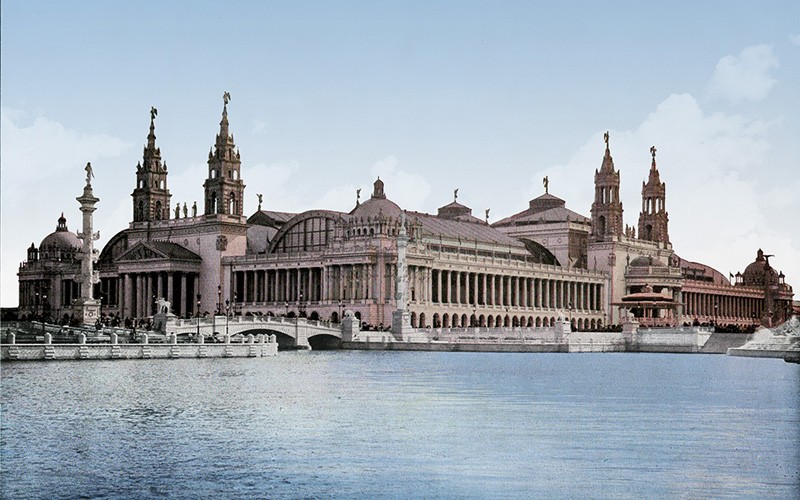
EAST FRONT OF MACHINERY HALL, AND THE OBELISK.—The area of water extending to the south from the Grand Basin and known as the South Canal was so entirely surrounded by the beautiful in art or architecture that a view across it from any point was sure to be something captivating. The view above is from the northeast corner of the canal, just where the " Farmer's Bridge " terminated on the area in front of the Agriculture Building, with [...]
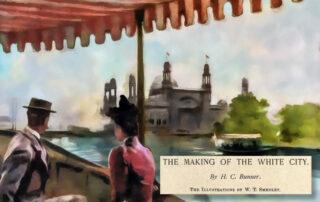
[Continued from Part 1] A great stage decked with ambitious scenery Perhaps the first thing that would strike a stranger entering the World’s Fair grounds in the summer of 1892 would be the silence of the place, the next the almost theatrical unreality of the impression by the sight of an assemblage of buildings so startlingly out of the common in size and form. When I speak of the silence, I mean the effect of silence. There are seven [...]
“The Fair, considered as an electrical exposition only, would be well worthy the attention of the world.” —Murat Halstead, “Electricity at the Fair” Cosmopolitan, September 1893. A great central power plant inside of Machinery Hall powered most of the incandescent lamps, arc lamps, motors, and water pumps for the 1893 World’s Columbian Exposition. Capable of delivering more than 12,000 horsepower (9480 kilowatts), this was not only—by far—the largest power plant ever built but also a stunning exhibit of the [...]
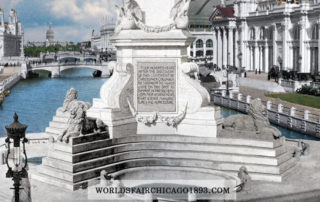
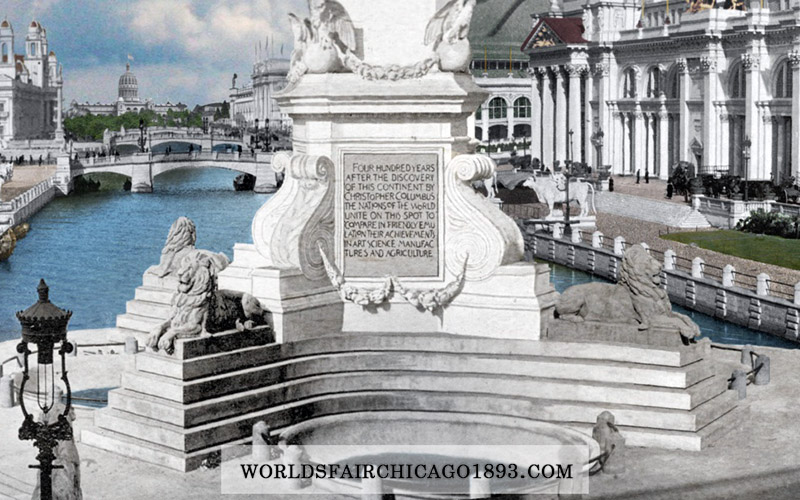
BIRD'S-EYE VIEW OF THE COLUMBIAN FOUNTAIN.—It was a merit of the famous Columbian Fountain and one indicative of its quality as a great work of art that it was beautiful from whatever direction a view of it might be taken. So perfect were the relations of its parts that even a bird's-eye view gave something symmetrical and picturesque In the illustration, the observer being almost directly north and at a slight elevation, minor details of the barge are not [...]
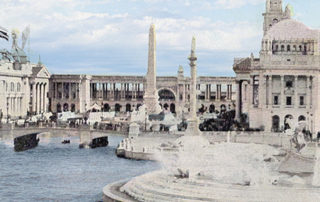
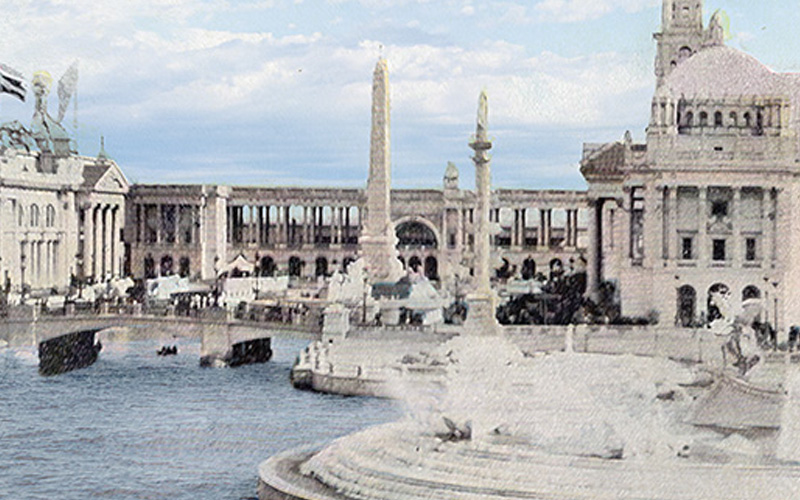
THE COLUMBIAN OBELISK.- The Obelisk, which was the prominent object at the southern end of the South Canal, connected the wonderful civilization the World's Fair represented with the hardly less wonderful civilization of thousands of years ago. Ancient Egypt furnished, in a manner, her contribution to the architecture of the Columbian Exposition, the Obelisk, from a distance, reminding the observer of one of the " Cleopatra's Needles," of which, by the way, an exact reproduction was among the attractions [...]
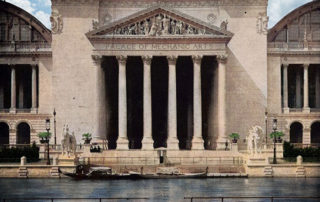
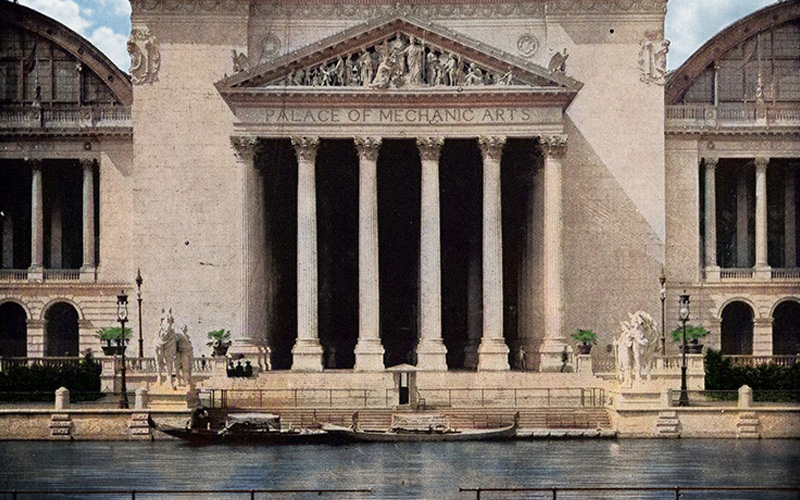
EASTERN PORTAL OF MACHINERY HALL.—The view here given is an admirable one of the eastern entrance to Machinery Hall and makes plain the remarkable architectural style of that great edifice. The entrance has been described at length, but only such a view as this, the reproduction of a photograph taken from the Agriculture Building at a point directly across the canal, could bring out the charming details. The portico of this entrance was a popular resort because here was [...]
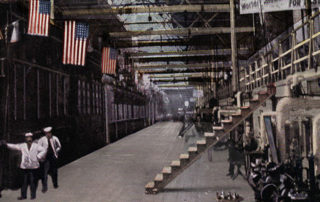
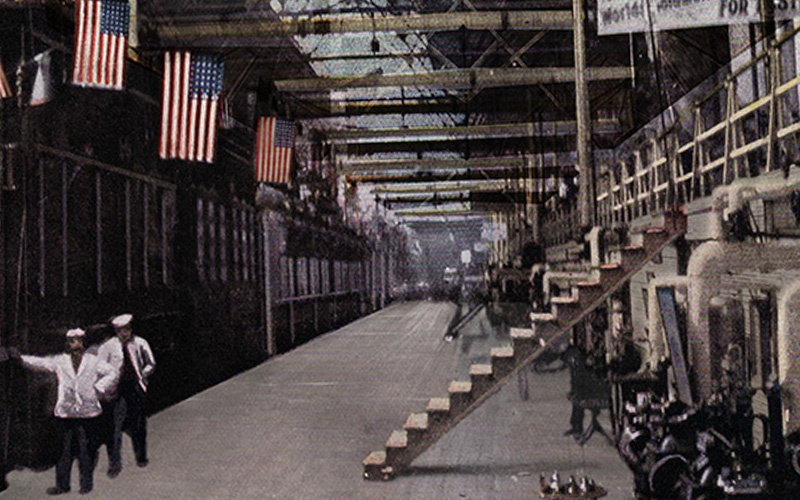
THE BOILER-ROOM OF MACHINERY HALL.—Never before was such a boiler-room as that which delighted engineers in Machinery Hall. It must needs be enormous, for it supplied the force for all the lights and machinery of the great buildings, but those who had never seen it were none the less astonished when they entered the great room. It extended north and south in the annex, and to look down it was like looking down a street the end of which [...]
Several media outlets, including the Guardian and People, are reporting on Chicago’s use of feral cats to beat back our nationally recognized rat population. It’s old news. We’ve been relying on our feline friends since at least the 1893 World’s Columbian Exposition. “Not many people are aware that the World’s Fair has a cat,” wrote the Chicago Tribune in September 1893. “This ignorance on the part of visitors is largely due to the fact that the cat does not appear [...]
THE OBELISK AND SOUTHERN COLONNADE.—A fitting termination made to the view south on the South Canal was formed by the Southern Colonnade with the Obelisk in front. The Obelisk was history repeated in stone, or at least in its imitation, for it was a reproduction of the famous Cleopatra's needle, the original of which, thousands of years old, was presented by the Khedive of Egypt to the United States and is now a prominent object in Central Park, in [...]
THE CITY OF WONDERS A SOUVENIR OF THE WORLD'S FAIR by Mary Catherine Crowley (1894)
The Newberry Library of Chicago has launched a “Midwest Time Machine,” and one the destinations in the 1893 World’s Columbian Exposition. Four first-hand accounts--coming from letters, diaries, and rare books in the Newberry's collections—include a diary of Errett McLeod Graham as he visits the World’s Fair in Chicago between June 24 and July 17, 1893. Hop around a map of the fairgrounds to browse journal entries about smells the Ceylon Building, tastes at the Big Tree Restaurant, sounds in [...]
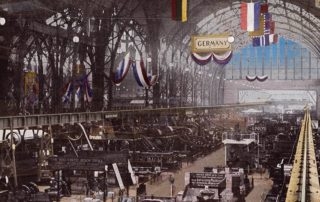
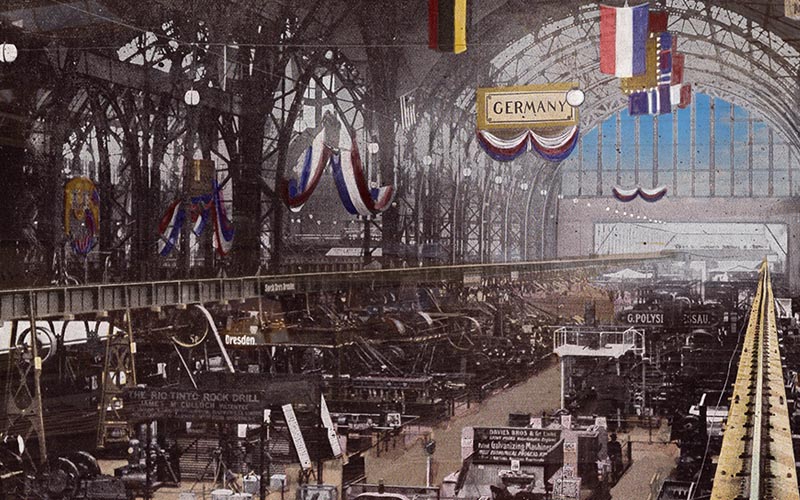
PICTURESQUE WORLD’S FAIR. AN ELABORATE COLLECTION OF COLORED VIEWS Page 88 – INTERIOR OF MACHINERY HALL INTERIOR OF MACHINERY HALL.—Quite different from the view afforded inside any other of the buildings of the Fair was that where the acres of all kinds of modern machinery were exposed in competition. So constructed that the most effective display of such exhibits could be made, the vast hall presented a scene never equaled of its kind before. A common simile in describing [...]
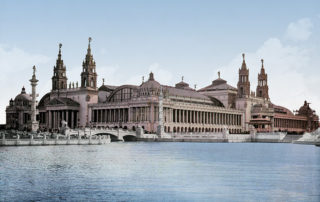
PICTURESQUE WORLD’S FAIR. AN ELABORATE COLLECTION OF COLORED VIEWS Page 68 – MACHINERY HALL MACHINERY HALL.—One of the most elaborate structures of the Columbian Exposition, Machinery Hall, or the Palace of Mechanic Art as it was termed officially, fully justified by its general effect the attention paid to ornamental details. The genius who achieved the lesser thing so well did not fail in the greater. Located at the south of the Grand Plaza and fronting to the east on [...]
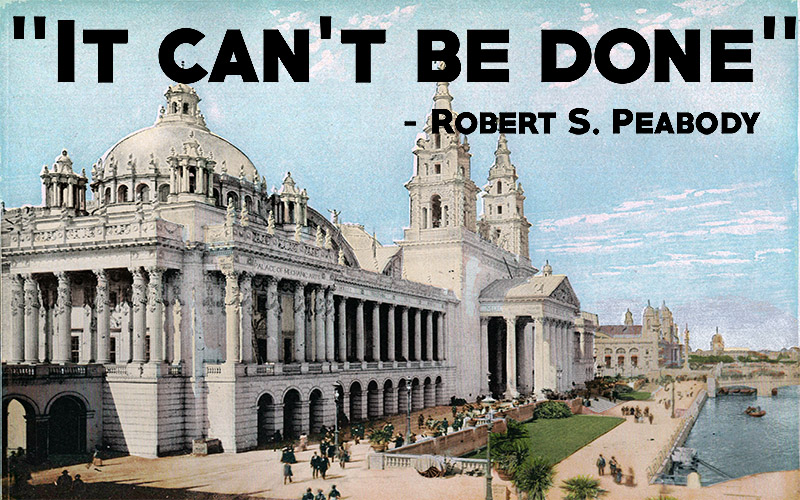
Robert Swain Peabody (February 22, 1845-September 23, 1917) died on this day at his summer home in Marblehead, Massachusetts. Cofounder of the renowned Boston architectural firm of Peabody & Stearns, he was one of the select east-coast architects invited by Daniel Burnham to contribute to the design of the 1893 World’s Columbian Exposition in Chicago. Despite his pessimistic statement in 1891 about the prospect of constructing the World’s Fair on the rough grounds of Jackson Park (“It can’t be done”), [...]
“Combine all the adjectives in the English language that express beauty, loveliness, grace and perfection, even then you will fail to describe a gala night at the Exposition.” -- World’s Columbian Exposition Illustrated January 1894. July 4, 1893, was a special day at the World’s Columbian Exposition, designated as "United States Day." Attendance swelled to enormous 283,273 paid visitors, making this the largest attendance of any day so far—even greater than on Opening Day—and perhaps the largest festival attendance [...]
The Greatest Crowd This is Part 13 of our series “Opening Day of the World’s Fair,” which explores the events of May 1, 1893, at the World’s Columbian Exposition in Chicago. The full series can be found here. They saw a beautiful sight When the Opening Day ceremonies were over, visitors had time to look around the fairgrounds. They saw a beautiful sight: a forest of great buildings decorated with flags, banners, and streamers in artistic designs and harmony [...]
The Great Transformation Scene This is Part 10 of our series “Opening Day of the World’s Fair,” which explores the events of May 1, 1893, at the World’s Columbian Exposition in Chicago. The full series can be found here. As the last words fell from his lips at the conclusion of his short address, President Grover Cleveland placed his finger on the telegraph key. With his hand touching the electric switchboard, a chrysalis transformation scene was about to begin [...]
A Sea of Humanity This is Part 3 of our series “Opening Day of the World’s Fair,” which explores the events of May 1, 1893, at the World’s Columbian Exposition in Chicago. The full series can be found here. As the procession of the President of the United States began its march south on Michigan Avenue, thousands of people in downtown Chicago began forming their own spontaneous parade to the World’s Fair. Everyone on West Madison Street and North [...]
The month of March, the saying goes, comes “in like a lion, out like a lamb.” Lions—both real and plaster—could be found at several locations around the grounds of the World’s Columbian Exposition of 1893. One example is Lions by German sculptor M. Arthur Waagen. This set of four lion sculptures adorned the base of the obelisk, which stood in the center of the Colonnade in the South Canal, between Machinery Hall and the Agricultural Building. The Chicago Daily [...]