
[Continued from Part 13]
Standing before a multinational crowd of 25,000 assembled at the end of the Midway Plaisance, the World’s Fair commissioner from Kansas had a few things to say about the Fourth of July.
Joseph R. Burton
Orator of the day, the Hon. Joseph R. Burton (1852–1923) of Abilene, Kansas, was a lawyer and member of the Kansas House of Representatives from 1882 to 1892. He earned his appointment as a World’s Columbian Exposition National Commissioner from Kansas on September 29, 1891, after Commissioner Reese R. Price resigned. Burton, a Republican, later served as a U.S. Senator from Kansas from 1901 to 1906. Despite the call for a “higher ideal in government” in his Fourth of July address, Burton holds the distinction of being the first Senator ever convicted of a crime, for accepting bribes to intervene with a federal agency in 1905.
In recent days, Joseph Burton managed to make headlines with a rather controversial speech in his home state. When invited to deliver an oration for a Memorial Day ceremony in Wichita, Mr. Burton offered a eulogy for Confederate President Jefferson Davis. He justified his stance by telling one reporter: “The only truly successful speaker is he who says just what he thinks and does not stop to consider the effect.” The Kansas press was still talking about what he thought on July 4th as he took the Midway speaker’s dais.
Commissioner Burton was “late in making his appearance,” noted the Chicago Herald (Jul. 5, 1893), which described his oratory skills this way:
He is a slender man with a brown mustache and a voice which nobody on earth would care to hear in the woods at night. It comes up from his heels and rolls round everywhere. His audience was not large. The speaker’s tardiness drove the chairman and Bedouins away, and the falling rain was rapidly dispersing the crowd outside the square when he stepped to the front of the platform with four sheets of manuscript in his hands.
A newspaper in Lawrence, Kansas, responded defensively that: “No one is likely to hear J. R. Burton in the woods. He does neither his fighting nor his talking there.”
Mr. Burton’s “Address to the Foreigners” prompted frequent cheering from the audience. As he spoke, a troop of American Indians, likely from the American Indian Village of the Midway, came up and solemnly circled the platform. Their silent statement undermined the meaning of the title of the Kansas Commissioner’s address.
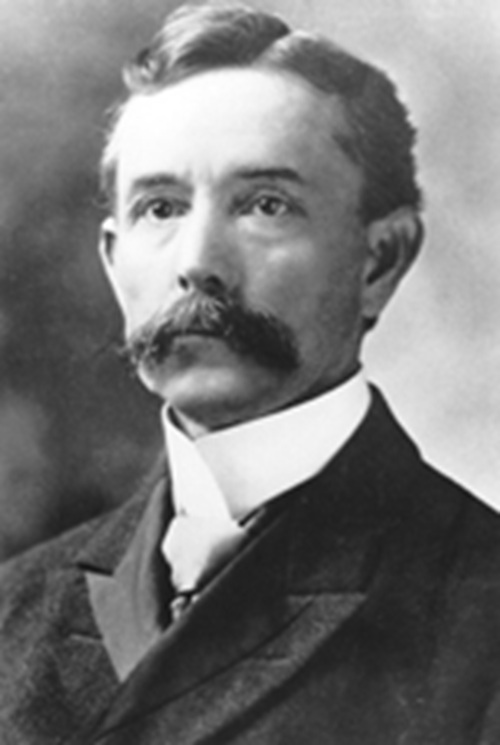
Joseph R. Burton, Kansas representative on the World’s Columbian Exposition National Commission, provided a Fourth of July address to the denizens of the Midway Plaisance. [Image from the Library of Congress.]
The Address to the Foreigners
Here today are assembled representatives from well-nigh every nation of the world. From our motherland the Briton is here today to rejoice with us in our wonderful achievements since we left the old home forever; the Irishman is here to bask in the sunshine of American freedom; the sturdy Scotchman, the honest German, the vivacious and versatile Frenchman—aye, all continental Europe that has helped us much to build up America—all are here today to do us honor and to salute our flag. From more distant shores come the Japanese, the Chinamen, the Persian, the Javanese, the Egyptian, the Turk, the Greek, the Italian and the Russian to study our commerce, to look at our civilization; and they stand here now uncovered in amazement at our triumphs and peaceful victories.
The salute fired to the flag a moment ago was fired by an Englishman from an English battery. The Swede, who has gained muscle, brain and virtue in his rugged land, has come to see the thousands of his more prosperous kindred who years ago crossed the North seas for a country that had a fairer climate and better laws. He is here today in great numbers and joins his voice in loud acclaim with all America in celebrating her birthday.
The son of the ancient Moor, whose ancestors conquered nations, founded dynasties, developed the arts and flourished in oriental splendor, is here to learn the wonders of the new world. From far-off south lands come the Algerian, the Congos, the South Sea Islanders and the Bedouins, who will show us their customs, development, ideas of life, efforts at art, science and invention, and their religion. They are deeply impressed with the unheard-of glories of our republic and heartily join in the festivities of this occasion. From the far-off lands of eternal snow comes the Laplander and the Eskimo with his family, his sleds and his reindeer.
Yes, from the isles of the sea and the most remote corners of the earth comes every tongue, and with one joyous shout salutes our flag—the nation’s ensign, the emblem of humanity. When this great Fair is over and these representatives return to their distant homes, may it be with better ideas of liberty and a deeper love for the United States.
The Declaration of Independence was the product of centuries of toil and suffering. It was the result of cycles of mental filtration. It was the ripe fruit of the tree whose seed was planted at the beginning of time and whose roots had been watered with the blood and the tears of millions. The ancient philosophers could not look deep enough to discover its truths. No ancient poet had imagination enough to foretell its discovery. By reason of the slow and painful progress of the human mind toward a higher plane of civilization there had to be the rise and fall of dynasties, the midnight of the middle ages, the dawn of the reformation, the emigration of pilgrims and the development of their successors in this country for two centuries, under every privation, undergoing every wrong before they could reach the mountain top of right and justice. And standing there, with all the past behind them and no precedent to guide them, our ancestors were first to see, know and feel and proclaim to the world that “All men are created free and equal before the law.” Blazed forth in the midst of bloody revolution, contended for by our fathers from Lexington to Yorktown, it took nearly a century more for our country to put into practice the Declaration of Independence, but even then it had to come, as we all know, at the awful price of treasure and blood.
But at last we have a universal acknowledgment of the truth expressed in that immortal declaration, and the problem for us, the inheritors of all the fruits and victories of our fathers and brothers, to solve is, Can we maintain it ? The poet has said:
Through the ages
One increasing purpose runs.
And the thoughts of men are widened
With the process of the suns.
But history teaches us that this constant struggle to a higher plane of civilization comes through tragic wars. Can we reverse this universal custom of man and make this progress without the letting of blood? Can we at once be virtuous enough and strong enough to maintain the liberty and rights of all before the law, without war? Can governmental questions be settled alone in the arena of debates? Since every man is equal before the law can we have such healthy public sentiment as to compel each to perform the duty that goes hand in hand with this right? Have we such public sentiment now? Is every man regarded as a criminal who fails in this duty—a criminal in the eyes of the law, whether he be rich or poor, humble or great? Is not such a public conscience necessary for the peaceable maintenance of our government? Can we help bring about that “ideal time”—for certainly it is not here—“When the rich man helps the poor man, and the poor man loves the great?” Can we reach that higher ideal in government and society when
The war drum throbs no longer
And the battle flag is furled
In the parliament of man.
The federation of the world?[1]
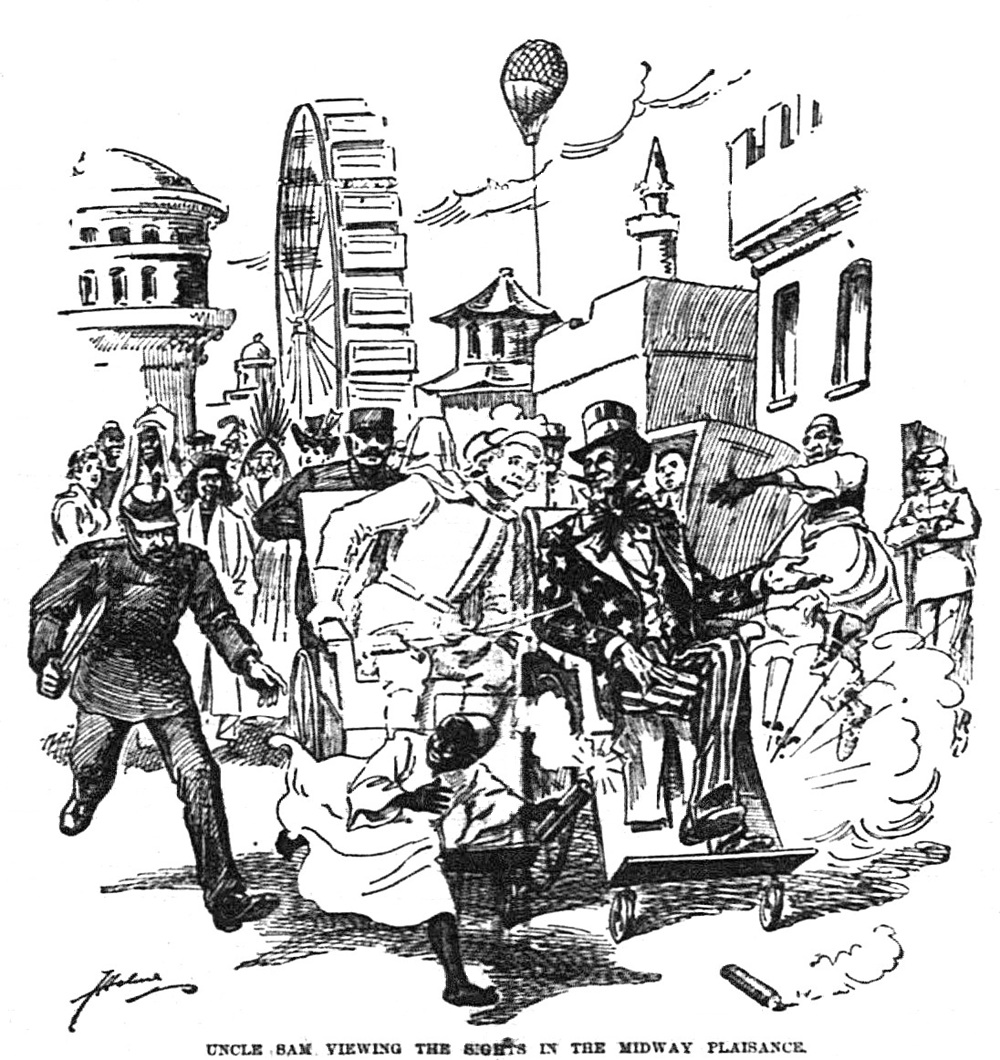
A cartoon representing Uncle Sam in a rolling chair viewing the sights in the Midway Plaisance on the 4th of July. [Image from the Chicago Times July 5, 1893.]
“A cosmopolitan gathering”
At the conclusion of Mr. Burton’s address, the Iowa State Band played some national airs and the people of the Plaisance marched back east, each contingent peeling off at their village or concession. “It was in truth a cosmopolitan gathering that was then assembled, and never before had the national birthday been honored by so many nations and in so many tongues,” recorded World’s Fair historian Hubert Bancroft. The Chicago Times admired the gathering of nations, but added:
When it comes to providing program and enthusiasm for Laplander and Sudanese, and encouraging Cossack and Turk to join hands in amicable rejoicing, and spurring on a British trooper to blend his hurrahs with the war cry of Zulu warriors, it amounts to more of a job than the signers of the declaration ever contemplated.
The Chicago Evening Journal offered a different perspective. The big celebration on the Midway “was likely to create demand for naturalization papers,” quipped its editorial page.
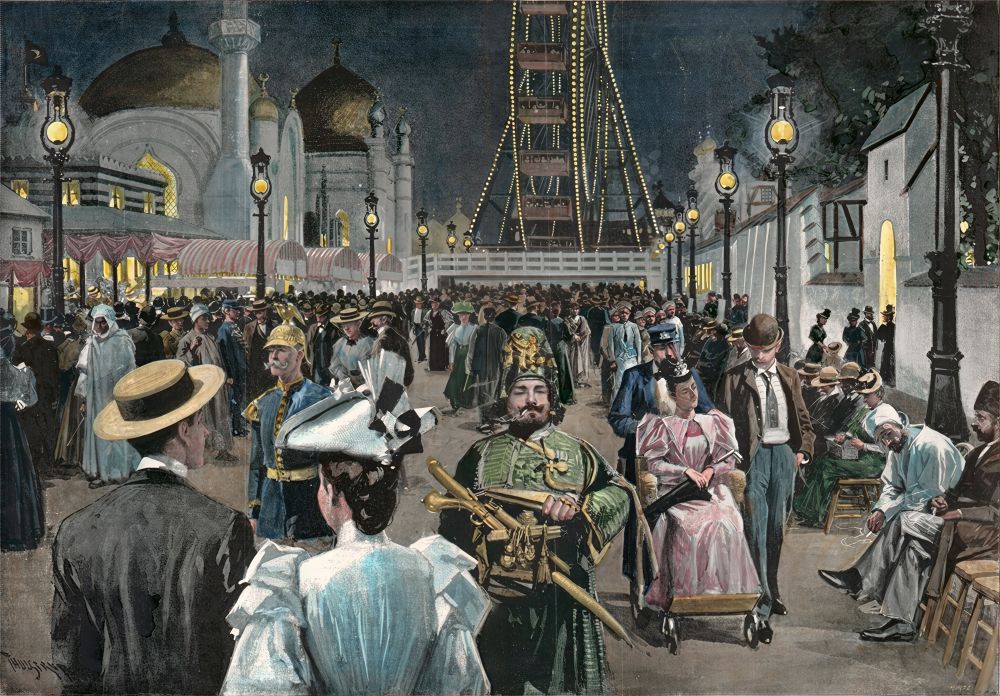
A depiction of the Midway Plaisance at night. Additional pendants and Japanese lanterns decorated the entertainment thoroughfare for the Fourth of July. [Image from Harper’s Weekly Oct. 7, 1893; digitally edited]
“A fairyland of lights and brilliant color”
All afternoon, visitors packed into the Midway Plaisance. “Crowded from curb to curb,” wrote the Chicago Times, “the vast silent river of humanity glowed down its length” Music of the world filled the air, with concerts by the infantry and cavalry bands in the German Village, a program of Irish and American music in one of the two Irish Villages. Samoans in the South Sea Island Theater sang “America,” which had been translated into their native language. In the Austrian Village, Carl Michael Ziehrer conducted the Fourth Infantry Band in the premiere of his “Columbian March” during their 5 pm concert. By this time, congestion on the Midway was so great that the Columbian Guard had to clear a path for ambulances, which, a few hours later, would be called to action.
The festivities and excitement did not end when the sun set. During the final show of the day at Hagenbeck’s Animal Arena, Prof. Darling, the lion tamer, narrowly escaped being torn to pieces by Pasha, one of the biggest stars of the show, as a thousand spectators watched in horror. Outside the arena, though, a scene of beauty emerged. “When twilight deepened into darkness, thousands of lights blinked in the gloom,” recorded the Chicago Record, “and when the various bands blared forth the patriotic American airs from thousands of throats rang the cheers.” Japanese lanterns and thousands of incandescent lamps brilliantly illuminated the famous thoroughfare. “The whole plaisance was a fairyland of lights and brilliant color,” wrote the Record.
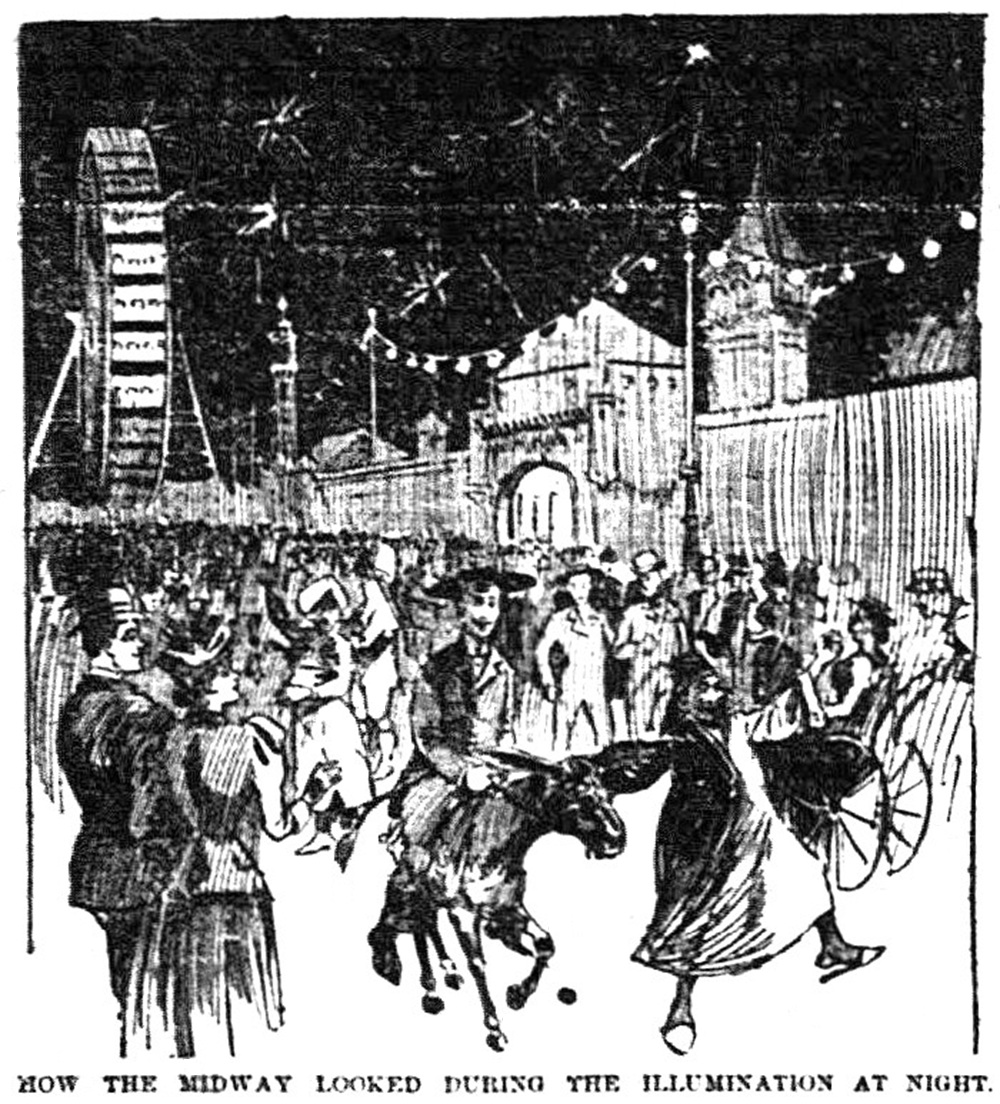
How the Midway looked during the illumination at night. [Image from the Chicago Times July 5, 1893.]
“Stood out like some monstrous skeleton”
Starting around 8 pm, the multitudes on the Midway, as if sharing a common thought, began marching eastward to join the crowds already swarming the Lake Michigan shoreline for the evening fireworks show. The Exposition’s entertainment district had one final surprise for everyone who lingered. The Midway Concessionaire’s Club had arranged their own special pyrotechnic display, made using hundreds of pounds of “red fire” (typically strontium salts). From 9 pm to 11 pm, red fire burned from every fourth car and from the axle of the Ferris Wheel. The Chicago Herald described the scene:
The great Ferris Wheel was aflame with red fire. It looked like a bleeding wound against the threatening sky. And shortly after 8 o’clock a searchlight was turned upon the monster contrivance from Manufactures Building. This powerful stream of light brought into bold relief the black figures of the men perched on top of the cars, who were feeding the glowing fires with chemicals.
The great search lights on top of the Manufactures and Liberal Arts Building illuminated the mammoth wheel as it revolved. “Swept by the penetrating rays of a search light playing on it, [the Ferris Wheel] stood out like some monstrous skeleton,” explained the Chicago Record. “Red fire blazed from the aerial cars, casting a weird look on the faces of those who stood and watched.” The Chicago Tribune noted that “the appearance of the Ferris Wheel, in every car of which red lights were burning, could be compared to nothing but a section of purgatory,” but also offered that the “burning of the red fire as the wheel revolved made a very pretty sight, causing it to look like an immense pinwheel as it turned.”
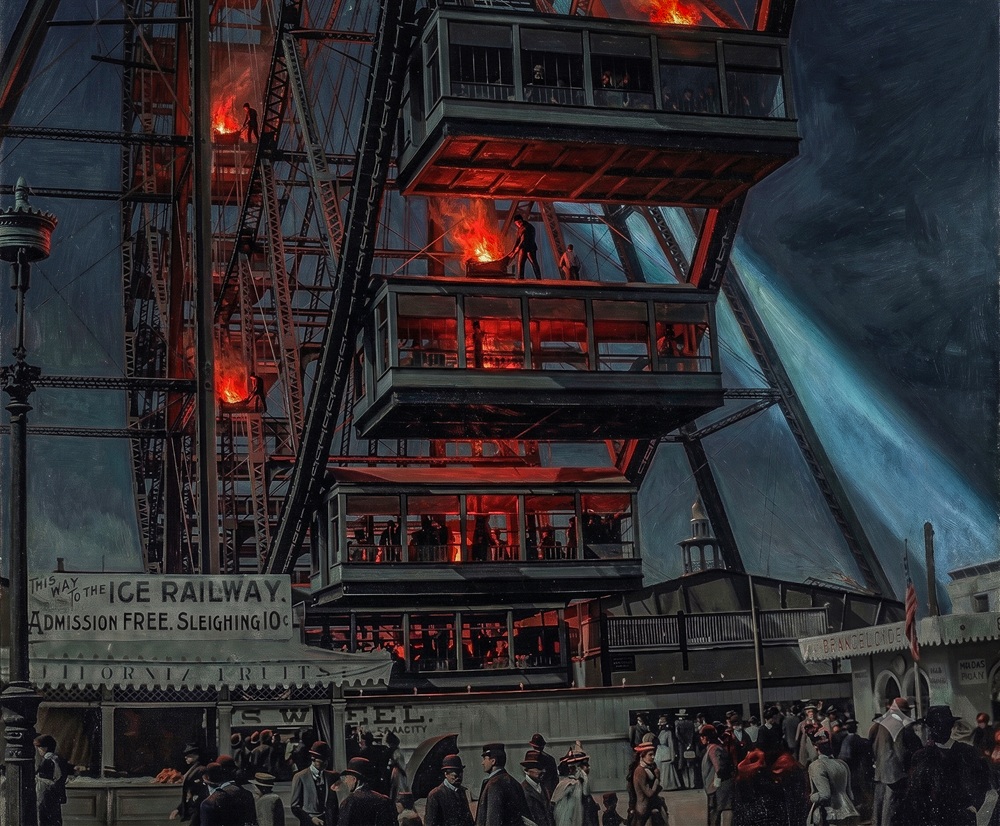
A depiction of the July 4th “red fire” display on the Ferris Wheel. [Image © worldsfairchicago1893.com.]
NOTES
[1] This and the previous verse are adapted excerpts from Alfred Lord Tennyson’s “Locksley Hall” (1835).
SOURCES
“All Honor the Nation” Chicago Times Jul. 5, 1893, p. 2.
“All Nations Cheer” Chicago Inter Ocean Jul. 5, 1893, p. 2.
“All Nations Join In” Chicago Tribune Jul. 5, 1893, p. 9.
Bancroft, Hubert Howe The Book of the Fair. The Bancroft Company, 1893.
Lawrence Daily Journal and Evening Tribune Jul. 10, 1893, p. 3.
“Midway’s Great Day” Chicago Herald Jul. 5, 1893, p. 3.
“On Midway Plaisance” Chicago Record Jul. 5, 1893, p. 3.
“Talks for Davis” Wichita Beacon May 30, 1893, p. 4.
“That Big Fourth of July …” Chicago Evening Post Jul. 5, 1893, p. 4.

Leave A Comment