
[Continued from Part 9]
The final speaker of the Fourth of July exercises was James S. Norton, of Chicago. An eloquent orator, Norton’s mastery of language reportedly rivaled that of Chauncey Depew. The opening line of an 1896 obituary for Norton remembered him as the Chicago attorney who read the Declaration of Independence at the 1893 World’s Fair. As he stepped to the speaker’s table, rain fell briskly, but no one seemed to mind. Mr. Norton refused an umbrella offered to him by Mayor Harrison, saying that “patriotism was actually oozing out.”
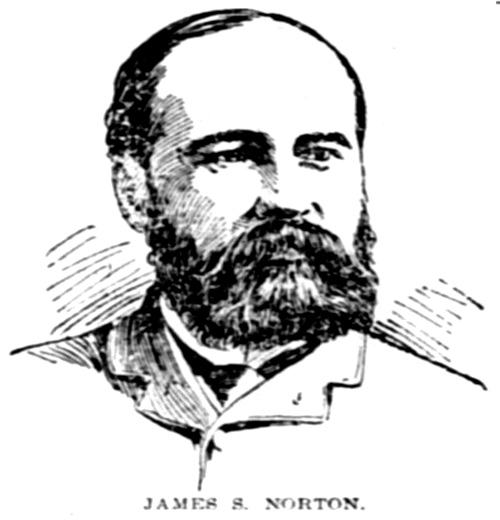
James S. Norton spoke on “The Work of the Signers” for the Fourth of July ceremony at the 1893 World’s Fair. [Image from the Chicago Inter Ocean Sep. 18, 1896.]
“The Work of the Signers”
The men who declared the colonies to be free and independent states builded better than they knew. Upon the foundations laid by them has arisen a nation great beyond the scope of their prophetic vision. To-day we, the people of that nation, by the grace of God still free and independent, have assembled in all her countless cities and villages to rejoice in the blessings of civil liberty, and to render tribute to those whose wisdom and valor secured them for us; and chief of all these festivals, unique in its conditions and of singular interest, is that we hold in this enchanted spot, where a great city, undreamed by those whose names we celebrate, stands hostess to all the world in her temples of art and science and industry. Was ever scene like this?
Where yesterday was nature unadorned we behold to-day the very apotheosis of art. It is as if some cunning hand had stolen from sleep the splendid pageantry of dreams and given to waking eyes a vision of celestial courts. Here we have harvested from every field of human effort and found new promise in our own; and here and now, above all other times and places, it is fitting that we should renew our devotion to those principles to which our nation owes its evident prosperity and now conceded greatness.
It is no new thing that men should long for liberty. It has been the dream of the oppressed since the first mastery of man over man; and one people after another had won it, abused it and lost it. Nor was it novel that men should seek to govern themselves by self-made laws. Republics had arisen, flourished and fallen. But here the occasion found a people fitted for self-government, in a land of plenty; and now, after many vicissitudes and more than a century of progress, we may reasonably claim to have demonstrated a theory of popular government in which the will of the sovereign people is conservative of individual liberty, and in which the humblest person finds his equal opportunity for development.
In this country a man is not merely permitted, he is expected to improve upon the condition of his parents. There is no such thing as being born to a fixed station in life. He is born to all that he shall merit, and encouraged to deserve the best. The true glory of our nation is not in her territory or commerce or special achievements in art or science, but in the millions of poor men made thrifty, of ignorant men brought to intelligence, of rude men taught the amenities of life and grown ambitious to rear their children in refinement.
Her glory is not in the progress of the highly favored to still greater wealth and more exquisite culture, but in the grand procession out of poverty and want into the decencies and modest comforts of life—out of darkness into light; and it is a melancholy fact that those who seem least to appreciate this belong either to that modern class which is made possible by the institutions which civilized and enriched its progenitors or to the ranks of those recent importations whose only hope on earth for the emancipation of themselves and their children from the bondage of poverty, ignorance and vice lies in those same beneficent institutions. But between that foolish fashion of disloyalty which pervades the one class and that stupid frenzy which blinds the other stands the patriotism of that vast majority who love the principles to which their land is dedicated.
It is to this great class, embracing those who look forward with eager hope to the promised rewards of industry and thrift, and those who remember with gratitude the early opportunities and constant encouragement which helped them to prosperity, that the country looks for loyalty. When a man becomes too rich to count the cost of his pleasure, or so polished as to forget the basis of common clay, he passes beyond the range of general interest, and the country expects from him no cheerful service, no willing sacrifice; and so, on the other hand, until the poor and ignorant man shall be awakened not only to desire, but stoutly to intend for himself and his family a better day and a rational life, he is a useless and dangerous citizen. Selfish wealth and hopeless poverty combine to present the great problem of the age; for one leads on to inhumanity—the essence of despotism—and the other to sullen despair—the source of anarchy.
This problem is to be solved by the average citizen—that plain, sturdy, self-reliant, ambitious man who is known as the typical American. And he will do it, not by attempting to reconcile the inveterate foes of our institutions, but by sustaining those institutions without regard to captious criticism or sentimental protests. To such men the declaration solemnly made by the early patriots that all men are created with equal right to life, liberty and the pursuit of happiness means something definite and practical. To them patriotism means something real to be applied to every act of citizenship, and pride of country is a natural instinct. To them even the noise and fervor of this day possess a clear and deep significance; and to them especially, and to all good patriots of other lands who may chance to hear and who will respect the utterance of brave men charged with a nation’s fate, I now repeat the words of that historic document by which our independence was declared.
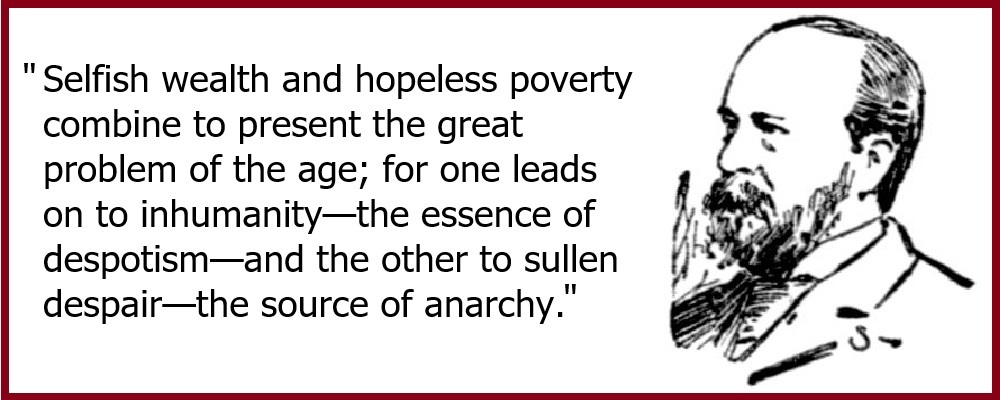
One sentiment from James Norton’s Fourth of July address.
“Thoughtful as well as jovial”
The editorial page of the Chicago Evening Post complimented Mr. Norton for a speech that “sustains, justifies and will increase the reputation he has won so suddenly.” The Post praised the oration as “thoughtful as well as jovial, logical as well as witty, plain as well as pyrotechnical in discourse,” adding that:
There is a flavor of Lincoln in all of this: possibly because it is so obvious and, yet so striking. The speaker has voiced the idea present in the minds of us all. He assures us of that which we have never doubted in our secret thoughts, which we have always worn in our breasts as a talisman against fear and apprehension—that we may safely trust in the common sense of the people.
Mr. Norton ended by reading the text of the Declaration of Independence, continuing an annual tradition begun in the earliest days of the Republic. “Hats off!” someone in the audience cried out as Mr. Norton began. While most people listened reverently, the Western Union operator transcribed an incoming message as the telegraph clacked noisily.
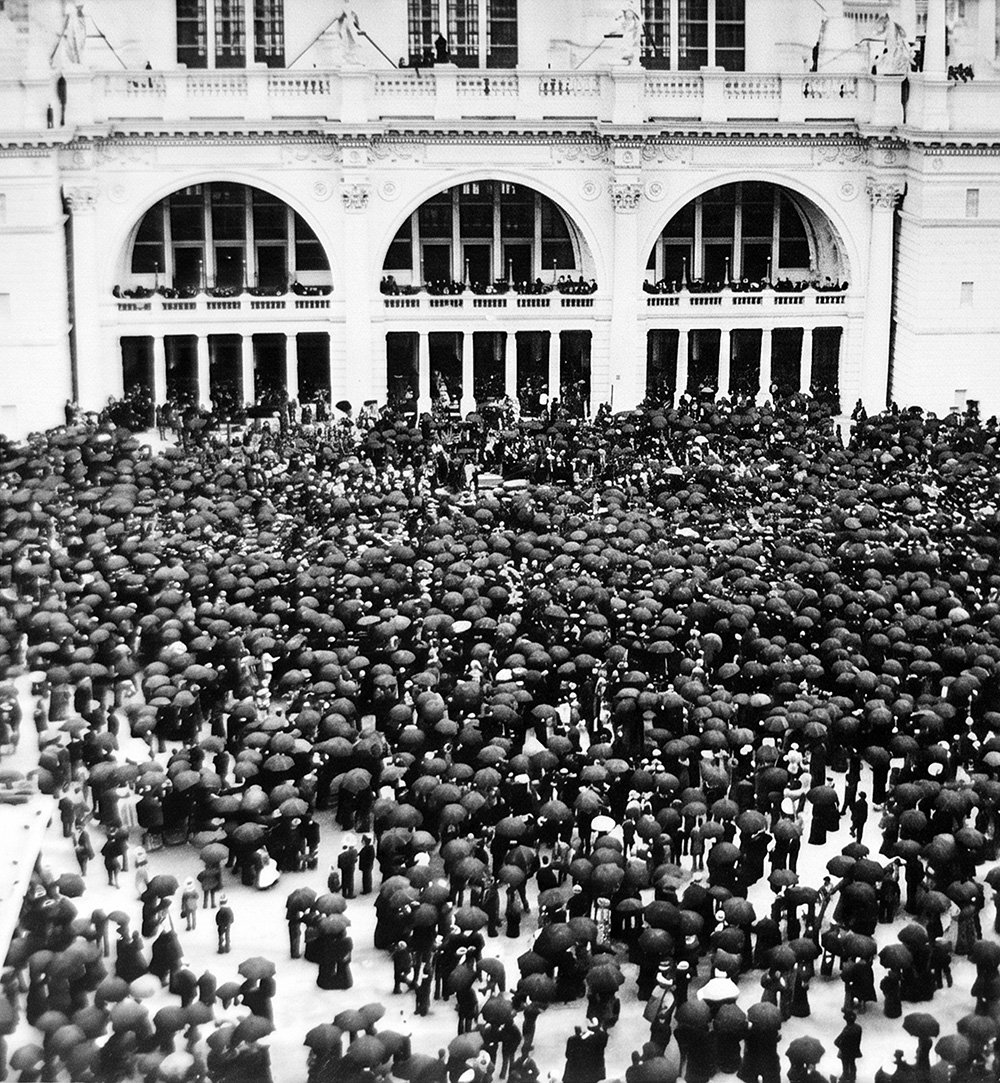
The crowd in front of Terminal Station for Fourth of July exercises came prepared for the wet weather. [Image from Kilburn stereoscope card; private collection.]
“Glory, glory, hallelujah!”
Young telegraph operator Frank Hemphill calmly transcribed an incoming message sent to William O. McDowell from the Meneely Bell Foundry in Troy, New York. When the applause following Mr. Norton’s address died away, Chicago Alderman Martin B. Madden, chief architect of the morning exercises, announced to the tens of thousands assembled: “At 12 o’clock the electric current was turned on here announcing the hour, and by this announcement the new Columbian Liberty Bell was rung in Troy, from which point I received the following telegram:”
The Columbian Liberty Bell was sounded the instant you touched the button at noon of this grand Independence Day, and this ringing was followed by the playing of national and patriotic airs on the grand chime made by us for St. Patrick’s Cathedral, New York City. Thousands upon thousands of patriotic citizens have called to see this historic bell, many coming long distances. The glorious day, bright and clear, seems to have been granted as a special favor to liberty lovers. You can announce to the 250,000 friends who have made such splendid offerings to this bell that their gifts have crystallized into grand form and that the new liberty bell has been set ringing to aid peace and good will throughout the whole world. —Clinton H. Meneely
The people gathered on the fairgrounds laughed at the description of a “glorious day, bright and clear” in New York. Those not protected by umbrellas were drenched. Without commenting on the local weather, Mr. McDowell had a reply telegraph sent to Troy reading simply: “Speakers’ Stand, World’s Fair Grounds, Chicago, Ill., July 4, 1893.—Clinton H. Meneely. Glory, glory, hallelujah!”
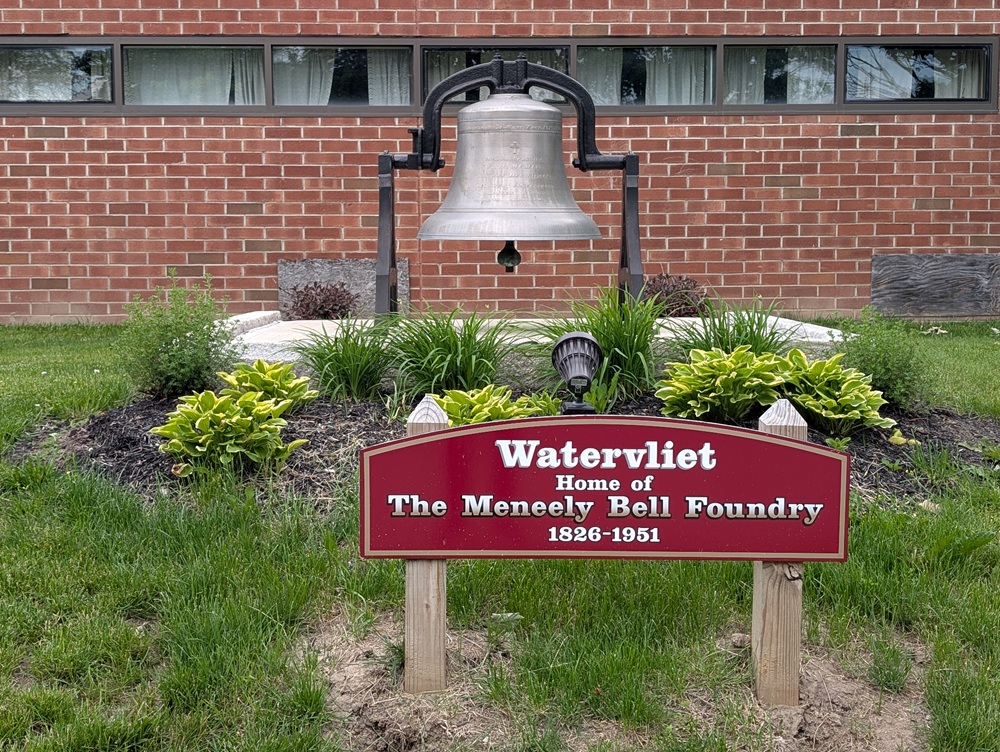
The site of the former McNeeley Bell Foundry in Watervliet (formerly West Troy), New York, where the Columbian Liberty Bell was rung for the first time on July 4, 1893. [Photo © 2026 worldsfairchicago1893.com]
“Never-to-be-forgotten Fourth of July cheer”
Director-General George R. Davis declared the meeting done. The band and chorus closed with “My Country, ‘Tis of Thee” and the ringing words of the “Doxology” as the huge audience joined in. Though dismissed, the throng did not want the festivities to end. When the band struck up the “Suwannee River,” the crowd lingered and then joined their voices in “Home, Sweet Home” and other songs. The informal concert continued for about an hour. “People were in a mood for celebrating with song,” observed the Chicago Record (Jul. 5, 1893). “The bright sun added its inspiration to the day, and the formal celebration was almost equaled by the impromptu one that succeeded it.”
Just as the crowd was finally about to disperse, Mayor Harrison cried out: “Just one moment. Before we go, let us give one rousing cheer for America!” Instead, they gave three. The Record called it “a real old-fashioned never-to-be-forgotten Fourth of July cheer that broke the clouds and brought out the sun for the first time during the day.”
The “John Paul Jones” flag and the “Flag of Universal Peace” were pulled down from their respective masts. After Mrs. Stafford retrieved her precious flag, she stood for half an hour while curious people trooped by caressing the folds and congratulated her. She and others from the platform party made their way to the Delaware State Building for another round of exercises. As the audience dispersed from Administration Plaza, a battery of English artillery marched through, the soldiers saluting the American flag as they passed on their way to the Midway Plaisance. It was a strange but fitting end to the Revolutionary War commemoration.
[Continued in Part 11]
SOURCES
“Big Day at the Fair” Chicago Times Jul. 5, 1893, p. 2.
“Cheering the Flag” Chicago Herald Jul. 5, 1893, p. 9.
“Fair’s Best Day” Chicago Times Jul. 5, 1893, p. 1.
“We Compliment Mr. Norton” Chicago Evening Post Jul. 5, 1893, p. 4.
“Within a Magic City” Chicago Inter Ocean Jul. 5, 1893, p. 2.
“World’s Fair Fourth” Chicago Record Jul. 5, 1893, p. 1.

Leave A Comment