
[Continued from Part 8]
The Hon. Hampton L. Carson (1852–1929) of Philadelphia continued the Fourth of July program with an address on “The Old and the New Liberty Bells.” Mr. Carson served as the Recording Secretary of the Historical Society of Pennsylvania from 1893 to 1903 and then as its Vice President from 1903 to 1921 and President from 1921 to 1929. One hometown newspaper described the forty-one-year-old as “Philadelphia’s silver-tongued young orator.”
Several newspapers printed his Fourth of July address, though most removed large sections. The transcription below comes mostly from the Chicago Herald. Some differences between published versions suggest last-minute editing to reflect the absence of both the Columbian Liberty Bell and the Columbus caravels.
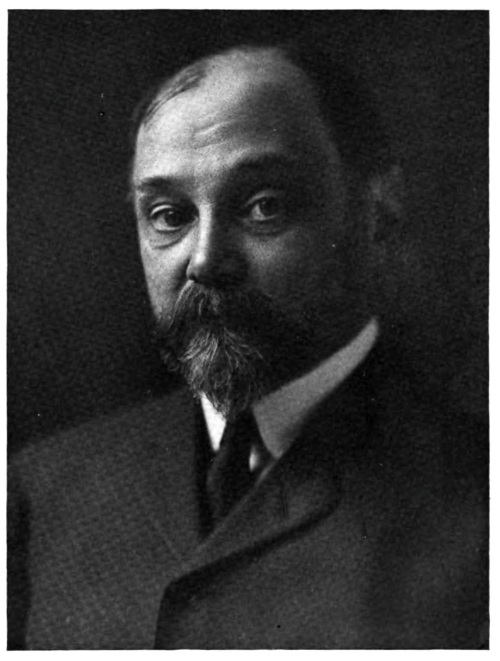
The Honorable Hampton L. Carson, of Philadelphia, spoke on “The Old and the New Liberty Bells” for the Fourth of July exercises at the 1893 World’s Fair. [Image from The Genesis of the Charter of Pennsylvania. Law Academy of Philadelphia, 1919.]
 “The Old and the New Liberty Bells”
Mr. President, Commissioners of the World’s Fair, Your Excellency Mr. Mayor, Citizens of Chicago, Fellow Countrymen: In response to your gracious invitation that a son of the city of the Declaration of Independence should give utterance to the sentiments appropriate to the celebration of the greatest of our national anniversaries, in the most marvelous city of modern times in the rapidity of her growth and the dazzling character of her achievements, I am here to bid you exclaim: “All hail, thou Fourth of July, 1893, all hail!”
To moral eyes no scene like this has ever been vouchsafed. We are in the presence of the august representatives of our national and state sovereignties; of municipal governments and civic enterprises; of officers of the army and navy; of statesmen, civilians, artisans and laborers; of honored potentates of foreign lands; of the subjects of five continents and the islands of the sea—all happily participating in this imposing display of the arts of peace, industry, commerce, labor, learning, science, literature and religion; attesting the harmony to be derived from a common devotion to international unity, to a belief in the brotherhood of man, the beauty of liberty, liberty according to law.
The time, the place, the occasion, and the landscape are unique. This is the Columbian year. This is the anniversary of an immortal declaration of human rights. This is the city of Chicago. This is the World’s Fair. The old Liberty Bell is here; spirit of the new Liberty Bell is connected with this assemblage by electricity; the American people are here; the nations of the earth are here. In ten thousand years of recorded history was there ever such a like conjunction of events? In all unnumbered years to come what probability is there that it will ever be repeated? National grandeur and state pride are in conjunction with international friendship. What political horoscope can equal this? The unclouded heavens, the boundless prairie, the teeming metropolis, the unvexed bosom of a vast inland sea, yonder palaces of art, resting tranquility on their shadows in the wave—all are in harmony with the occasion.[1]
This celebration is, in truth, a swelling epic. It is a psalm of thanksgiving. It is patriotism incarnate; both in inspiration and a prophecy. It recalls the past and its heroic struggles, it attests the present with its miracles of achievement; it foretells the infinite possibilities of the future. Its lessons are physical, intellectual, and moral. It confutes skepticism as to Republican institutions.[2] It surpasses the wildest dreams of the most farsighted of the fathers of the Republic; it satisfies the most ardent of the patriots of to-day; it arouses the loftiest hopes of the transcendent destiny of America.
The world has contemplated with awe the making of consuls and dictators, the crowning of kings, the proclamation of emperors; but in describing the scenes of today and the triumphal march of this morning, the modern Plutarch will commemorate a far different spectacle from that witnessed by him two thousand years ago. No Paulus Aemilius, crowned with Delphic laurel, nor ambitious Pompey, decked with the spoils of plundered provinces, appeared in that procession. No wailing victims of the fate of war were there to grace in captive bonds the conqueror’s chariot wheels; no bullocks were led out to slaughter; no savage games were thrown open to the people, where tigers, famished into madness, tore the flesh of men but little less ferocious than themselves; but the “Io Triumphe” of the American people rang out above the heads of the marching squadrons as they wound their glittering length through your great highways, to bow in reverence at the shrine of the Constitution, of liberty, of order and of law. Not on the Field of the Cloth of Gold, the Champs de Mars, nor even in Trafalgar Square, not in Venice in her days of glory, nor yet in the Crescent City of the Golden Horn, was ever witnessed such a convocation of mankind. All classes and conditions of persons, of all sects and creeds, of all nationalities, of all ranks and stations, are here in vast concourse, controlled not by bayonets, but by civil authority, to testify their allegiance to the Constitution and to the flag of the United States, and, in the expressive eloquence of their tumultuous applause, to assert the truth of their belief that in that Constitution there was granted to man the noblest and the freest chart of government that either ancient or modern times can boast.
Such is the day and such is the meaning of these impressive ceremonies. Difficult as it is to realize at this hour the exact circumstances of the occasion which led to the adoption, in the city of Philadelphia, of that declaration of human rights, which is among the most admired of the world’s political productions, and for which men waited in vain 6,000 years, it is proper that I should advert in a general way to the scenes which are dear to the memory of all Americans, and which can never be forgotten while patriotism exists. The history of the Liberty Bell, which is so conspicuous an object in Pennsylvania State Building, is intimately associated with those events.
The old house in Philadelphia stands upon the holiest spot of American earth. There, on the south side of Chestnut street, beneath the shelter of majestic elms, protected against the ravages of time and the rage for modern improvement, a quaint yet simple structure of plain brick and wood, erected in the year 1732 for the purpose of furnishing a place of meeting for the state government of Pennsylvania, stands the birthplace of our nation.
In 1751, the Speaker of the Provincial Assembly wrote to his friend, Robert Charles of London, as follows: “The Assembly having ordered us to procure a bell from England, to be purchased for their use, we take the liberty to apply ourselves to thee to get us a good bell of about two thousand pounds weight, the cost of which we presume may amount to ₤100, or, perhaps with charges, something more. Let the bell be cast by the best workmen and examined carefully before it is shipped, with the following words well shaped in large letters around it, viz: “By order of the Assembly of the Province of Pennsylvania for the State House in the city of Philadelphia, 1752,” and underneath, “Proclaim liberty throughout all the land to all the inhabitants thereof” (Lev. xxv. 10).
The bell arrived at the end of August, 1752, but upon being tested the Superintendent had the mortification to find that it was cracked by a stroke of the clapper, without any other violence. “Two ingenious workmen,” then in Philadelphia, undertook to recast it, meeting with success, but, as it was found to contain too much copper, it was once again recast. From this time forward for nearly one hundred years it was rung upon all extraordinary and unusual occasions, proclaiming either joy or sorrow, peace or war.
I need not dwell with particularity upon the oppression and the wrongs which led to the assembling of the Continental Congress within the walls of the State House in 1776. The tale is known of all men. Suffice it to say that on June 7 Richard Henry Lee, of Virginia, introduced his famous resolution: “that these united colonies are, and of right ought to be, free and independent states; that they are absolved from all allegiance to the British crown, and that all political connection between them and the State of Great Britain is, and ought to be, totally dissolved.”
A memorable debate arose. For nearly a month was the great question agitated. July 1 arrived. Nine colonies were there to vote affirmatively, and ten, should Ceasar Rodney arrive from Delaware before the vote was called. Two of the colonies were still adverse and one had declined to take part as the subject of independence was outside of its instructions. Lee, the mover of the revolution resolution, was absent in Virginia. Jefferson, although a power with his pen, was no speaker on the floor. Chase the Boanerges of Maryland, was away, while John Dickinson, the author of the “Farmer’s Letters,” was prominent in his opposition. Even James Wilson and Robert Morris counseled delay.
Then it was that John Adams became “the pillar,” and “the Colossus of the party of independence,” supported by George Wythe of Virginia and Dr. Witherspoon of New Jersey. On the evening of the 1st, Adams wrote to Chase that the debate had taken all the day, while Jefferson wrote that it had lasted nine hours without refreshment and without pause. The critical hour had come. The vote was taken in committee of the whole. Massachusetts, New Hampshire, Connecticut, Rhode Island, New Jersey, Maryland, Virginia, North Carolina and Georgia voted for the resolution. Pennsylvania and South Carolina voted against it. Delaware was evenly divided, and New York, at the request of its delegation, was allowed to withdraw. The second day arrived; the debate was resumed. Abraham Clark wrote: “the Declaration is now under debate; the panic which has seized the army has not yet reached the senate. In a few hours it will be determined whether we are to be a nation of free men or a race of slaves.” The lion-hearted Adams renewed his efforts. Edward Rutledge, of South Carolina, requested that the vote of his state should be changed. Pennsylvania, taking advantage of the absence of Dickinson and Morris, reversed its adverse vote. Rodney arrived by express and this enabled Delaware to cast its vote for the resolution. The deed was down, the bond which bound the colonies to the throne was sundered and, on the 2nd of July, 1776, America attollens humeris famam et fata nepotum. Bearing up her glory and the destiny of her descendants advanced with majestic steps to assume her station among the sovereigns of the world.[3]
It is a common error to suppose that the vote upon the resolution was taken upon the 4th instead of the 2nd of July. The facts were as I have stated. It was upon the 4th that the Declaration was adopted. The preparation of this important document had been consigned to a special committee, of which Mr. Jefferson was the organ, and the manner in which he discharged his task with burning eloquence and terse philosophy has caused the Declaration to support the “resolution” and the affections and memory of mankind and to mark the 4th of July as a national holiday.
It is a common error also to suppose that the Declaration was signed on this day. The only signatures attached were those of John Hancock and Charles Thomson, the president and secretary of Congress. It was not until the 15th that instructions were given to the clerk to prepare the Declaration for signatures, and on the 2nd day of August duly engrossed on parchment, it was brought into the chamber of Congress and placed on the president’s table for the signature of the individual members. All those actually present on that day affixed their names, and some were thus included who had no share either in debating or voting on the document.
The truths of history are more important than its fictions, and the part played in the great drama by the old bell must now be stated. Its voice was silent on the Fourth day of July, 1776, for Congress then sat with closed doors and in secret session; but when it had been ascertained that the sentiments of the people were in accord with what Congress had done, and that New York had signified her intention to concur, then was the word “unanimous” inserted in the published broadsides, and on the 8th the Declaration was read for the first time to the people by John Nixon, in the State House square, while the old bell rang forth its joyous notes of jubilee and verified the prophecy of its inscription.
It was the tolling of a bell at the Sicilian vespers which proclaimed the massacre of 8,000 French in a plot to free Sicily from Charles of Anjou; it was the tolling of a bell in the palace of Catherine de Medici which ushered in the slaughter of 100,000 Huguenots upon the night of Saint Bartholomew’s Day; it was the iron tongue of Roland in the proud city of the Brewer of Ghent which shrieked to Flanders of famine, fire and blood, and roused the Netherlands to resist the atrocities of Alva and the inquisitors of Philip II, but never yet in human history did bell or tocsin ever sound upon occasion so momentous to mankind as did this holy and precious relic of our heroic age. Forever honored be thy name, O Isaac Norris, speaker of the assembly of the province of Pennsylvania, who, in plainest Quaker speech, and under a potent moving of the spirit, was led to direct that there should be inscribed upon the crest: “and ye shall hollow the fiftieth year and proclaim liberty throughout all the land unto all the inhabitants thereof; it shall be a jubilee unto thee words which shook the brightest jewels from the British crown and gave a continent to liberty. Inscrutable providence! Mysterious are thy ways and hidden are they purposes, for in thy hands the modest men of peace become as potent instruments of destruction as they who forge the thunderbolts of war.
The subsequent history of the bell is briefly told. In 1777, when the British occupied Philadelphia, it was removed for safety to Allentown, Pa., and after Monmouth was restored to its place in the State House, ringing upon all occasions of national rejoicing or woe. It welcomed to our shores in 1824 the generous Lafayette, the companion of Washington, who had spilled his blood like water by the great chieftain’s side upon the field of Brandywine, and had risked his fortune, fame, position and influence in defense of American liberty. Surely it is not the least pathetic incident in our national story, that on July 8, 1835, it tolled in sorrow for the death of John Marshall and then was mute forever. The earthly voices of this harbinger of liberty and of the great Chief Justice died away together. But according to an immutable physical and moral law the tones of the one will never cease to vibrate, attuning the hearts and souls of men to harmonies divine, while the imperishable judgments of the other have built up a state which “our hearts hold priceless, above all things rich and rare; dearer than health and beauty, brighter than all the order of the stars.”
The institutions established by our fathers we hold in trust for all mankind. It was the Pilgrim of Massachusetts, the Dutchman of New York, the Quaker of Pennsylvania, the Swede of Delaware, the Catholic of Maryland, the Cavalier of Virginia, and the Nantesman of South Carolina, who united in building up the interests, and in contributing to the greatness and the unexampled progress of this magnificent country. The blood of England, of Holland and of France, wrung drop by drop by the agony of three frightful persecutions, was mingled by the hand of providence in the alembic of America to be distilled by the fierce fires of the revolution into the most precious elixir of the ages. It is the glory of this era that we can stand here today and exclaim that we are not men of Massachusetts, nor men of Pennsylvania, nor men of Illinois, but that we are Americans in the broadest, the truest, and the best sense of that word; that we recognize no throne, no union of church and state, no domination of class or creed.
American liberty is composite in its character and rich in its material. Its sources, like the fountains of our Father of Waters among the hills, are to be sought among the everlasting truths of mankind. All ages and all countries have contributed to the result. The American Revolution forms but a single chapter in the volume of human fate. From the pure fountains of Greece before choked with dead leaves from the fallen tree of civilization; from the rude strength poured by barbaric transfusion into the veins of dining room; from the institutes of Gaius and the Pandects of Justinian; from the laws of Alfred and the Magna Carta of King John; from the daring prows of the Norsemen and the sons of Rollo the rover; from the precepts of Holy Writ and the teachings of Him who was nailed to the cross on Calvary; From the daring courage of a Genoese and the liberality and religious fervor of a Spanish queen from the enterprise of Portugal and the devoted labors of French Jesuits; From the scaffolds of Russell and Sidney and of Egmont and Horn; From the blood of martyrs and the visions of prophets; from the unexampled struggle of eighty years of the Netherlands for liberty, as well as from the revolution which dethroned a James; from the tongue of Henry, the pen of Jefferson, the sword of Washington and the sagacity of Franklin; from the discipline of Steuben, the death of Pulaski and DeKalb and the generous alliance of French; from the constitution of the United States; from the bloody sweat of France and the struggles of Germany, Poland, Hungary and Italy for constitutional monarchy; from the arguments of Webster and the judgments of Marshall; from the throes of civil war and the failure of secession; from the Emancipation Proclamation and the enfranchisement of a dusky race; from the lips of the living in all lands and in all forms of speech; from the bright examples and deathless memories of the dead—from all these, and from ten thousand living streams, the lordly current upon which floats our ship of state, so richly freighted with the rights of men, broadens as it flows through the centuries, past tombs of kings and graves of priests, and mounds of buried shackles and the charred heaps of human auction blocks and the gray stones of perished institutions out in the boundless ocean of the future. Upon the shores of that illimitable sea stands the temple of eternal truth, not buried in the earth, made hollow by the sepulchers of her witnesses, but rising in the majesty of primeval granite, the dome supported by majestic pillars embedded in the graves of martyrs.
And thou, great bell! cast from the chains of liberators and the copper pennies of the children of our public schools, from sacred relics contributed by pious and patriotic hands, baptized by copious libations poured out upon the altar of a common country by grateful hearts and consecrated by the prayers of the American people, take up the note of prophecy and of jubilee rung out by thy older sister in 1776, and in your journey round the globe proclaim from mountain top and valley, across winding river and expansive sea, those tones which shall make thrones topple and despots tremble in their sleep, until all people and all nationalities, from turbaned Turks and Slavic peasants to distant islanders and the children of the sun, shall join in the swelling chorus, and the darkest regions of the earth shall be illumined by the heaven-born lights of civil and religious liberty.
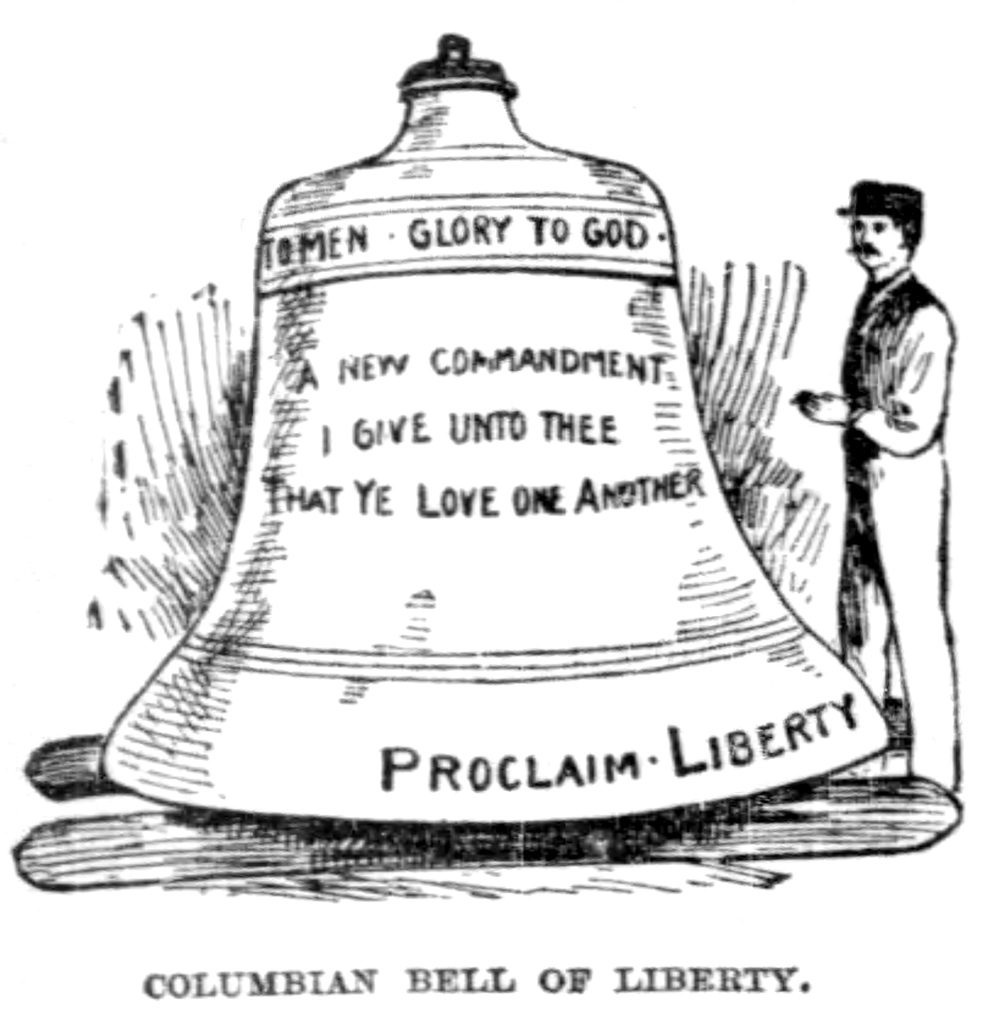
The Columbian Liberty Bell, “cast from the chains of liberators and the copper pennies of the children,” was absent from the Fourth of July ceremony at the Chicago fair, but did arrive later. [Image from the Chicago Tribune Sep. 3, 1893.]
NOTES
[1] In some printed versions this speech, this sentence also listed the “Viking ship and caravels” among the sites. Carson likely omitted the reference because the Columbus caravels and the Viking ship did not reach the fairgrounds until July 8 and July 12, respectively.
[2] This sentence was omitted in the Chicago Times and Chicago Tribune.
[3] In this paragraph, the author borrows heavily from John Fiske’s The American Revolution (Riverside Press, 1891)
SOURCES
“Cheering the Flag” Chicago Herald Jul. 5, 1893, p. 9.
“Fair’s Best Day” Chicago Times Jul. 5, 1893, p. 1.
“His Birthday Party” Chicago Tribune Jul. 5, 1893, p. 1.
“Orator of the Day” Minneapolis Journal Jul. 4, 1893, p. 1.
“Within a Magic City” Chicago Inter Ocean Jul. 5, 1893, p. 2.
“World’s Fair Fourth” Chicago Record Jul. 5, 1893, p. 1.

Leave A Comment