
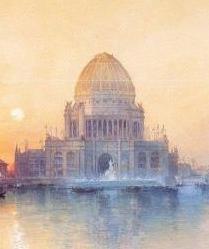
At precisely noon on July 4th, 1893, the Independence Day ceremony at the World’s Columbian Exposition reached its climax. Cannons fired, chimes rang, steam whistles blew. The mayor of Chicago waved Andrew Jackson’s sword above his head. A chorus of 2000 voices sang “The Star-Spangled Banner” as tens of thousands of spectators joined in and waved flags. The original American flag was hoisted up a flagpole and the new Columbian Liberty Bell—forged especially for the World’s Fair—rang for the first time. Never mind that the flag was inauthentic, the sword had never seen battle, and the bell was absent—this was the biggest day yet at the Fair and the most colossal day ever conceived in connection with the Fourth of July.
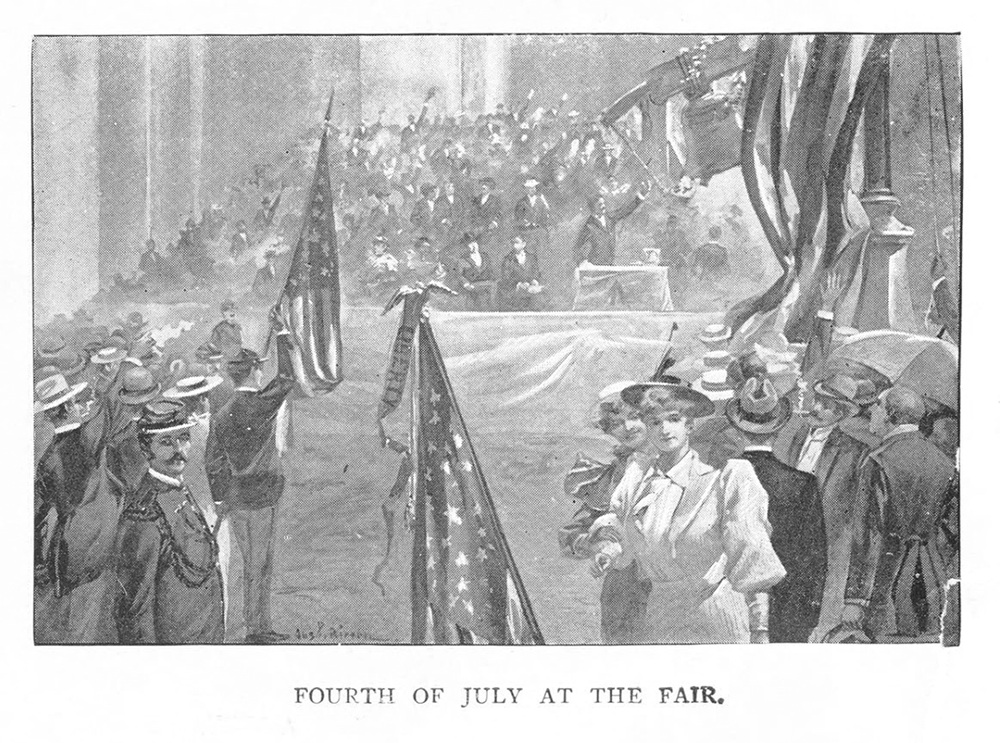
This vision of the Fourth of July celebration at the 1893 World’s Fair never came to pass. [Image from The Graphic History of the Fair. Graphic Co., 1894.]
“A grand celebration of the Fourth of July”
Directors of the Columbian Exposition desperately needed a big day. In the weeks after a spectacular Opening Day on May 1, attendance had lagged. Exposition historian Rossiter Johnson described it as “a period of great depression.” Newspaper reports spread across the country describing the unfinished state of the Fair. Exhibitors were still unpacking and setting up their displays, and many attractions on the Midway had not yet opened for visitors. Other stories complained of price gouging by unscrupulous hotels and restaurants, including some on the fairgrounds. Meanwhile, a serious financial panic was unfolding across the country and in the host city. The Chemical National Bank of Chicago, which had a branch on the fairgrounds, failed just a week after the Exposition opened. If all this wasn’t enough to keep people home, wet weather made things even worse.
Several “special days” at the Fair did generate bursts of high attendance. Decoration Day on May 30 honored America’s fallen and drew 140,000 onto the grounds, several thousand more than Opening Day had. Infanta Day on June 8, to fête the visiting Princess Eulalia of Spain, broke that record with around 170,000 entries. German Day on June 15 proved a huge success, pulling in more than 200,000 for parades and festivities. By June 20, Exposition officials began a push to fill the remaining months of the Fair with many more special days and celebrations to draw crowds. “The management felt that it was time to enter into a vigorous campaign for the purpose of drawing a large attendance,” records Johnson, so “preparations were made for a grand celebration of the Fourth of July.”
Columbian Exposition officials sought to bind 1492 with 1776. “Celebration of the discovery of America necessarily go hand in hand with the celebration of its independence,” offered the editor of the Chicago Daily News (July 3, 1893). The Fourth at the Fair would bring American independence and republican ideals before the eyes of countless visitors from around the world. “Not only are the people born to this national birthright enthusiastic, but the citizen by adoption, proud of his liberty and equality, lends his voice heartily to the celebration.” Chicago, then and now, is a city of immigrants. In his treatise on America’s Independence Day, Peter De Bolla writes:
And so to this day all manner of events have been bundled into the extraordinarily capacious maw of the Fourth of July—the laying of a railroad, opening a civic institution, the construction of a canal, the dedication of a monument, the naturalization of immigrants, the defeat of tyrants. It is this openness, the symbolic generosity of the Fourth which gives it such potency and longevity.
By June 1, Columbian Exposition Director James W. Ellsworth, who served on the Special Committee on Ceremonies, proposed a day of festivities for the national holiday. He envisioned special exercises, patriotic speeches by prominent men from around the country, concerts, a military display, and athletic tournaments. Exposition officials began to promote their event as “America Day,” “United States Day,” “Natal Day,” and “People’s Day.” A newly formed national peace group pushed to have it called “Liberty Bell Day.”
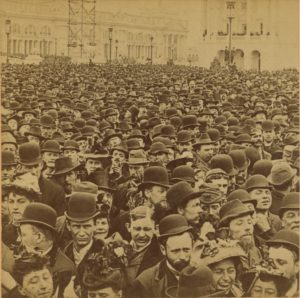
A “surging sea of humanity” had swept into the fairgrounds for the Opening Day ceremonies on May 1. Exposition directors hoped that more fête days, including “America Day” on July 4, would sell even more tickets. [Image from Kilburn stereoscope card.]
The Municipal Fourth of July Celebration Committee
The City of Chicago, meanwhile, was organizing its own Independence Day celebration. On May 22, the Chicago Common Council directed the mayor “to make provisions for a celebration by the city on the Fourth of July in recognition of the location of the World’s Fair in Chicago, and to appoint all necessary committees and to make all necessary preparations,” the Chicago Tribune (May 23, 1893) reported. In late May, city council formed a Municipal Fourth of July Celebration Committee to be in charge of the event, with Martin B. Madden (1855–1928) appointed as chairman. The Fourth Ward alderman, a Republican, regularly served as the Chicago Common Council’s presiding officer and chaired the Finance Committee. An English immigrant, Ald. Madden became the chief organizer of Chicago’s celebration of American independence.
Like many cities, Chicago usually celebrated Independence Day with a parade, reading of the Declaration of Independence, patriotic speeches, and fireworks. “In spite of all the paltriness attached to its observance in recent years,” observed the Chicago Evening Post (Jul. 3, 1893), “it is an anniversary that retains all of its old-time magic to fire the hearts of Americans.” This Columbian year, the celebration was expected to be much grander, though the Evening Post admitted that “the Fourth finds us celebrating the discovery of America in a city unknown even to the sons of the signers.” With the White City in Jackson Park serving as the temporary capital of the world, the Inter Ocean (Jul. 2, 1893) boasted that “Chicago has had many great celebrations of the Fourth of July, but compared to the jubilee planned for [this July 4th], they are as Lilliput to Gulliver.” Throughout June, the City’s plans evolved to have closer ties to the World’s Fair. Meanwhile, a national organization was working to assert itself into the Columbian Fourth of July ceremony with a mammoth gift.
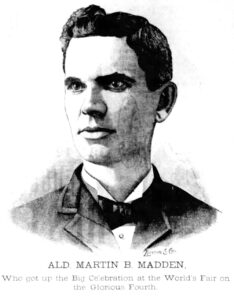
Chicago Alderman (and native Englishman) Martin B. Madden led the Municipal Fourth of July Celebration Committee. [Image from the Chicago Eagle Jul. 8, 1893.]
The Columbian Liberty Bell project
Well before either the Columbian Exposition or the City of Chicago began their Fourth of July planning, a national organization launched an ambitious project that would capture the imagination of the nation. Leading the movement was a New Jersey businessman who was active in numerous peace organizations as well as founding the Sons of the American Revolution (S.A.R.) and the Daughters of the American Revolution (D.A.R.). William O. McDowell (1848–1927), while at a meeting of the League of Human Freedom at Independence Hall in Philadelphia, saw “Liberty’s Bell,” a poem by Madge Morris Wagner (1862–1924), tacked up beside the old Liberty Bell. The verse of the California poet inspired him to build a new Liberty Bell, as outlined in her poem, and to have it ring for the first time at the Columbian Exposition in Chicago on the Fourth of July.
Having conceived the idea of a Columbian Liberty Bell, Mr. McDowell organized a Columbian Liberty Bell Committee with Miss Minnie Mickley (1859–1931), regent of the Liberty Bell Chapter of the D.A.R. in Allentown, Pennsylvania, serving as its secretary. She was a lineal descendent of John Jacob Mickley, who in 1777 helped save the old Liberty Bell by removing it from Philadelphia when the English threatened invasion. The Daughters of the American Revolution joined the Columbian bell cause with great energy under the leadership of Miss Mary Desha (1850–1911) of Kentucky, ex-vice president general of the D.A.R. The Columbian Liberty Bell Committee aimed to include in its body one lady from each state and territory in the union and additional members from the great patriotic societies of the world. Their goal was to privately fund the bell by soliciting two kinds of contributions.
First, the Committee sought donations of metal to be melted into the bell. Specifically, they called for historic artifacts made of gold, silver, copper, bronze or nickel, which would be fused with metal derived from ore donated from mines in several states and territories. The inspiration for this conglomeration came from Mrs. Wagner’s poem, which included the verse:
“It was not to be builded—this bell that they planned—
Of common ore dug from the breast of the land,
But of metal first moulded by skill of all arts—
Built of the treasures of fond human hearts.”
Donations of priceless relics of American and foreign struggles for liberty poured in. George Washington’s silver spoon, Thomas Jefferson’s copper kettle, Abraham Lincoln’s gold watch chain, and John Greenleaf Whittier’s pen joined metallic mementos sent by President Cleveland and U. S. Supreme Court justices. More than 200,000 men, women, and children—everyday citizens and national dignitaries—contributed some 22,000 different historical objects. The San Diego Sun (Mar. 21, 1893) reported that “chains of former enslaved people, bars and bolts used during the Inquisition, crowns and scepters of deposed tyrant monarchs, keys from the Bastille, and hinges from Siberian prisons” were amassed for the foundry furnace. Added to the pile were donations of “old swords, silver goblets, copper boilers, gold pens which have been used in signing famous documents, match boxes, and metals in every conceivable form,” reported the New York Times (Apr. 24, 1893). “Some of the relics are of such value that they have been placed in safe deposit vaults until the casting is made.” Many critics, outraged by what they considered criminal vandalism, condemned the project for foolishly destroying historic relics.
The Committee also solicited monetary contributions to pay for transport and caretaking of the bell. Mr. McDowell imagined that every child in the nation would contribute one penny for the cause. The estimated cost of the Bell was $6000, by the Meneely Bell Company of Troy, New York, which offered to manufacture it without profit. Another $500 would be needed to transport the bell to Chicago and additional expenses would pay a caretaker.
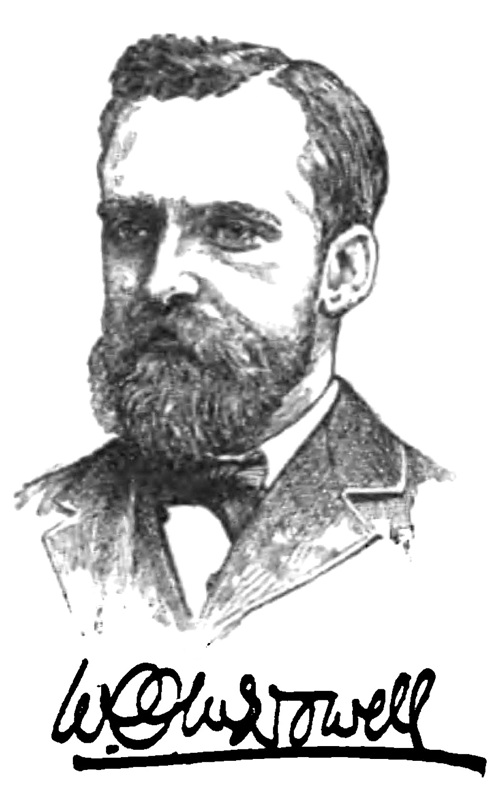
William O. McDowell conceived the idea of a Columbian Liberty Bell that would ring on July 4th at the Columbian Exposition. [Image from the The National Cyclopaedia of American Biography, Volume III. (James T. White & Co., 1893).]
“A Permanent Missionary of Liberty and Peace”
As both metal and money poured in during the spring of 1893, the Committee sought approval from the World’s Columbian Exposition for bringing the Columbian Liberty Bell—“a Permanent Missionary of Liberty and Peace”—to the fairgrounds and finding it a home there. “It was intended and planned that this bell should be the great memorial of the World’s Columbian Exposition,” wrote the World’s Columbian Exposition Illustrated (Nov. 1893). “It was recognized that the Exposition was in fact a monument illustrative of what was possible in a republic, and its most appropriate memorial was, therefore, a Liberty Bell.” By March, the Committee touted a plan for ringing the bell for the first time at a July 4th celebration on the fairgrounds under the supervision of the Board of Lady Managers. This administrative body of the Exposition “shall have custody of the bell and arrange for its location, and also have charge of its use,” the Boston Globe (Apr. 11, 1893) later reported.
On June 3, Mary Desha addressed a letter to the Exposition asking that the Fourth of July be designated as “Liberty Bell Day” at the Fair. Honors would be divided between the old Liberty Bell, already on the fairgrounds, and the new Columbian Liberty Bell about to be cast in Troy. She urged the Sons of the American Revolution, Daughters of the American Revolution, and other patriotic organizations to join together for “Liberty Bell Day” celebrations across the nation in sympathy with the World’s Fair and to have bells ring simultaneously from sea to sea at noon Chicago time.
With casting of the bell planned for April 30, the foundry would have amble time to prepare and engrave the bell and for Mr. McDowell to transport it to the fairgrounds in time for the Fourth of July. What could possibly go wrong?
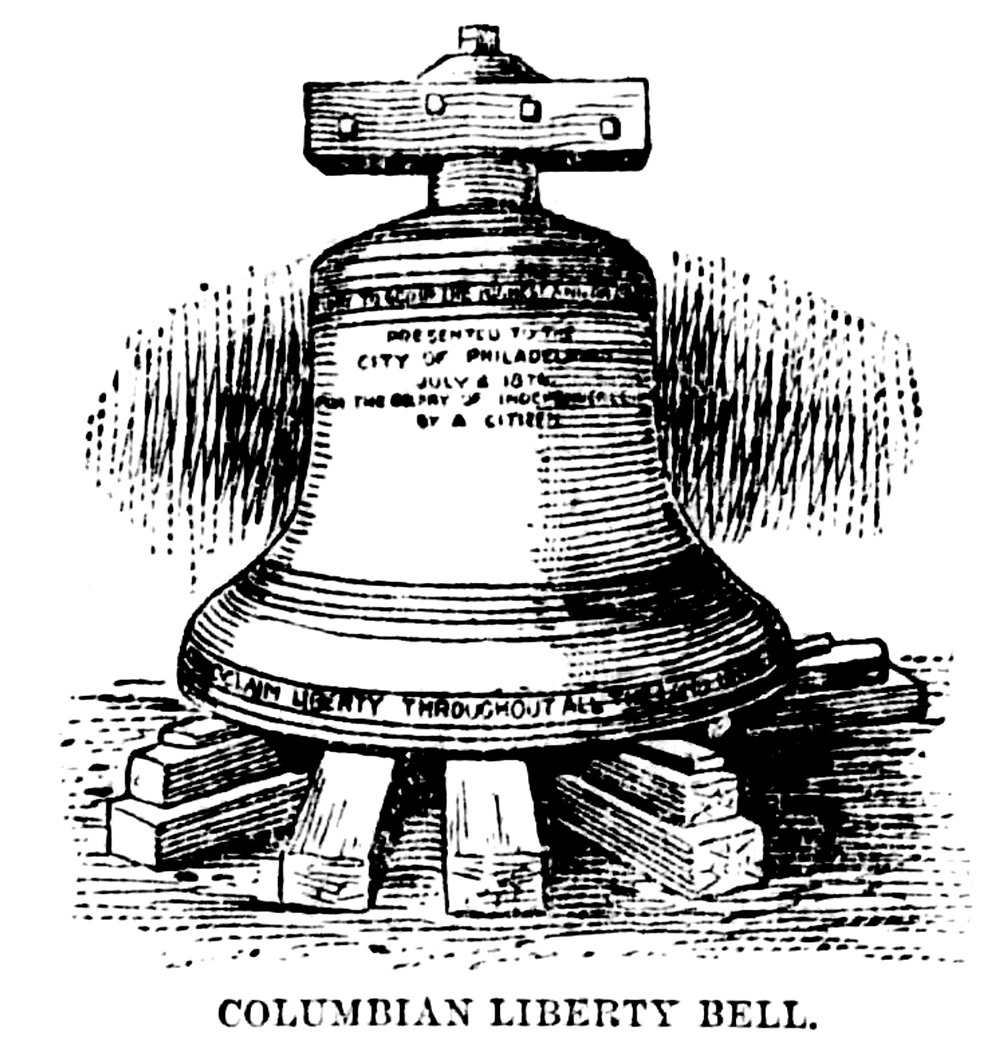
This illustration of the proposed Columbian Liberty Bell is based on the old Liberty Bell. The design of the new bell would have a different inscription on the face. [Image from the Trenton (NJ) Times Apr. 7, 1893.]
SOURCES
De Bolla, Peter The Fourth of July and the Founding of America. Abrams Press, 2009.
“For the Fourth of July” Chicago Daily News Jul. 3, 1893, p. 2.
“A Greeting for the Fourth” Chicago Evening Post Jul. 3, 1893, p. 4.
Johnson, Rossiter A History of the World’s Columbian Exposition Held in Chicago in 1893, Volume 1: Narrative. D. Appleton and Co., 1897.
“Jubilee of Liberty” Chicago Inter Ocean Jul. 2, 1893, p. 2.
“Liberty Bell” Boston Globe Apr. 11, 1893, p. 4.
“The Liberty Bell” San Diego Sun Mar. 21, 1893, p. 1.
“The New Liberty Bell” World’s Columbian Exposition Illustrated Nov. 1893, p. 246.
“Old and New” Cleveland Evening Post Jun. 3, 1893, p. 1.
“Old Glory’s Big Day” Chicago Evening Post Jul. 3, 1893, p. 1.
“Planning Fete Days” Chicago Tribune Jun. 21, 1893, p. 2.
“Plans for the Fourth” Chicago Record Jun. 2, 1893, p. 8.
“Urges Close Study” Chicago Tribune May 23, 1893, p. 5.
“Wonderful Liberty Bell” New York Times Apr. 24, 1893, p. 9.

Leave A Comment