

On the roof of the Manufactures and Liberal Arts Building of the 1893 World’s Fair were erected several of the most powerful search lights in the world at the time. While usually busy illuminating the fairgrounds each evening, the light rays occasionally were pointed toward distant locales. Historian Rossiter Johnson recorded that “the beam was seen at Milwaukee, eighty-five miles distant, on July 15, 1893, and at Antioch, Ill., sixty-five miles distant, on August 5.” St. Joseph, Michigan, on the eastern shore of Lake Michigan, is only sixty miles as the seagull flies from Jackson Park. Whether or not this news story below is true or not, the sweetheart signals described in it seemingly could have crossed the distance.
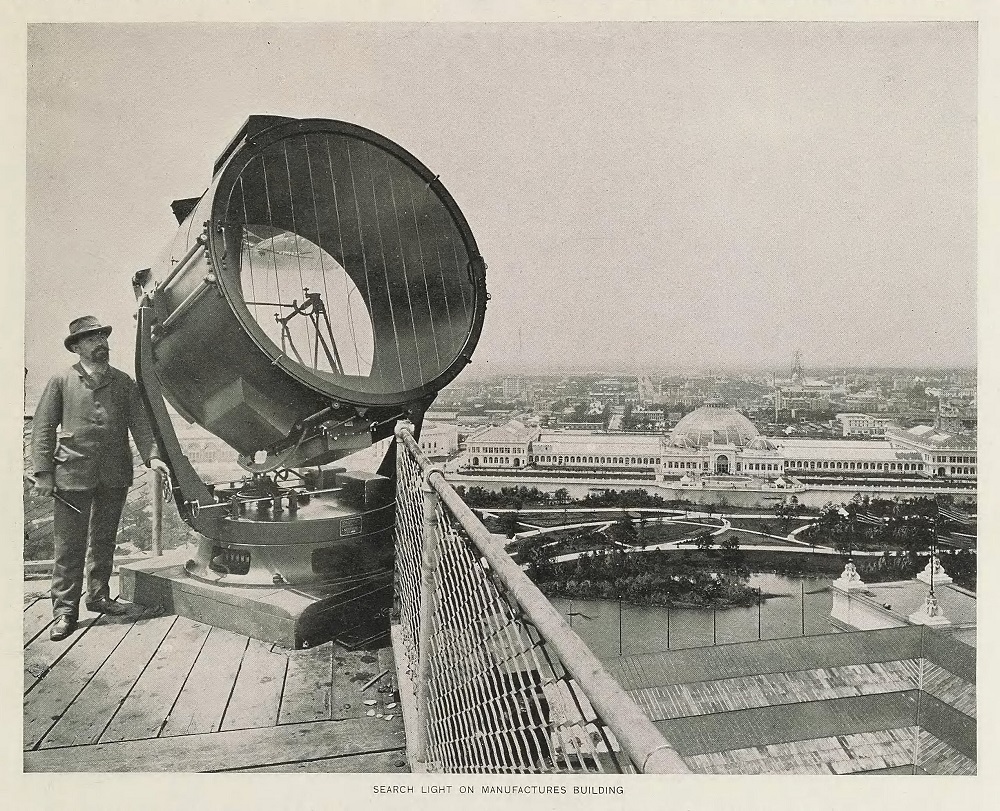
A search light on the roof of the Manufactures and Liberal Arts Building. [Image from Bancroft, Hubert Howe The Book of the Fair (The Bancroft Company, 1893).]
Love Will Find a Way
Being in Chicago and having a sweetheart in St. Joseph, Mich., has its drawbacks. John Berrian is the name of a man who is employed 6 nights a week cutting chunks of darkness out of the air and filling the space with a bright white light. He runs one of the search lights on Manufactures Building in the World’s Fair grounds and lives in Chicago. He has a sweetheart in St. Joe. Now boats to St. Joe are slow and trains have to make a circuit of the lower end of Lake Michigan, and the time of getting a letter through to St. Joe is long, and, besides, the mails are uncertain. Berrian tried for a time writing letters to his St. Joe sweetheart, but the best time ever made by a train could not get that letter through and an answer to Chicago in less than thirty-six hours.
John Berrian had the search light at the southwest corner of Manufacturers Building and he used to put a halo on Diana over on Agricultural Building and light up the MacMonnies fountain to the lasting pleasure of Fair visitors until one night when a man at the northeast corner was ill and he changed positions. From throwing a light out across the dark waters of Lake Michigan his thoughts began to wander to St. Joe and the girl waiting there for the Fair to end. He turned on the full power of the electrical current and wondered if it could be seen in St. Joe. The next Sunday he was in St. Joe and he incidentally mentioned the search light to his sweetheart, and he was pleased to learn that she had noticed the reflection in the sky the night he had the light turned north of east, and from that a great thought came to him. “Why not signal his sweetheart from the World’s Fair grounds?”
He found a friend who had a Morse alphabet, and he made two copies, one of which he left in St. Joe. When Monday night came visitors to the fair wondered what the matter was when there was a series of flashes from the northwest corner which, put in black and white, was like this:

And any telegraph operator can tell you that this translated is, “Do you love me?”
Of course, the St. Joe sweetheart had no search light with which to answer, but she can write all about it, and the letter would get to Chicago at 7:55 o’clock next morning. Now there is a message sent every night, and the postman brings an answer on his first round each succeeding morning.
SOURCES
Johnson, Rossiter A History of the World’s Columbian Exposition Held in Chicago in 1893, Volume 2: Departments. D. Appleton and Co., 1897.
“Love Will Find a Way” Chicago Tribune Sep. 17, 1893, p. 34.


Leave A Comment