
[Continued from Part 6]
As Mayor Carter Harrison swung the historic sword over his head, as cannons fired, and as a crowd of tens of thousands cheered with wild enthusiasm, two special guests simultaneously hoisted a pair of flags. To the right of the platform, a younger woman pulled a rope for the “Flag of Universal Peace” to rise gracefully and unfurl at the top of one pole. On the other side, an elderly woman dressed in a grandmotherly, black silk gown tugged at the halyards of another flagstaff. With trembling hands, Mrs. Harriet Rebecca Perry Stafford hoisted a well-worn flag having only twelve stars—the “John Paul Jones” flag.
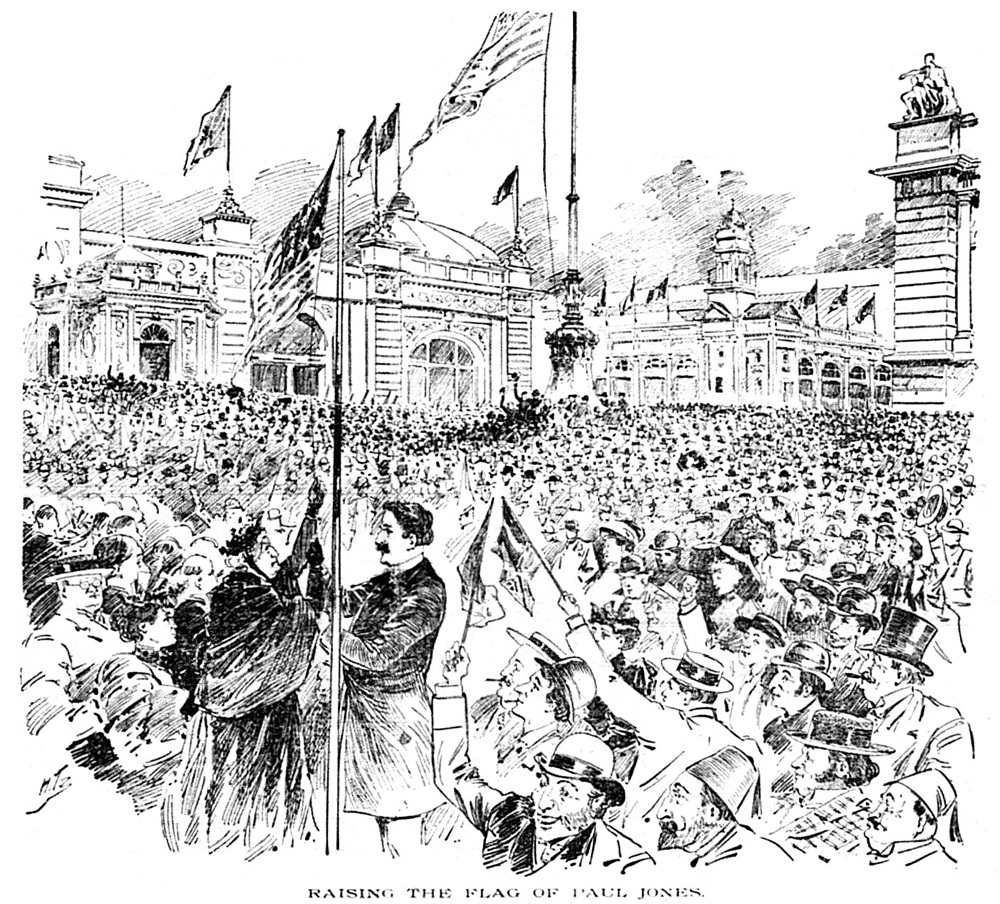
An illustration showing Mrs. Stafford helping to raise the “John Paul Jones” flag. [Image from the Chicago Herald July 5, 1893.]
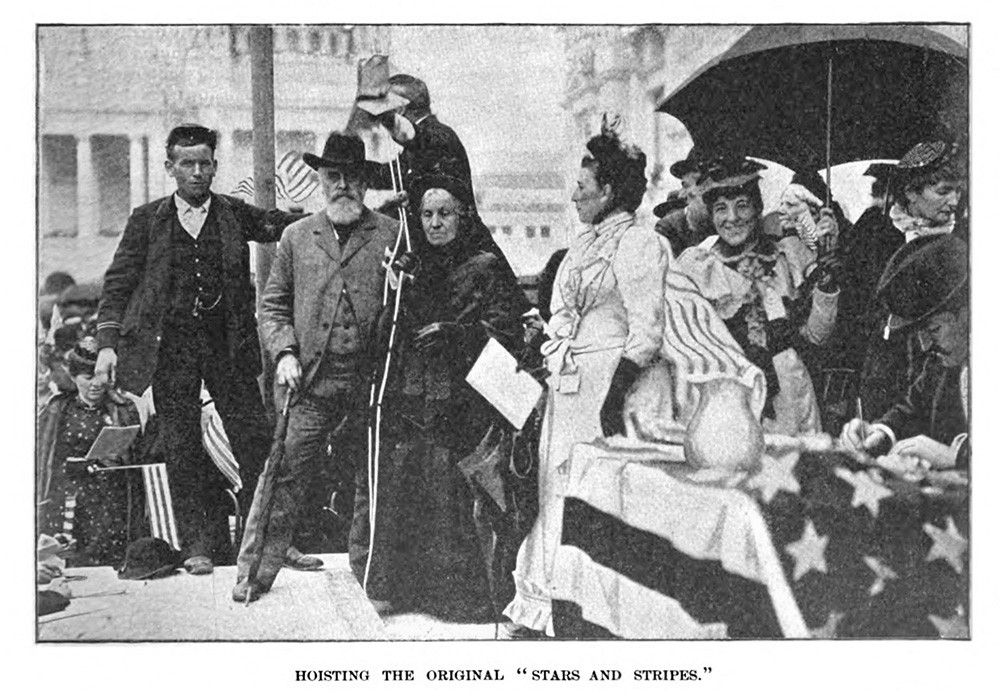
A “Kodak fiend” captured this photograph of members of the platform party during the hoisting of the original Stars and Stripes. On the far left is an unidentified man, possibly James (“Jimmy”) Hunt who managed flags for the Exposition. Next is Chicago Mayor Carter Harrison, wearing his trademark slough hat and carrying an umbrella. Behind the mayor is Mr. William O. McDowell, Chairman of the Columbian Liberty Bell Committee, passing the telegraph message announcing the ringing of the Columbian Liberty Bell. The elderly woman in black by the mayor’s side is Mrs. H. R. P. Stafford, owner of the “John Paul Jones Flag.” The next lady, dressed in white, is Miss Mary Desha of Kentucky, representative of the Daughters of the American Revolution. The woman holding up the umbrella and smiling is Miss Minnie F. Mickley, Pennsylvania’s representative on the Liberty Bell Committee. Behind her in the distance is Mrs. Isabella Beecher Hooker, well-known abolitionist and suffragist. Seated at the table is the telegraph operator, who received the message from Troy, NY, announcing the ringing of the bell. Behind him stands Mrs. Madge Morris Wagner, author of the inspirational poem “Liberty’s Bell.” [Image from the Review of Reviews Aug. 1893.]
The curious history of the “John Paul Jones” flag
When Mrs. Stafford arrived in Chicago on July 2nd, she brought not only the original American flag, but also a story of its history. She handled the family relic “with as much reverence as if it were the ashes of Washington and Columbus intermingled,” the Chicago Evening Post commented (without elaborating how that might occur). The small flag, made from coarse English bunting appeared to be “carelessly stitched together” with homespun thread and showed signs of aging in the “stained stripes and raveled seams,” according to the Chicago Herald (Jul. 5, 1893). The flagbearer showed less wear. “Father Time has traced gently the lines upon Mrs. Stafford’s brow,” commented the Chicago Tribune (Jul. 3, 1893), which described her as “a neat, precise little woman of 74 years, but bearing evidence of activity and energy that many women of 50 would prize.” On the other hand, several newspapers incorrectly described her as an eighty-five-year-old.
Newspapers around the country printed the legend of the original Stars and Stripes she had inherited. The story begins in Philadelphia in 1779, when George Washington and Captain John Brown arranged to have the Missus Sarah and Mary Austin make an American flag. The design featured thirteen stripes of red and white, but only twelve five-pointed white stars on its blue field, allegedly because Georgia had not yet come into the union.[1] This Revolutionary War ensign flew from the mizzen peak of the USS Bon Homme Richard during its encounter with the British frigate Serapis and sloop of war Countess of Scarborough on September 23, 1779. Lieutenant James Bayard Stafford, Mrs. Stafford’s father-in-law, served on the ship of Captain John Paul Jones, now considered the “Father of the American Navy.” During the naval engagement, Jones shouted his immortal battle cry: “I have not yet begun to fight!” When a shot tore away the top of the Richard’s mast and carried the flag with it into the sea, Mr. Stafford risked his life by plunging into the water to recover it. Amid great cheering, he nailed it to another mast. In recognition of his heroism, a Congressional marine committee presented the flag to him after the war. Lieutenant Stafford treasured the memento, and on his death willed it to his son, Samuel. When he died, the flag passed to his widow, Mrs. H. R. P. Stafford.
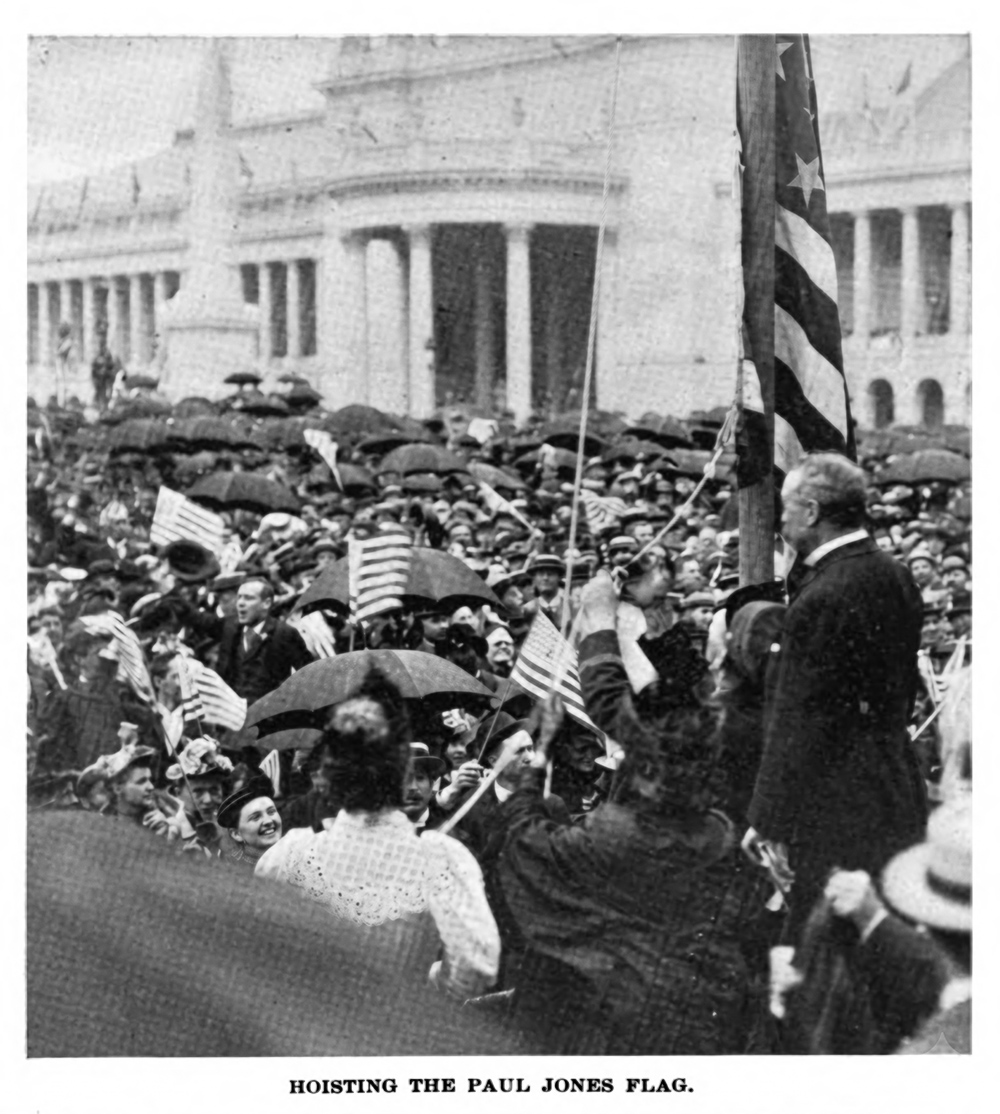
The Fourth of July crowd cheers wildly as the “John Paul Jones” flag is hoisted up the flagpole. [Image from Frank Leslie’s Illustrated Weekly July 20, 1893.]
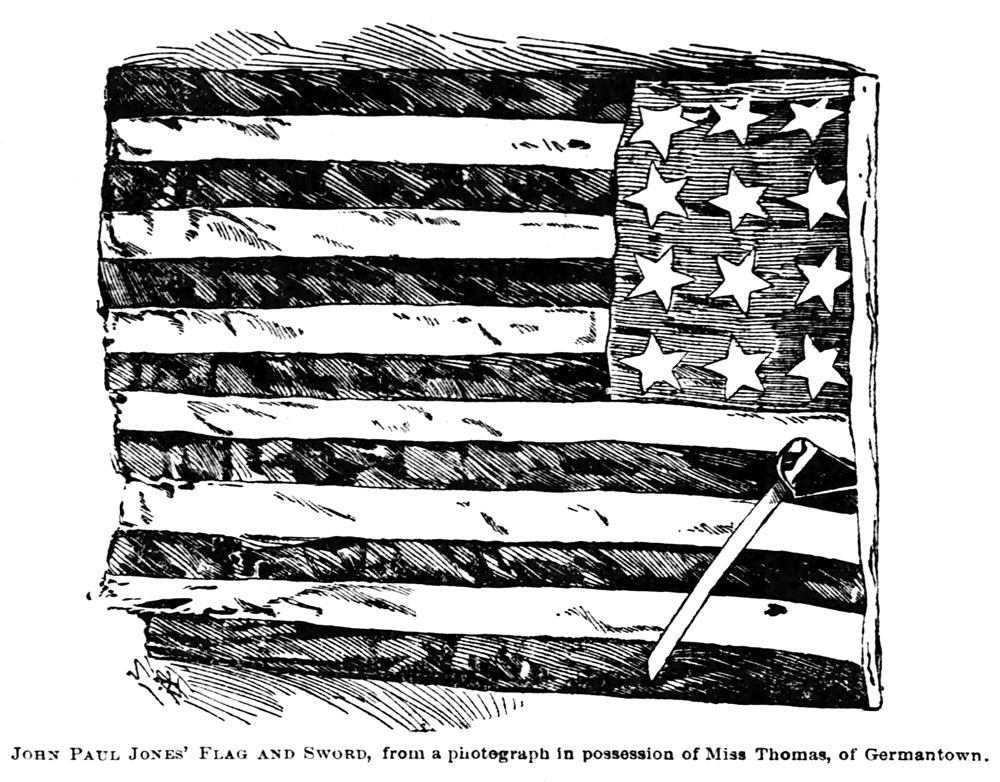
An illustration of the “John Paul Jones” flag. [Image from the Philadelphia Inquirer Sep. 3, 1893.]
The “John Paul Jones” flag after the Columbian Exposition
Mrs. Stafford held her treasured flag tightly during the Fourth of July morning ceremony and while moving about the fairgrounds throughout the day. “All the wealth of the Vanderbilts could not purchase my priceless emblem of light and liberty,” Mrs. Stafford had told a reporter for the Chicago Evening Post the day before. “After I am dead no one mortal will be able to claim this flag, for it will be willed to the Smithsonian Institution as a legacy for the United States of America.” She made her gift to the national museum before her death in 1903. Over the years, Mrs. Stafford cut away small strips for souvenirs; eventually more than half the flag was missing. On December 28, 1898, she presented her treasure to President William McKinley. The relic then “entered the sacred halls of the Smithsonian Institution,” write American flag collectors and scholars Boleslaw and Marie-Louise D’Otrange Mastai, “where it remained enshrined for about two decades before it was established as spurious.”
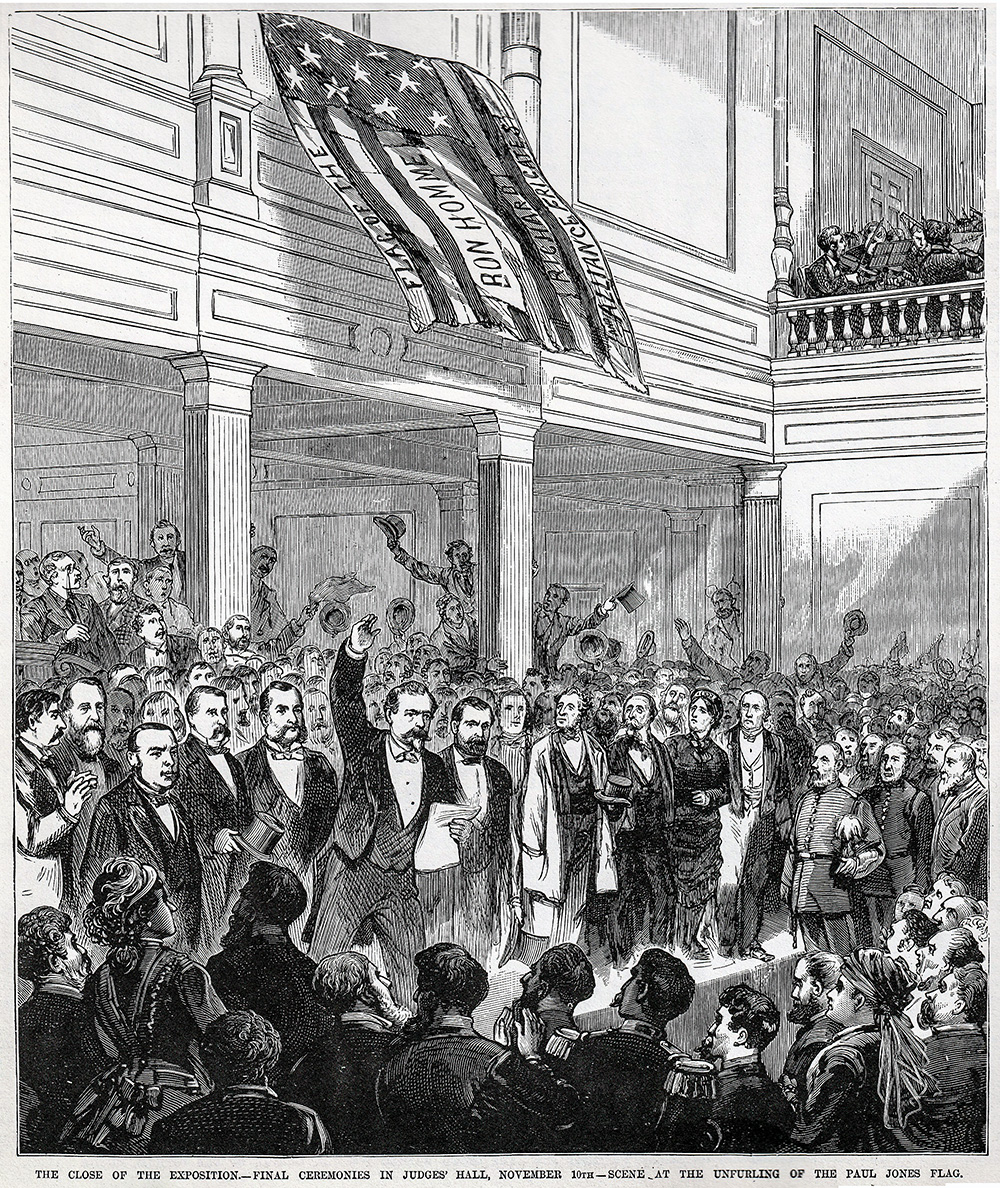
Mrs. Stafford’s “John Paul Jones” flag flew at the Closing Ceremonies of the 1876 Centennial Exposition. This illustration from Frank Leslie’s Historical Register of the United States Centennial Exposition, 1876 depicts a flag having 11 stripes and 11 stars and augmented by strips of cloth with wording.
The authenticity of Mrs. Stafford’s flag was called into question as early as 1876, when one commentator described her account of the flag’s history “a pleasant fiction,” because the battle description was historically inaccurate and no man named Stafford was listed among the officers of the vessel. “The falsity of the claim made by Stafford, relative to this flag which is now in the National Museum, is fully proved by [John Paul] Jones himself,” wrote Peleg D. Harrison in 1908. “The flag that was flying over the Richard during her battle with the Serapis is now at the bottom of the sea,” according to Jones’ journal. More recently, the Stafford’s story has been characterized as “historical romance” and a “hoax.” The so-called “Stafford flag”—which remains in the Smithsonian collection, though is not on view—has been “convincingly discredited,” asserts flag researcher Whitney Smith. Summarizing the criticism, journalist Chris Baer writes:
Many more historians weighed in afterwards, pointing out that the bunting material used in the flag didn’t exist in 1779. They also note that no crewman named “Stafford” appears on any of the ships’ papers. And the committee that supposedly awarded him the flag in 1784 had disbanded five years earlier. The flag only surfaced some 80 years later, during the Civil War, when Stafford’s daughter Sarah produced it to use in a fundraiser.
The cheers and tears greeting Mrs. Stafford’s flag during the 1893 World’s Fair Fourth of July celebration showed that her audience that day imbued the flag with historic sentiment, despite is murky origin.
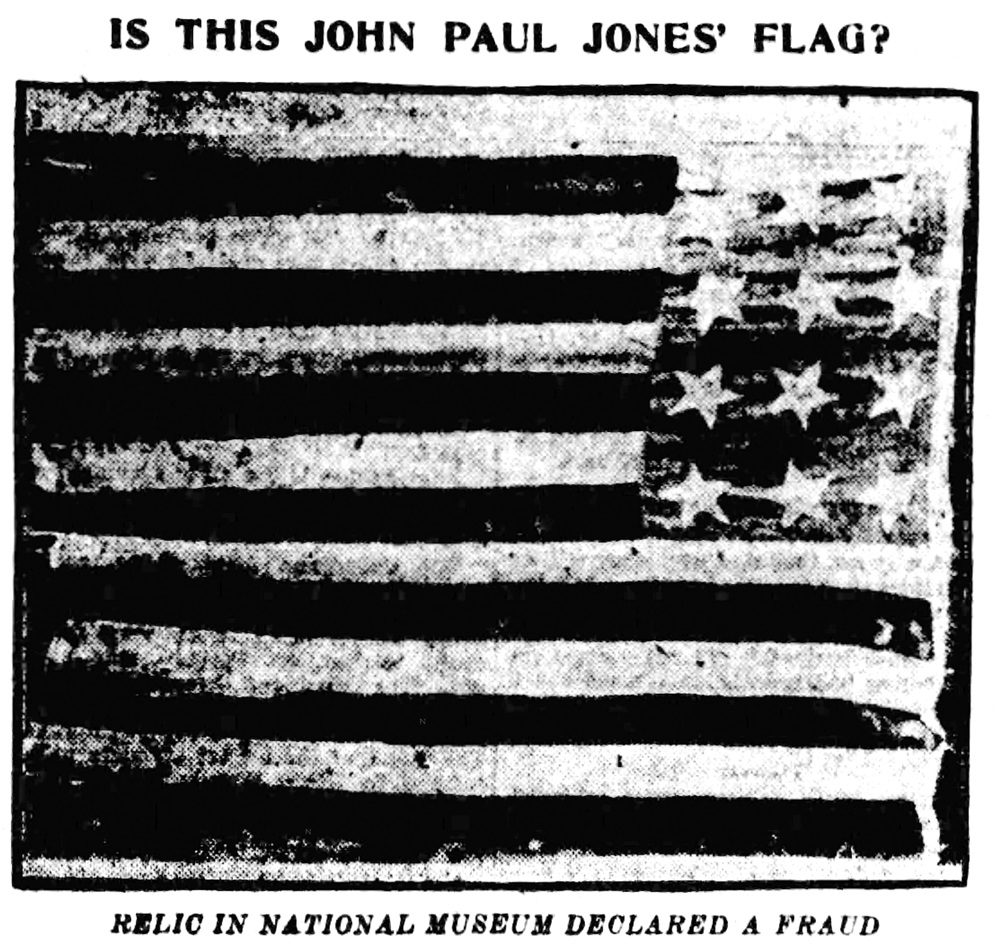
A photograph of the “John Paul Jones” flag on display at the Smithsonian c. 1910. By this time, many historians considered the item to be a “fraud.” [Image from the Baltimore Evening Sun Jun. 9, 1910.]
The Flag of Human Freedom and Universal Peace
In contrast to Mrs. Stafford’s flag, the “Flag of Human Freedom and Universal Peace” did not garner nearly as much attention at the 1893 World’s Fair or controversy since.[3] The banner represented the Universal Peace Union.[2] Their flag of human freedom, liberty, and peace—having the U.S. emblem inside a large field of white silk—was adopted at an 1891 gathering at Independence Hall in Philadelphia. Mrs. Mary Frost Ormsby then brought the banner to the International Peace Congress in Rome and the following year to Berne, Switzerland, but its first official flag-raising was at the Fourth of July celebration at the Columbian Exposition. Hoisting the banner were the hands of Mrs. Loulie (Lulu) M. Gordon of Georgia, representing the South, and Emily Nelson Ritchie McLean (Mrs. Donald McLean) of New York, representing the North. Having it fly above the White City “seemed an omen of the good time coming, when men shall cease to murder each other under the guise of war,” wrote the Oakland Enquirer. As the two flags were unfurled, Mr. C. E. Bredburg played “America” (“My Country ‘Tis of Thee”) on the chimes of Machinery Hall.
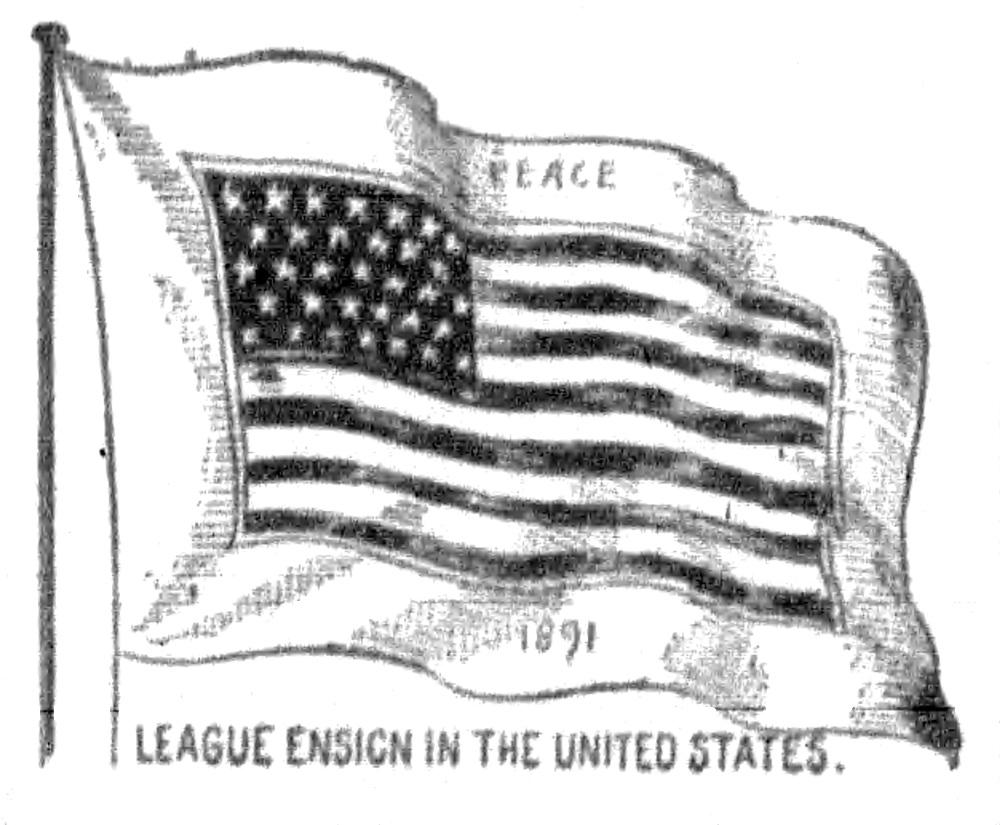
The Flag of Universal Peace was raised for the first time on July 4, 1893, at the World’s Fair. [Image from the Omaha Excelsior July 16, 1892.]
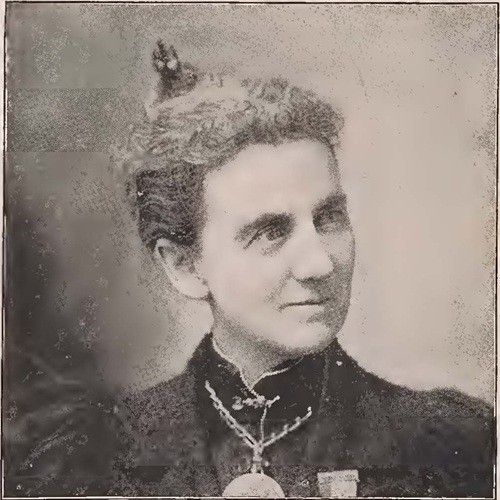
Mary Frost Ormsby of Rhode Island, a suffragist and peace advocate, represented the Universal Peace Union. [Image from The Cotton States and International Exposition and South, Illustrated (Illustrator Company, 1896).]
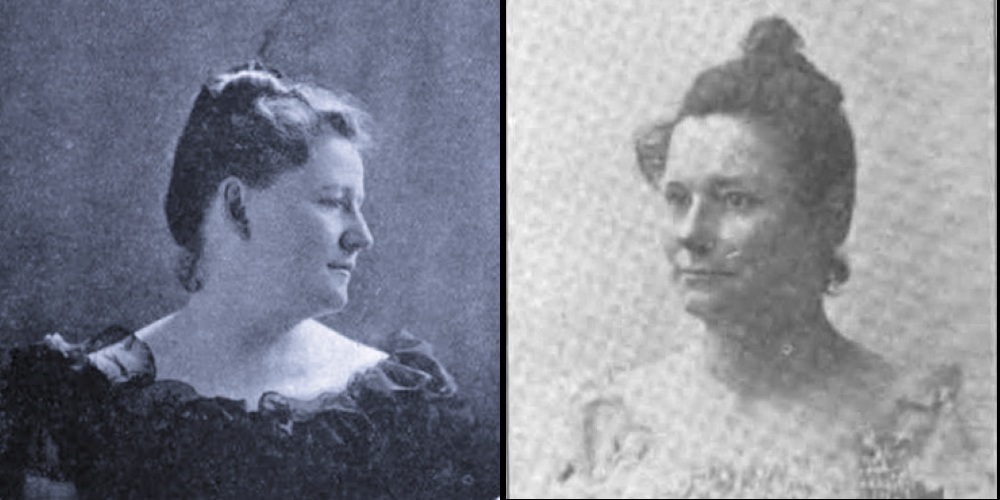
Mrs. Donald McLean (Emily Ritchie McLean) of New York (left) and Mrs. Lulu Gordon of Georgia (right) raised the “Flag of Universal Peace” at the World’s Fair. [Images from the Peterson Magazine July 1895 and the Midland Monthly March 1895.]
“The effect was sublime indeed”
As American flags of various designs flapped in the breeze, conductor Silas Pratt stood again and signaled to his mass chorus, which rose for “The Star-Spangled Banner.” The Chicago Times wrote that Mr. Pratt “beamed with excitement and perspired with the constant movement until big drops trickled over his tightly buttoned frock coat.” As the band thundered out the opening bars, “thousands of voices took up the refrain,” according to the Chicago Tribune. The song spread “across the still lagoons to the triumphal arch, where Columbus sat enthroned in his quadriga listening to the joyous music of the people whose path to greatness he paved.” A syndicated news story reported that “the effect was sublime indeed.”
When the chorus reached the refrain, Mayor Harrison shouted “Sing, sing, all sing!” to the audience, who waved flags and hats as they joined in. As the final notes died away, he crossed the platform and grasped Mrs. Stafford’s shaking hands, which still clung to the cord. “God bless you for this day,” he said as tears coursed down her face. A “Kodak fiend” came across the stage to take a photograph of Mrs. Stafford holding the ropes. The mayor also agreed to be shot.
Simultaneous with the Salute of the Flags and the singing of the “Star-Spangled Banner,” the Columbian Liberty Bell was rung for the first time. No one in Chicago heard it.
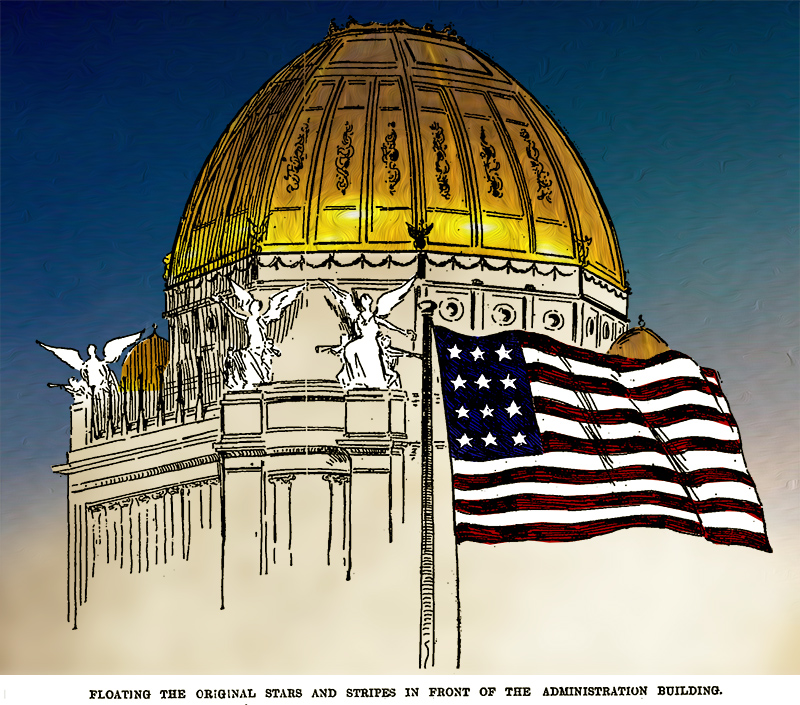
“Floating the original Stars and Stripes in front of the Administration Building” depicts the John Paul Jones flag flying at the Fair. [Image from the Chicago Tribune July 5, 1893; digitally colored.]
NOTES
[1] Georgia ratified the Articles of Confederation on July 24, 1778, becoming the tenth state to join the union.
[2] The Universal Peace Union was a pacifist organization founded in 1866 and disbanded in 1913. Notable members included social reformer Lucretia Mott, American Red Cross founder Clara Barton, and Nobel Peace Prize winner Frédéric Passy.
[3] The banner was called the “Flag of Human Freedom” and the “Flag of Universal Peace” interchangeably.
SOURCES
“All Honor the Nation” Chicago Times Jul. 5, 1893, p. 2.
Baer, Chris “This Was Then: Mother Stafford’s Flag, a Tale Made from Whole Cloth.” Martha’s Vineyard Times Mar. 25, 2020.
Bancroft, Hubert Howe The Book of the Fair. The Bancroft Company, 1893.
“Cheering the Flag” Chicago Herald Jul. 5, 1893, p. 9.
“Columbian Fourth of July” Review of Reviews Aug. 1893, p. 132.
“The Fair Fourth” Oakland (CA) Enquirer Jul. 12, 1893, p. 2.
“Glorious” Minneapolis Tribune Jul. 5, 1893, p. 1.
Harrison, Peleg D. The Stars and Stripes and Other American Flags. Little, Brown, and Co., 1908.
“His Birthday Party” Chicago Tribune Jul. 5, 1893, p. 1.
Hoyt, Ralph E. “From the World’s Fair” Los Angeles Evening Express Jul. 15, 1893, p. 3.
Mastai, Boleslaw; Mastai, Marie-Louise D’Otrange The Stars and the Stripes: The American Flag as Art and as History from the Birth of the Republic to the Present. Knopf, 1973.
“Old Glory’s Big Day” Chicago Evening Post Jul. 3, 1893, p. 1.
“Original Flag is in the City” Chicago Tribune Jul. 3, 1893, p. 1.
“Patriotism in Chicago” Philadelphia Times Jul. 5, 1893, p. 4.
“Paul Jones’s Flag” Camden (NJ) Daily Post Nov. 29, 1876, p. 1.
“Paul Jones’ Flag at the Centennial” Paris True Kentuckian Nov. 15, 1876, p. 2
Smith, Whitney The Flag Books of the United States. Morrow, 1970.

Leave A Comment