
[Continued from Part 2]
Across the city of Chicago on the eve of Independence Day, “the stillness of the night was broken by the cracking and booming of fireworks and the shouts of merrymakers,” reported the St. Louis Post-Dispatch. “Day broke to the accompaniment of a hundred guns from the gunboats in the lake, and the reverberations of the cannon awoke the sleepers.” One loud BOOM! for each of the colonies of 1776 reminded all that this was America’s birthday celebration at the World’s Fair.
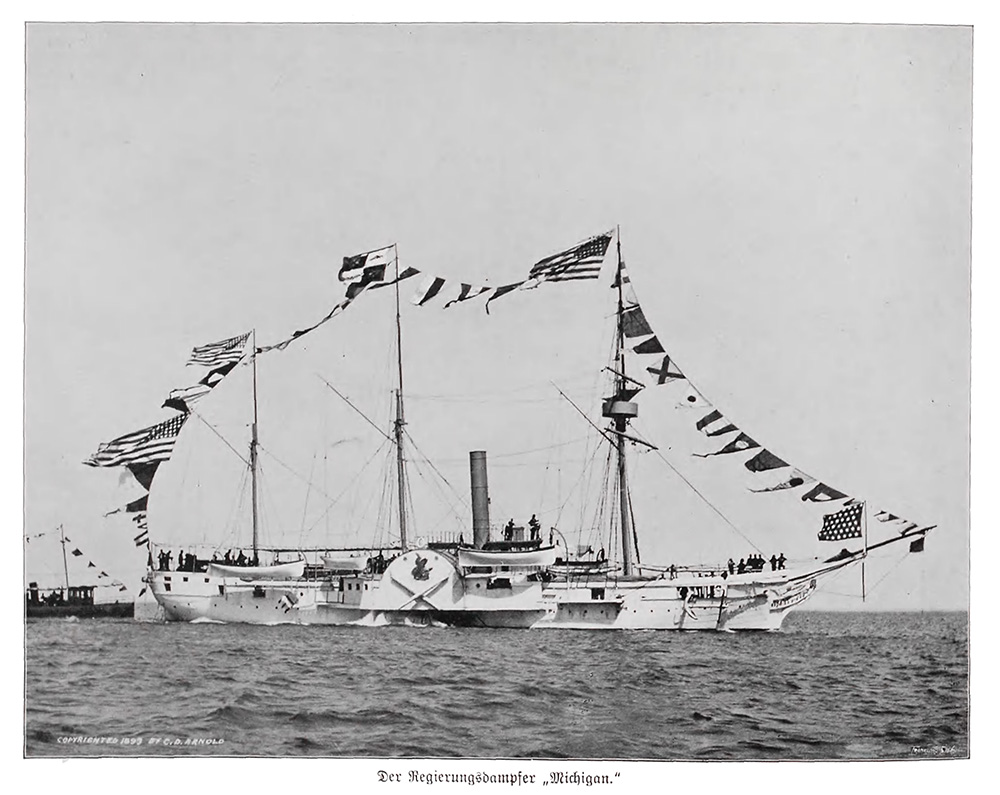
Cannons from the man-of-war USS Michigan sounded a thirteen-gun salute at dawn on July 4, 1893. [Image from Unsere Weltausstellung. Eine Beschreibung der Columbischen Weltausstellung in Chicago, 1893. Fred. Klein Co. 1894.]
“A peaceful army looking forward to welcome invasion”
As soon as the sun poked its nose over the edge of Lake Michigan, gunners aboard the man-of-war USS Michigan fired a thirteen-gun salute announcing the start of the day of celebration. The old warship—built in 1842 as the first iron-hull Navy ship—was anchored along the shoreline near the Manufactures and Liberal Arts Building. Commander Robert M. Berry ordered the vessel dressed in patriotic colors from stem to stern. “The army of workers knew that the day had come when they heard the boom of cannon across the waters from the Michigan,” reported the Chicago Record. “They were doubly certain when they heard an answering salute from the British battery on the shore, pealing its assurance that the strife of 1776 had been forgotten in the peaceful triumphs of 1893.” The reply came from the artillery of the English Military Tournament, which had moved onto the Exposition grounds the previous day.
Reverberations from the tumultuous blasts spread across the 686 acres of fairgrounds. A cool wind ran along the Midway Plaisance. The fickle morning sun fought against stubborn clouds, winning brief victories. Rays kissed the back of the golden Statue of the Republic and the top cars of the resting Ferris Wheel before yielding to a dark veil draped across the sky. Despite the threat of rain, Jackson Park burst with activity as it readied for the biggest day yet.
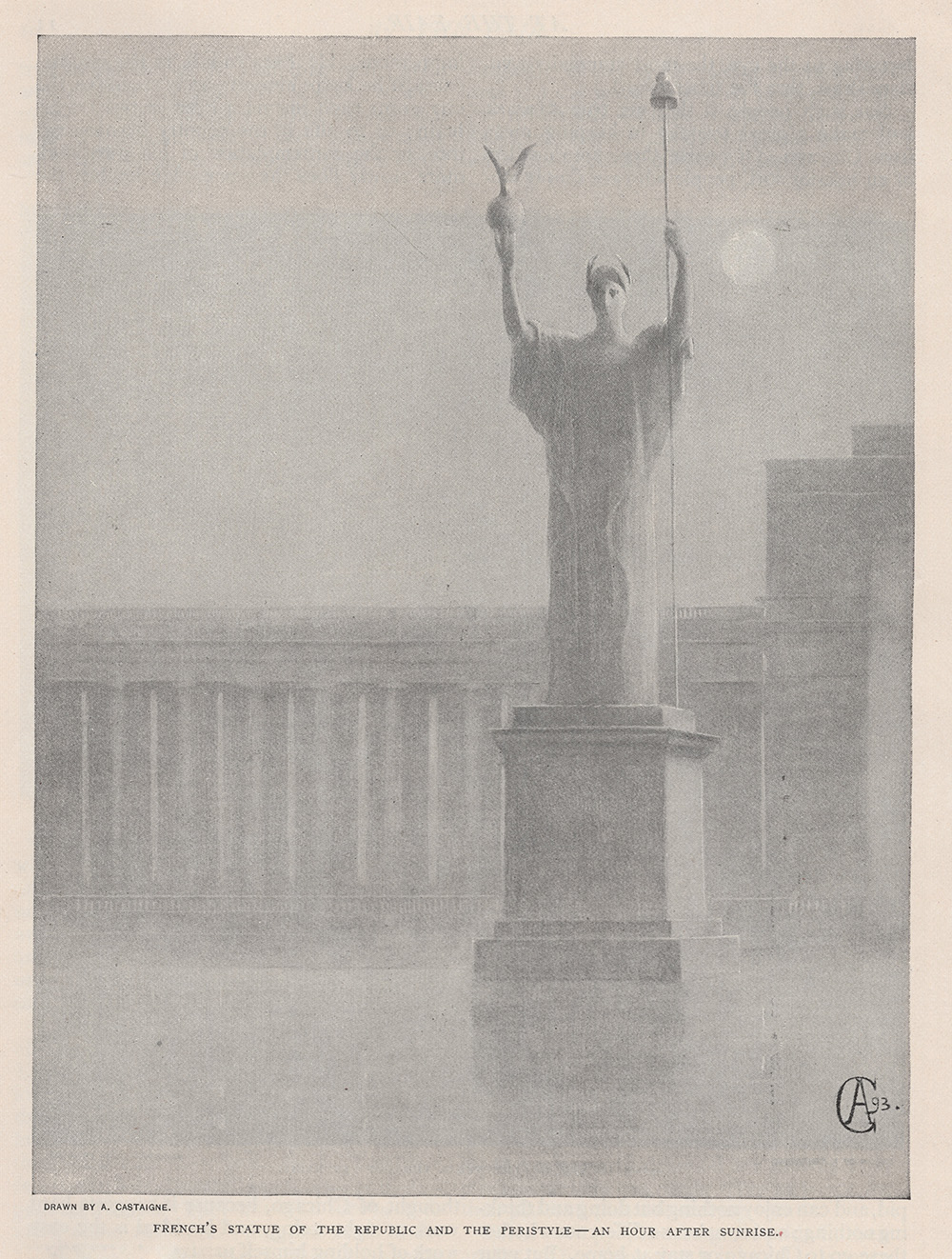
“French’s Statue of the Republic and the Peristyle—an Hour after Sunrise” by André Castaigne depicts morning in Jackson Park. [Image from The Century Magazine May 1893.]
The dawning of the day prophesied its glory. A hint of coming festivities came with the morning light as it shifted through rifts in the gray of the eastern sky. Occasional gleams of white radiance touched the spired domes and turrets of the lake palaces. A hum of busy men working with the cheer of expected rejoicing; a stir of life on the broad highways; the preparations of a peaceful army looking forward to welcome invasion—these betokened great things.
Workers—some arriving as early as 4 am—busied themselves with final tasks before the expected record-breaking crowd of visitors began arriving. Cameron describes the scene:
Agile men on every building began running up flags and shaking them to the wind. Gatekeepers took up the march for their stations. The state quarters were alive with preparations for the reception of visitors. The Plaisance awoke and bestirred itself to get in readiness for the feast of fraternal good-will.
Across the Columbian Exposition fairgrounds, buildings wore patriotic holiday attire. The great exhibition palaces boasted handsome decorations and a myriad of flags. Hardly a single ticket booth, comfort station, or rolling-chair station was not decked in red, white, and blue. The United States exhibits were especially festive, with the Government Building and battleship Illinois “giddy with the stars and stripes.” Foreign nations, too, entered into the spirit of the day by decorating their own national buildings and exhibit-hall pavilions with the American colors. Even the British exhibitors made a minimal effort to honor the rebels’ holiday.
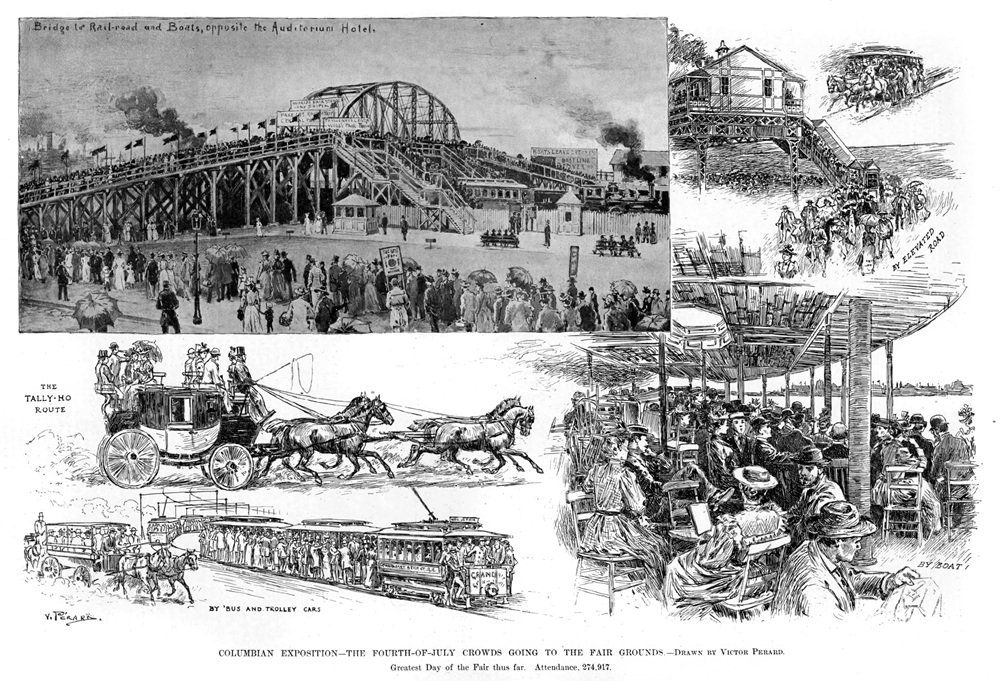
Crowds heading to the fairgrounds on the Fourth of July traveled by the elevated road, boat, bus, trolley, and tally-ho, as depicted in this drawing by Victor Semon Pérard for Harper’s Weekly July 15, 1893.
An endless stream of visitors
Visitors and excursion parties—all wanting to experience the Fourth at the Fair—had been arriving in Chicago from every direction for several days. To facilitate the demand, railroad companies offered discounted rates. Special trains loaded with sightseers pulled in from Milwaukee, Racine, Kenosha, Elgin, Rockford, Aurora, Joliet, Bloomington, Peoria, Springfield, Michigan City, and Indianapolis. On the morning of July 4th, out-of-towners joined a throng of locals to form a seemingly endless stream of patriots flowing into Jackson Park. They arrived by rail, road, and water.
Yellow express trains of the Illinois Central “chased each other down the lake shore with every car filled to the iron guards and the conductors hanging on the sides,” reported the Chicago Record. Trains of the Chicago elevated line pulled up to the fairground platform filled to capacity, requiring policemen to keep order in the crowd. Cable cars were loaded so thickly with riders that the grip men hardly had enough room to jerk the levers back and forth. The Christopher Columbus whaleback, gayly decorated with flags and bunting, dropped off boatload after boatload of passengers while The Music, the John A. Dix, and the City of Toledo steamships ran fifteen minutes apart. “So many people rode on the steamboats,” reported the Chicago Record, “that some young men tried to climb up on the smokestack so as to have some place to sit.”
By the time the fairground gates were thrown open at 7 am, an hour earlier than usual, pools of humanity had formed at each of the entrances. Rushing inward as fast as the attendants could grab their tickets, the crowds flooded the fairgrounds. The ceaseless click-click-click of the turnstiles counted entries at a furious pace all morning. Well over 100,000 people entered by noon, forcing many of the gate men to go without their lunches to keep up with their work.
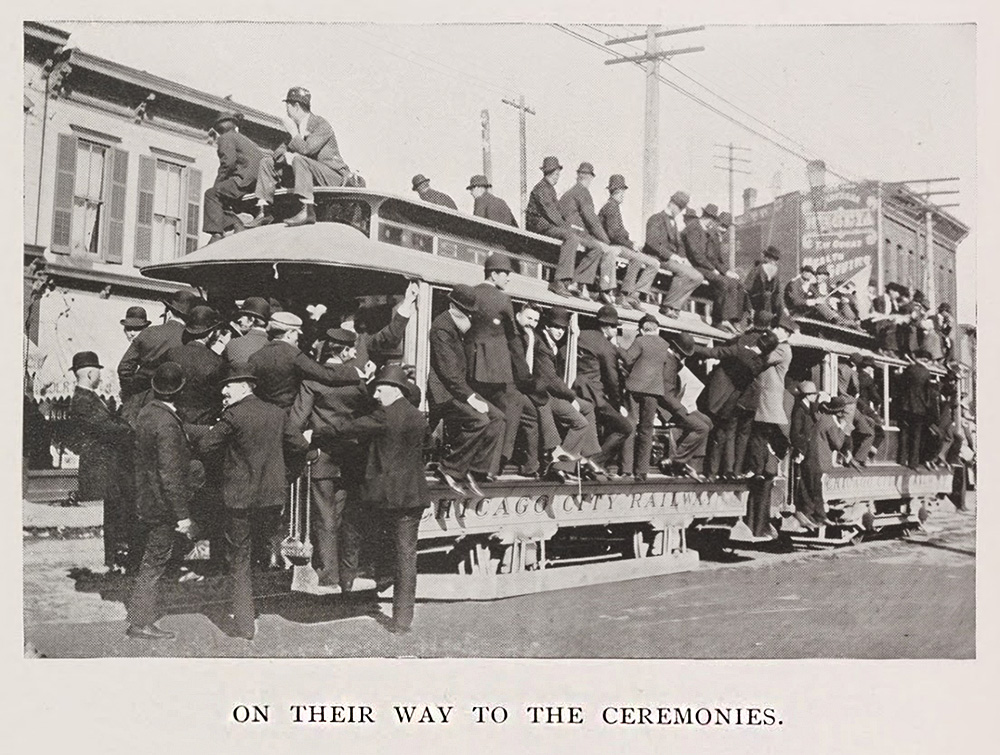
A Chicago cable car, overflowing with riders, heads to the Exposition fairgrounds. [Image from The Graphic History of the Fair. Graphic Co., 1894.]
The crowd gathers in Administration Plaza
The Independence Day program included celebrations scattered all around the fairgrounds and throughout the day, any one of which would have constituted a typical Fourth of July offering. The principal exercises were set to begin at 11 am in the large plaza bounded by the Administration Building on the east and the newly opened Terminal Station on the west, and from the Mines and Mining Building on the north to Machinery Hall on the south. This square, framed by four grand architectural structures, could hold nearly 200,000 people.[1]
Erected in front of Terminal Station and facing east was a large temporary stage for speakers and invited guests. The yellow-pine platform had a bank of seats behind it and a half circle of chairs on either side. Several early visitors found these open seats inviting and had to be shooed away by Columbian Guard.
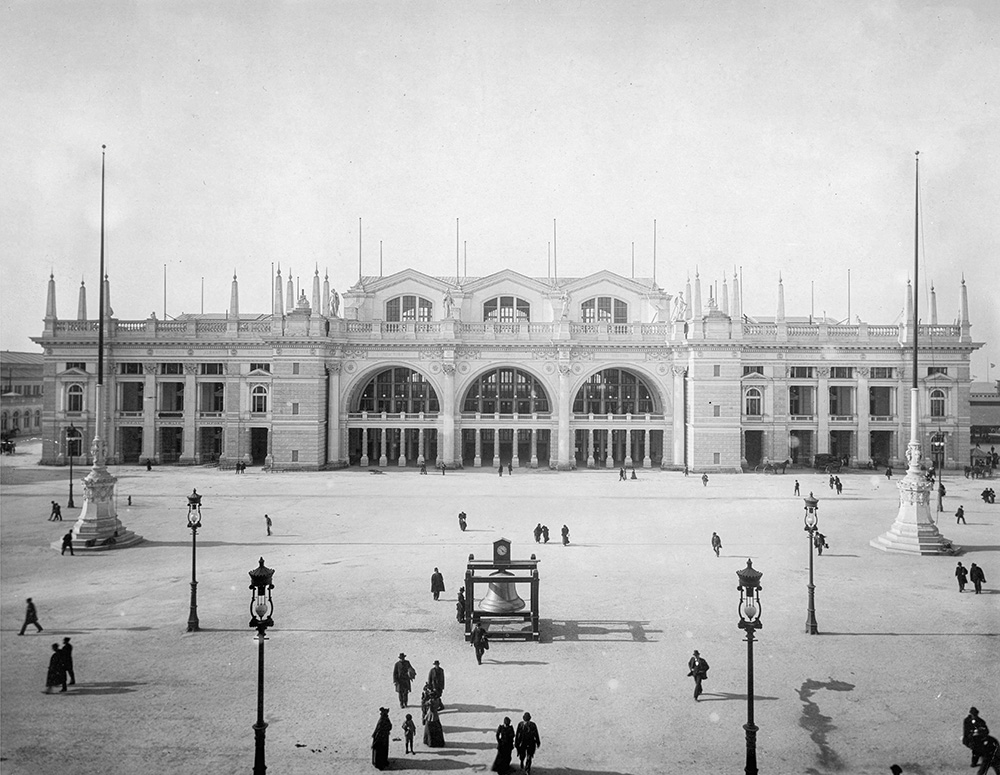
Terminal Station served as the railway depot for the Illinois Central Railroad and opened on Sunday, July 2, just in time for the largest attendance so far at the World’s Fair. This photograph by William Henry Jackson is from later in the season and shows the Columbian Liberty Bell in the foreground. [Image from Denver Public Library Special Collections, Call Number WHJ-10422.]
The startling information comes
From far-off Buzzard’s Bay
That Grover with his fishing rod
Has hied himself away.
Nobody knows where Grover is,
he left no word behind;
but it is thought he’s catching fish
and gaining peace of mind.
In the center of the platform, just behind the speakers’ stand, stood a table draped with an American flag. Its purpose was to serve as a desk for Director-General George R. Davis, presiding officer of the exercises, and also as a telegraph station. A wire attached to a Morse key ran from here to the loggia of Terminal Station, thence to the Western Union offices in Pavilion A of the Administration Building. For July 4th, the World’s Fair in Chicago had a direct connection to Troy, New York, 700 miles away.
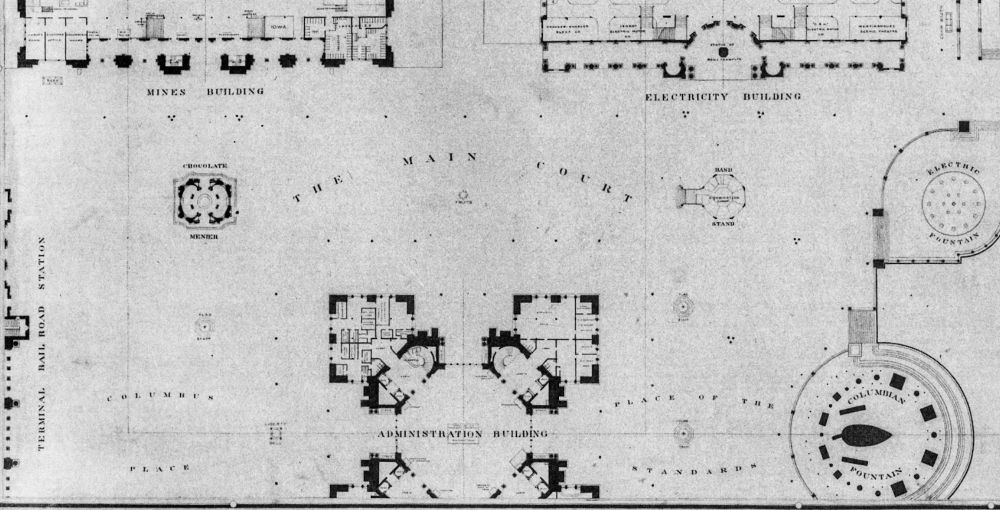
The plaza west of the Administration Building (officially named “Columbus Place” later that summer) was the site of the morning exercises on the Fourth of July. [Image from Burnham, Daniel H. Final Official Report of the Director of Works of the World’s Columbian Exposition, June 1894.]
“A tidy fringe of humanity”
Celebrants began gathering in the Administration Plaza as early as 8 am, three hours before the ceremony was set to begin. Some brought camp stools of their own or rented little, red folding chairs on site. Workers had filled a portion of the plaza with chairs and benches, and all were occupied quickly. A horse-drawn cart arrived later carrying another load of chairs for visitors to grab. Spectators continued to arrive in swarms, packed the square as tightly as they had for Opening Day on the east side of the Administration Building. By 10 am almost every available spot was occupied, and by 11 am not another person could fit. Still, the crowd was in constant motion. “As one stream of sightseers came into the plaza, another flowed away,” reported the Chicago Times.
Spectators filled every window and hung from projecting balconies overlooking the plaza. “A tidy fringe of humanity appeared on the rooftops,” noted the Chicago Times. As observed from the windows of the Administration Building, the colorful straw hats “looked like daisies in a strangely dark meadow.” As dark clouds threatened rain, parasols and umbrellas began opening, making the audience look like a giant bale of turtles. Visitors “climbed into the pillared loggias, out to the edges of the projecting eaves, and made ribbons of black around the golden-ribbed master dome” of the Administration Building, wrote the Chicago Herald. “They sat at the feet of the tall Apollos and clung to the high knees of the staff Indians.” A sea of faces extended all the way east to the shores of the Grand Basin.
As visitors passed by Terminal Station, many stopped to listen to several bands rehearsing for the upcoming ceremony.[2] The energetic forty-six-year-old musical director for the morning ceremony mounted the steps that led to the galleries inside Terminal Station. Using a roll of newspapers as a baton, he conducted the mass band of some 180 players in “Doxology,” “Red, White and Blue,” “The Star-Spangled Banner,” and “America” to rousing applause. When satisfied with the rehearsal, the conductor went to round up his mass chorus for their upcoming performance.
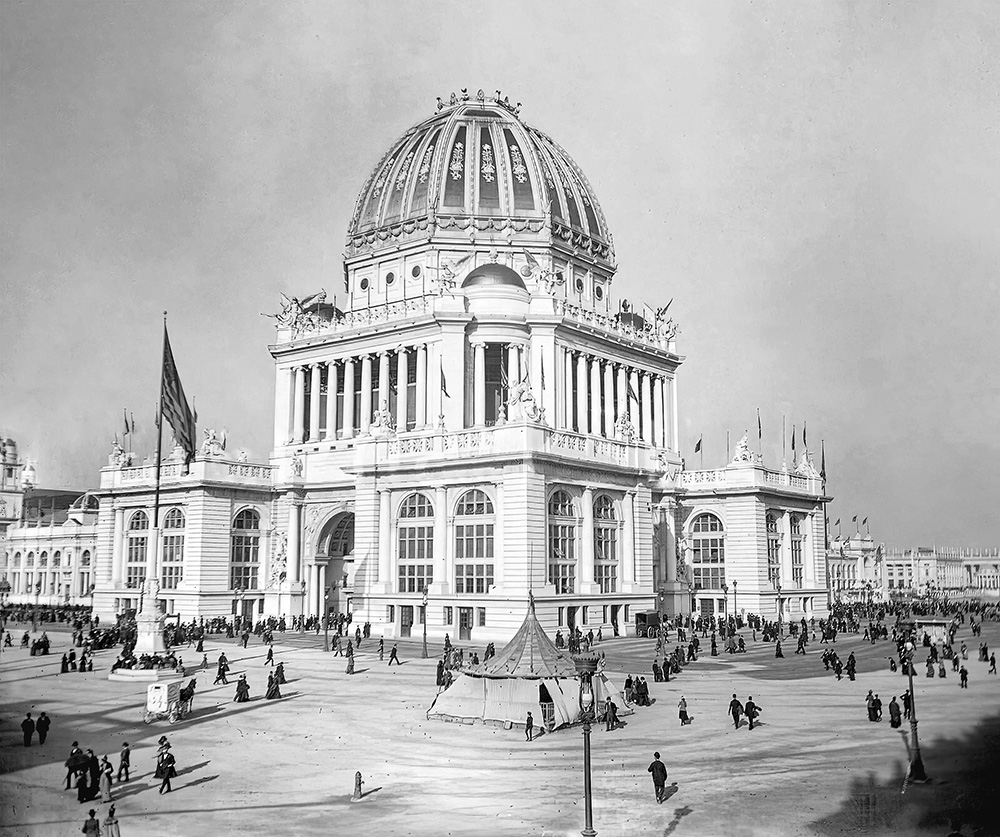
The Fourth of July exercises were held on the west side of the Administration Building. [Image from magic lantern slide, private collection.]
“A hard man to please”
One of the most ambitious plans for the Fourth of July ceremony was the formation of a mass chorus. Instead of using the Columbian Chorus, organized and conducted by William Tomlins for the Opening Day ceremony, the Exposition hired a composer and conductor from New York to organize a new chorus of volunteers. Silas G. Pratt (1846–1916) was appointed as director of the entire morning ceremony. Mr. Pratt previously served as the director of Chicago’s Opera Festival Chorus and directed a 10,000-voice chorus at New York’s Madison Square Garden in 1892. Pratt “gained a reputation for his grandiose ideas and audacious publicity stunts,” writes music historian E. Douglas Bomberger.
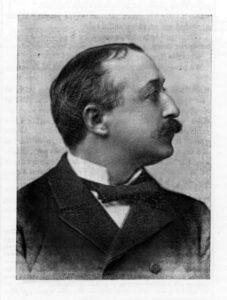
Silas J. Pratt directed the musical program for the Fourth of July ceremony and conducted the mass chorus and united bands. [Image from the Musical Courier Sep. 17, 1890.]
Making the Fourth of July performance more difficult was the dramatic staging of the singers. The ensemble was split into four sections—positioned around the plaza in the loggias of Machinery Hall, the Mines Building, and the Terminal Station—each with a section leader. [3] The four sections were “connected by means of electricity, so that Mr. Pratt may indicate the exact time to all alike,” reported the Inter Ocean. The Tribune quipped that this technical arrangement would work “provided that the dynamos are in running order and the current is continuous.”
The audience of tens of thousands of visitors was expected to participate in the singing, too. “The music will be one of the grandest features of the celebration,” announced the Chicago Evening Post. “The most inspiring American anthems will be sung, and everyone who has a voice that can be heard is expected to join in and swell the praise.” A printed sheet of song lyrics were distributed to assist the lay singers.[4] “The man with big packages of leaflets on which the music for the day was printed received a cordial welcome from the crowd,” reported the Tribune, “and his wares were quickly distributed, fluttering their way to the outer circle of the mass of humanity.”
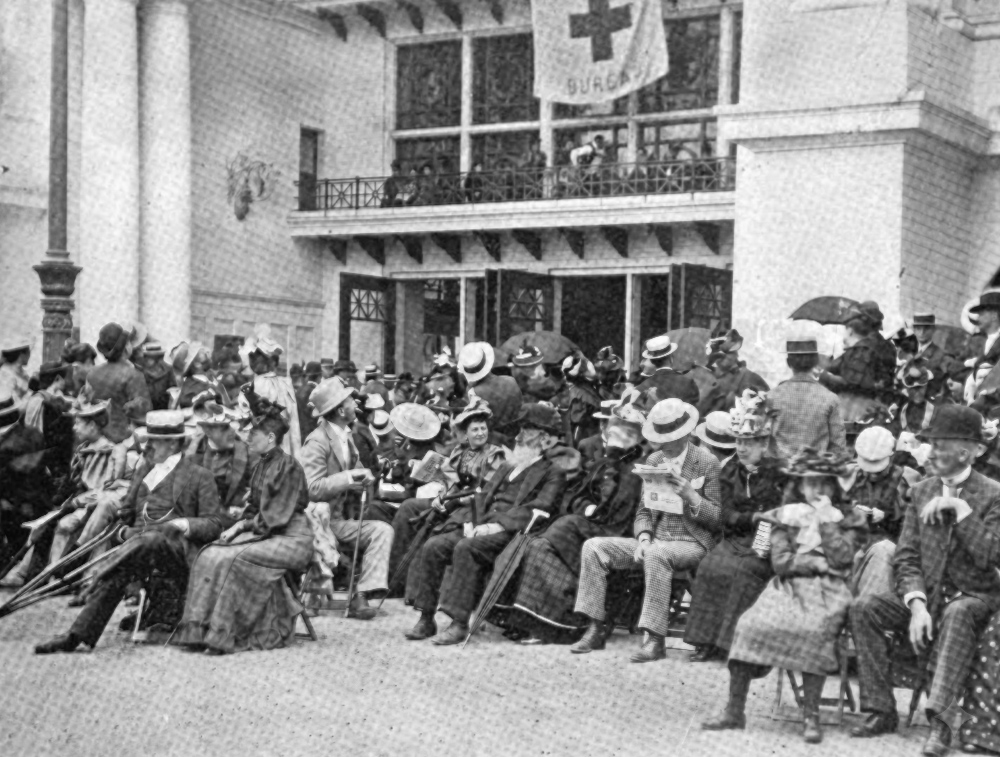
Everyone in the audience was an unofficial chorister on the Fourth of July. [Image from Frank Leslie’s Weekly Jul. 20, 1893.]
“Something of a sensation”
Patriotic songs united the crowd, as did patriotic attire. “Rich and poor alike mingled in genuine democratic fashion,” observed the Chicago Herald. Fairgoers of all backgrounds proudly wore festive dress and accessories. The Chicago Inter Ocean noted that:
Every visitor at the Fair, almost without exception, wore a flag somewhere about him. The men had handkerchiefs made of the national colors, else they wore flags pinned to the lapels of their coats. … The women tied their hair with red, white and blue ribbons or they had a knot of it pinned to their dress. The children carried flags and their hats, their hands, and their pockets.
Journalist Teresa Dean described one woman who “wore a skirt waist made of red, white and blue silk, with forty-four stars on the collar, and cuffs embroidered with white, [and] dressed her little girl and boy in the colors of the nation.” People representing countries and cultures around the world also sported the host nation’s flag, adding to an endless river of red, white, and blue. Families came prepared with lunch baskets, umbrellas, and wraps. “The national flag seemed to be in a good many lunch baskets with the cold chicken,” observed the Chicago Times, “and it came out ahead of the comestibles.” The newspaper also reported that one young girl (perhaps the same one spotted by Dean?) “created something of a sensation by appearing with the stars and stripes made into a mighty pretty bodice, and there were dozens who carried small flags and waved them long before the bannerets distributed by Ald. Madden began to flutter everywhere.”
Alderman Madden had a vision. His municipal Fourth of July Committee planned to give everyone entering Jackson Park a small American flag, a gift from the city of Chicago. He imagined that 100,000 voices singing during the finale would be joined by 100,000 flags waving in response to the line “Oh, say, does that star-spangled banner yet wave.” Madden’s dream fell a bit short. Once he arrived on stage, his team of young men unwrapped bundles of small flags and began tossing them out over the crowd. That action stirred the masses for the first time. Everyone wanted a flag, but there were not nearly enough to go around—only 2000 could be had! “Hundreds of hands were eagerly outstretched for the bright bits of color,” wrote the Chicago Tribune, “and once obtained waved them enthusiastically and untiringly until the rain fell and a black roof of umbrellas spread over the patriots like a pall.”
Observers noted that only one in ten received a miniature “Old Glory,” indicating that a crowd of some 20,000 had gathered in the plaza for the Fourth of July ceremony. By 11 am, chorus singers had gathered in their appointed places, and the united band was stationed to the right of the platform. City and Exposition officials with their honored guests were slow to arrive on stage. When a tall official sporting a bushy Van Dyke beard eventually stepped to the speakers’ stand, spectators strained to hear his opening announcement.
[Continued in Part 4]
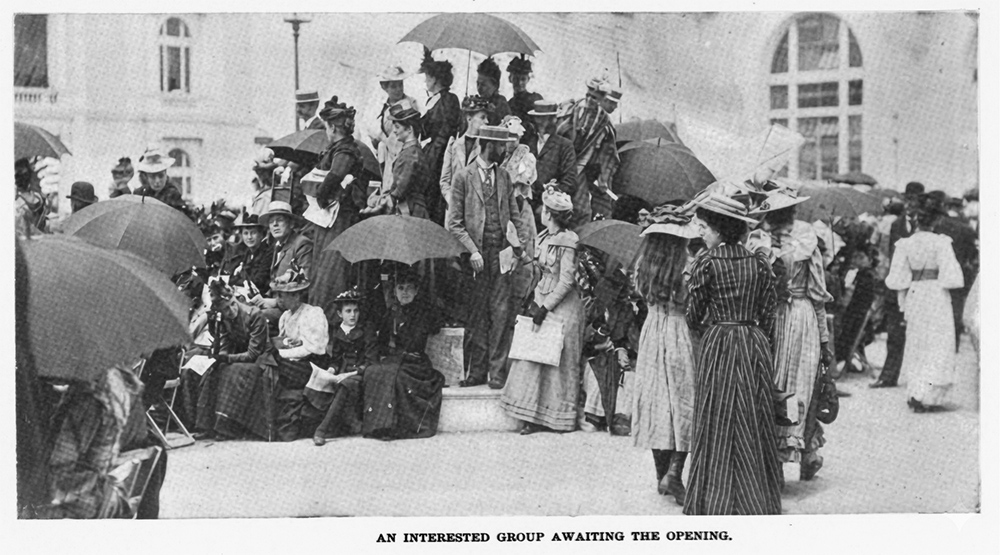
An interested group awaiting the opening of the Fourth of July exercises as the united band, mass chorus, and platform party assemble in the Administration Plaza. [Image from Frank Leslie’s Weekly Jul. 20, 1893.]
NOTES
[1] This plaza was named “Columbus Place” on the official Exposition map prepared in September 1893, but that name was rarely used to describe it. On the north end of the plaza stood a small and beautiful Chocolate Menier building. As tens of thousands of spectators packed the plaza, the New York chocolatier may have had record sales if the store was open on July 4!
[2] Newspapers gave conflicting reports of exactly which musical groups constituted the band collective. The Chicago Tribune [“World’s Fair Fourth”] reported that the Second Regiment Band (having arrived on the fairgrounds after escorting the city officials and visiting guests of honor) joined with the Pullman Band and the Thompson Band. The Chicago Times [“Fair’s Best Day”] reported that the Second Regiment had joined with Michael Brand’s Cincinnati Band and Adolph Liesegang’s Chicago Band.
[3] Assisting Prof. Silas Pratt was J. H. Howenstein, director of the First Congregational Choral Union; Warren C. Coffin, a Chicago vocal teacher and performer; Prof. H. S. Perkins, president of the Illinois Music Teachers’ Association and secretary of the Music Teachers’ National Association; F. M. Hicks; and J. Fred Roth, a Catholic newspaper publisher.
[4] Surviving printed sheets of song lyrics include the words for “Doxology,” three verses and refrain of the “Star-Spangled Banner,” two verses and chorus of “Home, Sweet Home,” two verses and chorus of “Columbia, the Gem of the Ocean,” two verses and chorus of “Old Folks at Home” (“Swanee”) and “America” (“My Country ’Tis of Thee”). The leaflets were provided to attendees courtesy of Lyon & Healy, a major musical instrument manufacturer in Chicago.
SOURCES
“Biggest Day of All” Chicago Herald Jul. 5, 1893, p. 2.
Bomberger, E. Douglas “A Tidal Wave of Encouragement”: American Composers’ Concerts in the Gilded Age. Praeger, 2001.
Cameron, William E. The World’s Fair Being a Pictorial History of the Columbian Exposition. P.D. Farrell, 1893.
“Cheering the Flag” Chicago Herald Jul. 5, 1893, p. 9.
Dean, Teresa “White City Chips” Chicago Inter Ocean Jul 6, 1893, p. 7.
“Fair’s Best Day” Chicago Times Jul. 5, 1893, p. 1.
“For a Grand Chorus” Chicago Inter Ocean Jun. 24, 1893, p. 9.
“The Glorious Fourth” Chicago Inter Ocean Jul. 5, 1893, p. 1.
“His Birthday Party” Chicago Tribune Jul. 5, 1893, p. 1.
“Jubilee of Liberty” Chicago Inter Ocean Jul. 2, 1893, p. 2.
“Last Rehearsal of the Chorus” Chicago Tribune Jul. 4, 1893, p. 2.
“Old Glory” St. Louis Post-Dispatch Jul. 4, 1893, pp. 1–2.
“Old Glory’s Big Day” Chicago Evening Post Jul. 3, 1893, p. 1.
“Plenty of Music for the Masses” Chicago Tribune Jul. 5, 1893, p. 10.
“President Cleveland Safe” Chicago Inter Ocean Jul. 5, 1893, p. 1.
“Songs for the Day” Chicago Inter Ocean Jul. 3, 1893, p. 1.
“Those who have been clamoring…” Chicago Tribune Jun. 28, 1893, p. 12.
“Will Join in a Patriotic Chorus” Chicago Tribune Jul. 3, 1893, p. 1.
“World’s Fair Fourth” Chicago Record Jul. 5, 1893, p. 1.

Leave A Comment