
The death of one of America’s great inventors on November 22, 1896, came as a surprise to many. George Washington Gale Ferris, Jr. succumbed to complications due to typhoid fever at the tragically young age of thirty-seven. His eponymous attraction debuted at the 1893 World’s Columbian Exposition in Chicago and helped lift the Exposition into financial success.
Despite the great popularity of his rotating invention, Mr. Ferris died under crushing debt in 1896. His original Ferris Wheel, although still carrying riders at its new home on Chicago’s North Side, had gone into receivership only days before his death. Some felt that the seizure of Mr. Ferris’ asset may have contributed to his rapidly failing health. The Chicago Record reported that Mr. Ferris had been admitted to Mercy Hospital in Pittsburgh only two days earlier and that “the attending physicians say his system was greatly run down by overwork.”

George Washington Gale Ferris, Jr., originator of the great Ferris Wheel on Midway Plaisance of the 1893 World’s Fair in Chicago. [Image from Smith, Frank H. Art, History, Midway Plaisance and World’s Columbian Exposition. Foster Press, 1893.]
One of the greatest wonders of the century
In the midst of reporting on George Ferris’ financial hardship, newspapers shifted tone to eulogize the great inventor in the days after his death. The Chicago Tribune (Nov. 24, 1893) praised Ferris’ “many noteworthy achievements” as an engineer:
“The greatest of all was the mechanical triumph which has become identified with the enduring fame of the Columbian Exposition. Mere mention of the Ferris wheel serves to bring back to memory all of the glories of the White City, for this revolving wonder was not surpassed in interest by any other of the myriad of attractions. It stood like a gigantic sentinel at the door of fairyland, the awe-inspiring prototype of the marvels beyond.”
“In 1892 Mr. Ferris conceived the idea of the wonderful Ferris wheel that has attracted the attention of all the world,” lauded the Chicago Chronicle, “and which will go down to history as one of the greatest wonders of the century.” The Pittsburgh Commercial Gazette wrote:
“Of the tens of millions of people who visited the World’s Fair in 1893, probably not one will fail to recall that most striking feature of the midway, the Ferris wheel. Millions rode upon it, and from its cars, high above the white palaces that adorned the lake shore, high above the loftiest towers and buildings of the city, obtained a view of the level landscape that could be had nowhere else. The wheel carried thousands daily, and during all the months that the fair lasted, there was never an accident or a mishap. The giant wheel did its work steadily and well, and grandly, as became its size.”
Ferris’ hometown newspaper continued with a recount of the wheel’s origin story:
“In 1892 Mr. Ferris visited Chicago, mostly out of curiosity concerning the probable lines of the World’s Fair developments, and its opportunities, and while there conceived what was then pronounced by leading engineers to be a flighty notion, impractical and dangerous, regarding the construction of an immense wheel 400 feet in diameter [the Ferris Wheel as constructed was only 250 feet in diameter], to rival the Eiffel Tower of Paris, as an attraction for the fair. He drew a rough outline of the structure and commenced to figure on the work. It took him months, and during that time he talked of nothing else. He was laughed at and his friends advised him to drop such a notion, but he persisted and his success is now known to all the world.”
Other news outlets also mentioned professional skepticism about the viability of Mr. Ferris’ design. The Chicago Tribune noted that “he consulted the best engineers of the country, but they shook their heads and said the wheel would not revolve. Ferris had faith in his idea and worked it out.” A report in the Chicago Inter Ocean asserted that Mr. Ferris “was recognized as a mechanical genius of erratic ideas. He was bold in his innovations,” but also noted that, regarding the great wheel, “his partners advised against it, and the leading engineers of the country laughed at him.”
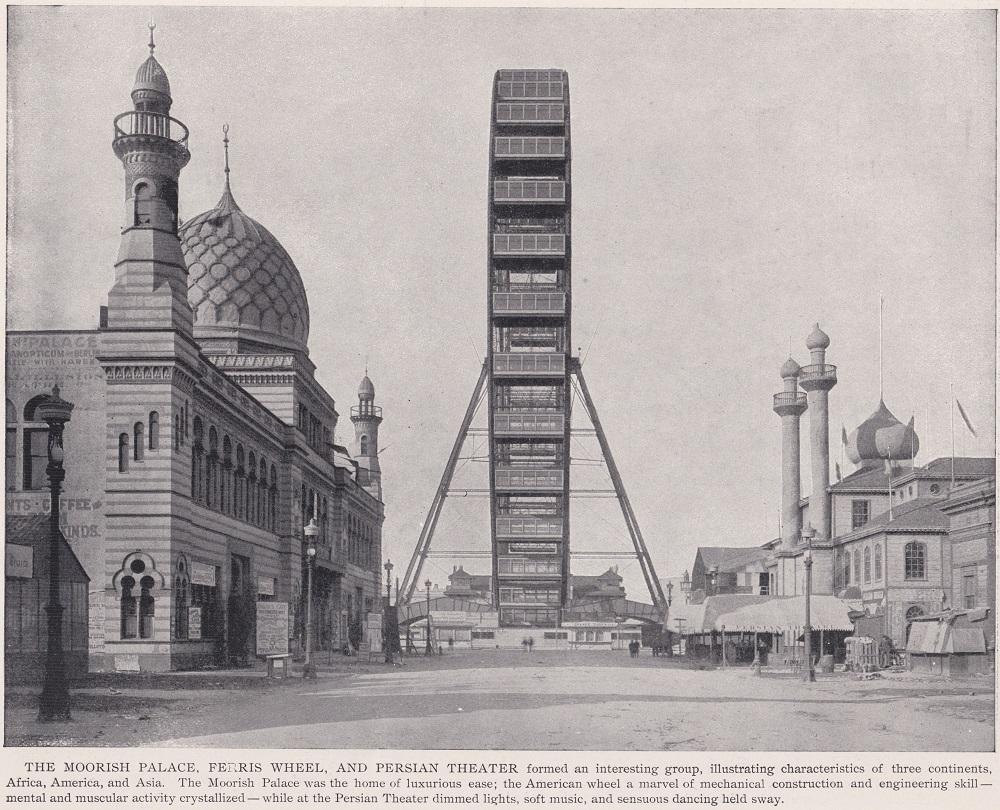
The great Ferris Wheel “stood like a gigantic sentinel at the door of fairyland” on the Midway. [Image from The Columbian Exposition Album: Containing Views of the Grounds, Main and State Buildings, Statuary, Architectural Details, Interiors, Midway Plaisance Scenes, and Other Interesting Objects Which Had Place at the World’s Columbian Exposition, Chicago, 1893. Rand, McNally & Co., 1893.]
Something stupendous
A sharply different first-hand account came from the Chicago Chronicle (Nov. 24, 1896), which ran this recollection of Ernest Graham, who worked as the Superintendent of Buildings for the Exposition:
“I remember distinctly of Mr. Ferris coming into the office with the complete plans of the great wheel. I was connected with the Columbian Exposition construction department and Mr. Ferris came to us with his plans in the fall of ’92. Before his appearance absolutely nothing was known of his plans. We had known he was working on something stupendous in the matter of an engineering feat, but not an inkling of its nature could be secured. It had begun to look as if the exposition would have no high structure. A steel tower of enormous height had been suggested, but had not materialized.
“With the coming of the plans for this great wheel everyone felt a relief, for this was certainly an engineering marvel. We did not doubt the practicability of Mr. Ferris’ plans, for his ability as an engineering expert was beyond question. The plans were approved and then came the location of the huge thing. Mr. Ferris wanted it placed between the Woman’s Building and the Intramural Railroad, but this would spoil the general plan of the esplanade. Its ultimate location was on the Midway. The story of its erection and the part it played in the great exposition are too well known to need retelling. It was deservedly a financial success, and, being viewed daily by thousands, it told a continual story of the skill of American engineers.”
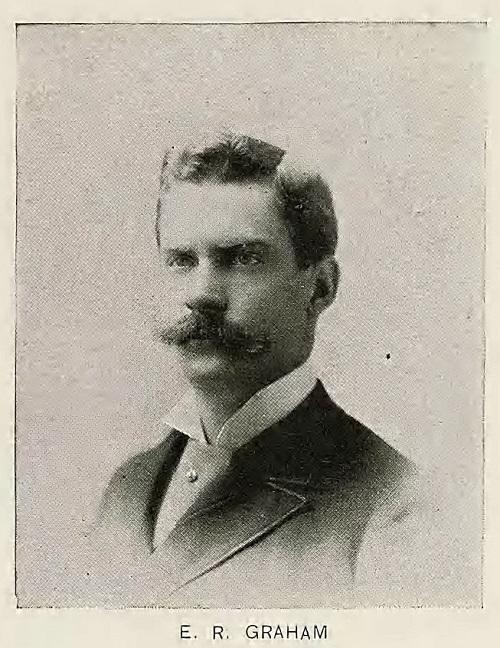
Ernest R. Graham, Superintendent of Buildings for the World’s Columbian Exposition. [Image from Bancroft, Hubert Howe The Book of the Fair. The Bancroft Company, 1893.]
Infinite joy
The original Ferris Wheel on the Midway Plaisance sold nearly 1.5 million tickets (many of which, surely, were repeat riders), bringing in $726,805.50 in gross income. No other attraction came close to such earnings, making it the most lucrative concession at the 1893 World’s Fair. Mr. Ferris, however, had accumulated debt while erecting the wheel, and the Ferris Wheel Park on Chicago’s Nort Side had failed to recoup enough by 1896. Mr. Ferris “has realized the traditional fate of the inventor, and died a poor man,” observed the Chicago Tribune (Nov. 24, 1893). “The genius had brought wealth to others was not proof against erratic outbursts which swallowed up in unsuccessful ventures the money earned by his great achievements.” The Logansport Pharos commented on the rise and fall of Mr. Ferris:
“The Ferris wheel probably gives as much healthful and innocent pleasure to the minute to men, women and children has any invention ever made. There is an infinite joy, a serene happiness in riding slowly and majestically through the air above all the smoke, dust, clamor and fretting at the Earth’s surface, above the tops of five and six story buildings, and taking in long breaths of the air as the Almighty made it. We may hope that the enterprise will recover from its temporary embarrassment and that the great wheel will still roll on, serene and prosperous.”
The Chicago Tribune (Nov. 24, 1893) claimed that Mr. Ferris “left a lasting monument to his genius and courage in the giant wheel that bears his name.” His original monument, however, would not last. After its third and final stint, at the 1904 Louisiana Purchase Exposition in St. Louis, the original Ferris Wheel was demolished for scrap iron on May 11, 1906. For a time it seemed as though Ferris’s name, too, might become lost. After his wheel was acquired at auction and moved to St. Louis, it operated as the “Observation Wheel.” Furthermore, the imitations of his invention that began spreading across Europe and around the world also did not bear his name. Today, however, most people know them as Ferris Wheels—the lasting memorial to the ingenious inventor.

Fifty-one feet taller that George Ferris’ wheel in Chicago, “La Grande Roue” in Paris was built for the 1900 Exposition Universelle. [Image from the Library of Congress Digital Collection.]
Footnote
One of the strangest twists in the story of George Washington Gale Ferris, Jr. deals with his bodily remains. Mr. Ferris had authorized cremation, and a Pittsburgh mortician executed this request. Ferris’ ashes remained unclaimed by family and eventually were transferred to a woman who worked for one of Ferris’ companies. Where she took the ashes and what happened to them remains a mystery. Whether the remains of George Ferris were interred, scattered, or simply lost, is unknown, but the lasting memorial to the great inventor are the multitude copies of his eponymous invention scattered around the globe.
SOURCES
“Death of G. W. G. Ferris” Chicago Record Nov. 23, 1893, p. 2.
“Death of G. W. G. Ferris” Chicago Tribune Nov. 24, 1893, p. 6.
“Ferris Dead” Pittsburgh Commercial Gazette Nov. 23, 1893, p. 1.
“G. W. G. Ferris Dies at Pittsburg” Chicago Tribune Nov. 23, 1893, p. 2.
“Great Wheel Builder is Dead” Chicago Inter Ocean Nov. 23, 1893, p. 1.
“George W. G. Ferris Dead” Chicago Chronicle Nov. 23, 1893, p. 5.
“It is unfortunate …” Logansport (IN) Pharos Nov. 24, 1893, p. 4.
“Recalls Mr. Ferris’ Plans” Chicago Chronicle Nov. 24, 1893, p. 7.

Leave A Comment