
Many of the most effusive and eloquent descriptions of the fairgrounds of the 1893 World’s Columbian Exposition focus on the nightly illumination. This electrical spectacle, augmented with flame torches and fireworks, dazzled visitors in Chicago’s Jackson Park. Some cried. Others thought they were glimpsing the heavenly beyond. The luminous poetry seemed like magic, but was actually cutting-edge science. Ponderous steam engines generating some 17,000 horse power drove great dynamos that created the electrical current feeding the 8,000 arc lamps and 130,000 incandescent bulbs that lit the grounds and buildings.
The illumination so impressed a student visiting from North Carolina that he crafted an article, reprinted below, for a student journal of Wake Forest College (now University).
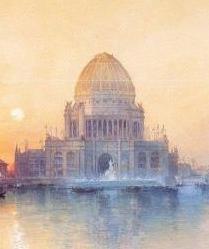
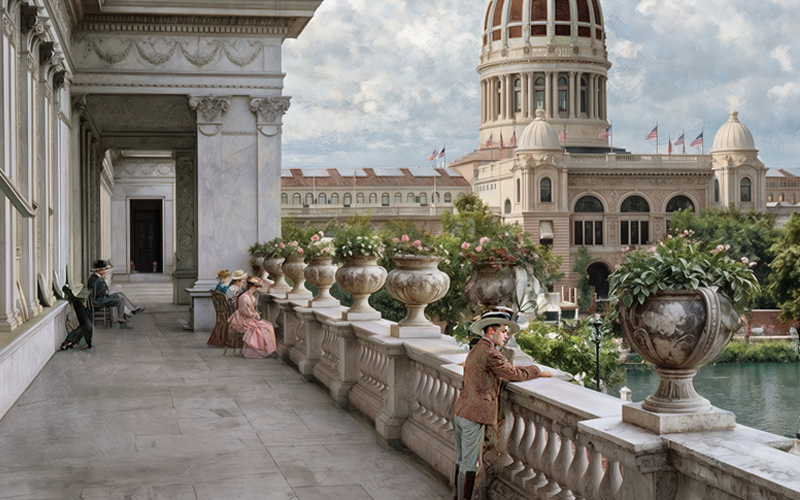
Assume that we are in Chicago—in Jackson Park—standing by the Administration Building. It is conceded to be the architectural gem of the Exposition. While it covers the comparatively small area of 262 feet square, it lifts its graceful proportions to the airy height of 277 feet. On each of its four fronts is a richly wrought portal, thirty-seven feet broad and fifty feet high.
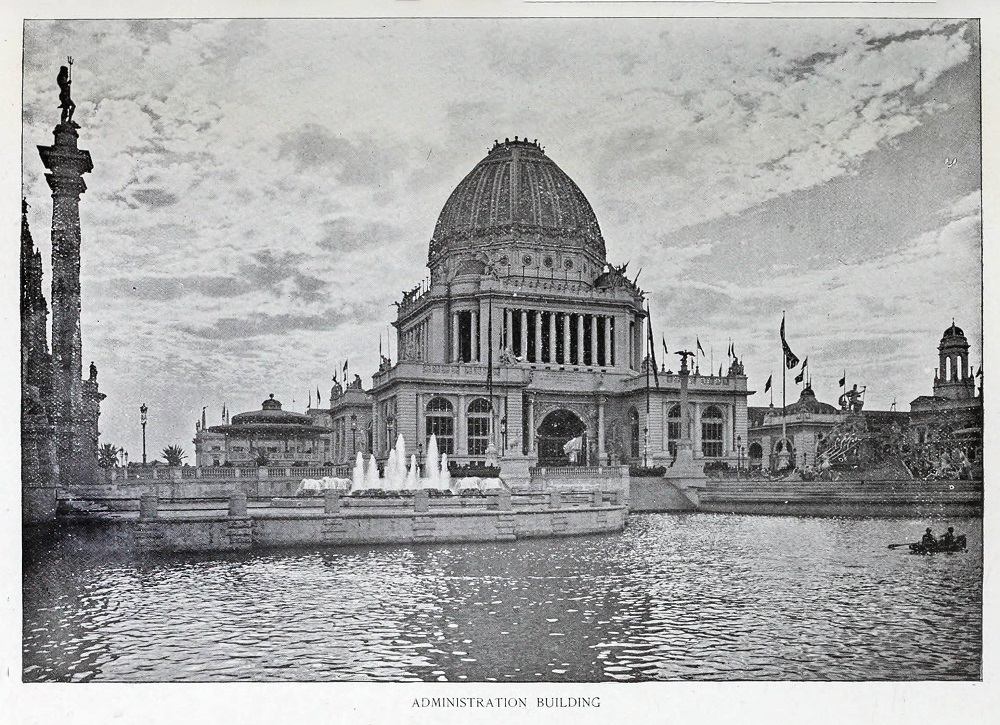
The capitol of the Columbian Exposition, Richard Morris Hunt’s Administration Building. [Image from Report of the Board of General Managers of the Exhibit of the State of New York at the World’s Columbian Exposition (James B. Lyon, 1894).]
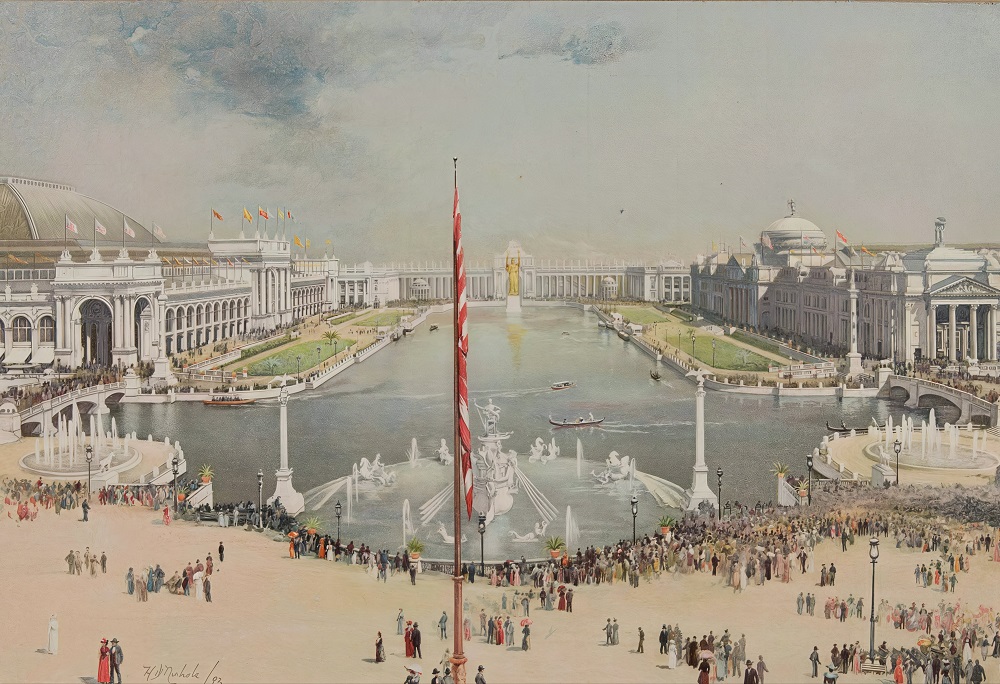
“The Court of Honor” by H. D. Nichols. [Image from Bancroft, Hubert Howe. The Book of the Fair: An Historical and Descriptive Presentation of the World’s Science, Art, and Industry, as Viewed Through the Columbian Exposition at Chicago in 1893. (Bancroft Co., 1893.)]
A scene of fairy-like loveliness
Here the Wizard, Electricity, creates nightly a scene of fairy-like loveliness.
Mark, if you please, the salient features of this Court of Honor.
We look down upon an open space 600 feet wide from north to south. This space, preserving its width of 600 feet, or nearly one-eighth of a mile, extends eastward toward the lake nearly a half mile, to what is called the Peristyle. That structure marks the further end of the Court by a kind of colonnade from north to south, consisting mainly of forty-eight imposing columns sixty feet high. They represent our forty-eight States and Territories. Each column bears the coat of arms of a State and is surmounted by a symbolic statue. On our right, bordering the Court, is Machinery Hall, with a frontage of 800 feet. Beyond it, tracing further east the right border, is another front of 800 feet, reaching to the Peristyle. That is the Agricultural Building, surmounted high in air with the striking statue of Diana, gracefully poised on one foot, bent bow in hand, and breeze-blown scarf from her shoulders.
On our left, marking the Court’s north border, are the Mining Building, the Electricity Building and the Liberal Arts Building, the latter reaching to the Peristyle.
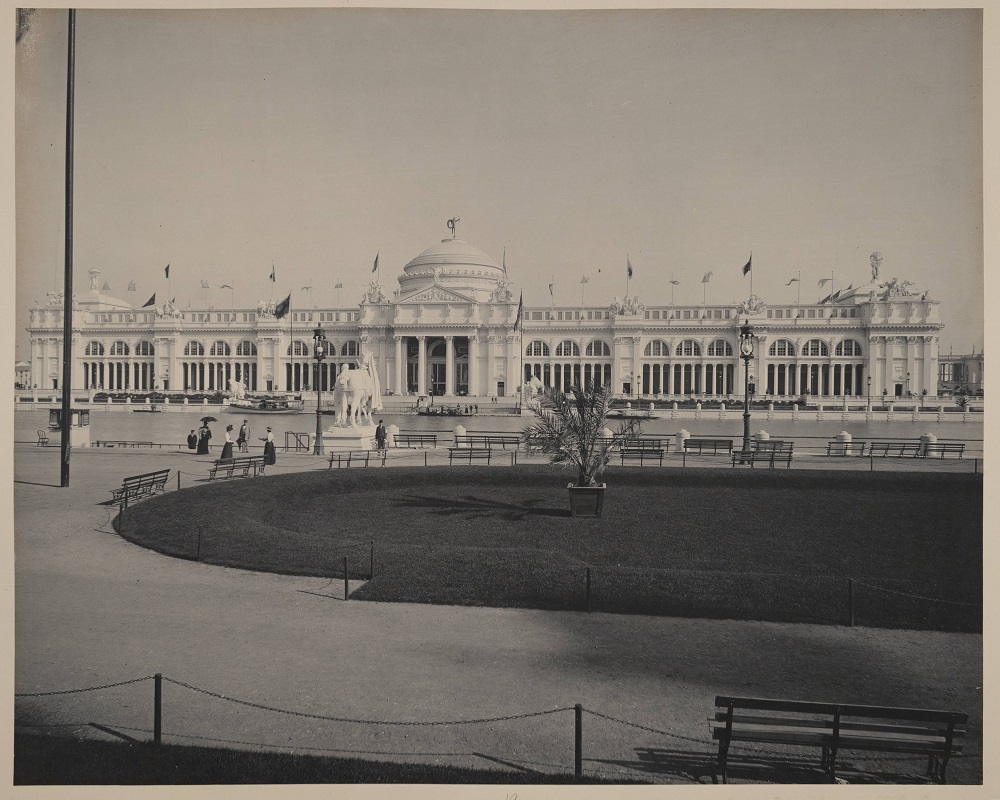
Photograph by C. D. Arnold of the Agricultural Building, looking south across the Grand Basin from the Manufactures and Liberal Arts Building. [Image from the C.D. Arnold Photographic Collection, Chicago Public Library Special Collections & Preservation Division.]
At the near end of the Basin are the two electric fountains, each sixty feet in diameter, whose waters shoot up to a height of 150 feet, and between them is the unrivaled artistic fountain of MacMonnies. A short distance beyond the fountains, the South Canal flows out under a broad, arched bridge between Machinery Hall and the Agricultural Building. And opposite is the North Canal, under a similar bridge between the Electricity Building and the Liberal Arts Building.
Lustrous in the light
At the far end of the Basin, near the Peristyle, there rises forty feet out of the water a massive pedestal, on which is a statue sixty feet high, representing the Republic—its total height being thus 100 feet. The majestic figure is lustrous in the light, for from foot to head it is coated with pure gold!
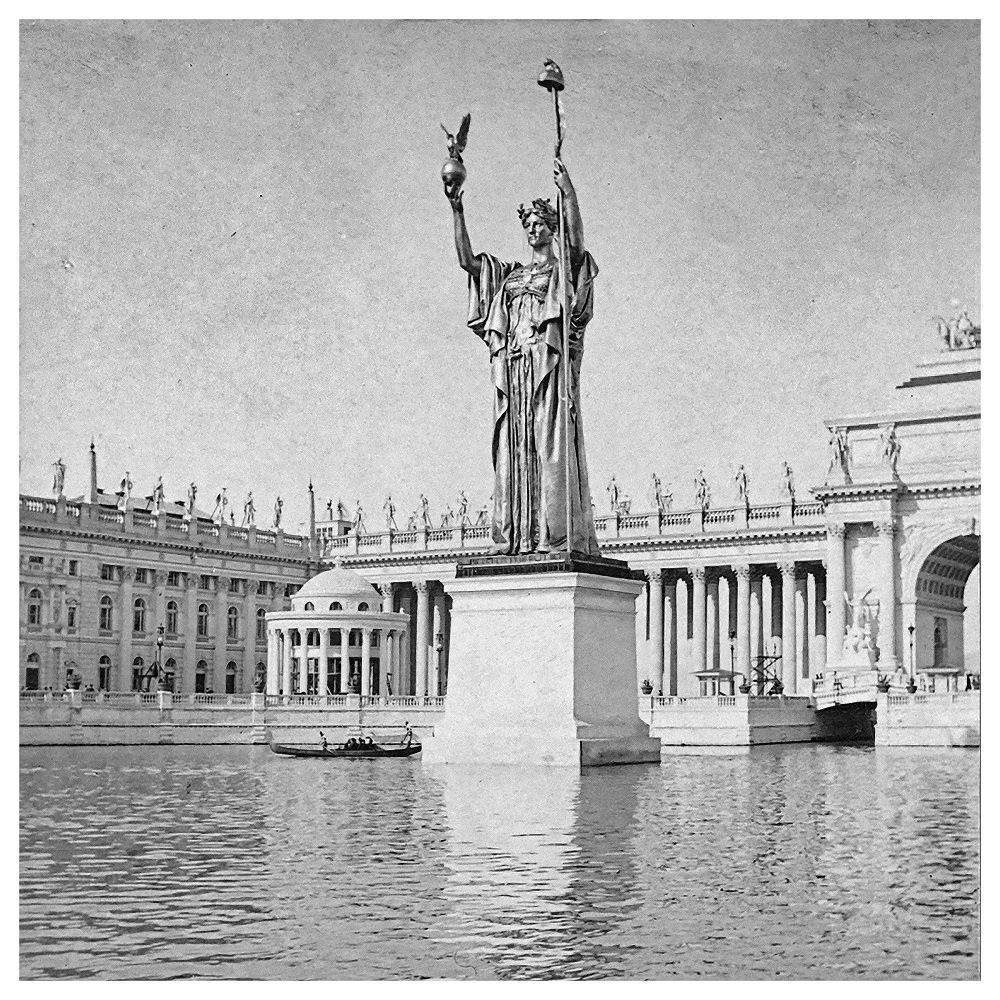
The Statue of the Republic, the “Goddess of Liberty.” [Image from Kilburn stereoscopic view card.]
But now, evening draws her dusky veil over this animated scene of artistic triumphs. The shadows deepen, the restless groups and the still statuary fade from view. Even the pronounced architectural outlines are only dimly discerned.
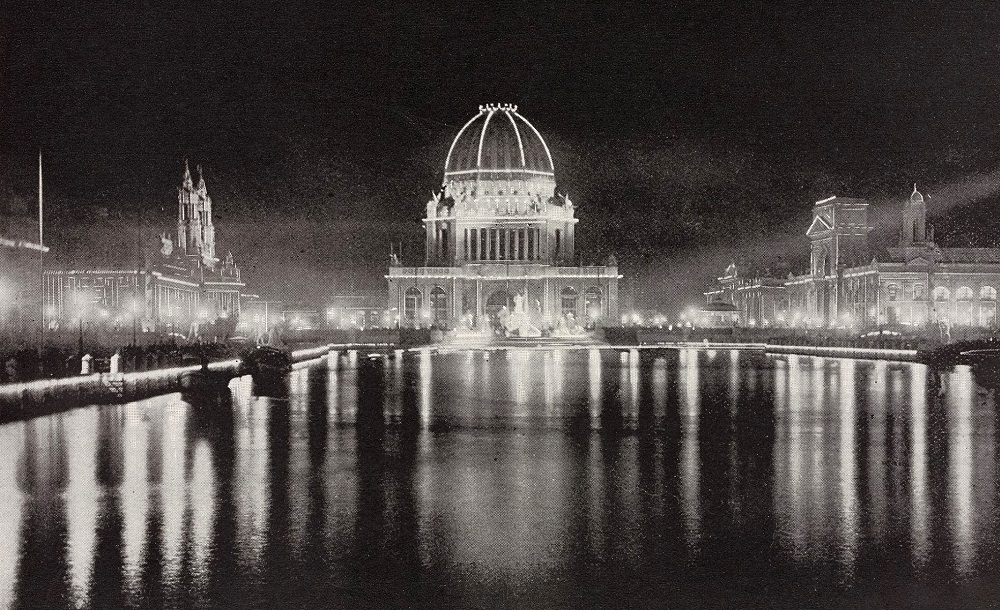
The Administration Building in the evening illumination. [Image from The Graphic History of the Fair (Graphic Co., 1894).]
The magic touch of electricity!
And now, the magic touch of electricity! Darkness flees—yielding quickly to the generous light which instantly glows from thousands of incandescent lamps all around and about and above the ample Court of Honor. They trace in light each leading line and angle of the long-extended facades and multiplied domes and pinnacles of Machinery Hall and the Agricultural Building on our right, of the Peristyle in the distance, and of the Liberal Arts, Electricity and Mining Buildings on our left. And all around the base of the balustrade enclosing the Basin, and along the arching canal bridges, flashes out a line of countless lights, each duplicated in the broad water-mirror. And the balcony on which we stand, at the head of the spacious Court, and especially the graceful dome above us, in lines of brightness curving to its radiance-crowned summit, 277 feet in air, is all ablaze with electric lights!
The good-humored, jostling throngs upon the bridges, the gathered multitude upon the plaza below, the gliding gondolas and launches, and the bewildering architecture, all are again before us! while over all, bends as before, the serenity of sky and stars.
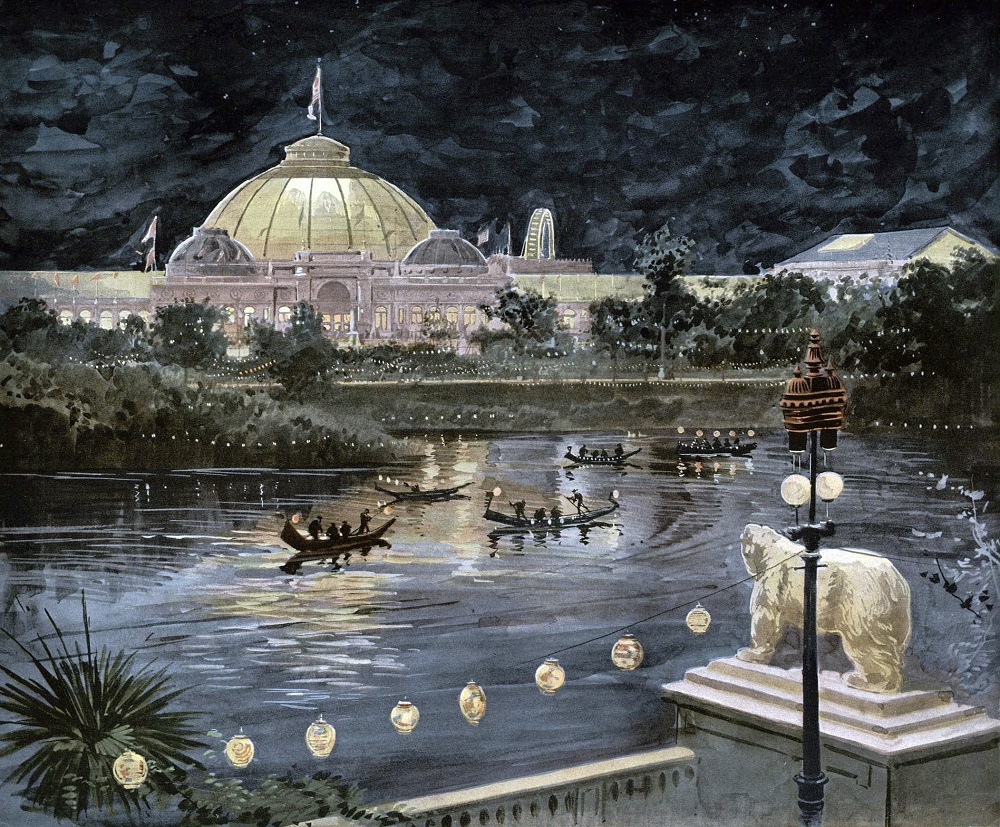
The Lagoon at night, with “gaily-colored gondolas busily plying the waters.” [Image from Vistas of the Fair in Color. A Portfolio of Familiar Views of the World’s Columbian Exposition (Poole Bros., 1894).]
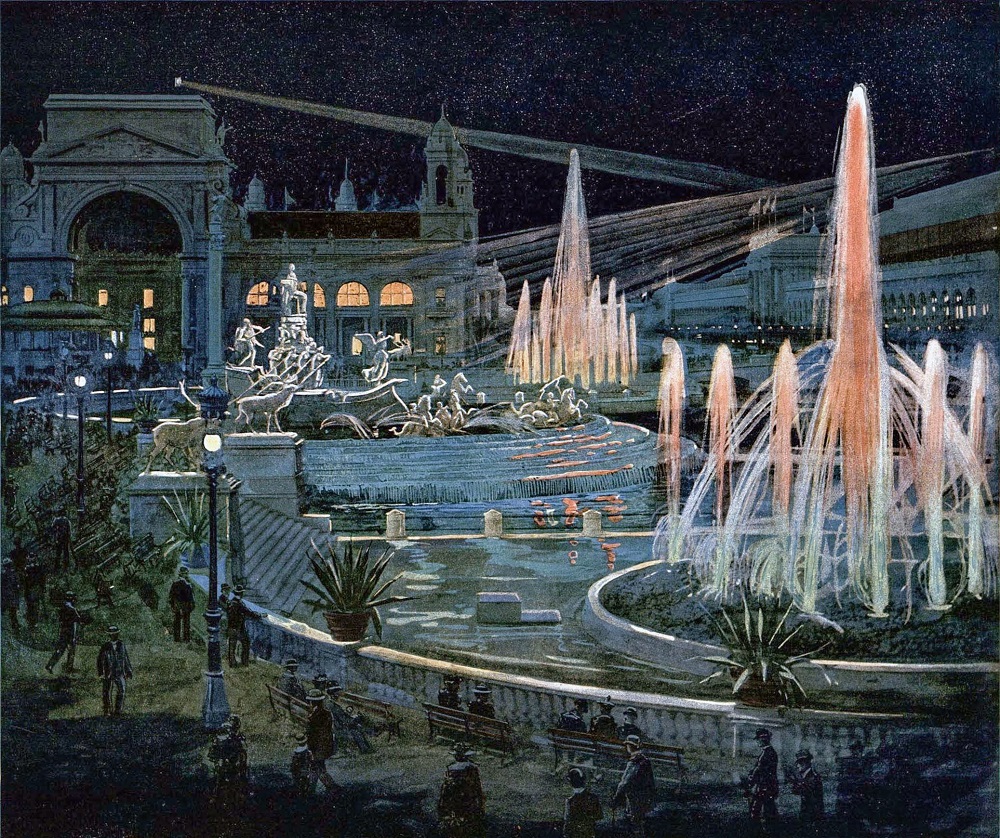
A night scene, looking north from Machinery Hall showing the electric fountains and MacMonnies Fountain. [Image from Vistas of the Fair in Color. A Portfolio of Familiar Views of the World’s Columbian Exposition (Poole Bros., 1894).]
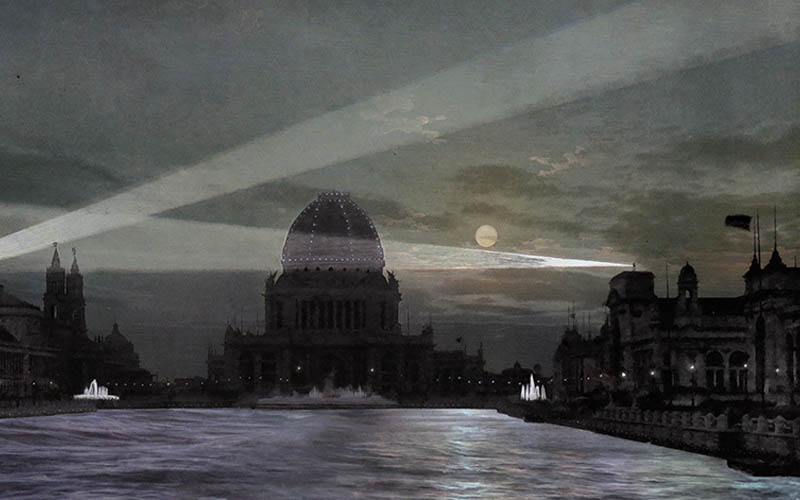
See the great search-lights
But look! see the great search-lights upon the roofs of the buildings. What is a search-light? It is the most powerful of electric arc-lights, placed near the bottom of a drum-like case, which is so mounted that its open glass face can be easily turned in any direction—upward or downward or sideways. Within the case, back of the light, is a burnished parabolic mirror, made of silver on glass, which concentrates all the rays and throws forward the beam of intense light to a great distance.
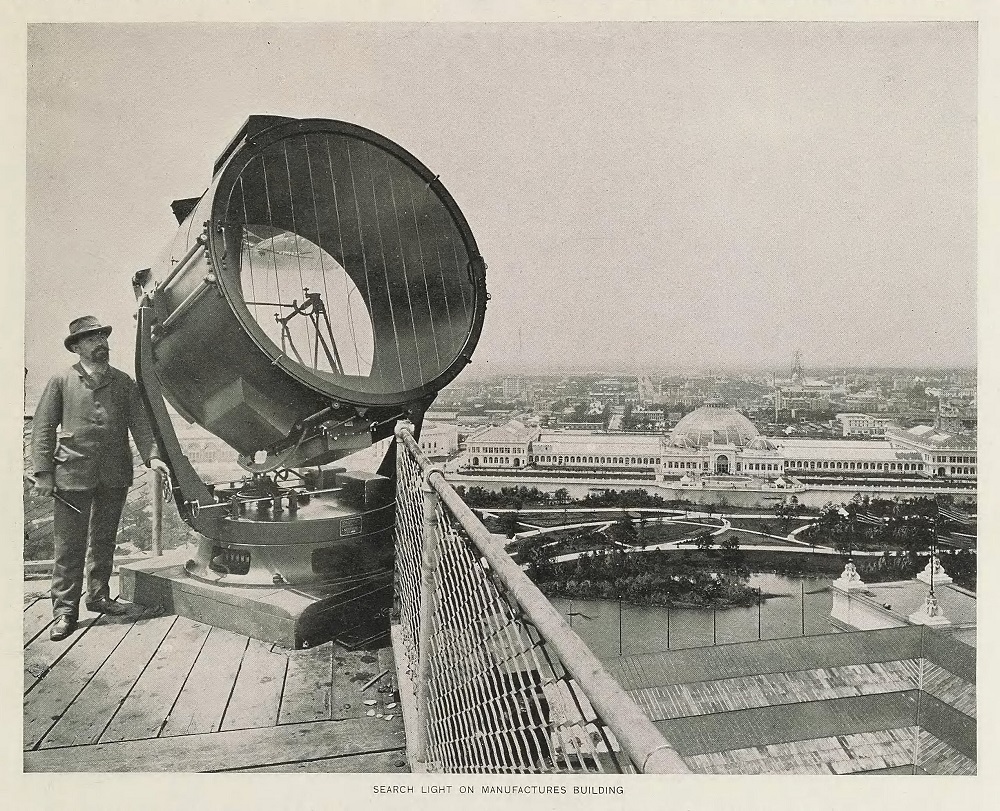
A search light on the roof of the Manufactures and Liberal Arts Building. [Image from Bancroft, Hubert Howe The Book of the Fair (The Bancroft Company, 1893).]
Now look! A search-light is turned on the high central arch of the distant Peristyle—above it—on the splendid group of statuary, emblematic of the world’s progress. We see, conspicuous against the back-ground of night, every figure, to the minutest detail. Another turn, and it bathes in brightness the main entrance of Agricultural Hall, showing vividly its elaborate decoration. Then, sweeping the long facade on our right, it floods the south bridge with almost sunlight—perhaps revealing your friend in the crowd. Suddenly, the long comet-like stream of brightness from the distant roof is lifted from the bridge and slowly turned eastward and upward, until it clothes in glistening white the graceful statue of Diana, poised high above Agricultural Hall.
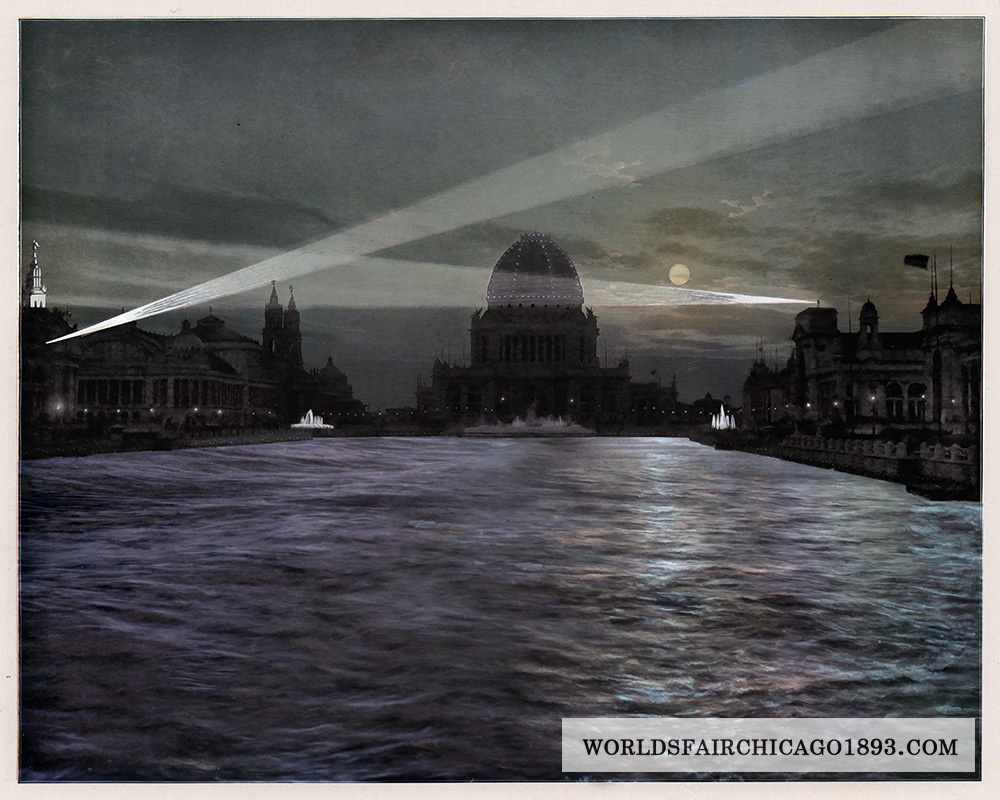
The Grand Basin at night, showing search lights. [Image from Picturesque World’s Fair (W.B. Conkey, 1894); image digitally edited.]
The Cloud Projector
But turn quickly to your left, for in that quarter a bomb shoots high in air. It bursts, forming a broad, floating, white cloud. And see, upon the cloud appears a weird placard in large letters—an announcement of to-morrow’s attractions—riveting every eye! A slide is changed, and lo! upon the cloud the smiling features of a well-known face! That is the work of a search-light, ingeniously arranged as a “cloud projector.”
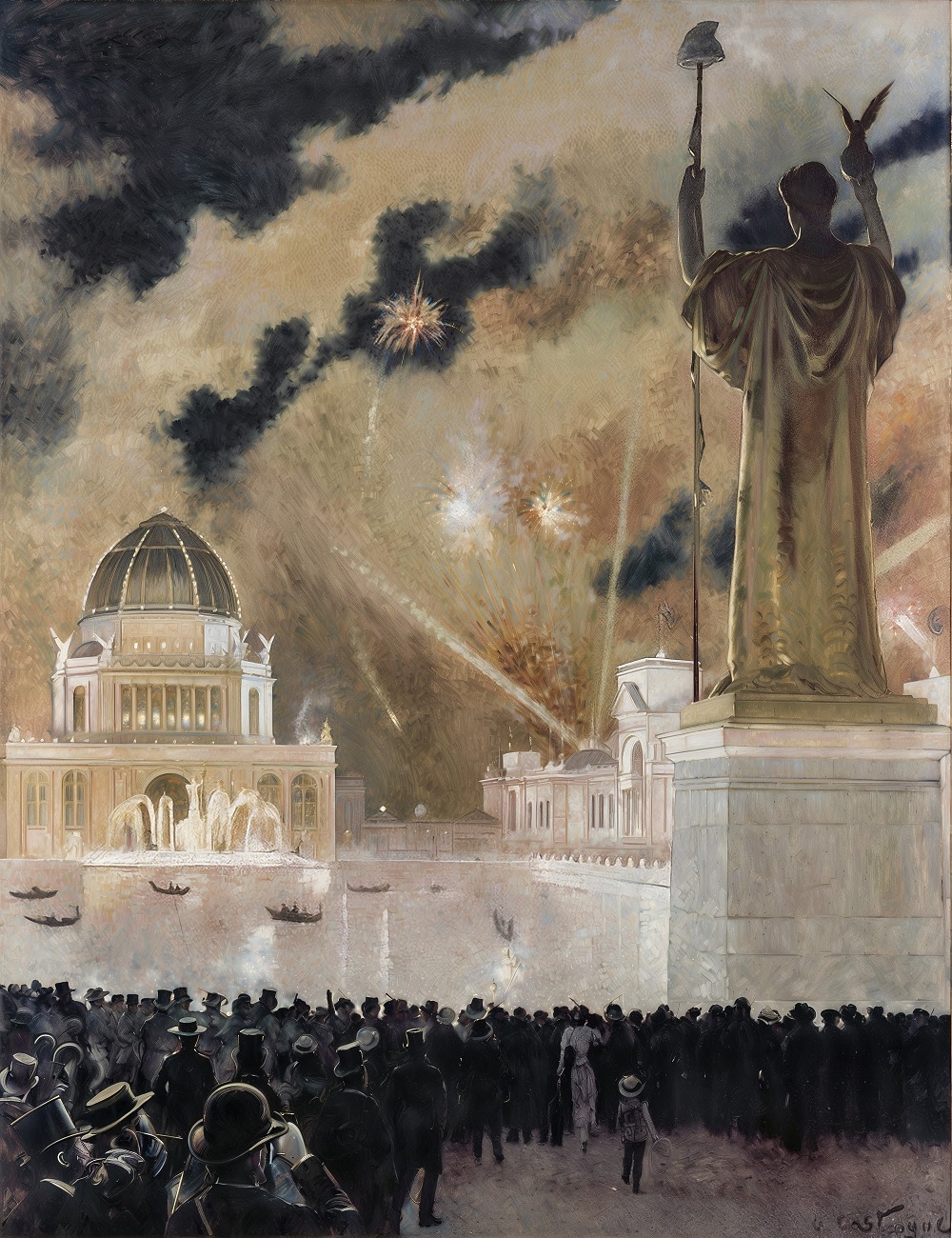
“The Court of Honor, Illuminated” by André Castaigne. [Image from Walton, William. Art and Architecture: Architecture (G. Barrie, 1893).]
SOURCE
Lanneau, John F. “New Uses of Electricity” Wake Forest Student Nov. 1893, p. 44–55.

Leave A Comment