
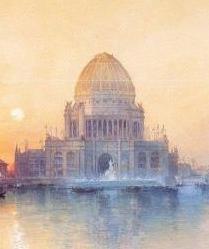
Visitors to the 1893 World’s Fair encountered several models of notable buildings. A miniature U.S. Treasury building constructed from half-dollar Columbian souvenir coins caught the attention of those who passed through the rotunda of the Administration Building. Lever Brothers displayed an impressive model of Windsor Castle in the British section of the Manufactures and Liberal Arts Building, and the Pullman Palace Car Company’s exhibit in the Transportation Building featured a model of the entire company town of Pullman, Illinois. In terms of craftsmanship and beauty, however, few could compete with the silver model of a World’s Fair building on display inside that same building.
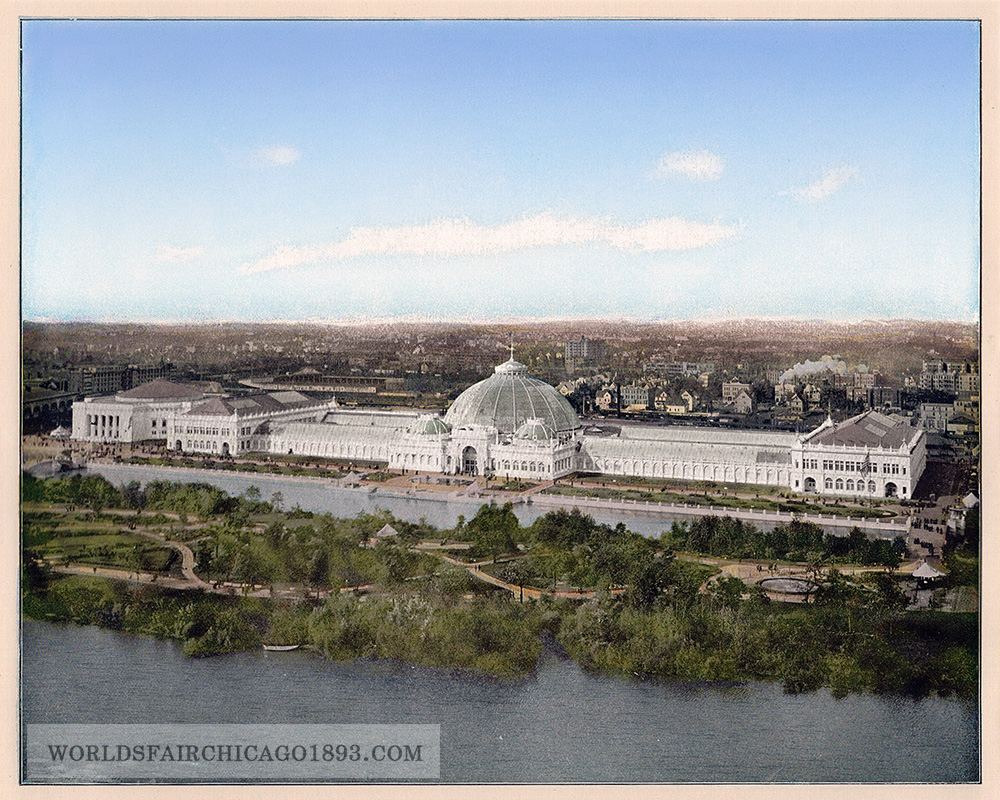
William Le Baron Jenney’s breathtaking Horticultural Building at the 1893 World’s Fair. This structure, the “largest hothouse in the world,” stood on the west side of Jackson Park, facing the Lagoon and featured north and south pavilions connected to a central domed pavilion. [Image from Picturesque World’s Fair. W.B. Conkey, 1894; digitally edited.]
A model of Horticultural Hall in silver filigree
In the gallery of the north end of Horticultural Hall—tucked among the displays of plants, canned and dried fruits, seeds, and a tower made from cases of English walnuts—stood a lovely model of the exhibition palace. Crafted from 110 pounds of pure silver, the filigree structure—eleven feet, two inches in length; three feet, two-and-a-half inches in width; and two feet, nine-and-three-quarters inches tall—portrayed the Horticultural Building at a scale of one-eighth of an inch to the foot. World’s Columbian Exposition Illustrated described the display as:
“… a very fine specimen of this class of work. The model is perfect in every detail and as a work of art is second to none at the Exposition. The main building and the two wings are reproduced in exact imitation of the style of architecture used in the construction of the building, nothing being forgotten, even to the flagstaff and banners surmounting the roof.”
The San Francisco Chronicle clarified that, “while the general form and outline of the building has been strictly adhered to, the artist has sought in minor details to bring out the delicate beauties of the filigree work rather than to make an exact reproduction of the building.” Newspaper reports described this piece as being “among the most beautiful works of art which the great exposition brought together,” and “a remarkable specimen of the silversmith’s art.” None mentioned if the delicate model contained within it a tiny, inch-long model of the same proportional scale.
The artist who created this handsome display especially for the World’s Columbian Exposition was A. M. Endweiss of Monterey, Mexico—though he was associated with several other names and several other hometowns.
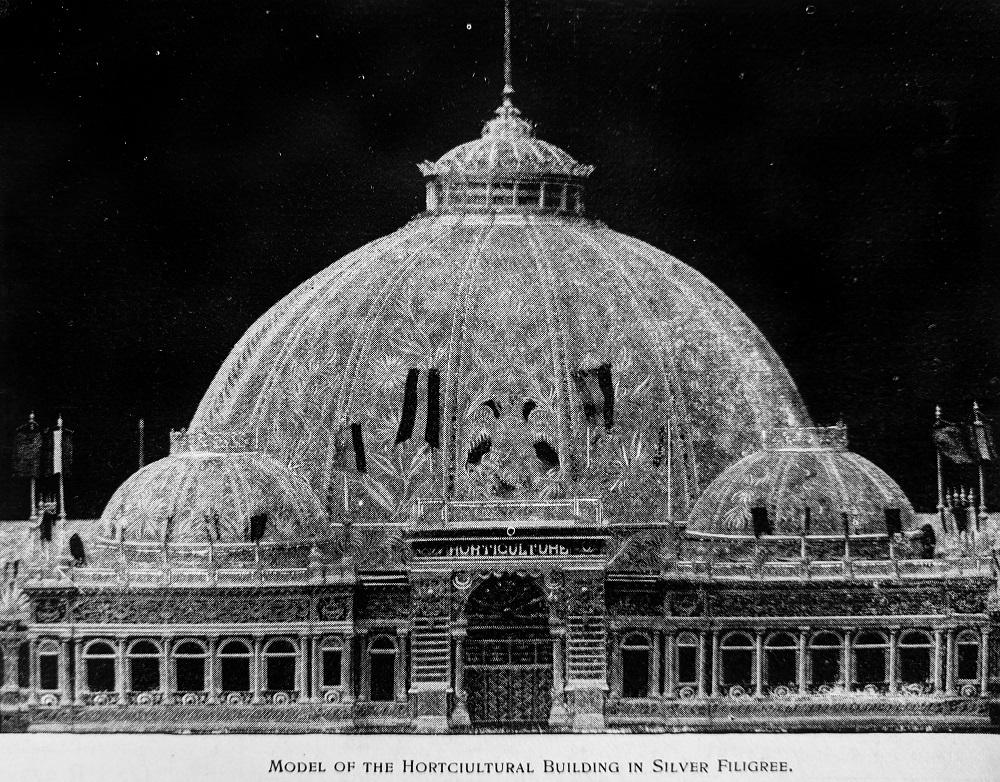
The central domed pavilion of a silver filigree model of the Horticultural Building made by Mexican artist A. M. Endweiss. [Image from American Gardening May 1893.]
Watchmaker from Imperial Russia
Born in Russia, A. M. Endricoff developed his craft by apprenticing with the imperial court watchmaker of St. Petersburg. After working for a Swiss watchmaker in La Chaux-de-Fonds and for London horologist Charles Frodsham, the Russian emigrated to the United States, changed his surname, and worked at Tiffany’s in New York for nine years. The Endweiss chronometer clock, a “mechanical curiosity” manufactured by “A. M. Endweiss,” was being advertised in Brooklyn in 1870. By the following year, Mr. Endweiss had moved to the heartland and was living in Leavenworth, Kansas, running a business as a practical watchmaker using the name “Albert M. Endweiss.” In the spring of 1887, he moved to Emporia, Kansas, and advertised that he had come to town to establish himself “in a legitimate business of a watchmaker and jeweler.” When not running his watch shop out of the town’s post office, Endweiss wrote histories of France and his native Russia for a local newspaper. After two years of active life in Emporia, Endweiss moved to Monterrey, Mexico. From there, he wrote back to Kansas describing the history and spellbinding beauty of his new home. While living in Mexico he changed his name to “Alberto M. Endweiss” and began plans for a beautiful display at the upcoming Columbian Exposition in Chicago.
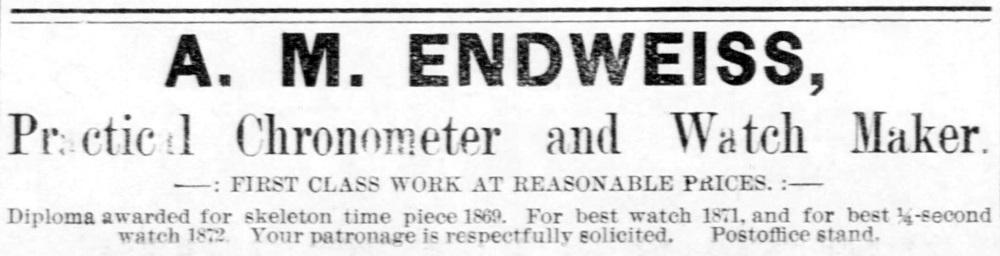
An advertisement for A. M. Endweiss’s new watch business in Emporia, Kansas. [Image from the Emporia Evening News, Oct. 14, 1887.]
“A remarkable piece of work”
Stories about the silver model of the World’s Fair building emerged as early as December 1892. The Chicago Tribune reported that jewelers from the City of Mexico (Endweiss was not named) would be creating a silver showpiece of Horticultural Hall using designs for the building supplied by architect William Le Baron Jenney. The description of the proposed model matches that of the final display, except in two details. The planned structure was to have the Mexican coat-of-arms, made of enamel and showing the national colors, ornamenting the central dome. Also, the model would stand only 2 feet, 3 inches tall. These differences in ornamentation and height perhaps can be accounted for by the addition of a flagpole with the Mexican flag sitting atop the central dome of the finished model. The Tribune report also notes that the Mexican jewelers “think the project will be eventually profitable to them,” though offers no explanation if this means they would sell the model, display it elsewhere for profit, or use it as an advertisement to sell other products.
“Every little while there comes to an exposition official some token of the widespread interest which is being taken in the fair by the people of foreign countries,” announced the Memphis Commercial a few days later. “The latest is in the form of a series of photographs and a number of newspaper clippings describing a remarkable piece of work, which Mr. A. M. Endweiss, a Mexican jeweler, and four clever silversmiths have just completed after thirteen months labor.” This report indicates that not only was work on the model already finished by December 1892, but that the piece also had been displayed in the City of Mexico for 47,000 people to see.
Endweiss’s own advertising stated that the model had required the labor of twelve men working eighteen hours a day for thirteen months. In addition to using roughly $2,000 in silver, he reportedly paid the workers $33 a week, so may have spent another $1,700 on labor. To recoup this very expensive investment, Mr. Endweiss sought a concession from the World’s Columbian Exposition.
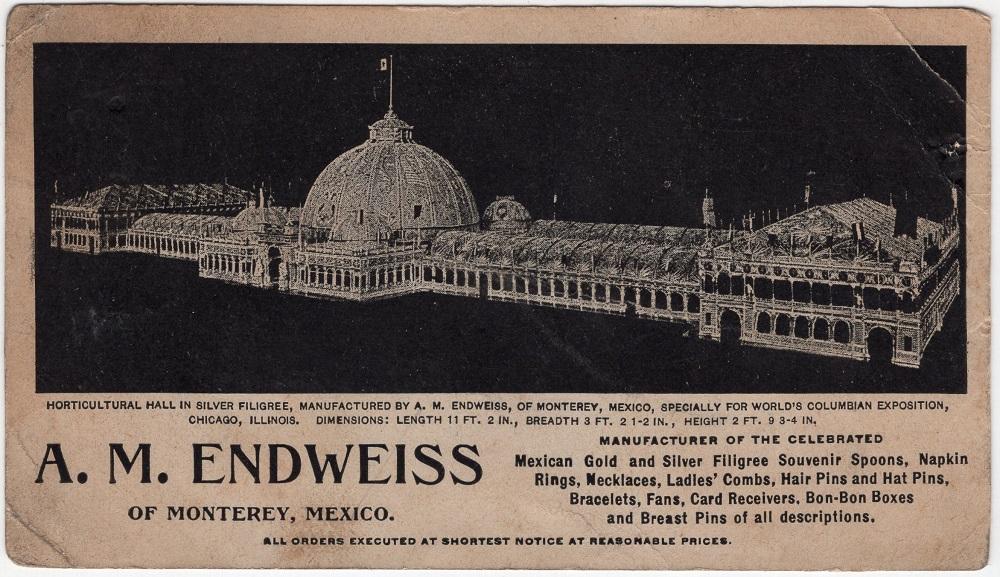
A photograph sold by A. M. Endweiss to advertise both his stunning display and the many other silver and gold filigree products he offered for sale at the Columbian Exposition. [Image from private collection.]
“Will undoubtedly find many buyers”
On February 25, 1893, the Chicago Tribune reported that the silver filigree model, credited to “Alberto M. Enduiess,” [sic] would be on display in the central dome gallery of Horticultural Hall; the location changed sometime in the next three months. A few days later, on March 1, Mr. Endweiss received a contract from the Exposition company for a “concession to sell filigree silver work,” though reports at this time did not mention his silver model. Although exhibitors in the main halls were strictly forbidden from sales, there were a few concessions to be found inside some exhibit halls. The ticketed Mammoth Crystal Cave display under the dome of Horticultural Hall is one such example. Endweiss, however, is also listed as an exhibitor, classified with Department H (Manufactures), Group 97 (gold and silver ware, plate, etc.). His exhibit, however, was not inside the Manufacturers and Liberal Arts Building with the other silver and jewelry companies. Perhaps because of the subject of his model, or to avoid inserting a silver concession onto the floor of the Manufacturers building, Endweiss’s combination concession/display instead was placed in Horticultural Hall. It is listed in the Official Catalogue under Department of Horticulture (B) as “Model of Horticultural Building in filigree silver, and sundry filigree articles.”
Mr. Endweiss arrived in Chicago around March 26 and brought with him several of his employees. They would “execute in full view of the public” the filigree objects for sale in his booth. He also obtained permission to sell photographs of his model, “which will undoubtedly find many buyers.” Mr. E. P. Bruner of Emporia, Kansas, ran into his former townsman during the second week of June and reported home that the former Emporia jeweler was now from the City of Mexico. “Our old friend is the sole owner of that establishment,” wrote Bruner. “He greets his old friends just as cordially as he did before becoming a Spanish don.” A visitor from England also reported meeting Mr. Endweiss in June.
What did Endweiss sell? In his advertising, he described himself as a “manufacturer of the celebrated gold and silver filigree souvenir spoons, napkin rings, necklaces, ladies’ combs, hair pins and hat pins, bracelets, fans, card receivers, bon-bon boxes, and breast plate pins of all descriptions.” World’s Columbian Exposition Illustrated noted that “this gentleman is the manufacturer of the celebrated Mexican gold and silver filigree souvenir spoons, card receivers, breast pins, and all description of ornaments.” Bancroft’s Book of the Fair describes “fine metal and filigree work, a case filled with wreaths and flowers, closely resembling imitations in wax.” Mr. Bruner noted seeing “a large stock of fine Mexican filigree silver work.”
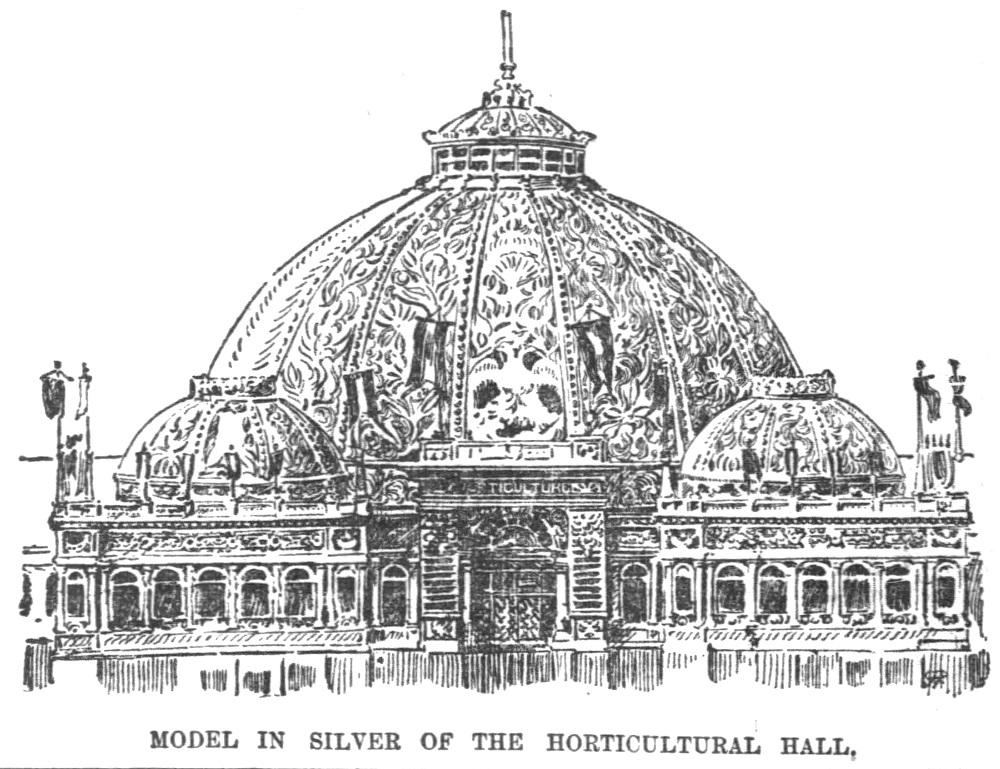
This image of the Horticultural Building silver model circulated days before A. M. Endweiss’s contract for a concession at the Fair received final approval. [Image from Chicago Tribune Feb. 25, 1893.]
“One of the most remarkable and attractive exhibits”
Although the Exposition opened on May 1, Mr. Endweiss did not get his model installed in the north pavilion gallery until May 18. Why it took him almost a month to set-up is not clear. The San Francisco Chronicle (May 19, 1893) described it as “one of the most remarkable and attractive exhibits in Jackson Park” though was puzzled about the location of the display:
“It is somewhat of a mystery why this surprisingly beautiful work of art should be exhibited in an obscure location in the gallery of horticultural hall. The place is not visited by large crowds, and it is about the last place in the grounds where a work of this character would naturally be looked for.”
Still irritated about the matter the next day, the Chronicle editor added:
“The placing of the silver model of the horticultural building in horticultural hall at the world’s fair is one of those things which the ordinary man cannot understand. If this model is as fine a bit of work as is reported it should go in one of the art exhibits, where it would receive the attention that it deserves.”
A report in an Ontario newspaper in August stated that the beautiful model was on “the main floor,” suggesting it may have moved during the summer. Wherever it was, the judges found it, for Mr. Endweiss earned an award from the Exposition for his silver model, competing in the same category as such prestigious firms as Gorham Manufacturing Company of Providence, Rhode Island, and Goldsmiths & Silversmiths Company of London.
After almost six months of sales, Endweiss did not appear to have recouped the cost of his beautiful display. President Higinbotham’s Final Report lists the concession for “Gold and Silver Filigree” as having made only $4,408.70 in gross receipts, of which $440.93 (10%) went to the Exposition. The amount that Endweiss reportedly invested in the silver filigree model varies widely, though far short of his $4,000 in earnings. A Rand, McNally guidebook notes that the silver display cost $5,000, while a boilerplate World’s Fair news summary valued it at $35,000, “about one-seventh the cost of the larger building itself.” His friend from Emporia, Mr. Bruner, wrote that Endweiss spent $24,000 on the model. In any case, the Mexican silversmith departed the Fair in a financial hole. Like so many other exhibitors, though, he recognized the potential to squeeze more cash out of his World’s Fair investment.
The silver filigree model of Horticultural Hall traveled the country for months after the 1893 World’s Fair closed. [Image from Baltimore Sun July 17, 1894.]
After the Fair
As with several other wonders of the World’s Fair, the silver filigree model of Horticultural Hall went on a road show in the spring of 1894. With his gorgeous display packed in a large box, Endweiss traveled the Midwest, offering an accompanying lecture about his craftwork and life in Mexico. He charged a ten-cent admission for adults and five cents for children. While exhibiting his model at a former clothing store in Lima, Ohio, for a few days beginning on March 22, the local paper noted a new feature of the silver model—electrical lighting that is “extremely beautiful.” Another report noted that “when lighted from within, the domes and arches sparkle in the thousands of polished silver wires and delicate tracery.”
Eleven weeks later, he could be found about only seventy-five miles south, in Springfield, Ohio. Endweiss was not having good luck on his tour. After exhibiting his silver showpiece for several nights there, he teamed up with an expressman named William Eckert and his brother-in-law Edward Gorden. They furnished a wagon and offered advertising services for an exhibition circuit through southern Ohio that included South Charleston, Jeffersonville, Washington Court House, Greenfield, Bainbridge, Jackson, McArthur, and reaching Chillicothe by the Fourth of July. The partnership fell apart at the first stop, when Mr. Gorden ran off with the door receipts. Stranded, Mr. Endweiss hitched a ride to Chillicothe where he told a local newspaper reporter his sad story “with much feeling, punctuated with copious tears at judicious intervals.” Undeterred, he continued the tour and exhibited at Baltimore’s Posner Brothers department store in mid-July. Mr. Endweiss appears to have returned to Monterrey, Mexico, by July of 1895.
What happened to the 110-pound silver model of Horticultural Hall? During the 1894 tour, Endweiss claimed that he had “benefitted the American nation by donating his treasure work to the Chicago Museum.” The filigree model does not seem to have made it into the Field Museum collection, however. The Guide to the Field Columbian Museum for 1895 does list “Examples of Mexican silver filigree work” being on display in a wall case in the Higinbotham Hall of Gems and Jewels and (elsewhere) credits A. M. Endweiss as being a collector who contributed to the museum’s holdings. This listing does not appear in the collection guides after 1896, and the dimensions of a display case make it unlikely that the large Horticultural Hall model was part of this display.
The fate of this beautiful model of a World’s Fair building remains a mystery.
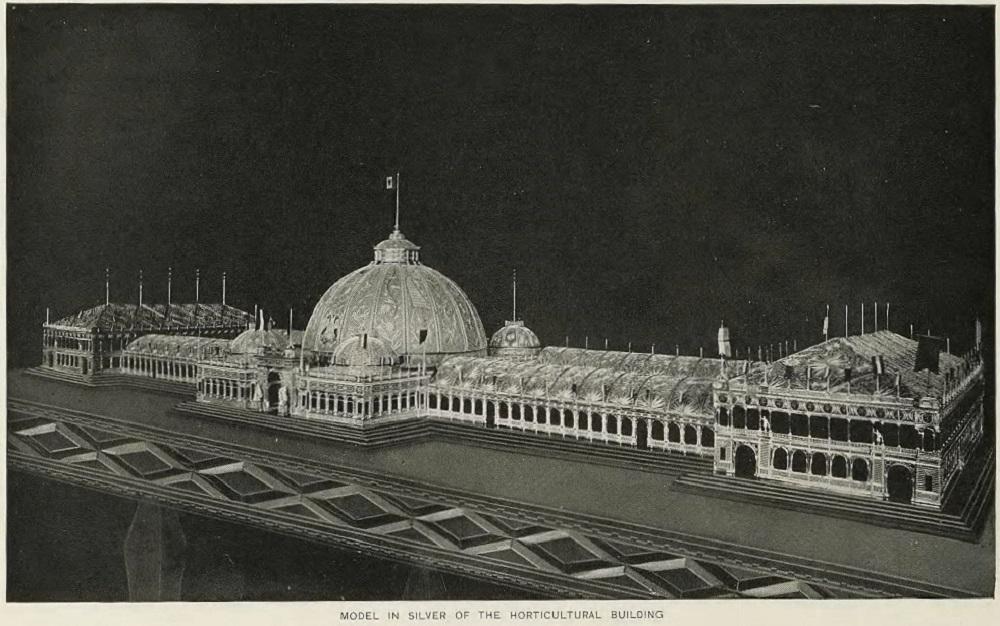
Alberto M. Endweiss created “a remarkable specimen of the silversmith’s art” for the 1893 World’s Fair. [Image from Hubert Howe Bancroft’s The Book of the Fair (The Bancroft Company, 1893).]
SOURCES
“Artistic Work in Silver” San Francisco Chronicle May 19, 1893, p. 1.
“Awards at the Fair” Chicago Tribune Oct. 3, 1893, p. 5.
“Horticultural Hall in Silver Filigree” World’s Columbian Exposition Illustrated Nov. 1893, p. 233.
Bancroft, Hubert Howe The Book of the Fair. The Bancroft Company, 1893.
Bruner, E. P. “Letter from Chicago” Emporia (KS) Daily Republican Jun. 22, 1893, p. 2.
Guide to the Field Columbian Museum: with Diagrams and Descriptions. Field Columbian Museum, 1985.
Handy, Moses P. I. W. B. Conkey, 1893.
Higinbotham, H. H. Report of the President to the Board of Directors of the World’s Columbian Exposition. Rand, McNally & Co., 1898.
“Horticulture Building in Miniature” Baltimore Sun Jul. 16, 1894, p. 8.
“Horticultural Hall in Silver Filigree” World’s Columbian Exposition Illustrated Nov. 1893, p. 233.
“Knocked Endweiss” Chillicothe Gazette Jun. 8, 1894, p. 1.
“El Palacio de Horticultura de Filigrana” Tucson (AZ) El Fronterizo Apr. 15, 1893, p. 3.
“Pansies at the Fair” Chicago Tribune Feb. 25, 1893, p. 9.
“The placing …” San Francisco Chronicle May 20, 1893, p. 6.
Rand, McNally & Co.’s A Week at the Fair. Rand, McNally & Co., 1893.
Sheppard, John Frederick A Trip Across the Atlantic, a Tour in the States, and a Visit to the World’s Fair. Southampton Times Printing Works, 1893.
“Sights at the Fair” Omaha Daily Bee Jun. 22, 1893, p. 4.
“Silver House from the World’s Fair” Lima (OH) News Mar. 22, 1894, p. 5.
“Silver Model of Horticultural Hall” Chicago Tribune Dec. 23, 1892, p. 10.
“To the People of Emporia” Emporia (KS) Evening News Mar. 21, 1887, p. 1.
“The World’s Fair” Memphis (TN) Commercial Dec. 25, 1892, p. 9.
“Seen in the White City” St Catherine’s (ON) Standard Aug. 1, 1893, p. 2.

Very interesting article. Miniatures were seemingly very popular at that time. Is anyone familiar with an endeavor involving George Washington Gale Ferris and Luther Rice that consisted of a miniature replica of the Columbian Exposition and toured to several sites following the exposition?