RECENT POSTS ABOUT THE HISTORY OF THE COLUMBIAN EXPOSITION’S BUILDING, FAIRGROUNDS, EXHIBITS, EVENTS, AND PEOPLE.
Harriet Monroe’s History of the World’s Fair (Part 1)
“The World’s Columbian Exposition has never been so well revealed and appreciated as through her imagination and her eyes,” wrote renowned poet William Carlos Williams, describing fellow poet and publisher Harriet Monroe (1860–1936). “And her part in it was distinguished.” Two of Monroe’s distinguished accomplishments served as bookends to the 1893 World’s Fair. The Dedication Day Ceremony held on the fairgrounds on October 21, 1892, featured a reading of an excerpt of her monumental poem “The Columbian Ode.” Harriet Monroe’s 1896 biography of architect John Root, her brother-in-law, provided an in-depth account of the early days of planning and [...]
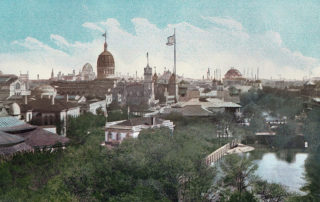
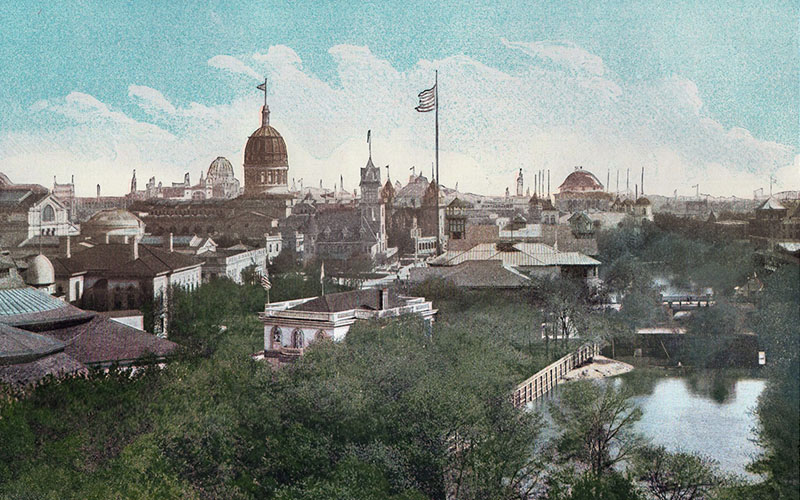
PICTURESQUE WORLD’S FAIR. AN ELABORATE COLLECTION OF COLORED VIEWS (p. 20)
PICTURESQUE WORLD’S FAIR. AN ELABORATE COLLECTION OF COLORED VIEWS Page 20 BIRD'S-EYE VIEW LOOKING SOUTH.—It is difficult to determine what first attracts attention in this picture—the mirror surfaces of water, the cluster of state buildings, or the distant but easily recognized outlines of the great Exposition buildings. Certain it is that Nature, in all her loveliness, never appeared more at her best or appealed more bewitchingly than she does in these two sequestered sheets of water. The crowded roofs only make us feel that these leafy nooks were forgotten in the hurry and Dame Nature given a chance to [...]
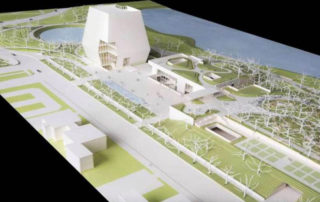
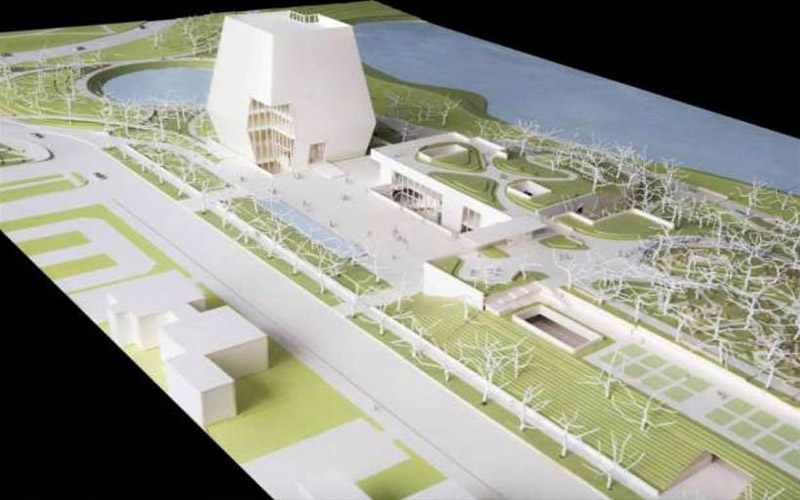
Is Chicago about to ruin Jackson Park? asks the Cultural Landscape Foundation
"Is Chicago about to ruin Jackson Park?" asks Charles A. Birnbaum, President & CEO of the Cultural Landscape Foundation in an opinion piece published this week in The Huffington Post. Birnbaum highlights several major projects affecting the park that in 1893 was home to the Columbian Exposition. Plans for the Obama Presidential Center (OPC) locate it on the west side of Jackson Park lagoon (approximately where the Woman's Building and Horticultural Building once stood), and an associated parking facility will sit on the east end of the Midway Plaisance (where several exhibits and structures stood during the Fair.) A proposal to consolidate and [...]
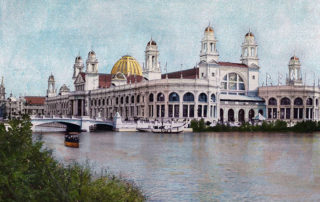
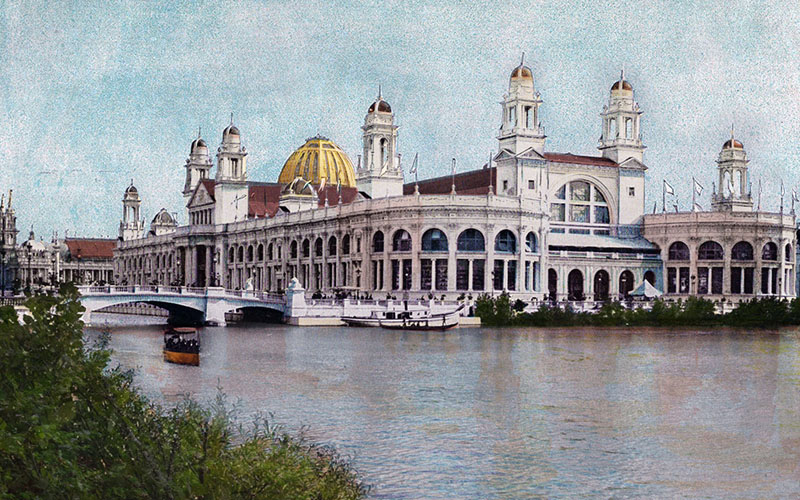
PICTURESQUE WORLD’S FAIR. AN ELABORATE COLLECTION OF COLORED VIEWS (p. 19)
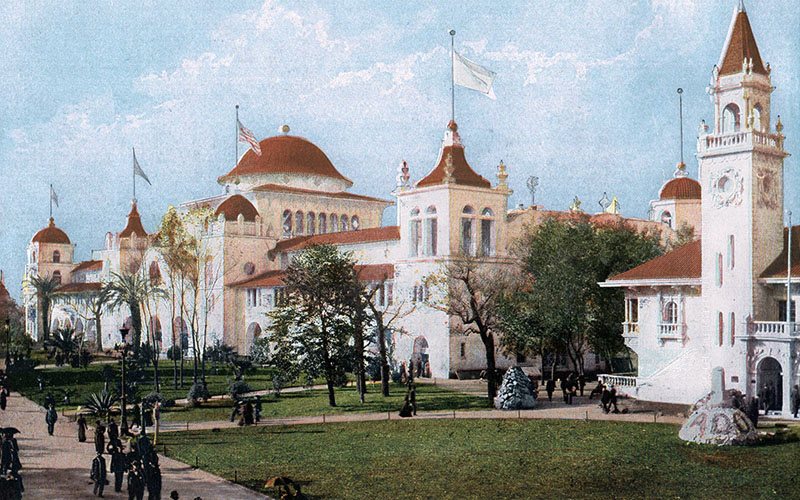
PICTURESQUE WORLD’S FAIR. AN ELABORATE COLLECTION OF COLORED VIEWS Page 19 THE ELECTRICITY BUILDING.— A brilliant picture is presented of the palace for the accommodation of Electricity, a Science and Industry that at our Centennial had little more than a name — much less a habitation. Its architecture speaks the romance of the Italian Renaissance; its contents, the magic of modern electrical science. The view here allows the eye to sweep the whole of the north and east fronts, a distance of three hundred and fifty and seven hundred feet, respectively. The situation is at once apparent. The waters [...]

Happy New Year! Happy 125th Anniversary!
Welcome to 2018 Happy New Year to our readers. 2018 marks the 125th anniversary of the 1893 World's Fair, and we look forward to celebrating the year with posts about the history of the World's Columbian Exposition, images of the fairgrounds, reports on news and events related to the WCE (we expect there will be much happening in 2018!), notices of interesting WCE auctions and collectibles, and other Columbian commemorations. Would we ever be able to see it all? This was the question we asked ourselves each night when we returned home for a few hours of rest after [...]
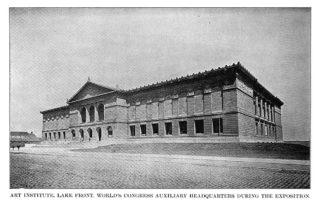
Architectural Digest selects the top-20 world’s fair buildings of all time
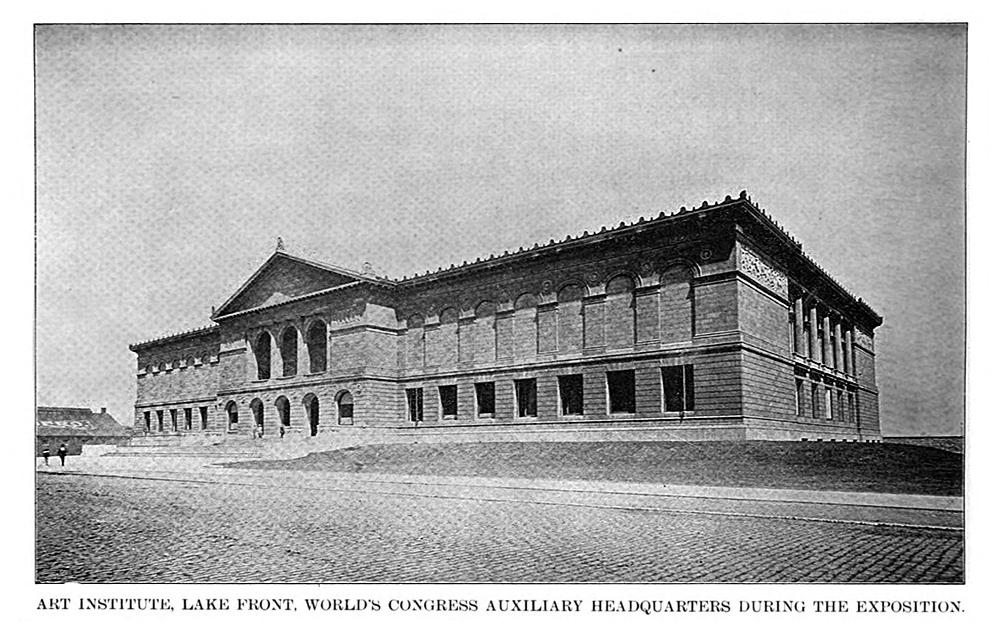
Architectural Digest recently took a look "back at some of the most innovative architecture built for expositions around the globe." In his article "The 20 Boldest Buildings in the History of the World's Fair," Niki Mafi lists the Art Institute of Chicago at #5, behind the Eiffel Tower (Paris, 1889), the Grand Palais (Paris,. 1900), the Royal Exhibition Building (Melbourne, 1880), and the Arc de Triomf (Barcelona, 1888). The classical Beaux-Arts building designed by Shepley, Rutan and Coolidge of Boston is sometimes forgotten as being part of the 1893 World's Fair. Located on Michigan Avenue in the Chicago Loop, the structure [...]
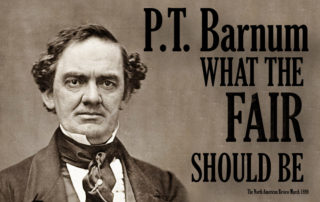
P. T. Barnum’s “What the Fair Should Be”
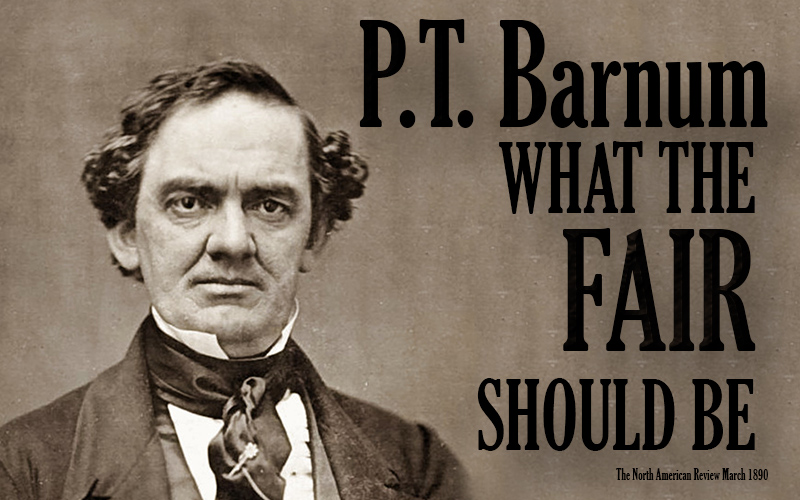
The new musical biopic The Greatest Showman starring Hugh Jackman is shining the spotlight on the life and time of Phineas Taylor Barnum. Although the legendary circus showman died before the Columbian Exposition opened in Chicago in May of 1893, Barnum penned some thoughts on the upcoming World's Fair--then slated for 1892 in a still undetermined city. His short piece was published in March 1890 issue of The North American Review. Perhaps the greatest showman on Earth would have enjoyed the "stupendousness of the incongruity" found between the White City and the Midway. WHAT THE FAIR SHOULD BE by P. T. Barnum [...]
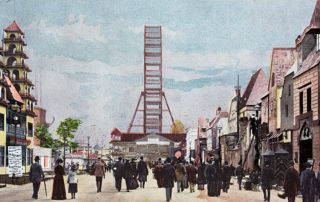

PICTURESQUE WORLD’S FAIR. AN ELABORATE COLLECTION OF COLORED VIEWS (pp. 15-16)
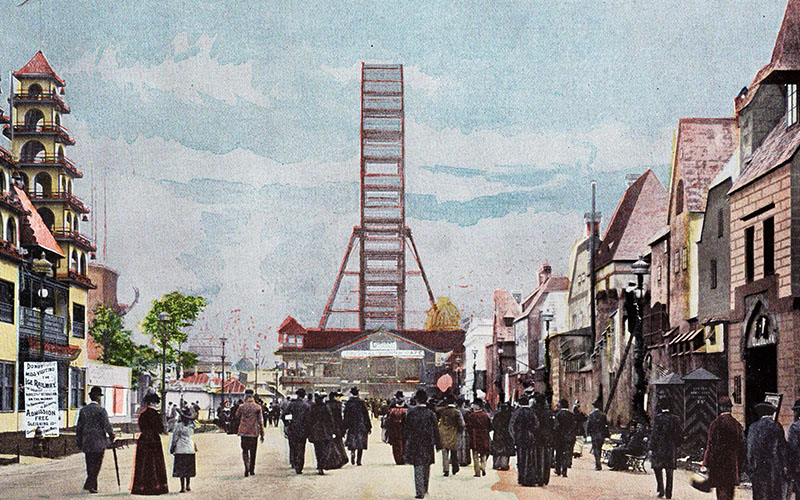
PICTURESQUE WORLD’S FAIR. AN ELABORATE COLLECTION OF COLORED VIEWS Page 15 A VIEW IN MIDWAY PLAISANCE.—A city in itself was the Midway, picturesque certainly, and educational as well, however meretricious some of its droll features. It was the playground of the multitude and they learned much while they ate, drank, stared and were merry. The view above presented is from a point about the center of the west half of the Plaisance and a little west of the Ferris Wheel. On the right appear the fronts of Old Vienna and on the left the entrance to the Chinese Village [...]
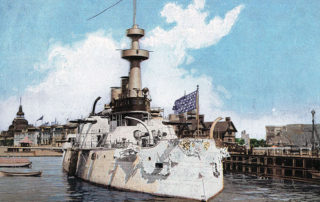
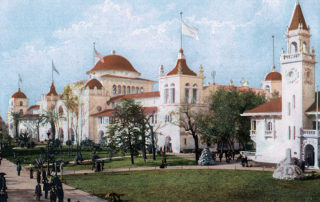
PICTURESQUE WORLD’S FAIR. AN ELABORATE COLLECTION OF COLORED VIEWS (pp. 17-18)
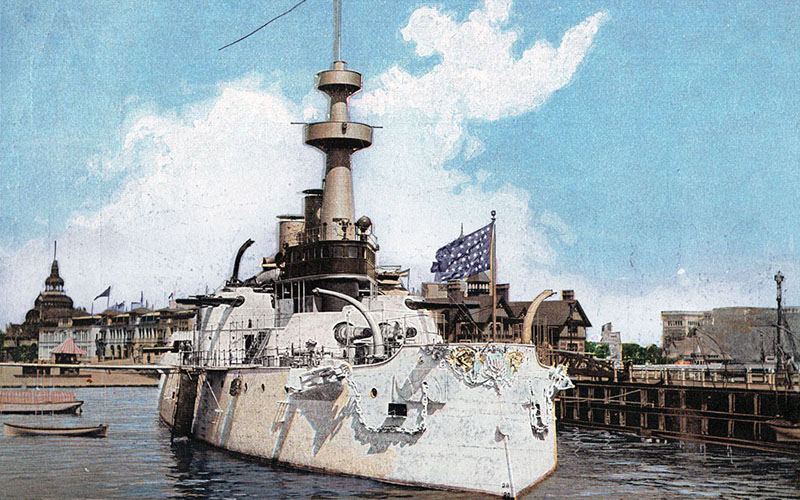
PICTURESQUE WORLD’S FAIR. AN ELABORATE COLLECTION OF COLORED VIEWS Page 17 THE UNITED STATES BATTLE-SHIP ILLINOIS.—The happy idea of a battle-ship as a part of the naval exhibit at the World's Fair is said to have originated with Commodore R. W. Meade, U. S. N. The result of the conception was the "Illinois," which lay apparently at anchor in Lake Michigan, near Victoria House, and approachable from one of the docks. The "Illinois" was a reproduction of one of the ten thousand three hundred ton battle-ships of the navy, such as the "Oregon" and "Indiana," and was built of [...]