

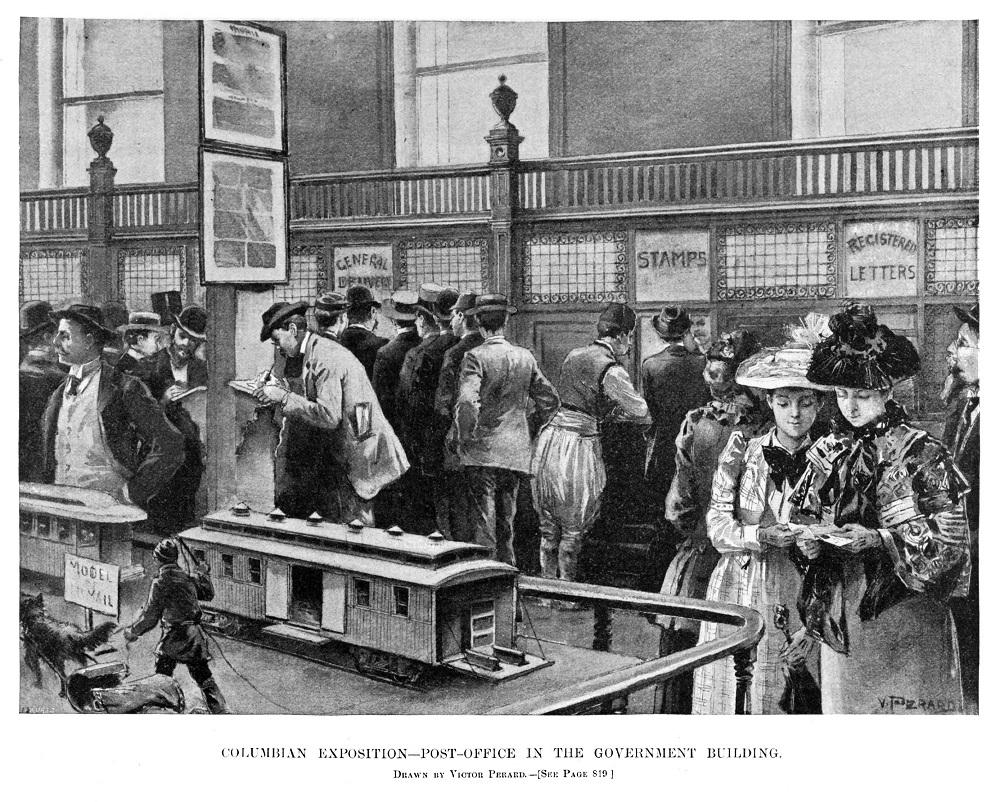
The U.S. Government Building at the 1893 World’s Fair housed exhibits from the official host of the Exposition. A display from one federal agency was described as “the grotesque mingling with the horrible, and tender sentiment jostling with the ghastly evidences of tragedies.” [Image from Harper’s Weekly August 26, 1893.]
“There is one collection of rarities in the government building which holds the passers-by with a baleful fascination as potent as that exercised by the ancient mariner in his palmiest days,” declared the Minneapolis Journal, adding that:
“Everybody who goes sightseeing through the building stops to look at it, and it seems sometimes as if everybody who went through the building stopped here at precisely the same time. They stand around the cases from three to ten deep and gaze, first in silent wonder, then with a gradually broadening grin of comprehension, which in not a few cases deepens into the sheepish, half guilty look assumed by a person whose conscience has received a sudden and unexpected jolt.”
The Chicago Record reported that
“So much that one sees in the buildings is of a serious purpose that the visitors welcome any suggestion of comedy. That is why two large cases in the government building are always hedged in by snickering men and women…. People stand around for half an hour pointing and laughing.”
This was the mail morgue, the Dead Letter Office Exhibit of the United States Post Office.
A photograph showing the working United States Post Office branch in the U.S. Government Building. [Image from Johnson, Rossiter A History of the World’s Columbian Exposition Held in Chicago in 1893, Volume 3: Exhibits. D. Appleton and Co., 1897.]
“Articles of unique and curious character”
Postmaster General John Wanamaker directed the United States Post Office to establish an exhibit in the U.S. Government Building at the Columbian Exposition. The agency’s 15,000-square-foot exhibit, mounted in the southwest corner of the building, included a working model post office that served the entire fairgrounds as a branch station to the Chicago post office. Working employees formed a living display as they stamped and sorted mail behind plate glass viewing windows. In the next section, visitors could see a full-sized railway postal car named the Benjamin Harrison, a stage coach, and all other means of mail transportation. A Postal Museum just north of that displayed stamps, mail, postal equipment, and photographs of Post Office veterans. “Hardly a stamp in the whole category of the bits of paper which the nations have licked and put in a corner all these years past was missing from the collection,” observed historian Henry Northrop.
What drew some of the largest crowds, however, was a collection of curious articles of mail matter which had accumulated in Postal Service headquarters. According to the Official Directory, the display consisted of
“… six large cases of articles taken from the museum of the Dead Letter Office at Washington. This collection comprises about one thousand articles of unique and curious character, found in the mails and undeliverable to the senders or addresses. The Dead Letter Office exhibits have always been a source of great interest to visitors to the National capital.”
A postal system handing the mail of 65 million Americans, addressing their envelopes and packages by hand, was bound to end up with an enormous amount of items for the mail morgue—and it did. Mr. D. P. Leibhardt, Superintendent of the Dead Letter Office in Washington, reported at the end of 1892 that they had received more than five million letters, with about ten percent of them undeliverable. Official practice was that, if the owner was not found or did not claim an item after one year, the Post Office would either auction items or add them to a growing museum of oddities in the nation’s capital. From among this selection were harvested the World’s Fair display of lost mail. Mr. Leibhardt arrived in Chicago with other post officials on April 19 to oversee the installation of the exhibits. Mr. Edward Bond, of the postal exhibit force, arranged some of the displays.
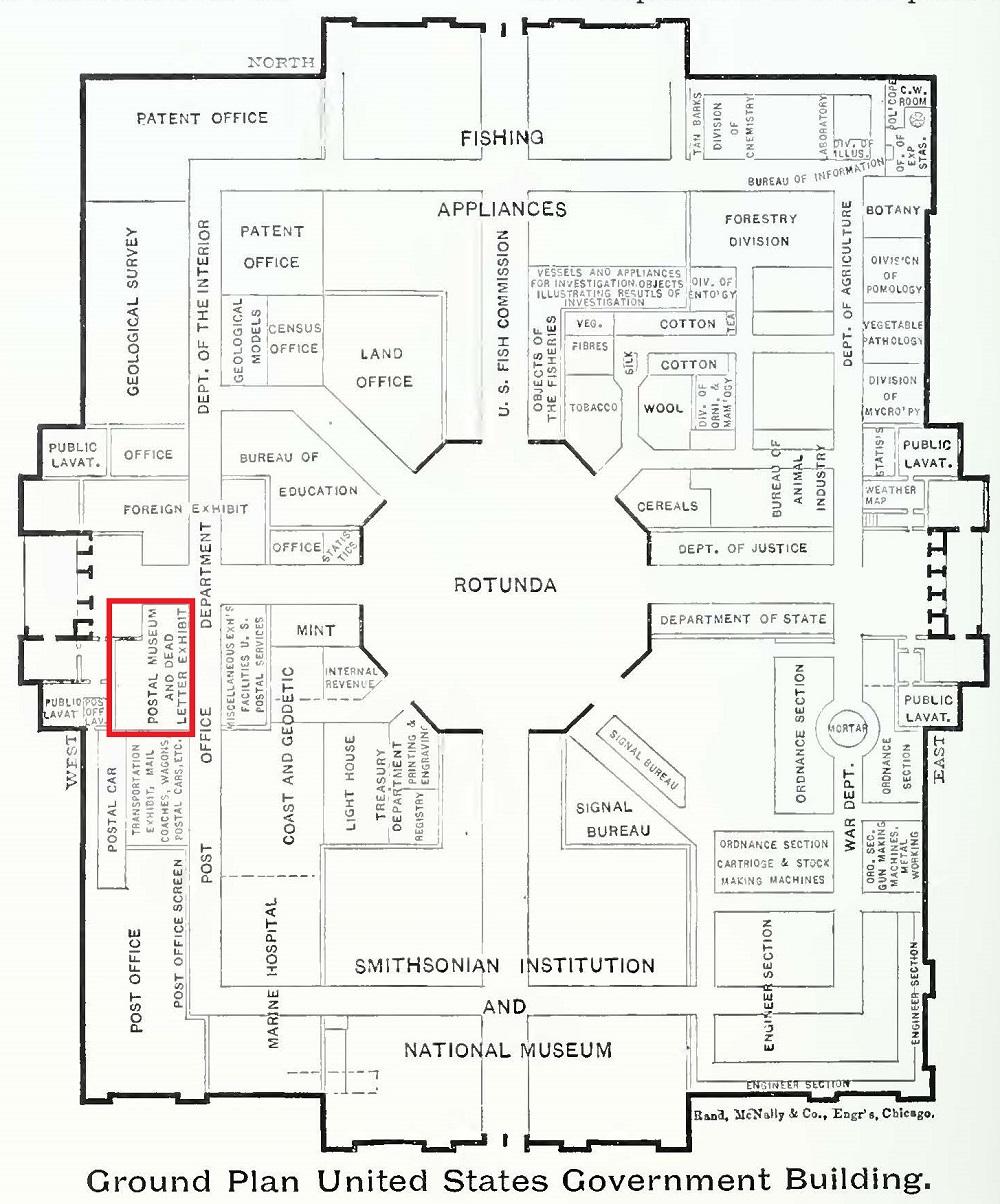
About a thousand items in the Dead Letter Office Exhibit were displayed in the southeast corner of the U.S. Government Building. [Image from Rand, McNally & Co.’s A Week at the Fair. Rand, McNally & Co., 1893.]
“Grotesque and strangely blended groups”
The results was “one of the most interesting features of the governmental exhibit.” Several newspapers reported that the Dead Letter Office Exhibit attracted the greatest crowds. Amused and interested spectators constantly surrounded the upright cases displaying many hundreds of curious items. Columbian Exposition historian Hubert Bancroft records that:
“To the average sight-seer the most attractive exhibits in the postal department are those which contain the unclaimed packages of the dead-letter office. … In truth it is a fitting accompaniment of an exposition intended to display all the products of soil, mine, and sea, for many of those products, including also the denizens of air, are to be found in these grotesque and strangely blended groups.”
A syndicated news story titled “The Uncle Sam Show” described the scene as “the grotesque mingling with the horrible, and tender sentiment jostling with the ghastly evidences of tragedies.” Presumably the reporter spoke of the items on the shelves and not the people gawking at them.
Mrs. Mark Stevens described her tour of the Post Office display:
“As we wandered past many things we would like to tell about, we heard ripples of laughter growing louder as we neared the Dead Letter Office. Oh, what a conglomeration there was of clothes pins, watches, birds’ nests, jewelry, sticks of wood, brickbats, Irish, Dutch and negro rag dolls, bracelets, spikes, teapots, cardboard on which was worked ‘Welcome Home.’ In a box was a paper of raisins, fruit cake, some candles, a box of boot blacking; next we saw corn poppers, a flat flask labeled ‘When I’m full send me home to Johnny Dunn,’ combs, clockworks, pine-tree combs, a hunk of candy as big as your head, ears of corn, a cage of horned toads which the United States guard informed us were received in 1880, and up to that time, June, 1893, they had not had a drop of water or anything to eat, except as they caught flies, the guard adding, ‘They are fly toads.’”
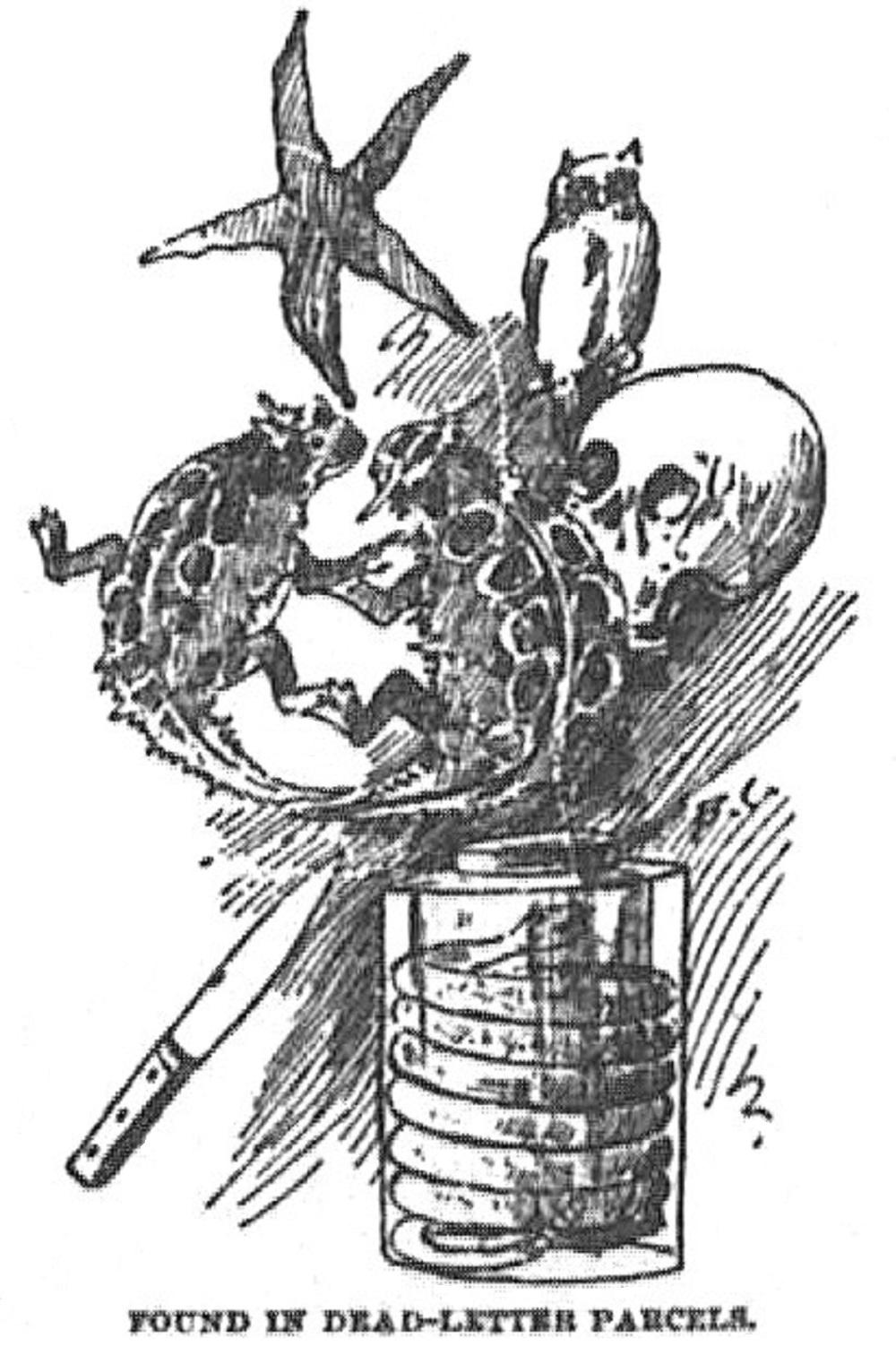
An illustration of some items found in dead letter parcels. [Image from the Chicago Record July 26, 1893.]
“A varied collection of odds and ends”
Each visitor had different curiosities catch their eyes. “Never was there such a varied collection of odds and ends in so small a space before. It ranges from alligators to layer raisins, and includes everything on earth, in air, or sea,” reported a story in the Minneapolis Journal. An article in the Nashville Tennessean remarked that “As an illustration of what one would naturally think would never be consigned to the mail but in reality is received at the dead letter office daily, there are a pair of felt boots, a large basket of dishes, a wedding cake and all manner of wearing apparel. There are also “birds’ eggs, a sack of flour, a can of salmon, a gold headed cane and a pint bottle of potato bugs.” Other reports described displays of “a string of battered Chinese coins;” “cocoa nuts, cakes, candles, umbrellas, tambourines, watches, walking sticks, dolls, an elephant (Jumbo), and a number of snakes alive in a perforated tin can.;” “sleigh bells jumbled inside by side with stuffed birds and rag babies;” “musical instruments such as tambourines, banjos, accordions etc., which have never responded to the touch of the one to whom they were consigned;” “teapots, sprinklers, boot jacks, flat irons, canes, umbrellas, lamps, clocks,” “a bushel of rocks and minerals;” “enough medicine to stock an apothecary’s shop;” and “a package of tobacco [that] awaits its owner.”
Among the personal gifts sent but never received were:
- “a china cup having in gold letters on its side, ‘For Mother’s Boy. Thus is another illustration given the world of a mother’s love for the absent child”;
- a large rag doll sent to, but not accepted by, a young lady on fashionable Fifth Avenue in New York;
- a boot-black’s foot-box with a note tacked on it reading “Happy New Year!”;
- a wedding cake—meant to convey a great burden of joy and happiness, but never did—now somewhat old and dry, possibly possessing the necessary elements for a nightmare;
- and a crude picture frame made of porous rock inscribed with “Taken from the Modoc beds, Oregon” and containing a tin-type of a man resembling poet Joaquin Miller.
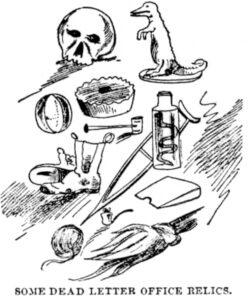
Some Dead Letter Office Relics. [Image from the Livingston County (MI) Daily Press and Argus July 27, 1893.]
“Everybody notices this volume”
Several rare and valuable historical artifacts ended up in the lost-mail display. Among them was a letter containing a hand-written note and lock of hair sent to a young lady by Charles Guiteau at the time of his trial for the assassination of President Garfield. The present was intended to enlist the girl’s sympathy and move her to a loan of money to carry on the defense. She did not accept the letter. Other items on the shelves included:
- ancient books and manuscripts written on vellum in a score of languages;
- a silken banner from the ill-fated USS Vandalia, which was wrecked by a cyclone in Apia Bay, Samoa, on March 16, 1889;
- a scroll containing the Lord’s Prayer in fifty-four languages executed by hand;
- a Masonic apron of fine leather, beautiful in design and workmanship;
- a pen picture of the famous Mushroom Club of Dorchester, Massachusetts. The current Club members identified the men depicted in the picture, most dead by the time of the 1893 Fair.
Residents of Decatur, Illinois, were especially proud to discover an item from their hometown in one display case. A neatly bound volume having the title Spiritual Series. Ireland’s True Spirit. A Guide to Health and Happiness was edited and published by D. W. Brenneman, a well-known citizen and saloon owner of Decatur. Protruding modestly from a small round hole at the top of the book could be seen the mouth of a whisky bottle. “Everybody notices this volume, and speaks of it to his neighbor, and in this way it serves to give our city a large advertisement,” boasted the Decatur Daily Republican.
Authorities immediately seize certain types of contraband—firearms, powder and ammunition, poisons, reptiles and live animals—which violate U. S. postal laws. “The Colombian Guard have devised a very pretty story about a little pearl-handled revolver in this department, and tell the credulous visitor how it was sent to a beautiful girl by a discarded lover, who had loaded it so that it would be discharged upon touching a certain secret spring,” wrote the Tennessean. “The truth of it is, however, that it is not a pistol at all, but a very ingeniously contrived cigarette case, with a long cylinder as a holder.” Also on display were:
- pistols of every quaint and bygone pattern known to man, and daggers and knives sufficient for an army of assassins;
- a box, to all appearances containing Chinese candy, that based on an unusual odor was found to be little balls of opium encased in a sugar crust.
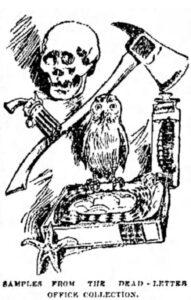
Samples from the Dead Letter Office. [Image from the Alton (IL) Evening Telegraph Aug. 17, 1893.]
“Thrown in to add to the gilded horror”
Among the most disturbing items were the human remains, including a couple of human skulls and a withered ear “thrown in to add to the gilded horror,” according to the Minneapolis Journal. “The Imagination of the guard might be used in this connection also,” wrote the Tennessean, “but in all probability these uncanny articles have been sent from one doctor or medical student to another.” The Burlington Clipper reported that “the most uncanny thing to be seen is a human skull, and an ear which it would seem was taken from the victim while yet alive, as the blood marks may be plainly seen.” Other bodily parts on display included:
- an Indian’s scalp with a shock of coarse black hair matted with blood, in a package stamped “Joseph, Oregon”;
- a plundered and blood-stained mail sack belonging to F. M. Peterson, mail carrier in Arizona who was killed by Apache Indians on July 23, 1885;
- false teeth galore arranged near an array of dentists’ implements, toothbrushes and powders, to complete the general effect;
- an owl perched serenely upon (another?) human skull.
Joining these human parts were other formerly living artifacts. A huge rattlesnake from the plains was found very much alive in a mailed package. A woman in Washington who removed the lid from its a perforated box fainted as the unhappy occupant made a break for liberty. After a five-minute chase, the chloroformed rattler was added to collection. Joining the rattler were:
- a crocodile or alligator (depending on the source), five feet in length;
- a robin’s nest with three eggs in it, placed in a cardboard box, and marked with best love of little cousin “E. L.”;
- a large tarantula from Mexico;
- two very large centipedes, confined in a bottle;
- a few buffalo hoofs and horns;
- a box of six horned toads all alive when sent in a cigar box and still alive while exposed to view at the World’s Fair, much to the horror of certain individuals amongst the crowd of sightseers;
Objects heavier than five pounds were not allowed to be mailed according to Post Office rules at the time, and several of these massive items found their way into the display, including:
- a full-sized fireman’s ax;
- a peck box of anthracite coal;
- a large satchel filled with clothing;
- a gamblers coat from the Fiji islands, made of playing cards sewed upon the cloth.
“To testify to the puerile eccentricity of some of the people of our enlightened land,” observed the Tennessean, “there are letters written upon boards several feet long and one foot in width. One of these singular epistles cost the sender forty cents postage, and then never reached its intended designation.” Other strange mail media used by senders included a love letter written “To Dear Hattie” on a board the size of a shingle. The amorous sender “Dick” was either sad that his long epistle was not delivered or perhaps proud that the world learned of the depths of his ardor. A linen cuff mailed from Seattle in 1889 contained this legible inscription besides the address, which could never be deciphered: “If not called for in thirty years return to Farallone Islands.” Uncle Sam was expecting to carefully treasure the solitary cuff until 1919.
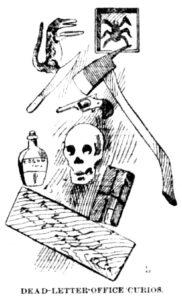
Some curios from the Dead Letter Office Exhibit. [Image from the Monmouth (IL) Daily Review Atlas Aug. 28, 1893.]
“Queer and impossible addresses”
The Dead Letter Office display also included mail that was only mostly dead. “The post-office vaults were disemboweled of their musty contents to make an exhibit” records Henry Davenport Northrup. “The dead-letter office, with all its aggregated ingenuity of mistake, was profusely illustrated, as likewise the process of expert deciphering the apparently undecipherable. There were some strange things from the Dead Letter Office, such as queer and impossible addresses, and remarkable objects sent by mail to no one in particular that eventually fell into the hands of the Government.”
The Sterling Standard reported that “on the sides of the cases containing these articles where sample letters found in the mail daily, and how human ingenuity can discover their true destination from the unintelligible scrawling, is a mystery.” It was no mystery, just a team of uncredited women. The Tennessean described these experts capable of determining the correct address: “ Among the forces of clerks are several ladies experienced in deciphering problems in chirography and versed in a dozen or more of the modern languages, so that there is every possible chance for a letter to go aright.”
Visitors at the Fair could inspect “facsimiles of re-addressed letters delivered after some delay, with illustrations of the way in which the parties concerned were found,” noted English visitor John Frederick Sheppard. The examples included:
- a letter addressed to W. Hawkins, Fair Water, Ill, but delivered at Fair Weather, Ill.;
- a letter addressed to Mrs. P. S. Clarke, Hy., but delivered at Hyamus, Mass.;
- a letter addressed to F. L. Swarth, Stillwater, Mo, but delivered at Deep Water, Mo.;
- a letter addressed to A. K. Spencer, Red Wood, Ma., but delivered at Red-mud, Mason’s County;
- a letter addressed to Mr. Budd Whitley, Bill Town, Kansas, but delivered at Williamstown, Kansas;
- a letter addressed to O. Stout, 786 Large Ave, Saintly City, Gopher State, but delivered at 786 Grand Ave, St. Paul, Minn.;
- a letter addressed to Daniel Maccamon, Silver City, Mo, but delivered at Golden City, Mo.;
- a letter addressed to Mrs. F. A. Smoot, c/o. Mrs. Pickett, Halfpenny, Mo, but delivered at Half Way, Mo.;
- a letter addressed to 48 Mussery St., Borden, Ill., but delivered at the Borden Art Co., 48 Murray St., New York;
- a letter directed to Smokey City but delivered at Pittsburg.
Zip codes were still seventy years away.
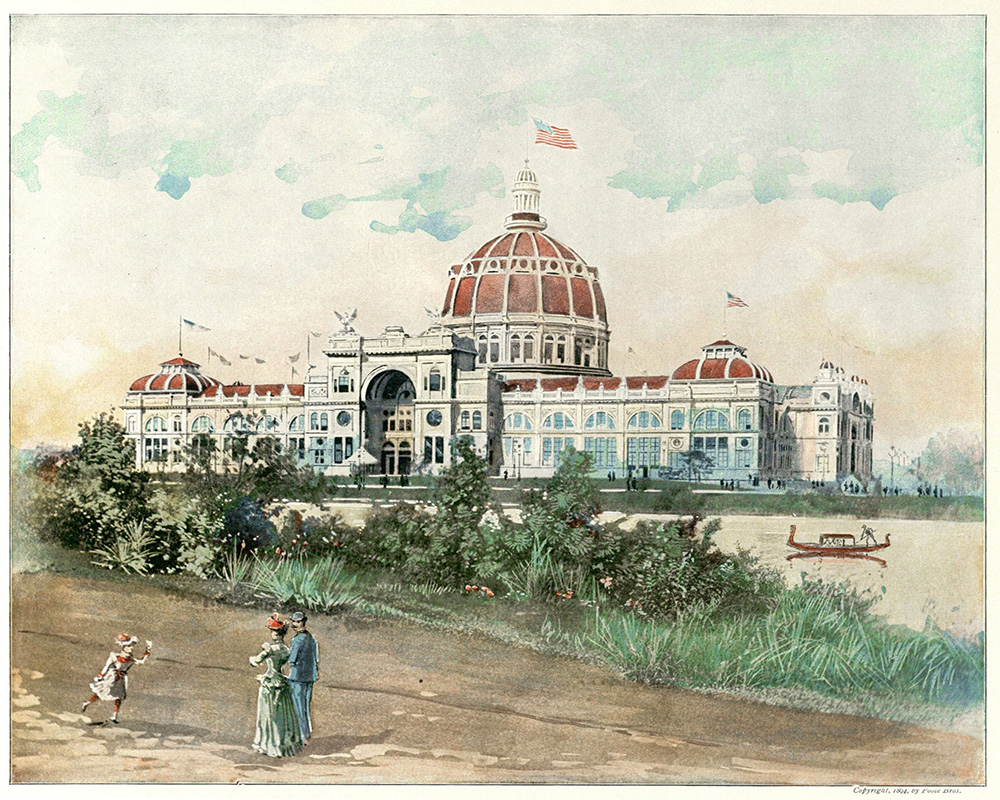
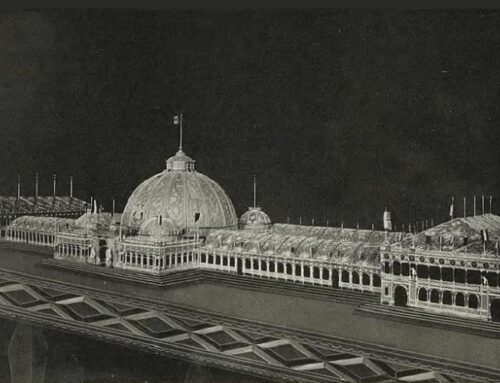
The United States Government Building, looking eastward from Wooded Island at the 1893 World’s Fair. [Image from Vistas of the Fair in Color. A Portfolio of Familiar Views of the World’s Columbian Exposition. Poole Bros., 1894.]
“A strange collection”
The Dead Letter Officer Exhibit offered visitors to the World’s Fair something practical yet poetic. Hubert Bancroft noted that “among other purposes, the Fair may serve as a means of restoring to owners some of their stray effects.” A syndicated newspaper story published in the Olneyville Tribune also pondered the idea of some items finding their rightful recipients:
“A person who stands before this case has many strange thoughts. It is a place where a poet might muse and a wit will be in paradise. Think of a human ear being sent through the mail, or a skull, doll babies, relics of hair, mourning cards, whole cakes, axes, cartridges, boxes of candy, etc., etc. A shirt cuff that was left by some traveler who failed to pay his bill has been written on and rhymed on, and sent after the absconder. But he never got it; I wonder if some of the people who mailed some of the objects in that case have as yet seen and recognized what they have lost and never knew whence it had gone? There are sad things, too—objects that meant ever so much to some poor heart or another. Verily, it is a strange collection.”
Even if the lost letters and package never found their way home, the oddball collection served to entertain and inform spectators. “Something new and startling is always being added to the museum,” reported the San Francisco Chronicle. “The exhibits sent from Washington excites the smiles of thousands every day.” The Rome Daily Sentinel noted that “skulls, scorpions, tarantulas, rattlesnakes, horned toads and Gila monsters are not usually considered humorous things, but it is hard to avoid smiling at them when they are seen among the entries of the dead letter office in the post office exhibit at the world’s fair.”
“All day long the crowds gather and part, and their uneasy consciences ever bring them back for just one more fascinated stare at the heterogeneous collection, ” wrote the Minneapolis Journal, which observed that “a man may stand in front of it and merrily jest on the folly of any one sending snakes or chewing tobacco through the mails, and underneath all his blithesome manner may lie the consciousness that it was only last week that he himself sent molasses candy or cologne.” The Los Angeles Herald described the scene as:
“a never ending source of amusement to the wondering sightseers, who stop, gaze, comment and make fun of any rational person who would send live horned toads, bricks, skulls, molasses candy, snakes, rag dolls, Indian scalps and everything else on earth, in air or sea through the mails, under the seal of a Columbian stamp…. All the odds and ends of civilization and barbarism thrown together, probably forms the most varied collection ever conceived of in the brain of a maniac faddist.”
In an attempt to explain the display’s popularity, the Los Angeles Herald posited that “the majority of world’s fair visitors are ruralites who have never been privileged to visit the splendid museums at the national capital, from which places the bulk of the exhibits here are drawn.” Exposition historians White and Igleheart concurred, calling the USPS display “an exhibit which appeals to every one, so closely are its interests connected with our daily life.” The Monmouth Daily Review noted simply that “a visit to the post office exhibit in the Government building is apt to increase one’s respect for the little postage stamp.”
Despite being surrounded by displays of seemingly magical inventions, monstrous showpieces, masterworks of the art world, and cultural artifacts from across the globe and across time, these mostly quotidian objects seemed to delight fairgoers. Display cases filled with lost stuff celebrated the network that connect every home and business to every other one in the nation—the United States Post Office. Visitors may have left with a better appreciation of the vast, mostly unseen, mail delivery system they depended on.
SOURCES
“At the Fair” Decatur (IL) Weekly Herald Despatch Jul. 1, 1893, p. 6.
“At the Fair” Olneyville (Providence, RI) Tribune Sep. 30, 1893, p. 6.
Bancroft, Hubert Howe The Book of the Fair. The Bancroft Company, 1893.
“Dead Letter Curios” Rome (NY) Daily Sentinel Sep. 20, 1893, p. 4.
“Decatur Exhibit at the World’s Fair” Decatur (IL) Daily Republican Jun. 24, 1893, p. 1.
“From the Dead Letter Office” Minneapolis (MN) Journal May 19, 1893, p. 8.
Handy, Moses P. The Official Directory of the World’s Columbian Exposition. W. B. Conkey, 1893.
“Matters at the Chicago Fair” Los Angeles Herald Oct. 8, 1893, p. 9.
Northrop, Henry Davenport The World’s Fair as Seen in One Hundred Days. Ariel Book Co., 1893.
“One Week at the Fair” Burlington (VT) Clipper Jul. 14, 1893, p. 1.
“Pennsylvania Chautauqua” Lebanon (PA) Daily News Jul. 21, 1893, p. 1.
“Postal Curiosities” Monmouth (IL) Daily Review Aug. 28, 1893, p. 3.
“Queer Mail Packages” Nashville (TN) Tennessean Jun. 6, 1893, p. 6.
Sheppard, John Frederick A Trip Across the Atlantic, a Tour in the States, and a Visit to the World’s Fair. Southampton Times Steam Printing Works, 1893.
“Society People are Puzzled” Chicago Record Jun. 15, 1893, p. 3.
Stevens, Mrs. Mark Six Month’s at the World’s Fair. Detroit Free Press Printing Co. 1895.
“That State Souvenir” Spokane (WA) Spokesman Review Jul. 20, 1893, p. 10.
“Uncle Sam’s Big Part” San Francisco Chronicle Sep. 30, 1893, p. 2.
“The Uncle Sam Show” Bureau County (IL) Tribune Jul. 7, 1893, p. 10.
White, Trumbull; Igleheart, William World’s Columbian Exposition Chicago, 1893. J. W. Ziegler, 1893.
“The World’s Fair” Austin (TX) American-Statesman May 6, 1893, p. 5.
“World’s Fair Sights No. 3” Sterling (IL) Standard Jun. 29, 1893, p. 2.






Leave A Comment