THE CITY OF WONDERS: A Souvenir of the World’s Fair (Chapter 5)
THE CITY OF WONDERS A SOUVENIR OF THE WORLD'S FAIR by Mary Catherine Crowley (1894)
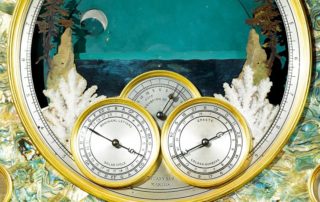
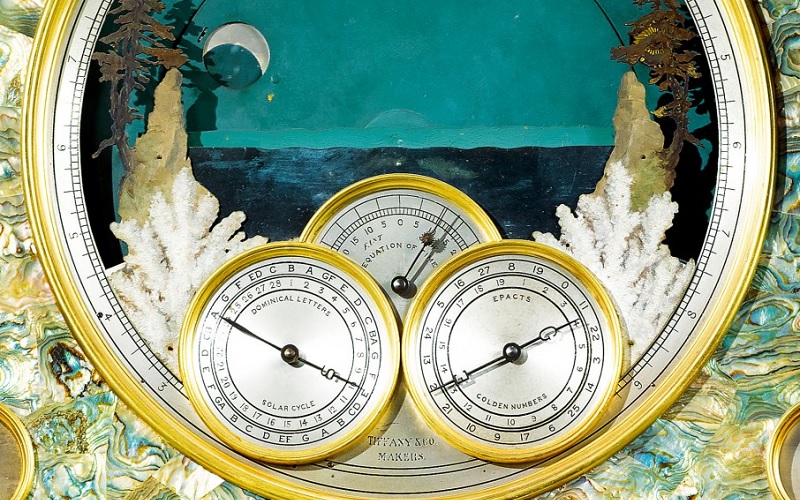
(Left) The “Louis XV Clock” on display in the Tiffany Pavilion within the Manufactures and Liberal Arts Building. [Image from Bancroft, Hubert Howe The Book of the Fair. The Bancroft Company, 1893.] (Right) The Tiffany clock today. Note the plain lower panel, compared to the image of the clock from 1893. [Image from Sotheby’s.] A magnificent clock manufactured by Tiffany & Company and exhibited at the 1893 World’s Fair sold by Sotheby's at their June 4, 2019, auction [...]
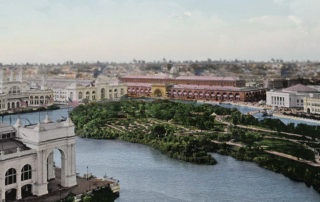
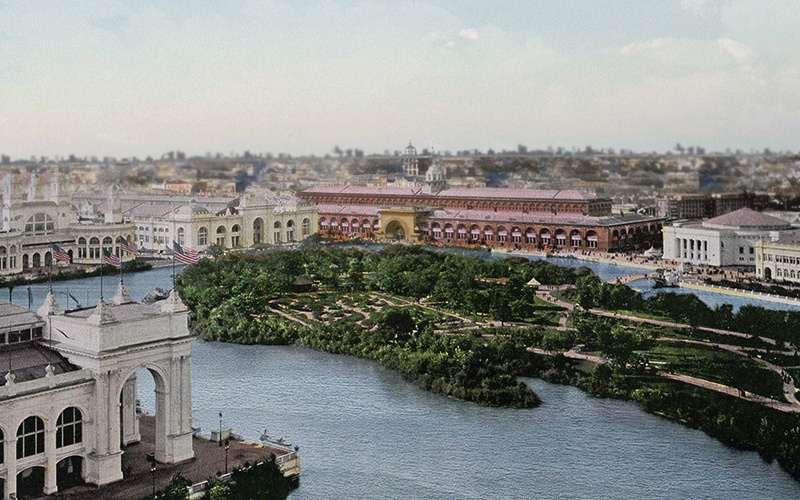
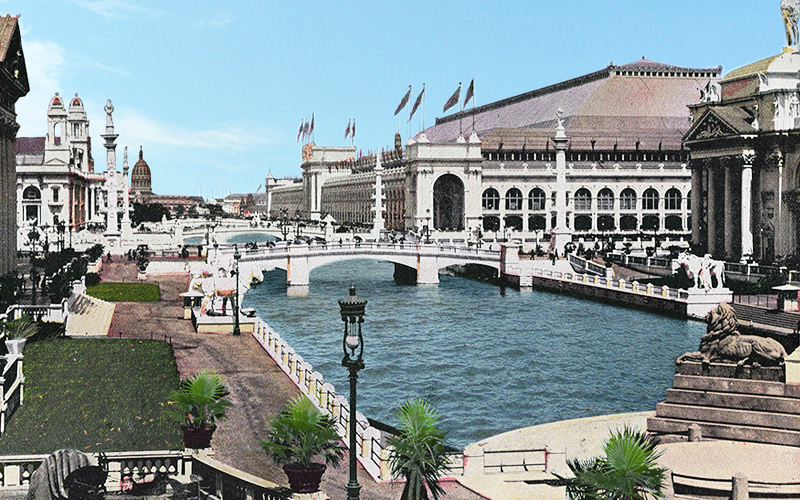
PICTURESQUE WORLD’S FAIR. AN ELABORATE COLLECTION OF COLORED VIEWS Page 84 – LOOKING NORTH FROM THE SOUTH COLONNADE LOOKING NORTH FROM THE SOUTH COLONNADE.—In the opinion of many people the most striking extended view to be had upon the Fair grounds was from the Obelisk, at the southern extremity of the South Canal, or better still, from the Colonnade immediately in its rear. From this point opened a vista nearly a mile in length terminated only by the beautiful [...]
Mr. Harry Hems of Exeter, England, submitted the following report on his return visit to Chicago for the opening of the 1893 World’s Fair. At the Exposition, he worked in the British section of the Manufactures and Liberal Arts Building. His unflattering missive from May 15, 1893, about “the most dangerous town in the world” was reprinted in the June 1 issue of the Irish Builder. Let’s hope the rest of Mr. Hems’ time at the Chicago fair left [...]
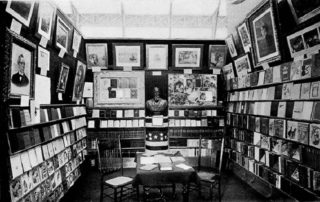
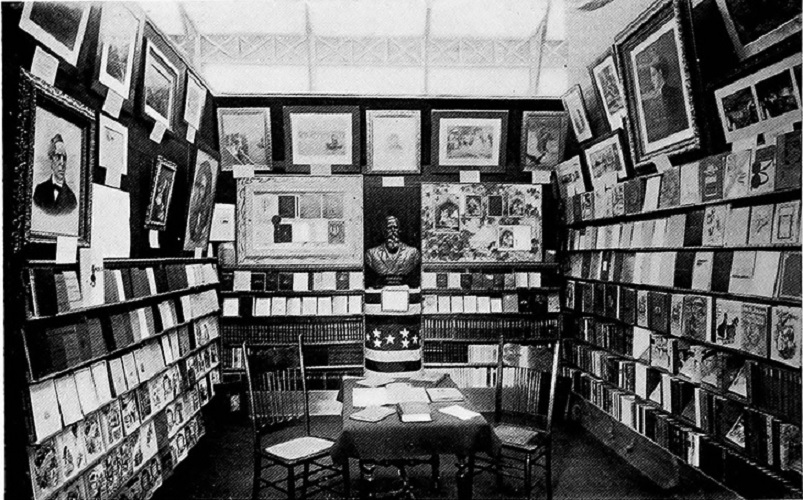
“Extremes meet at Chicago.” —librarian Caroline Harwood Garland. The 1893 World’s Fair was full of contrasts: exotic dancing on the Midway and educational exhibits; fountains illuminated by electricity and bibles illuminated by paintings, dynamos and the Dewey decimal system; balloon rides and books. Amidst the Cracker Jack and orange cider was also “food for reflection in the existence of so many libraries.” To celebrate National Library Week, let’s take a look at libraries at the 1893 World’s Columbian Exposition. [...]
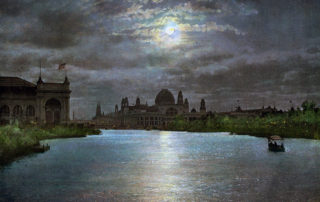
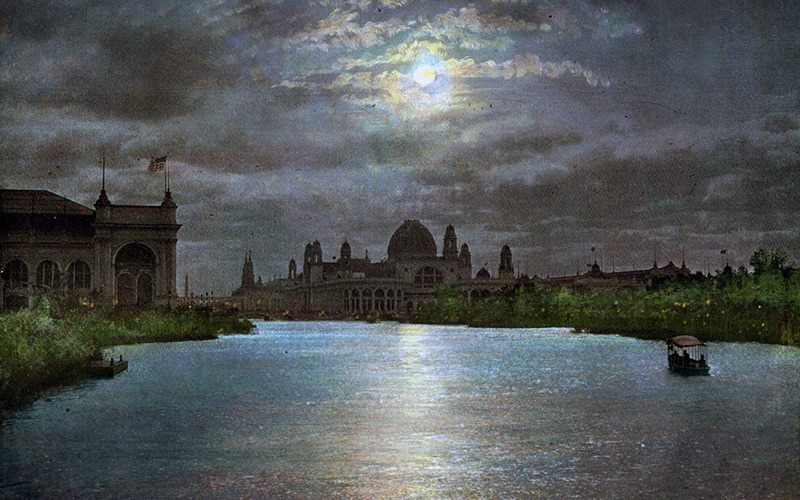
PICTURESQUE WORLD’S FAIR. AN ELABORATE COLLECTION OF COLORED VIEWS Page 77 – THE EAST LAGOON BY MOONLIGHT THE EAST LAGOON BY MOONLIGHT.— The night scenes at the Fair were undoubtedly the most beautiful for those who liked dreamy pictures, or half darkness contrasted with a blaze of glorious lights, better than unvarying white beauty. The fireworks, the illumination about the Court of Honor, the colored effects upon the Wooded Island were all charming and, in addition to these, was [...]
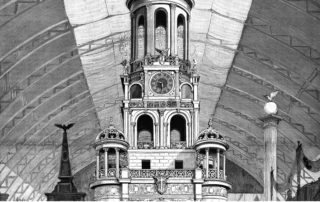
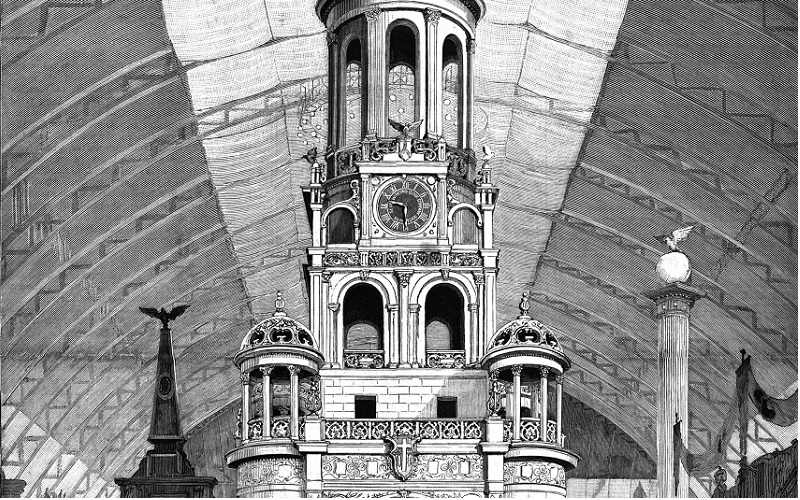
A timely reminder from World'sFairChicago1893.com to set your clocks ahead for daylight savings, which begins on Sunday, March 10, 2019. The Clock Tower of the Self-Winding Clock Company in the center of the Manufactures and Liberal Arts Building. [Image from Scientific American, July 29, 1893.]
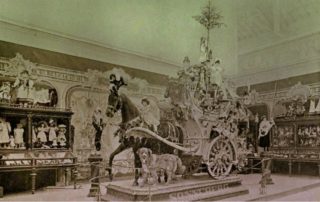
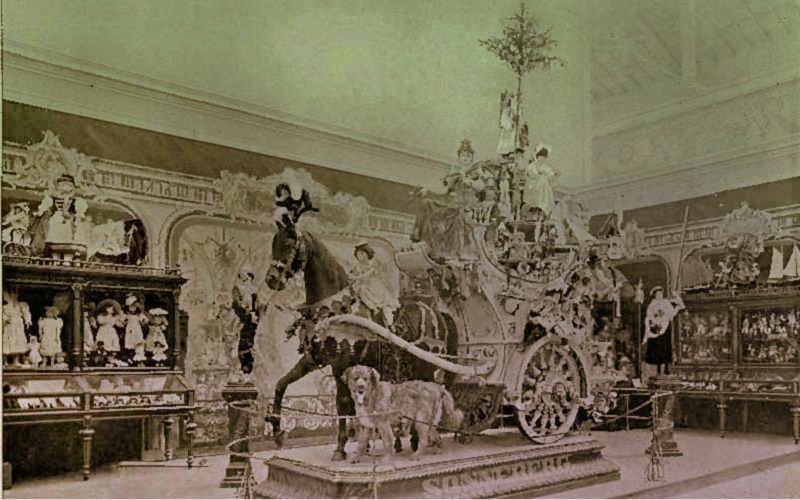
Although the 1893 World’s Columbian Exposition ran during the warm months of May through October, a touch of Christmas could be found on the fairgrounds. Nestled in the northwest corner of the German Pavilion inside the Manufactures and Liberal Arts Building (Section F, 77-79), the toy manufacturers of Sonneberg, Germany, featured a lovely display of toys and dolls filling an ornate carriage and topped by a Christmas tree. A photograph of the German toy exhibit in the Manufactures [...]
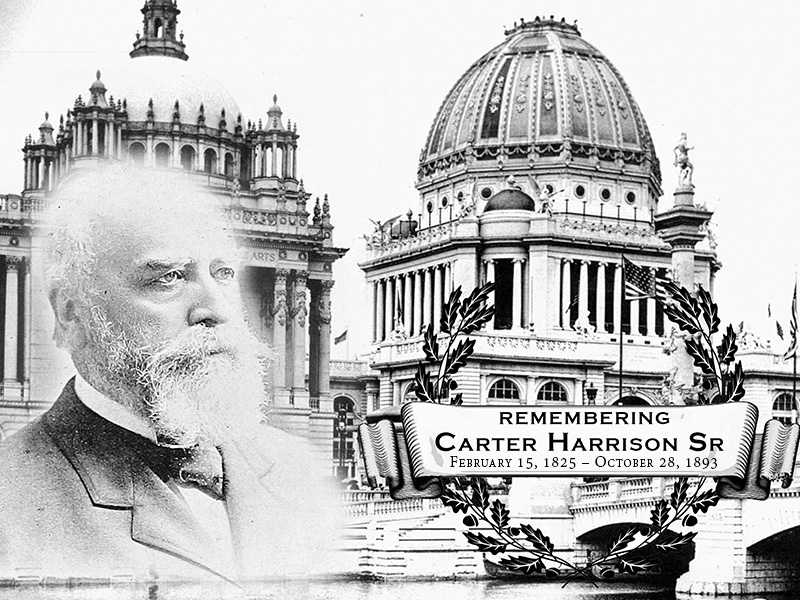
World’s Columbian Exposition celebrated “American Cities Day” on Saturday, October 28, 1893, two days before the close of the Fair. Chicago’s Mayor, Carter Harrison, hosted what was thought to be the largest congregation of U.S. mayors ever assembled. Greeting the guests as they arrived on the fairgrounds on the bitterly cold day was the blast of a cannon and musical fanfares from a group of sixteen trumpeters stationed around Music Hall. Mayors represented the great cities of Philadelphia, Milwaukee, [...]
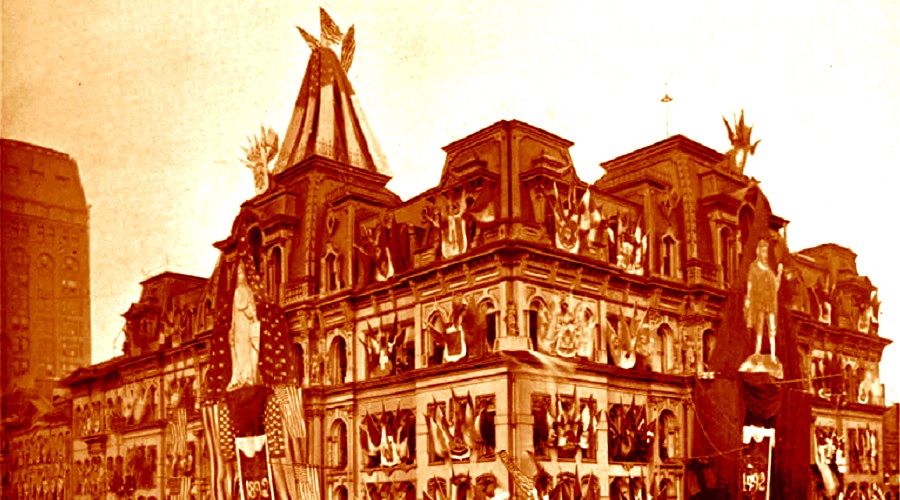
Frank Lloyd Wright was known for his Cherokee red, and Maxfield Parrish had his own blue. Diana Vreeland was known for wearing red, and Shelby Latcherie’s colors were "blush" and "bashful" (a.k.a “pink” and “pink”). Icons often have a signature color. In October of 1892, Chicago excitedly prepared for her coming out ball. The world soon would arrive to see the Fair, and downtown businessmen decided to decorate their city for the occasion. Chicago needed a signature color. An object [...]
Perched on a hilltop above Lake Geneva, Wisconsin, stands a magnificent structure having two significant connections to the 1893 World’s Fair. After more than 120 years of operation, this important legacy of the Columbian Exposition faces an uncertain future. Architect Henry Ives Cobb. (Image from The Graphic History of the Fair. (Graphic Co., 1894).] Henry Ives Cobb, born on August 18, 1859, in Brookline, Massachusetts, had become one of Chicago's most distinguished architects by the time of the [...]
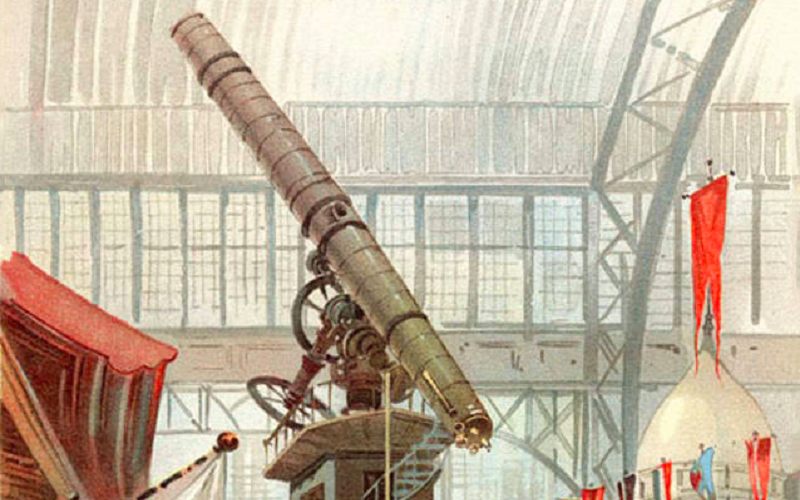
Among the many enormous and record-breaking displays at the 1893 World’s Columbian Exposition, none were astronomical as the Yerkes Telescope. The historic telescope has been on view to the public, and in service to scientists, for the past 120 years while housed in the Yerkes Observatory in Williams Bay, Wisconsin, a beautiful building designed by World’s Fair architect Henry Ives Cobb. The observatory and treasured telescope face an uncertain future as the University of Chicago ceases operations of the [...]
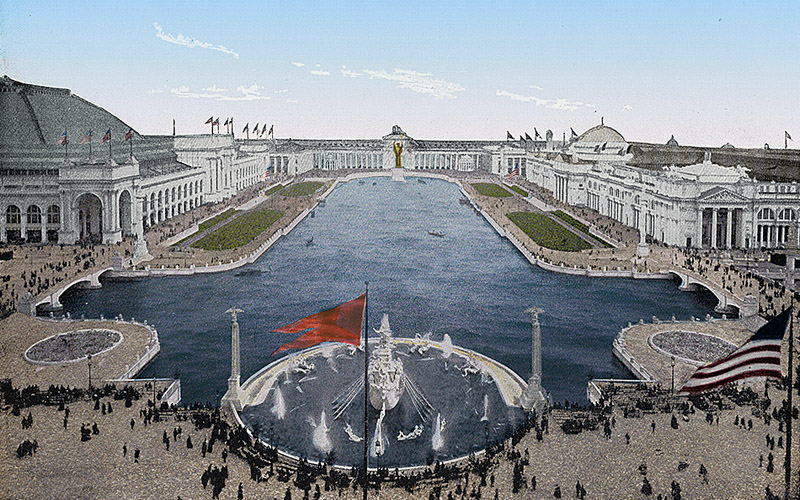
PICTURESQUE WORLD’S FAIR. AN ELABORATE COLLECTION OF COLORED VIEWS Page 62 – THE GRAND BASIN FROM THE ADMINISTRATION GALLERY THE GRAND BASIN FROM THE ADMINISTRATION GALLERY.—Very striking was the effect produced by the body of water known as the Grand Basin, forming a symmetrical marble-framed lake in the center of the Court of Honor. Here, during the day, were reflected the hosts of white fronts uprearing on every side; here, at night, were flashed back the blaze of light [...]
Within the enormous Manufactures and Liberal Arts Building on the fairgrounds of the 1893 World’s Columbian Exposition stood the imposing German Pavilion. Along with the other world powers of the era—Great Britain, France, and the United States—Germany displayed her national output in a prominent location around the central clock tower along the middle stretch of Columbia Avenue. Floorplan of the Manufactures and Liberal Arts Building [Image from Diagrams of World's Fair Buildings. Rand McNally, 1893.] Occupying a section [...]
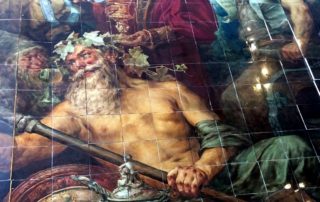
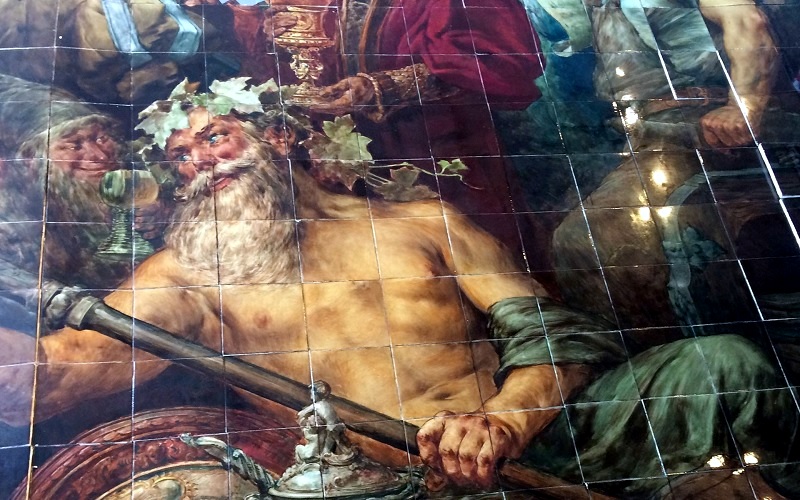
A German ceramic tile tableau exhibited at the 1893 World’s Fair is back on display for a limited time at the DANK Haus German American Cultural Center in Chicago. The Glory of Germania is an 18-by-12-foot tableau constructed of 1,057 individual tiles displayed with the German exhibit inside the Manufactures and Liberal Arts Building at the 1893 World’s Columbian Exposition. (See our full post here.) After 93 years on display in the Germania Club of Chicago and another 32 [...]
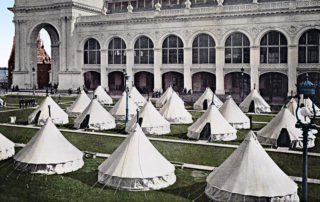
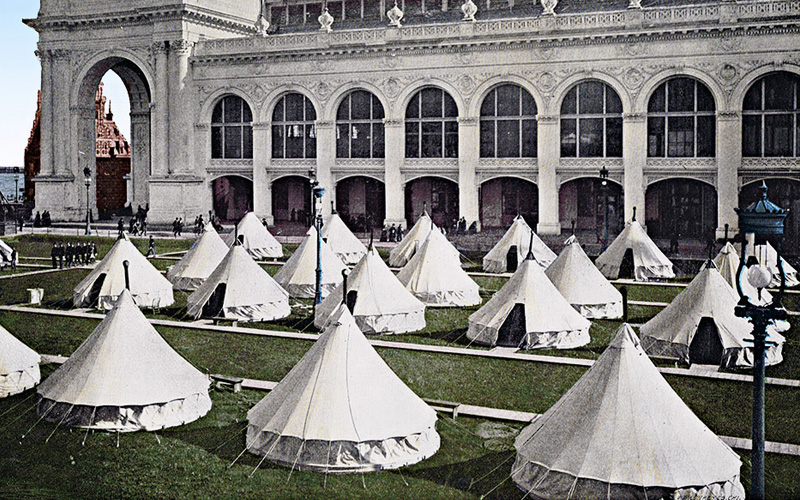
PICTURESQUE WORLD’S FAIR. AN ELABORATE COLLECTION OF COLORED VIEWS Page 55 – UNITED STATES MILITARY ENCAMPMENT, GOVERNMENT PLAZA UNITED STATES MILITARY ENCAMPMENT, GOVERNMENT PLAZA.—North and east of the Manufactures Building was an extensive plaza devoted altogether to the uses of the United States Government. Here were the military encampment, the life-saving station, the signal service bureau, the naval station, the light-house exhibit and similar governmental features. The view shown is taken from the Government Building looking southeast, the northeast [...]
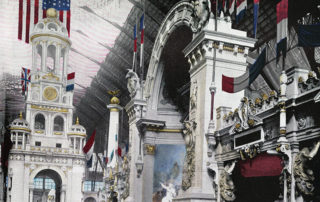
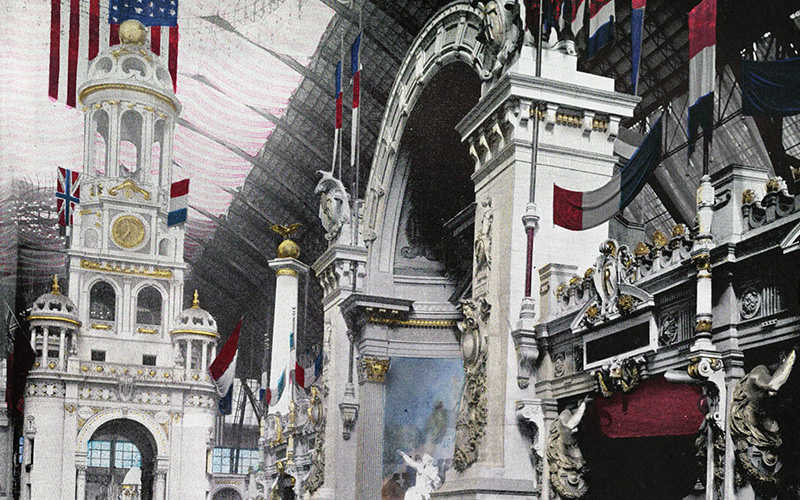
PICTURESQUE WORLD’S FAIR. AN ELABORATE COLLECTION OF COLORED VIEWS Page 54 – THE FACADE OF THE FRENCH SECTION FACADE OF THE FRENCH SECTION.—Among the various magnificent national displays made in the Manufactures Building that of France ranked with the greatest, either exteriorly considered or with regard to the works and products on exhibition. The section was on the east side of the north and south thoroughfare, known as Columbia Avenue, and at its junction with the main division east [...]
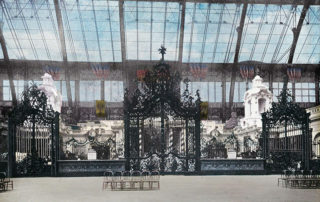
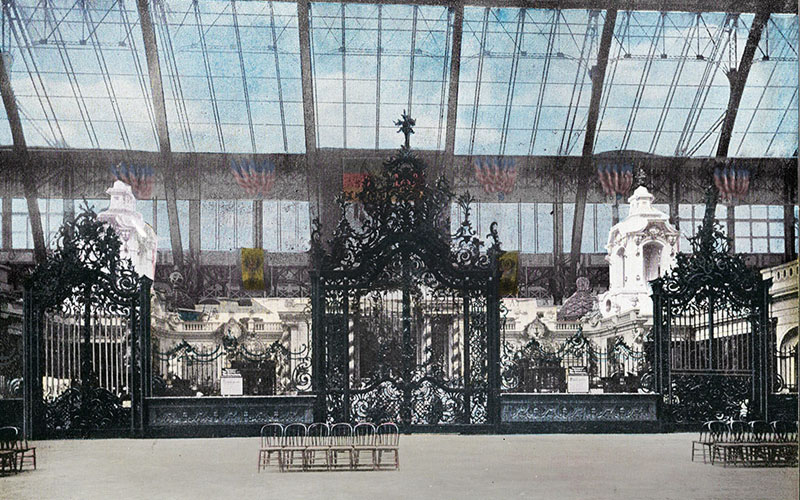
PICTURESQUE WORLD’S FAIR. AN ELABORATE COLLECTION OF COLORED VIEWS Page 49 – THE IRON GATES, GERMAN SECTION THE IRON GATES, GERMAN SECTION.—The facade, if it may be so called, of the German exhibit in the Manufactures Building, was as unique as it was attractive. No solid front or imposing arches faced the visitor, but, instead, merely three iron gates connected by an iron fence. But the gates were on a grand scale and with the connecting fence formed in [...]
Tour of the Fairgrounds This is Part 12 of our series “Opening Day of the World’s Fair,” which explores the events of May 1, 1893, at the World’s Columbian Exposition in Chicago. The full series can be found here. After the “Banquet of Nations” luncheon, President Cleveland and his entourage embarked on a whirlwind tour of the Columbian Exposition grounds and buildings. They departed from the north entrance of the Administration Building where carriages were waiting. “President Cleveland [...]
The Great Transformation Scene This is Part 10 of our series “Opening Day of the World’s Fair,” which explores the events of May 1, 1893, at the World’s Columbian Exposition in Chicago. The full series can be found here. As the last words fell from his lips at the conclusion of his short address, President Grover Cleveland placed his finger on the telegraph key. With his hand touching the electric switchboard, a chrysalis transformation scene was about to begin [...]