
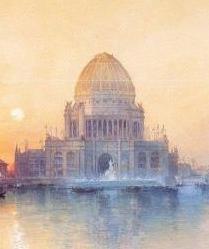
RECENT POSTS ABOUT THE HISTORY OF THE COLUMBIAN EXPOSITION’S BUILDING, FAIRGROUNDS, EXHIBITS, EVENTS, AND PEOPLE.
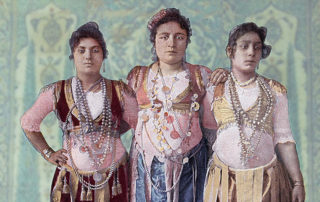
PICTURESQUE WORLD’S FAIR – Egyptian Dancing Girls (p. 34)
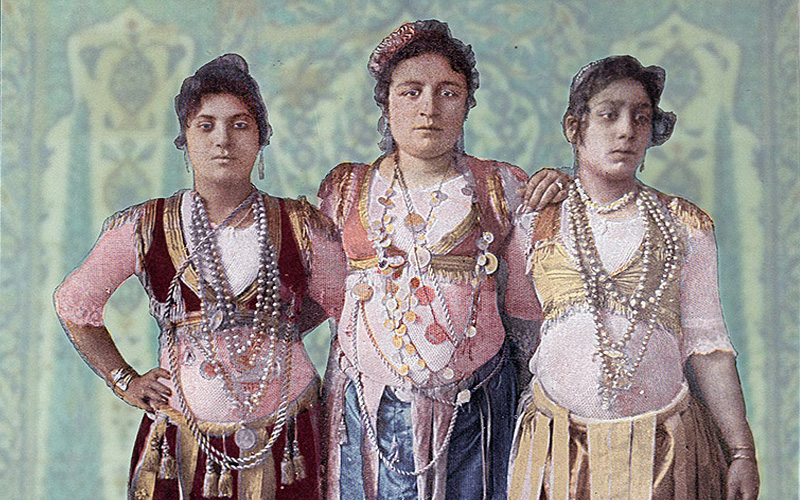
PICTURESQUE WORLD’S FAIR. AN ELABORATE COLLECTION OF COLORED VIEWSPage 34 – EGYPTIAN DANCING GIRLSEGYPTIAN DANCING GIRLS.—That prominent feature of the Midway Plaisance, a Street in Cairo, had a theatre among its attractions, and what doubtless drew most visitors to this place of entertainment, was the performance of the Egyptian Dancing Girls. The illustration gives excellent portraits of the three dusky beauties who were most prominent there, and shows also the semi-Oriental costume in which they danced. Of the performance it may be said that it was something entirely new in America and something not likely to become acclimatized. Suggestive it [...]
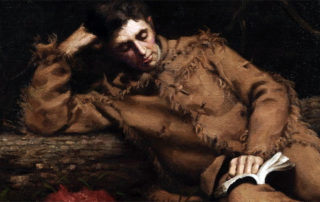
Presidential Painting
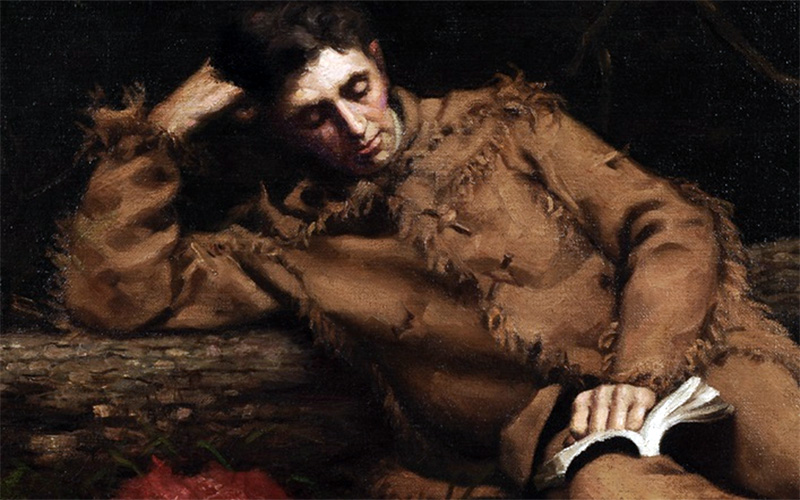
A painting of a young Abraham Lincoln, reported to have been on display at the 1893 World’s Columbian Exposition, was unveiled on February 9, 2018, at the Lincoln Presidential Library and Museum in Springfield, Illinois. The Young Abraham Lincoln by William Morton Jackson Rice [Image from the Abraham Lincoln Presidential Library and Museum.] The Young Abraham Lincoln, a 56-by-85-inch oil painting by William Morton Jackson Rice (1854-1922), depicts Lincoln sitting in front of a tree he has just chopped down. The buckskin-clad youth is shown reading a book with a small meal set on a red cloth handkerchief at [...]
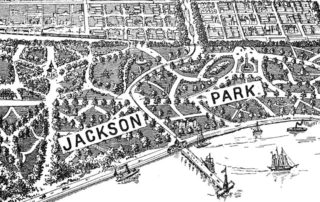
Site of the World’s Columbian Exposition
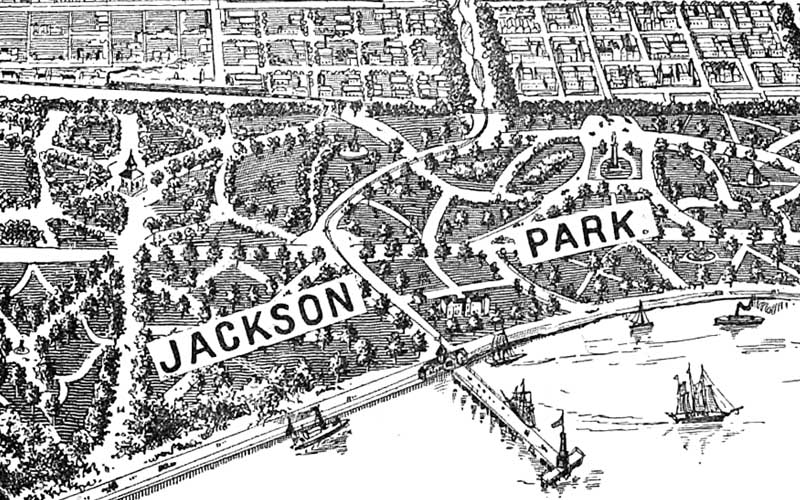
The piece below, from the first issue of The World’s Columbian Exposition Illustrated (Vol. 1 No. 1, February 1891) and likely written by editor James B. Campbell, offers an enthusiastic description of the locations that Chicago had recently selected to host the 1893 World’s Fair. The editorial boosterism belies much of the bitter fighting that went into reaching the decision to use Jackson Park as the main fairgrounds. At the time of this publication in early 1891, plans to use Washington Park (connect by the Midway to the west of Jackson Park) and the downtown site then known as [...]

March 8, 2018: Union League Club of Chicago lecture on “The Columbian Exposition”
The Union League Club of Chicago (ULCC) is celebrating the 125th anniversary of the 1893 World's Fair with a presentation by Greg Cook titled "The World's Columbian Exposition and its Transformation of Chicago Architecture" on Thursday, March 8 from 5:30-7 p.m. at the Union League Club (65 Jackson Boulevard in Chicago). The Union League Club of Chicago. [Image from https://www.facebook.com/ULCChicago/] A cocktail reception with a cash bar and light appetizers will start at 5:30 pm and feature a display of the Union League Club's recently conserved prints from Hubert Howe Bancroft’s The Book of the Fair and other archival artifacts from the [...]
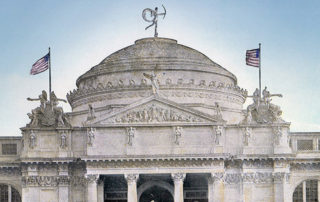
PICTURESQUE WORLD’S FAIR. – Dome of Agriculture Building (p. 33)
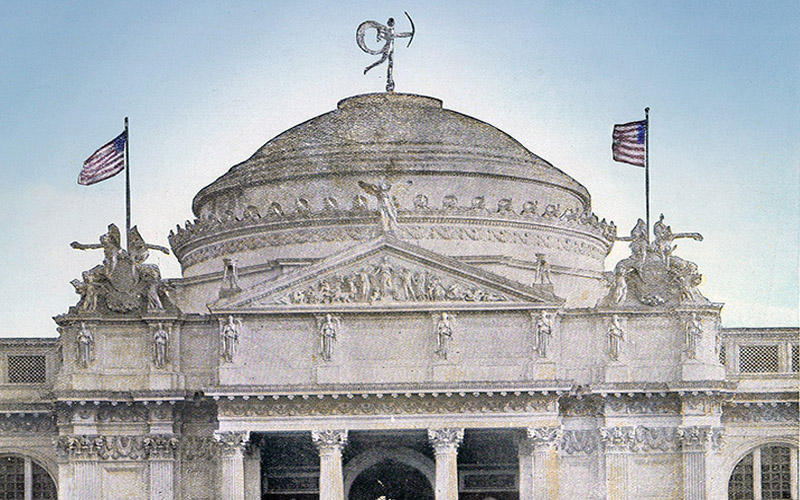
PICTURESQUE WORLD’S FAIR. AN ELABORATE COLLECTION OF COLORED VIEWS Page 31 – DOME of AGRICULTURE BUILDING DOME OF AGRICULTURE BUILDING.—The agriculture department of the World's Columbian Exposition was housed in a palace, for the great building devoted to the purpose was a magnificent structure, both as to dimensions and architectural character. The main building stood beside Lake Michigan its principal facade facing the grand basin in the Court of Honor, full opportunity being thus afforded for the display of its imposing features. The view above given is that of the principal entrance, with the landing for gondolas and electric [...]
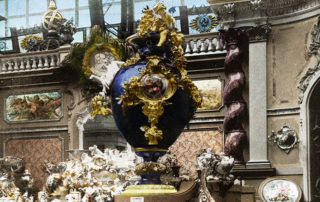
PICTURESQUE WORLD’S FAIR – Royal Berlin Porcelain Vase (p. 32)
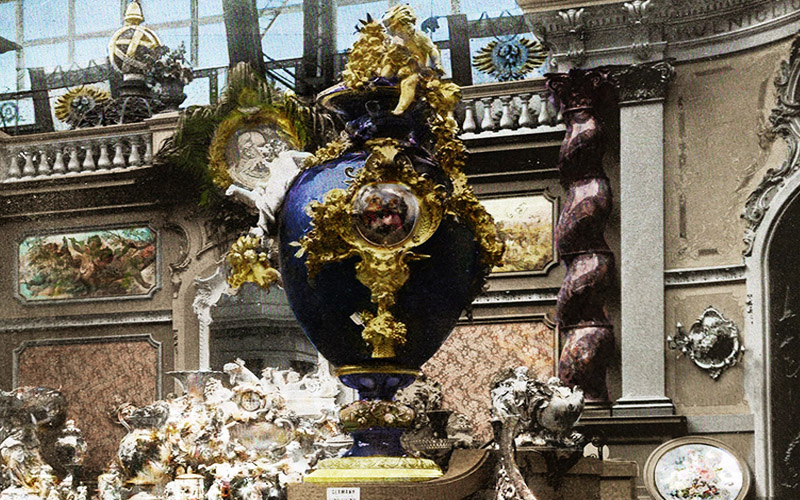
PICTURESQUE WORLD’S FAIR. AN ELABORATE COLLECTION OF COLORED VIEWS Page 31 – ROYAL BERLIN PORCELAIN VASE ROYAL BERLIN PORCELAIN VASE.—There were some very beautiful objects in the porcelain display by Germany, in the Manufactures Building, but easily first was the Royal Porcelain Vase, nine feet in height, which is the subject of this illustration. It was part of the showing made by the Royal Berlin Porcelain Works, which are conducted under government patronage, and was one of the largest, if not the largest, vase of the kind ever made. It may be added that the vase will yet be [...]

Happy National Ferris Wheel Day!
Up 'n' down Ferris wheel Tell me how does it feel To be so high Looking down here. -- Norah Jones "Carnival Town" Grab a box of chocolates and a bouquet of roses, because today is ... National Ferris Wheel Day! This annual celebration honors the anniversary of George Washington Gale Ferris, Jr.’s birth on February 14, 1859, in Galesburg, Illinois. Ferris, of course, was the engineer who invented the biggest attraction of the 1893 World’s Fair. More than 1.4 million people rode on his great wheel on the Midway Plaisance. The image we offer here is from the Chicago [...]

March 6, 2018: World’s Fair Auction #31 ends
World's Fair Auction #31 is now open for preview and online bidding closes on Tuesday, March 6, 2018. The auction catalog can be viewed at: http://www.worldsfairauction.com/cgi-bin/CATALL.CGI
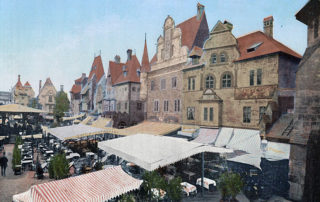
PICTURESQUE WORLD’S FAIR – Interior of “Old Vienna” (p. 31)
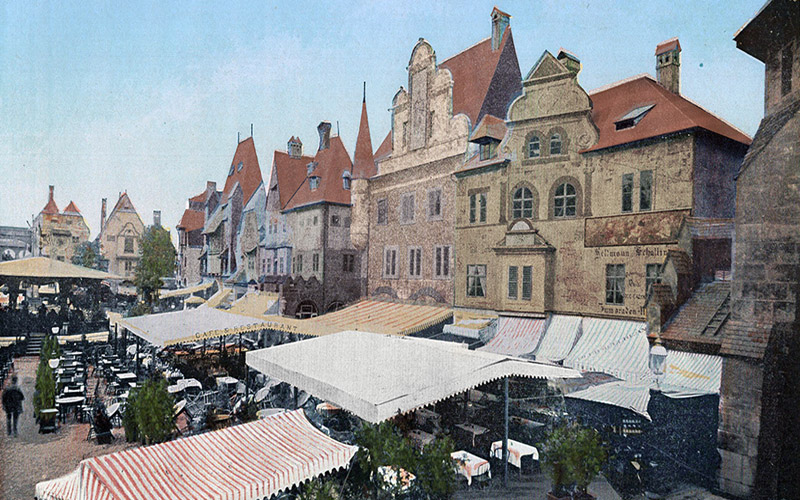
Page 31 INTERIOR OF “OLD VIENNA."— From: PICTURESQUE WORLD’S FAIR. AN ELABORATE COLLECTION OF COLORED VIEWS INTERIOR OF “OLD VIENNA."—To leave the Exposition without having visited the Austrian Village, more widely known as "Old Vienna," was, in the opinion of many people, not to have seen the Fair at all. It was one of the most popular places of resort for the multitude, despite the expensiveness of the luxury, for prices in Old Vienna were "World's Fair prices" indeed. There was a charm about the place, though, this faithful reproduction of "Der Graben" in the Vienna of one hundred and fifty [...]


Mar. 23-Aug. 29, 2018-Exhibit Showcases Mexicans at the 1893 World’s Fair
An upcoming exhibit at the National Museum of Mexican Art in Chicago features the early artistic involvement and influence of Mexican immigrants in Chicago beginning with the World’s Columbian Exposition in 1893. Arte Diseño Xicágo: Mexican Inspiration from the World's Columbian Exposition to the Civil Rights Era opens on Friday, March 23, 2018, with a reception from 6–8 pm, and continues through August 19, 2018, in the Main Gallery. One of the earliest proponents of holding a world’s fair to mark the quadricentennial of Columbus’ arrival on the continent was a Mexican physician, Dr. Carlos W. Zaremba, who proposed that [...]