
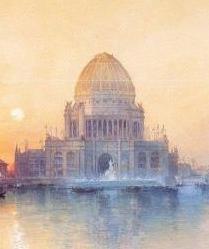
RECENT POSTS ABOUT THE HISTORY OF THE COLUMBIAN EXPOSITION’S BUILDING, FAIRGROUNDS, EXHIBITS, EVENTS, AND PEOPLE.

“The Current War” offers only a dimly lit view of the 1893 World’s Fair
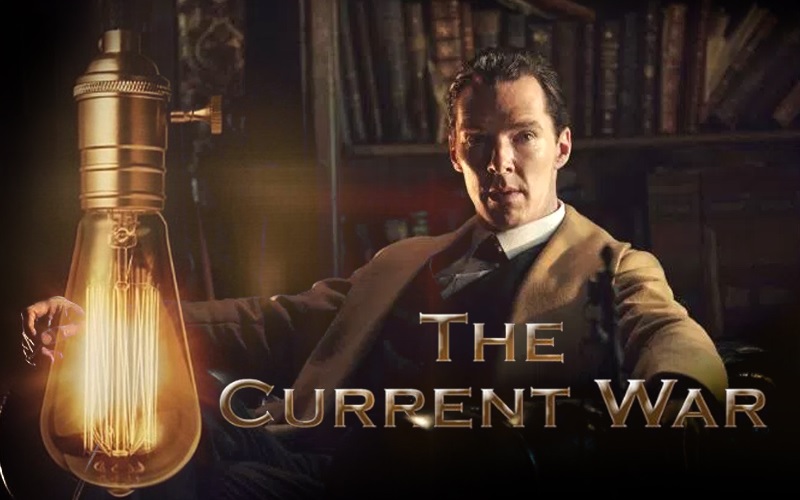
The 1893 World’s Fair in Chicago shines on the big screen, if only for a few minutes. The Current War (2017, released 2019) tells the story of the rancorous rivalry between inventor Thomas Edison (Benedict Cumberbatch), who adamantly championed direct current (DC) technologies to electrify and illuminate American cities, and George Westinghouse (Michael Shannon), who banked on alternating current (AC). The legendary “war of the currents” has these titans of the electrical industry setting their sights on powering the Columbian Exposition. Thomas Edison showing off his new incandescent light bulb opens The Current War. ------ SPOILER ALERT ------ [...]
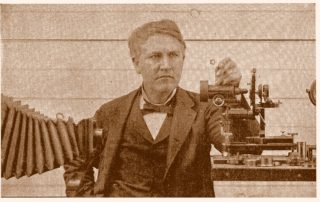
“Greatly Interested in the World’s Fair is the Wizard.” Thomas Edison’s 1891 Visit to Chicago
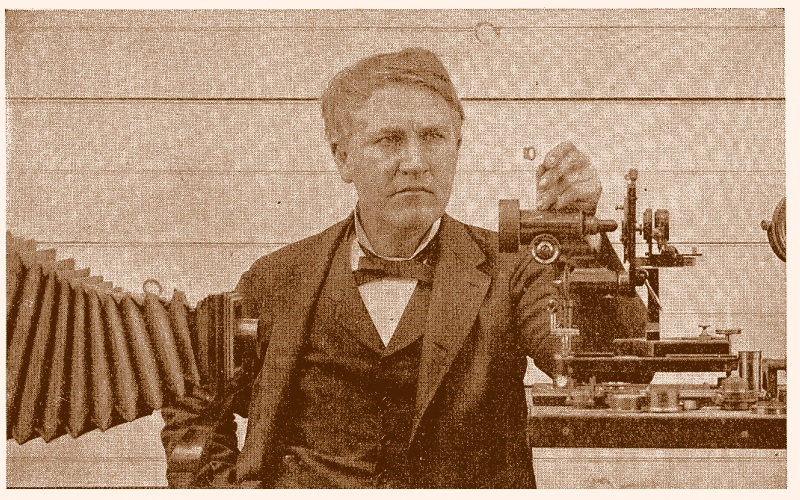
Thomas Edison visited Chicago on May 12, 1891, staying for several days “to attend to some private interests” and to consult with Prof. John P. Barrett, Chief of the Department of Electricity and Electrical Appliances for the World’s Columbian Exposition. [“Proposition for a Compromise” Chicago Inter Ocean May 12, 1891, p. 8.] The article below, from the front page of the May 12, 1891, issue of the Chicago Evening Post, describes his interest in the 1893 World’s Fair and his imminent, but unnamed, invention that will allow a viewer at home to watch a remote performance on a screen [...]
“Quietly Enjoying His Lunch.” Thomas Edison Visits the 1893 World’s Fair
In August 1893, Thomas A. Edison visited the World’s Columbian Exposition in Chicago. His time at the World's Fair bears little resemblance to the story portrayed on screen in The Current War. According to the report below, from the September 2, 1893, issue of Electrical Review, Edison kept a low profile and showed little interest in the electrical exhibits. Thomas A. Edison, accompanied by his family, arrived in Chicago last Monday evening, and went immediately to a house on Lake avenue, in the southern part of the city, where he will live while he is here. Mr. Edison is [...]
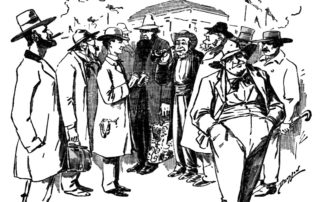
Guidance for the Unsophisticated
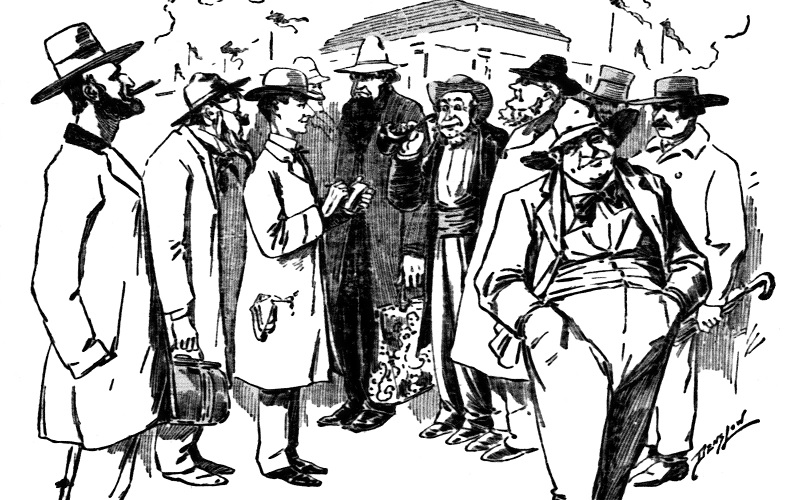
Before “Goin’ to the Fair,” Americans received unsolicited advice in their small-town newspapers on how to navigate the city of Chicago during their visit to the 1893 World’s Columbian Exposition. The June 22, 1893, issue of the Mount Vernon (OH) Democratic Banner offered these words of guidance: There is little doubt that a large proportion of those who will attend the World's Fair ought to be under the charge of a guardian while in the Windy City. This would be almost impossible -- expensive, to say the least. And so a set of questions [sic] has been printed as [...]
Goin’ to the Fair
Americans planning to visit the 1893 World’s Fair in Chicago were inundated with cautionary tales about evil trappings in the big city and stories of tourists being ripped off. While an event the size of the World’s Columbian Exposition certainly had its fair share of scammers, reports of exorbitant prices on the fairgrounds were largely unsubstantiated. Even before the opening of the Fair, the poem reprinted below offered guidance to the unsophisticated who contemplated a trip to see the Exposition in Chicago. “Goin’ to the Fair,” came from the New York Evening Sun, a paper that spilled much ink [...]
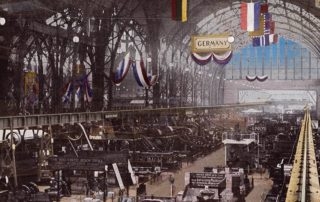
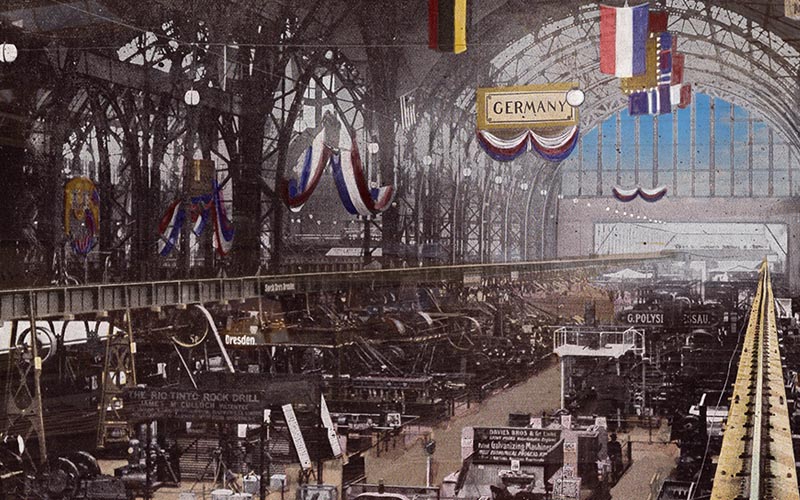
PICTURESQUE WORLD’S FAIR – Interior of Machinery Hall (p. 88)
PICTURESQUE WORLD’S FAIR. AN ELABORATE COLLECTION OF COLORED VIEWS Page 88 – INTERIOR OF MACHINERY HALL INTERIOR OF MACHINERY HALL.—Quite different from the view afforded inside any other of the buildings of the Fair was that where the acres of all kinds of modern machinery were exposed in competition. So constructed that the most effective display of such exhibits could be made, the vast hall presented a scene never equaled of its kind before. A common simile in describing the place was to compare its interior with three immense tram houses set side by side and surmounted by a [...]
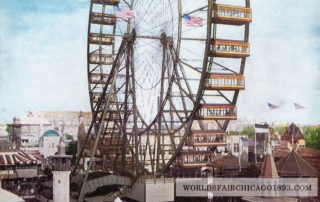
Oct. 24, 2019: “A History of Illinois Ferris Wheels and the 1893 Columbian Exposition” (Assumption, IL)
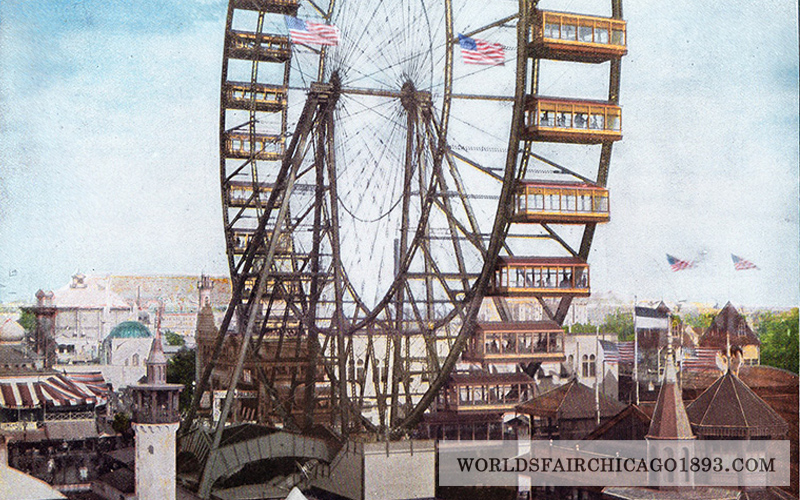
Macon County Historian Mark Sorensen will speak about the 1893 World’s Fair at the Oct. 24 meeting of the Assumption Historical Society in Assumption, IL. His illustrated talk on “A History of Illinois Ferris Wheels and the 1893 Columbian Exposition” starts at 6:30 p.m. at the Bromwell Lodge (225 N. Chestnut St. in Assumption) and is free and open to the public.

Autumn 2019 Trivia Question
Our seasonal newsletter includes a “Palmer Puzzler” exclusive to those who subscribe. (You can sign up here.) The first person to send us the correct answer wins a small prize. The Autumn 2019 Trivia Question Which famous world leader stood motionless on the fairgrounds of the 1893 World's Columbian Exposition pointing at the New York State Building? We had several interesting guesses--Teddy Roosevelt (who was at the Fair), George Washington, and Winston Churchill, and one correct answer: Augustus Julius Caesar. A replica of the famous statue Augustus of Prima Porta in the collection of the Vatican stood at the [...]
A Fair Harvest
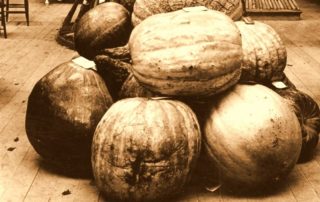
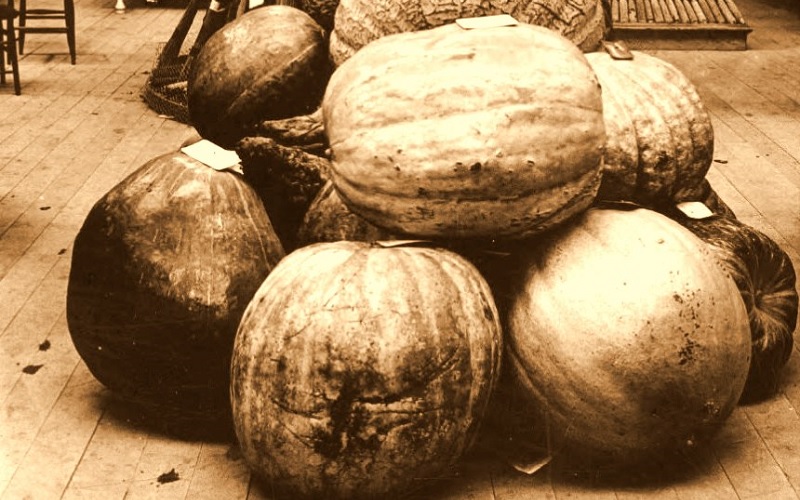
With autumn comes the fall harvest. The doggerel below, from the April 1892 issue of Halligan’s The Illustrated World's Fair, has a rural farmer anticipating the upcoming World’s Columbian Exposition in Chicago. Poet W. H. Jewett may be referencing Littleville, Alabama, in the second verse. A photograph of pumpkins from the California exhibit in the Agricultural Building, from a Kilburn stereoscope card. [Image from the Keystone-Mast Collection, UCR/California Museum of Photography, University of California at Riverside.] FARMER HEDGEROW'S CONCLUSION by W. H. JEWETT Now John, my boy, plow good an' deep an' harrer every field— We'll take a [...]



Oct. 22, 2019: World’s Fair Auction #35 closes
Columbian Exposition collectors may be interested in World’s Fair Auction #35, now open for preview. Online bidding closes on Tuesday, October 22, 2019. The auction catalog can be viewed at: http://www.worldsfairauction.com/cgi-bin/catalog.cgi. Lots 17 through 55 are items related to the 1893 World’s Fair, and include several products commemorating various building of the White City: a lovely "Columbus Panorama" tri-fold book that depicts "American Declaration of Independence July 4th, 1776," the "Discovery of America," and "The Proclamation of Emancipation of Slaves by Abraham Lincoln, on January 1st, 1863" (image below); an Administration Building match safe; a shaving mug featuring a [...]