


[Continued from Part 1]
On June 20, Alderman Madden submitted his Fourth of July plans, with himself as Master of Ceremonies, to Mayor Carter Harrison. Chicago anticipated hosting “a celebration of national character [that] should be held under the auspices of the City at the World’s Fair grounds,” announced the Chicago Tribune (Jun. 21, 1893). Madden’s proposed program began with a “monster parade” of military organizations, civic societies, bands, and school children marching from Washington Park into the fairgrounds in the morning. The parade was expected to be “the biggest procession ever seen in this country,” according to the Chicago Tribune (Jun. 22, 1893). By late June, many organizations had accepted invitations, and some 25,000 men were expected to march. Just days before the Fourth, however, the civic parade was cancelled. The Inter Ocean (Jun. 29, 1893) reported that this was “owing to the fact that the military would not be admitted to the grounds free.” Exposition officials had been tightening belts all month and were not about to give away so many free admission tickets. While some lamented the celebration lacking the picturesque touch of a civic parade, another idea emerged for a parade of global citizens.
For the exercises, Madden’s committee proposed speakers that included Illinois Governor John Altgeld and Thomas W. Palmer, President of the National Commission of the World’s Columbian Exposition. Mayor Harrison also would deliver an address. Only the latter made it into the final ceremony. On June 26, the governor pardoned three men imprisoned for their connections to the 1886 Haymarket affair, an act that resulted in public outcry. Someone must have thought it best to keep Gov. Altgeld away from the public lectern for a while, and (as we will see) he was replaced by another Illinois politician of higher rank and popularity. Also falling off the program was President Palmer, who announced on July 1 that he wished to step away from his Exposition duties to care for his ailing wife. Newspapers falsely reported on July 4 that he had resigned his post. In fact, he remained involved in Exposition events before and after July 4th, though appears to have been absent from the Independence Day celebration.

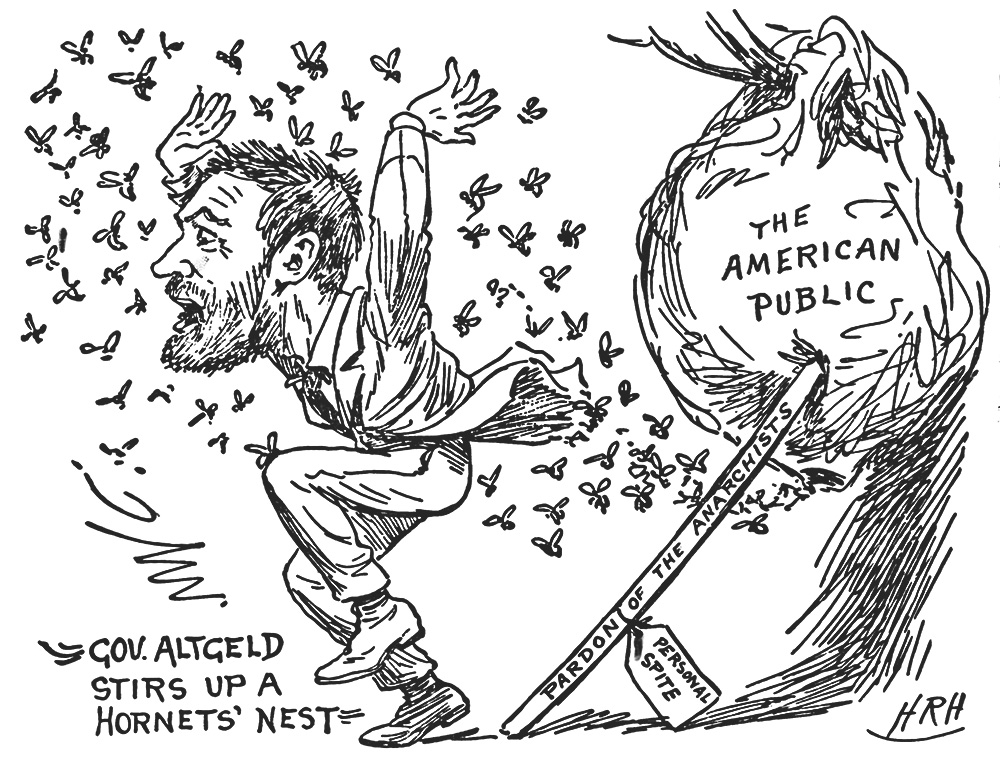
“Gov. Altgeld Stirs Up a Hornets’ Nest” illustrates the controvery when Illinois Governor John Altgeld, just before the World’s Fair Fourth of July, pardoned three men imprisoned for their connections to the 1886 Haymarket affair. [Image from Chicago Tribune July 2, 1893.]
“Make the heavens glow”
The centerpiece of the World’s Fair Fourth of July ceremony was to be the Columbian Liberty Bell. Ald. Madden’s proposed program had William O. McDowell formally presenting the newly forged bell to the cause of universal liberty and peace. Col. Alexander K. McClure, editor of the Philadelphia Times, would speak on “Old Liberty Bell to the New.” His oration would be timed to lead to a climax at noon when the Columbian Liberty Bell would toll for the first time. Mr. McClure, however, quickly notified the Exposition that he would be unable to deliver the speech. Rounding out the ceremony would be a reading of Mrs. Madge Morris Wagner’s “The Song of the Liberty Bell,” and Mrs. Frank Stewart Osborne of Chicago delivering a poem titled “The New Liberty Bell.” The Fourth at the Fair would ring.
Alderman Madden’s plan (even in its earliest drafts) called for an immense fireworks display at night. This excited Mayor Harrison, who, according to the Chicago Record (Jun. 2, 1893), “jumped up in his enthusiasm that every man in town who could toot a horn or pound a drum should be in line on the Fourth.” Exposition officials were eager to make sure that these lines form at the fairgrounds admission gates.
The Exposition’s Committee on Ceremonies also met on June 20 and drafted their own plans for the Fourth of July. They envision an international procession down the Midway Plaisance in the morning, and afternoon reading of the Declaration of Independence and speeches by “the most distinguished statesmen and citizens of the country,” and a $10,000 fireworks show that will “make the heavens glow and the waters bubble with fire,” reported the Chicago Tribune (Jun. 20, 1893) Officials expected that the new Columbian Liberty Bell would be there to toll, even though its casting was delayed. On these last two features, City and Exposition planners agreed—the bell would ring and the skies would shine with fire. Chairman McDowell of the Columbian Liberty Bell Committee had just arrived in Chicago to start preparations for the bell’s reception.

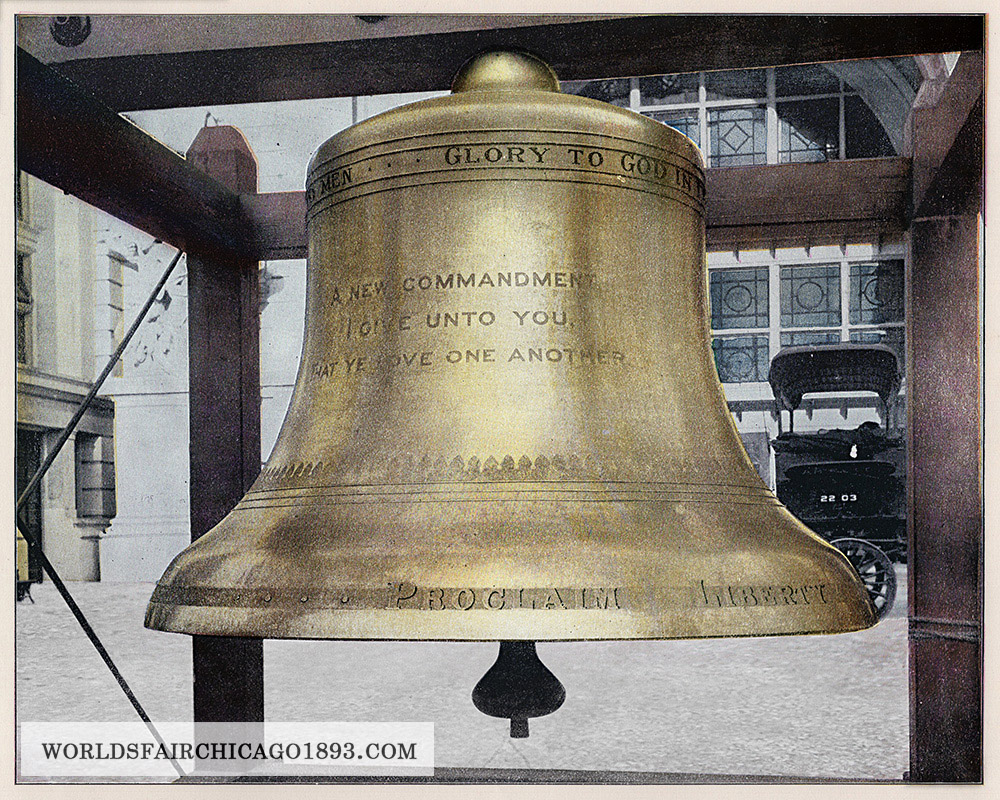
The Columbian Liberty Bell, funded by donations from around the country, was intended to ring for the World’s Fair Fourth of July celebration. [Image from Picturesque World’s Fair. W.B. Conkey, 1894; digitally edited.]
A joint celebration
Uniting the various plans made sense to organizers in City Hall and Jackson Park. On Thursday, June 22, the City Council’s Municipal Fourth of July Celebration Committee along with Mr. McDowell headed to Jackson Park. They planned to meet with the Exposition’s Council of Administration, but were referred directly to Director of Works Daniel Burnham and Director of Decoration Francis (“Frank”) Millet, who were placed in charge of the celebration with instructions to cooperate with Madden’s committee. A plan for a joint celebration emerged.
Over a series of meetings in the following days, Mr. Millet’s deft input refined the program. He moved the exercises from the plaza east of the Administration Building to the plaza on the west side in order for more people to be able to see and hear the speakers. He arranged for flagstaffs to be erected for the original “John Paul Jones flag” and the banner of the Human Freedom League, both on their way to Chicago. Mr. Millet also arranged for a platform to display the original Liberty Bell next to the new Columbian Liberty Bell. This decision set off some premature fireworks.

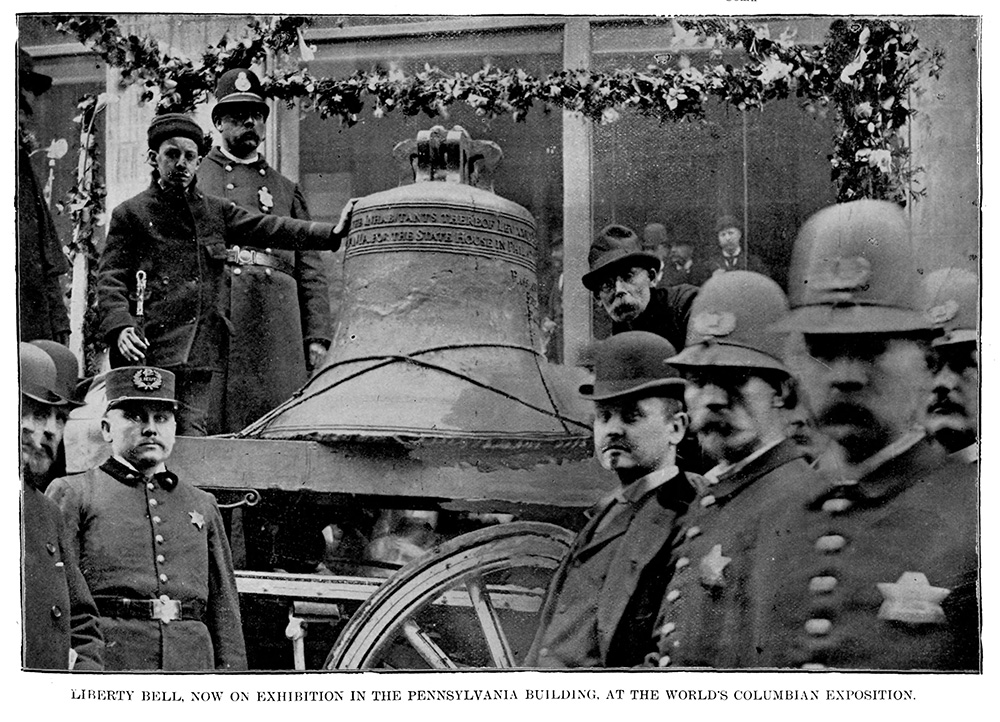
The original Liberty Bell was exhibited in the Pennsylvania State Building at the 1893 World’s Fair, dutifully guarded by four Philadelphia policemen. [Image from Campbell, James B. Campbell’s Illustrated History of the World’s Columbian Exposition, Volume I. M. Juul & Co., 1894.]
“A prominent position”
Controversy erupted when newspapers announced the scheme to move the old Liberty Bell for the Fourth of July exercises. The historic treasure had arrived on the fairgrounds on April 28, after a four-day whistle-stop tour from Philadelphia. A phalanx of Pennsylvania officials and a team of security guards escorted the old bell throughout its journey and into its temporary new home inside of the Pennsylvania State Building. Pennsylvania’s commissioners and Philadelphia officials, of course, expected that their bell would be a huge draw on July 4th, but were blindsided by descriptions of it being hauled outside for a ceremony—a direct violation of their agreement with the Exposition. The Chicago Record (Jun. 2, 1893) announced that “the old liberty bell will occupy a prominent position during the exercises. It will hang near the speaker’s stand and close to the youthful successor, the new liberty bell.” The relic necessarily would remain silent while its shiny young progeny rang.
“Old Liberty Bell, guarded by the big policeman from Philadelphia, is to be carried out to greet new Liberty Bell,” said Mr. Millet in a meeting on June 22. “The old bell will be brought from the Pennsylvania building to the Terminal Station. Now we ought to have a platform to put the two bells on, where everybody could see them and witness the greeting.” When newspaper dispatches about this plan reached Philadelphia, Pennsylvania Executive Commissioner A. B. Farquhar issued a sharp rebuke, saying:
I deem it my duty in behalf of the committee to which the care of the bell was committed to which the care of the bell was committed to protest against the proposed removal, and in so doing beg to express the hope that you will exercise your authority to prevent it, as public feeling here is such that if done it will most likely result in the bell’s being immediately brought back to Philadelphia.
Although Exposition officials decided before July 1 that the old bell would not be disturbed, George E. Vickers, a General Agent serving on Pennsylvania’s Joint Special Committee of Councils on World’s Columbian Exposition, was not taking any chances. He jumped on a train leaving Philadelphia “with the avowed purpose of preventing the removal of the original Liberty Bell from the State building,” the Inter Ocean (Jul. 2, 1893) reported. Meanwhile in Chicago, the four Philadelphia policemen protecting the bell “prepared to resist with force of arms any attempt on the part of anybody to remove the sacred relic” from its designated spot in the rotunda. All four stood guard all day and night “prepared against surprise from any point,” according to the Philadelphia Inquirer (Jul. 12, 1893). There was no need to fight. Exposition officials quickly dropped all plans to move the Liberty Bell. The treasured relic remained in place until October 31 and then safely made its way home to Philadelphia.

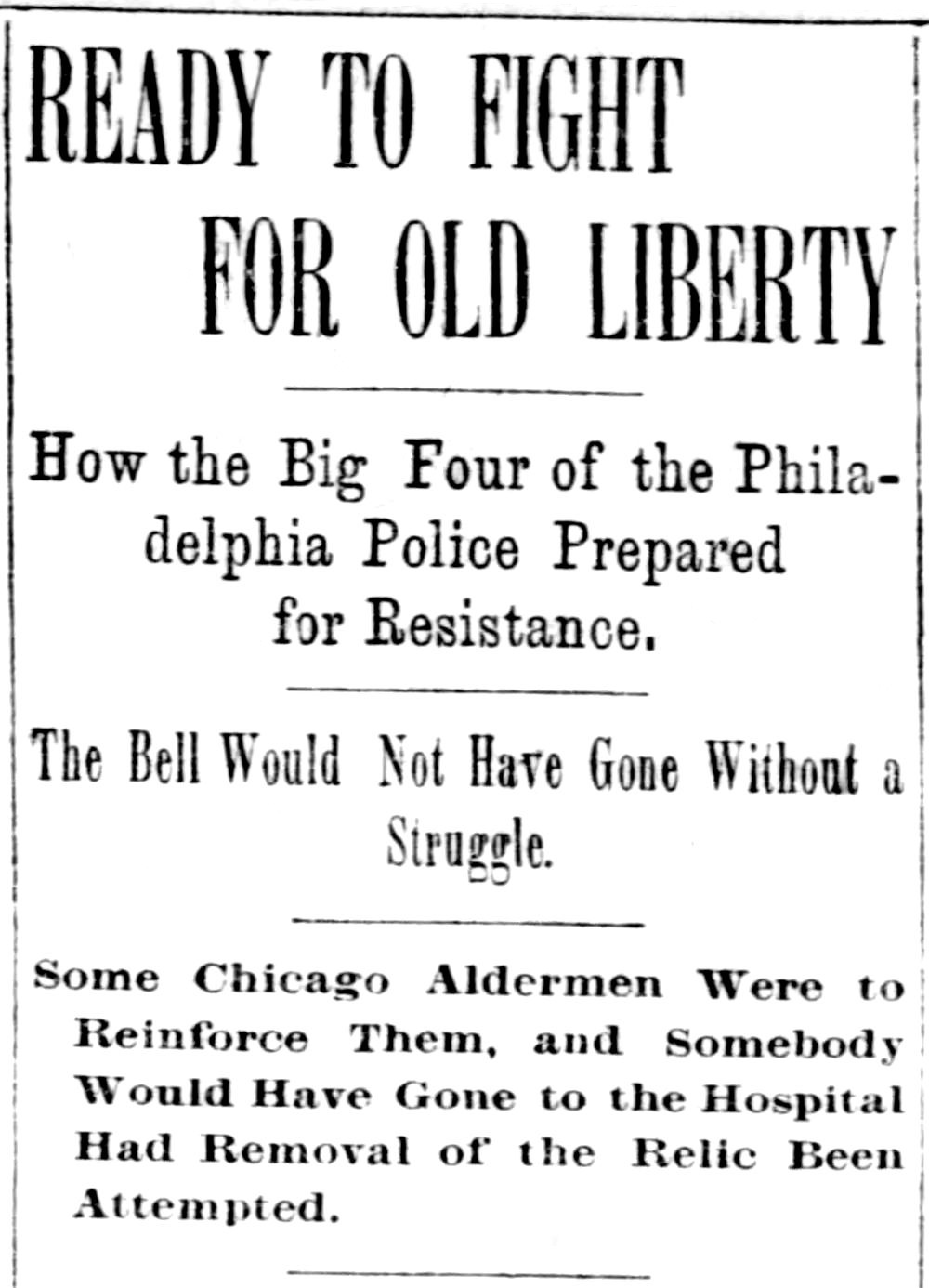
A headline from the Philadelphia Inquirer (July 12, 1893) assures their city that guards were “Ready to Fight for Old Liberty” should anyone in Chicago attempt to move the relic.
“Celebrate fittingly the glorious old Fourth”
Other groups pledged their support. When the American Exhibitors’ Association met in Festival Hall on June 26 to formally organize their union, some 22,000 exhibitors intended “to do everything in their power to make the Fourth of July a decided success,” reported the Chicago Tribune (Jun. 25, 1893). The Association pledged to raise at least $100,000, feeling certain “they will be patriotic enough to throw up their hats and their cash in order to celebrate fittingly the glorious old Fourth.” Thousands of exhibitors also planned to greet the mayor and City Council at the gates of the fairgrounds on the morning of the Fourth.
Foreign exhibitors also committed to honor the American birthday. “That wonderful physician, Old Time, has healed up all the soreness and animosities which for a time attended the advent of the new Nation,” wrote the Inter Ocean, “so that even John Bull can grasp Uncle Sam by the hand and join in the universal benediction of long life and prosperity to this newest and greatest of nations.” The most diverse foreign participation would be at a separate Fourth of July ceremony held on the Midway Plaisance, organized by the Midway Concessionaire’s Club. A draft plan called for tournaments involving races for donkeys, camels, horses and ostriches, feats of strength and speed, and juggling and dancing contests.
Throughout planning, Columbian Exposition officials likely reflected on the milestone Fourth of July celebration held at the 1876 Centennial Exposition in Philadelphia. For America’s first great World’s Fair, a new liberty bell had been cast by the foundry of the Meneely Bell Company in Troy, New York, where its 1893 sister bell also was made. In the first minute of July 4, 1876, the Centennial Bell sounded thirteen strokes across the city from the steeple of Independence Hall, followed by “such a shout as had never been heard in Philadelphia before.” (Listeners complained the sound quality was poor, so it was removed from the steeple and sent back to the foundry to be recast.) A salute of cannons fired at sunrise. The Fourth of July in 1876 was also a day of patriotic protest, when members of the National Woman Suffrage Association—among them Susan B. Anthony, Phoebe Couzins, and Matilda Joslyn Gage—stormed the stage of the centennial celebration at Independence Hall to present their “Declaration of the Rights of Women.” These three trailblazing women’s rights activists, and many more, were in Chicago in 1893, but did not participate in the Fourth of July exercises. Despite numerous revisions to the morning program, not a single woman spoke on the stage.[1]
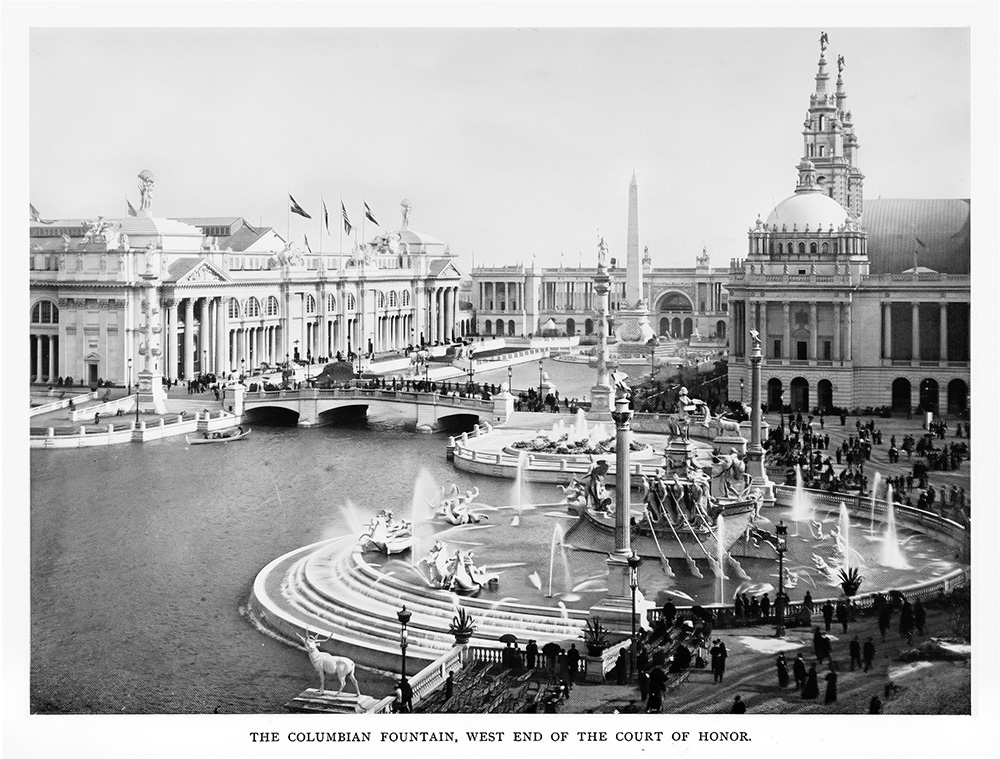
The White City of 1893 inspired an American poet to record that “Thine alabaster cities gleam.” [Image from Johnson, Rossiter A History of the World’s Columbian Exposition Held in Chicago in 1893, Volume 3: Exhibits. D. Appleton and Co., 1897.]
“A thing of beauty”
Through distance and time, one woman’s voice preserved a memory of the Fair in verse. On July 3rd, a thirty-three-year-old English professor from Wellesley College departed Chicago after a three-day visit with the family of her life partner, Katharine Coman. After visiting the fairgrounds together, she described it in her diary as “a thing of beauty.” A few weeks later, a majestic view from Pike’s Peak in Colorado inspired her to write a poem. “Thine alabaster cities gleam” emerged from her memory of the fairgrounds in Chicago. Katharine Lee Bates missed the Fourth of July celebration at the 1893 World’s Fair by one day but enshrined a vision of the White City in the final stanza of what eventually would become America’s unofficial national anthem, “America the Beautiful.”
[Continued in Part 3]
NOTES
[1] At one point in late June, Bertha Palmer, President of the Board of Lady Managers, was invited to deliver addresses but she was not part of the final program.
SOURCES
Curtis, George D. Souvenir of the Centennial Exhibition … Geo. D. Curtis, 1877.
“Day of Patriotism” Chicago Inter Ocean Jun. 29, 1893, p. 1.
“Fourth at the Fair” Chicago Inter Ocean Jun. 21, 1893, p. 7.
“Fourth at the Fair” Chicago Inter Ocean Jul. 4, 1893, p. 1.
“Fourth at the Fair” Chicago Tribune Jun. 29, 1893, p. 2.
“Fourth of July at the Fair” Chicago Tribune Jun. 22, 1893, p. 4.
“In Freedom’s Honor” Chicago Tribune Jun. 21, 1893, p. 9.
“Jubilee of Liberty” Chicago Inter Ocean Jul. 2, 1893, p. 2.
“Liberty Bell Cast” Chicago Herald Jun. 23, 1893, p. 2.
“The New Liberty Bell” World’s Columbian Exposition Illustrated Nov. 1893, p. 246.
“One Day at the Exposition” Chicago Inter Ocean Jun. 23, 1893, p. 7.
“Open Every Evening” Chicago Tribune Jun. 20, 1893, p. 1.
“Plans for the Fourth” Chicago Record Jun. 2, 1893, p. 8.
“Ready to Fight for Old Liberty” Philadelphia Inquirer Jul. 12, 1893, p. 7.
“Will Raise $100,000” Chicago Tribune Jun. 25, 1893, p. 8.