


[Continued from Part 12]
America’s birthday celebration at the 1893 World’s Fair extended well into the entertainment district of international villages, amusement rides, shopping, and restaurants. “The foreigners at the fair are as enthusiastic as the Americans,” announced the Chicago Daily News (Jul. 3, 1893). “Those who live in Midway Plaisance are going to take a hand in the uproar.” The press in 1893 made much of this willingness to participate. Most of those working on the Midway, however, were employees of the private enterprises and corporations that ran the attractions. Therefore, their participation in the Fourth of July ceremonies likely was expected and enforced, not optional and spontaneous. Enthusiasm on display may have been a form of entertainment for viewers.

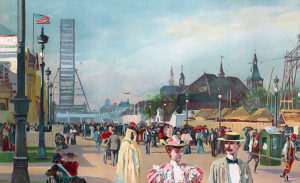
The Midway Plaisance by T. de Thulstrup. [Image from Burnham, Daniel Hudson; Millet, Francis Davis The Book of the Builders Vol 1. No 3, May 5, 1894.]
“Separate and distinct”
Invoking the success of the June 17th “Parade of All Nations” that had the denizens of Midway marching through the main fairgrounds, the Chicago Tribune (June 22, 1893) expected that “undoubtedly the Fair officials also will arrange to have the queer people of the Plaisance, with their quaint insignia, their animals, and their music, join the procession, giving the assembled thousands ‘Yankee Doodle’ on every conceivable instrument.” When Chicago’s municipal Fourth of July parade was cancelled on June 28, an idea for a Midway parade gained steam, but as an event running independent of the ceremony in the Court of Honor. “There will be a parade by the midway plaisance people, however, but their celebration will be separate and distinct from the other,” announced the Inter Ocean (Jun. 29, 1893). The plan called for the American flag to be raised and saluted, and all the international bands in unison playing the American anthem, followed by various national airs. The paper also reported that Illinois Governor John Altgeld would be invited to deliver an address to the Midway folk; relegation to this side-ceremony perhaps was intended as a slight to the embattled politician.[1]
Representatives of the World’s Columbian Exposition managers and the Midway Concessionaire’s Club organized the Midway celebration. Frank Millet, who had been serving as the Exposition’s creative Director of Color exited that appointment on July 4th, but in the preceding weeks was transitioning into his new role as an event planner and promoter for the Fair. He coordinated various components of the Fair’s Fourth of July celebration, from the morning exercises to the evening fireworks display. With cultural insensitivity common in the era, a syndicated news story printed in the Newark Advocate announced that “all Midway freakdom is being infected with the fever of celebration and Frank Millet, the artist master of functions, is being flooded with suggestions.” Millet worked with the Midway Concessionaire’s Club to plan the Midway ceremony.

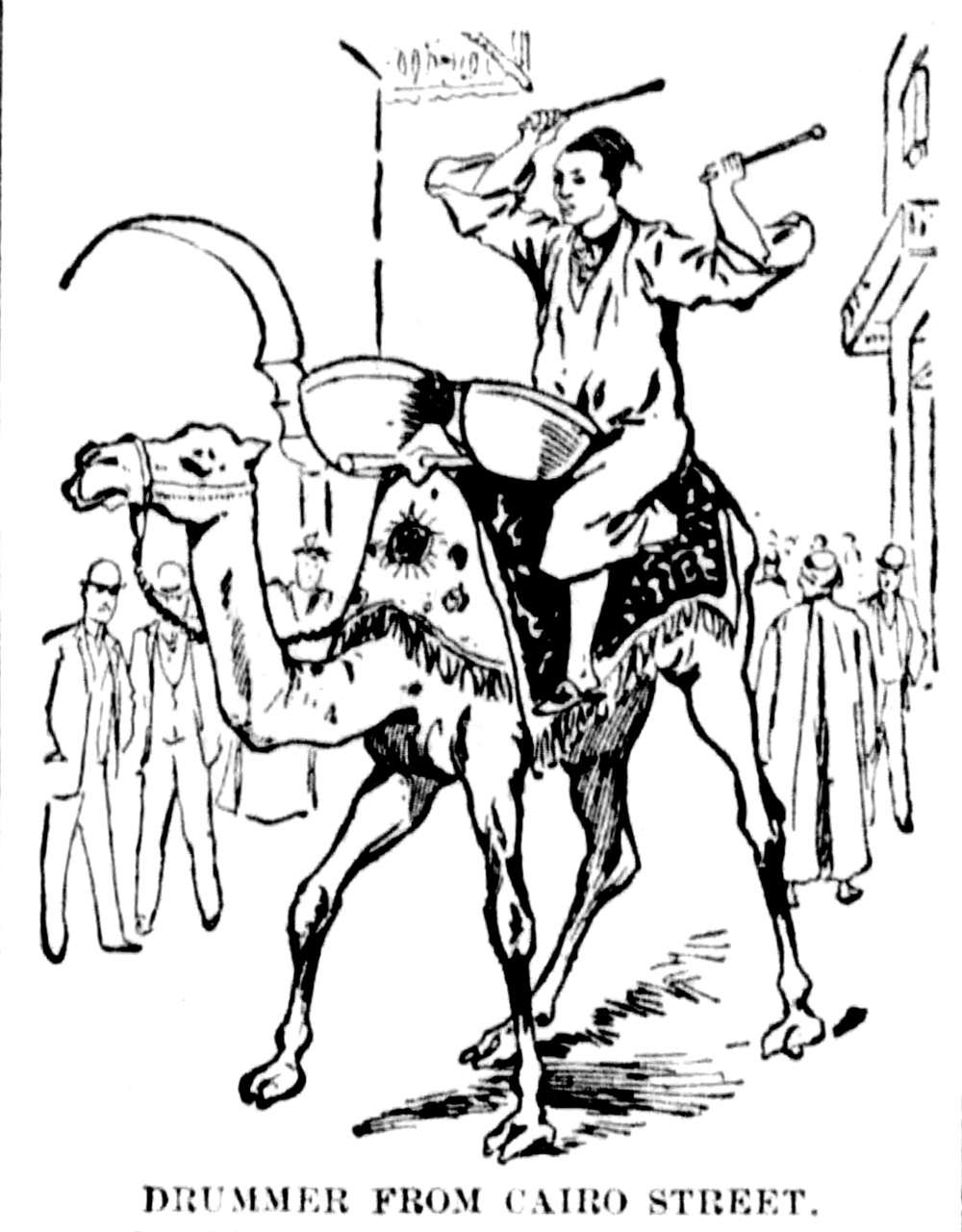
A drummer from the Street in Cairo riding a camel. [Image from the Roanoke Times Jun. 20, 1893.]
“The enchanted ground of the Plaisance”
At the start of the Fair, concessionaires of various Midway attractions formed a union to bring complaints to Exposition managers and to help organize events to promote their businesses in their entertainment district. George W. Prussing, of the Street in Cairo concession, served as the Club’s president; Robert Levy, of the Turkish Village, was elected chairman; and Sol Bloom, of the Algerian Village concession, served as its secretary. The Chicago Evening Post (Jul. 3, 1893) reported that Bloom and “dozens of assistants have been busy for a week to get up a show of which all will be proud.”
Tens of thousands of visitors arrived on the fairgrounds on the morning of July 4th with the intent of heading straight to the Administration Plaza for the morning ceremony. Many, however, found themselves pulled instead into the festive Midway Plaisance. A “patriotic pleasure-seeking procession” for hours filled the avenue from side to side, according to the St. Louis Post-Dispatch. Many never made it over to hear the lengthy patriotic speeches, choosing instead to ride on the Ice Railway, watch glassblowers create Liberty Bell paperweights in the Libbey Glass Factory, eat at the Log Cabin of ’76 restaurant, or drink a cold one in the Hungarian Café. The Chicago Times (Jul. 5, 1893) observed that:
The latest researches of scientists have made clear the fact that of those who set foot upon the enchanted ground of the Plaisance in the morning, the percentage who escape before night is very small, consequently a good many patriots did not reach the Administration Plaza in time for the most interesting proceedings of the day.

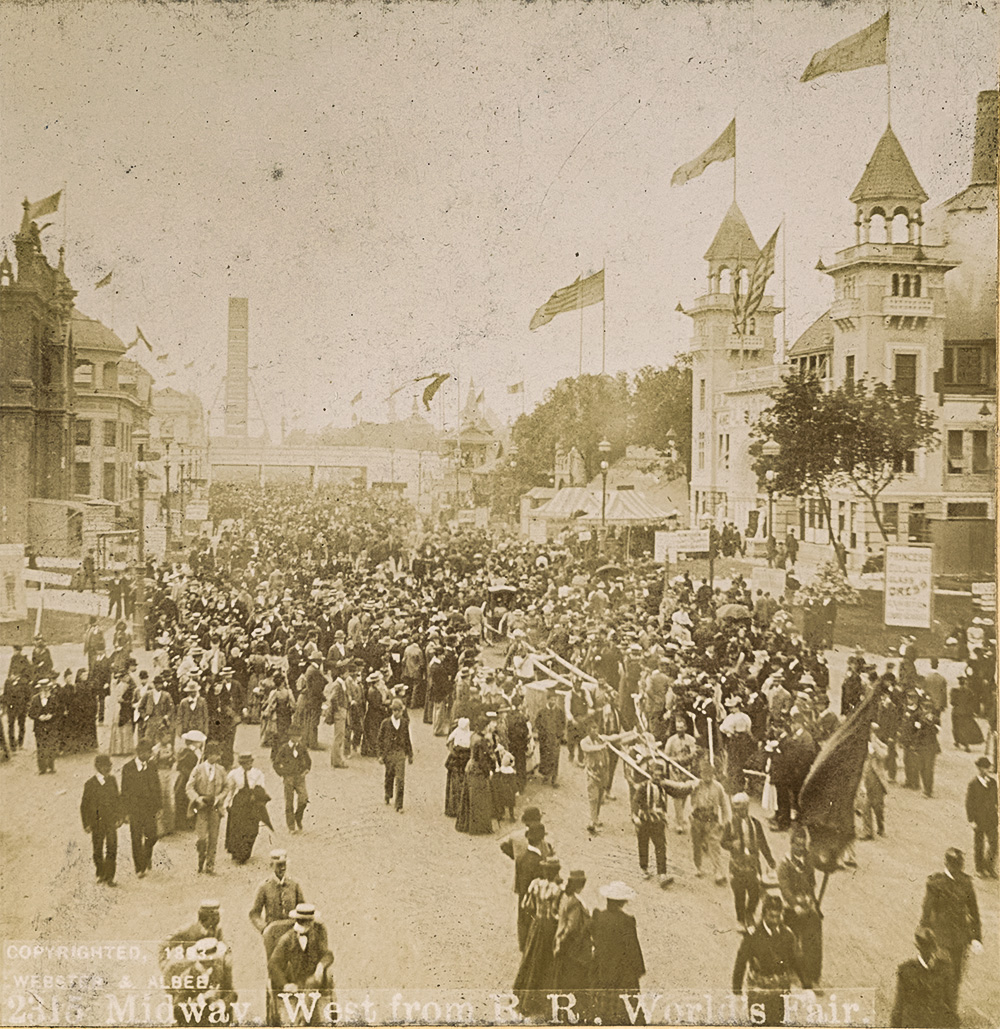
The Midway Plaisance, looking west from the Illinois Central railroad tracks. [Image from Webster & Albee stereoscope card, Library of Congress.]
“Bewildering and beautiful”
All night, employees of the Midway villages hung thousands of colorful triangular pennants and suspended a string of some 3000 Japanese lanterns along the Plaisance. On the morning of the Fourth, the international avenue awoke dressed in a resplendent costume of bright banners and patriotic robes. “On each side of the Plaisance throughout its whole length were also dancing, fluttering lines of the same heterogeneous colored mass connecting with the cross lines,” reported the St. Louis Post-Dispatch. Visitors were greeted by a festive trail of color. “The flags of all nations mingled in a medley of the most brilliant description,” observed the Chicago Times (Jul. 5, 1893), but the Stars and Stripes of the Republic occupied a position of honor among the international villages. World’s Fair historian William E. Cameron described the picturesque scene:
The wonderful street and its many strange buildings were beautifully decorated for the occasion. … Flags, banners and pennants of every hue and bearing many a strange device fluttered from every pinnacle and every coigne of vantage up and down Midway. A rope had been stretched along the tops of the lamp posts on either side of the Plaisance from end to end of the broad way, and at distances of three feet hung triangular banners halved and quartered by the gay colors of the spectrum. Similar ropes spanned the street at frequent intervals, and between the banners swung Japanese lanterns of various shapes. Seen with the favoring angle of vision lent by distance they presented the effect of a swirling, kaleidoscopic canopy. The effect was bewildering and beautiful.
Each village and concession added their own unique charm in honoring the American birthday celebration. On the east end, inside the World’s Congress of Beauty building, the two women officially from the United States became the center of attention for the national birthday. At the U.S. Submarine Diving Company exhibit, the diver offered an underwater concert to the audience by singing “America” into a telephone connected to his headpiece. Over the Japanese Bazaar flew a huge fish-shaped pennant, lovely though seemingly off-theme.
Continuing westward, the Java Village had red, white, and blue twined ropes hanging in great festoons from the thatched dwellings of the outer fence. The German Village “attracted much attention for decorations made of oak leaves twined in ropes, which swept from post to post along the streets in curving pendants,” noted the Inter Ocean (Jul. 5, 1893). The Chicago Times (Jul. 5, 1893) observed that the display “had quite a Christmas look, for it was hung down its entire length with holiday greenery.” The Turkish Village across the street also employed greenery for decoration, with the Inter Ocean providing this description:
Oddest of all was the bowery, erected in front of the Turkish building. Temporary posts were draped with evergreens and Turkish cloths of many varieties. Among the evergreens nestled glasses apparently filled with wine, but a wick in the center of each indicated that it was for the night illumination. Red Turkish flags with star and crescent finished the oriental canopy.

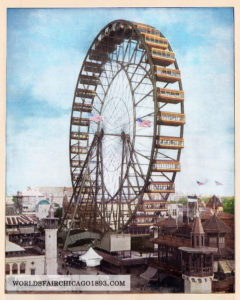
The Ferris Wheel was decorated with American flags and bunting for the Fourth of July. At night, the attraction featured a dramatic display. [Image from Picturesque World’s Fair. W.B. Conkey, 1894; digitally edited.]
“Dizzy with color”
The Chicago Times described the scene as being “dizzy with color [that] gave one the impression of a dissolute rainbow that had got itself all mixed up.” From the topmost peak of the minaret of the mosque in the Street in Cairo were hung numerous strings, thickly studded with Egyptian pennants. Even the Ferris Wheel wore a patriotic dress, with each car decorated in red, white, and blue; flags fluttered from every accessible point. Later that night, the big wheel would put on an even more dramatic show.
“Beyond the Ferris Wheel the decorations were a trifle slimmer,” the Chicago Times pointed out. The Inter Ocean (Jul. 5, 1893) noted that portals of buildings in the Algerian and Tunisian Village were “outlined with the national colors arranged in graceful figures, making a particularly pretty appearance.” Flying over the theater of the Chinese Village was a red flag with the Declaration of Independence, translated into Chinese characters, painted on it. Across the street at the Austrian Village, a banner hung over its ancient gateway with this friendly greeting:
“We hail thee, Columbia the land of the free,
Old Vienna rejoices in welcoming thee,
This Glorious Fourth of July, 1893.”
Next door in the Dahomey Village, the women honored Uncle Sam by wearing shirts made from U. S. flags, which “presented a very gorgeous appearance,” according to the author of a syndicated report titled “White City Gossip.” By late morning, representatives from these and other Midway attractions prepared to assemble at the west end of their thoroughfare for an international salute.

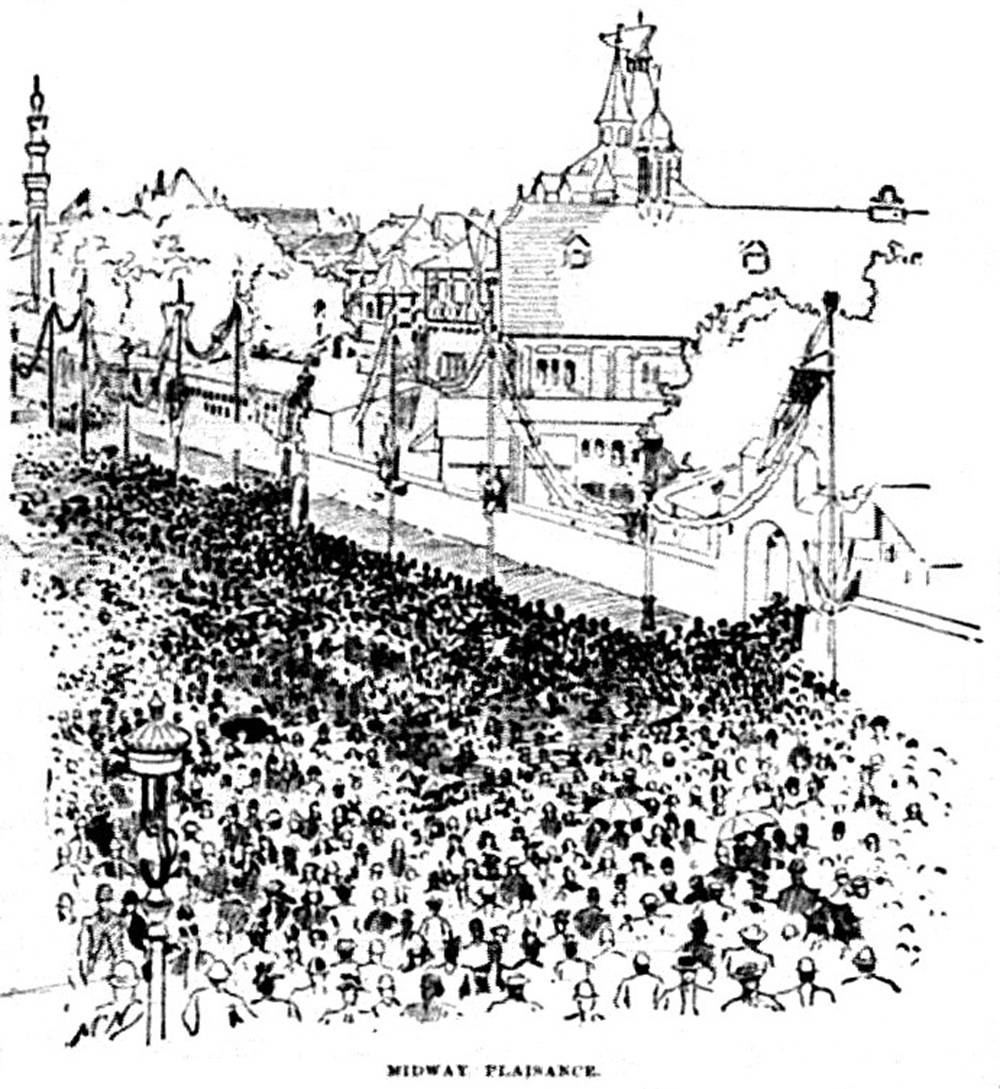
A crowd of 25,000 gathered in the Military Encampment lawn at the west end of the Midway Plaisance for an international salute to America’s birthday. [Image from the Chicago Herald, July 5, 1893.]
“The most remarkable panorama”
As midday approached, the denizens of the Midway Plaisance began an informal march down their main street, heading to the Military Encampment ground near the west entrance at Cottage Grove Avenue.[2] Organizers called the gathering “a meeting of the races.”
Some people arrived riding on animals or in palanquins. Most walked. Camels from the great Saharan desert, donkeys from historic Cairo, and some of Arabia’s finest steeds added to the picturesque parade. First to arrive were Bedouins from the Wild East Show just across the street from the encampment ground. Mounted on their thoroughbred Arabian horses, beautifully caparisoned, and carrying long spears, the Bedouins stationed themselves around the parade ground to serve as guards for the swelling crowd. Next came a procession of Turks, many wearing clothing richly embroidered in silver and gold. Village officials arrived riding in the sedan chairs popular with visitors. First on the scene was Robert Levy, a Jewish entrepreneur from Constantinople who was the concessionaire of the Turkish Village. His entourage carried the American Stars and Stripes along with “half a hundred crimson emblems of the Ottoman Empire,” according to the Chicago Herald. When they arrived on the encampment grounds, the Turks unrolled a rug on the grass under a spreading chestnut tree near the speakers’ platform.

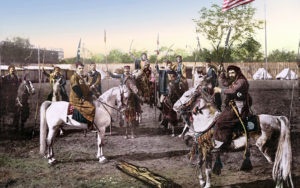
Riders from the Bedouin Camp of the Wild East Show served as safety escorts for the Midway Fourth of July exercises. [Image from Picturesque World’s Fair. W.B. Conkey, 1894; digitally edited.]
Colonel Hong Sling, manager of the Chinese Village, marched at the head of his procession of twenty actors and jugglers. One carried the American flag and another a yellow banner bearing a blue dragon. Chinese musicians struck great copper gongs and small wooden tom-toms. Dahomeyans also brought drums to the assembly. To the ears of most American spectators, the music sounded rather curious. The Chicago Record mentioned that some of the foreign musicians were “struggling with fearsome results to play American national airs” but also noted that the musical mélange was “surely the most remarkable panorama that a Fourth of July ever presented.”
As several of the village bands played their native instruments, a dray pulled by two big bay horses came along with the Iowa State Band riding on board. Band leader Frederick Phinney led them in a patriotic medley of “America,” “The Star-Spangled Banner,” “Yankee Doodle,” “Dixie,” “Hail Columbia,” “Tramp, Tramp,” and “The Belle of Chicago.”

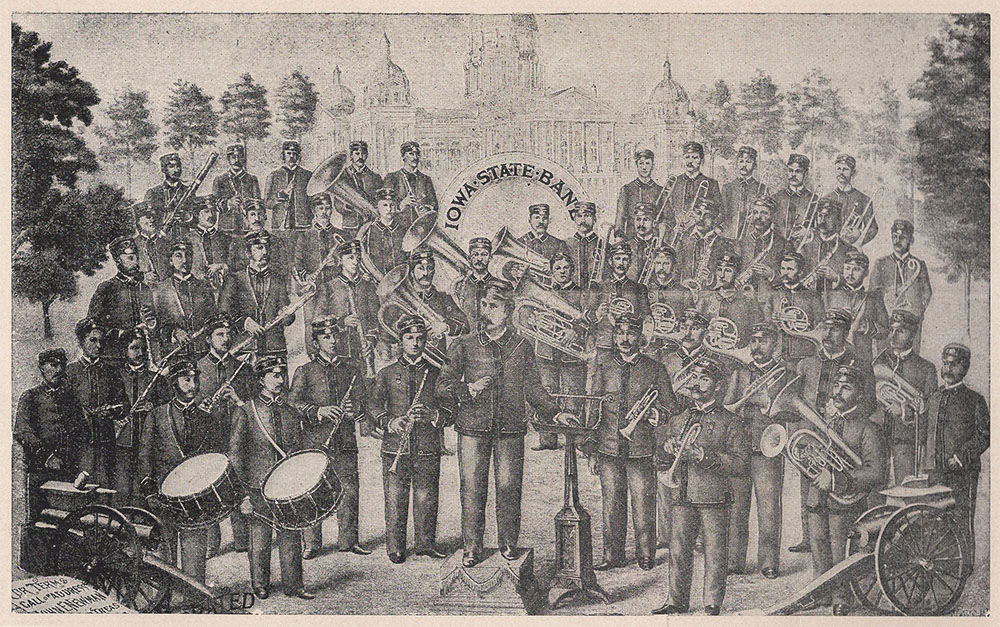
The Iowa State Band. [Image from Pictorial Album and History of the World’s Fair and Midway. Harry T. Smith & Co., 1893.]
The British are coming!
The assembled villagers congregated in one area of the lawn, while spectators watched from separate roped-off areas. By 11 am, 5,000 people had gathered inside the ropes of the encampment lawn. By noon, the assemblage had swelled to 25,000. The Tribune reported that the Bedouin horsemen “galloped up and down before the crowd, brandishing their long spears and frightening folks, who, not knowing how quickly they could turn, fancied they were going to be run into.”
Spectators found the international gathering of nations to be fascinating, confusing, and impressive. The appearance of one foreign representative, in particular, resulted in many raised eyebrows. The British military enthusiastically joined the celebration of America’s Independence Day. “Even England buried the memory of the past and joined in commemorating the era of good will,” wrote the Inter Ocean, “for British cavalry lent its presence and evolutions to this celebration, and British artillerymen fired the salute which greeted the unfurling of the star spangled banner.” These were members of the English Military Tournament, an equestrian show that opened this day in the Live Stock Pavilion after moving their operation from Tattersall’s theater downtown. The mounted unit trotted down the Plaisance, turned in near the west gates, and drew up in a fighting rank behind the speakers’ stand. Manager Levy, serving as master of ceremonies, saluted the red-breasted English captain in three ways—first with military salute, then with a traditional salaam, and finally with a common bow during which he nearly fell out of his saddle.

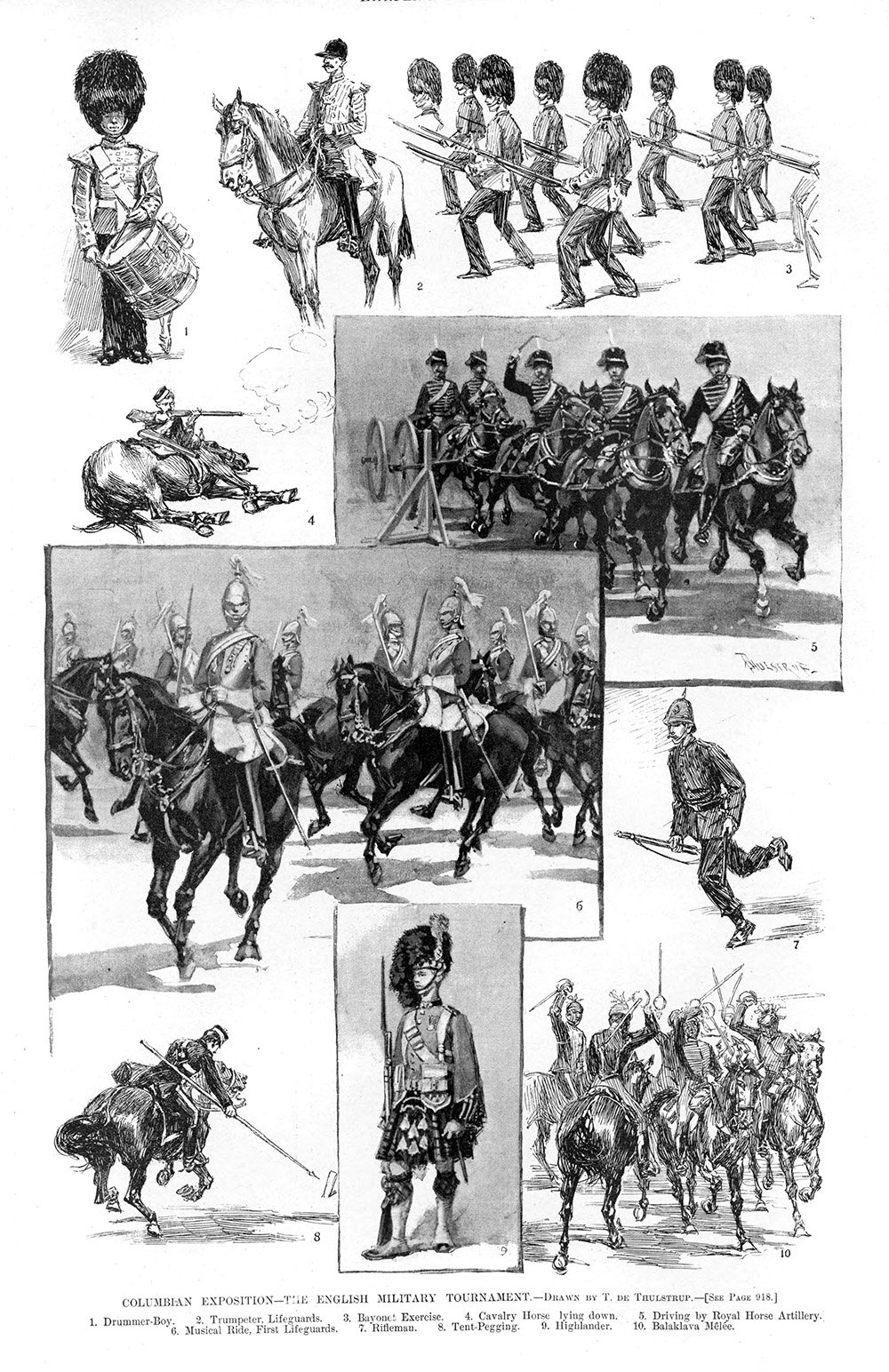
The English Military Tournament, newly relocated to the Exposition fairgrounds, participated in the American Independence Day celebration. [Image from Harper’s Weekly Sep. 23, 1893.]
Rain began falling before the exercises started. At noon—as the White City erupted with the sounds of cannons, whistles, and chimes; as the original U.S. flag rose on its flagpole; and as a long-distance electric connection signaled for the new Columbian Liberty Bell to ring for the first time—the Midway ceremony began. The English artillery fired their cannon as a trans-Atlantic salutation from Her Majesty Queen Victoria.
At the same instant as Britain’s booming salute, Dan Handley received his orders. As the Iowa Band played the “Star-Spangled Banner,” the bronzed and grizzled Civil War veteran pulled the halyards of the big flagpole. A second later, an 800-square-foot American flag, which had been hanging in a lump at the top of the staff, shook itself out and floated proudly over the assembled guests. “When the Stars and Stripes were loosed to the breeze,” wrote Edward B. McDowell, “cheer after cheer went up from people from all parts of the earth. Never before had such a cosmopolitan gathering saluted the emblem of our nation.”
An international salute came in the form of an uproar. Turks swung their crimson flags, Chinese villagers beat their gongs, Bedouins howled and brandished their spears. The Chicago Record recorded that “Babel’s tower in its most interesting moments would have fallen short of the confusion of tongues that shouted huzzas” as the Stars and Stripes floated above the Midway. Cheering was loud enough to frighten the ducks in nearby Washington Park. The Iowa Band again struck up “The Star-Spangled Banner” followed by “America.”

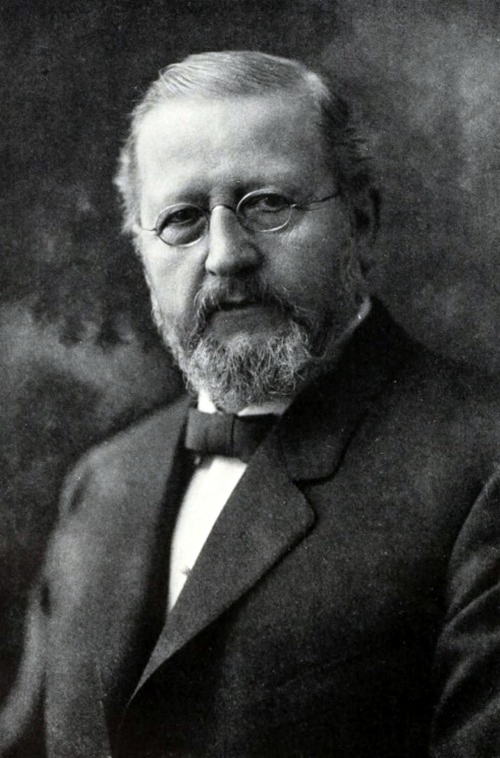
George W. Prussing, President of the Midway Concessionaire’s Club. [Image from Findagrave.com]
President George W. Prussing
When the commotion ceased, a lean and gray-whiskered Muslim priest identified as Shereef Jamal Effendi stepped into the circle and offered a prayer, asking Allah to bless the Fair and make it a great success.” Manager Levy made an impromptu speech in Turkish, and Far Away Moses struck up a chant calling on Allah to bless President Cleveland, the United States, Chicago, and the World’s Fair concessioners. A reporter for the Tribune commented that “it was rather funny … for a [Muslim] priest to pray to Allah to bless this country and its flag when the Committee of Ceremonies had not thought it of sufficient importance to ask a Christian minister to do a like service.” Whether intentionally planned or not, this may have been one of the most religiously diverse Fourth of July ceremonies to date.
Mr. Prussing of the Concessionaire’s Club then stood upon the platform. The German-American builder, a long-time resident and prominent citizen of Chicago, served as the President of the Egypt-Chicago Exposition Company, which operated the Street in Cairo attraction. He opened the ceremony with a short welcome speech that included this sentiment, reprinted by Inter Ocean:
This is a cosmopolitan audience I see before me, but I bid you all a hearty welcome for the day America celebrates. No matter whether your skins are dark or fair, no matter what tongue you use, no matter under what government you first saw light, you all belonged to the brotherhood of man. You all have the same hope, the same aspiration, the same love of liberty, and we should all venerate that emblem of liberty, the star-spangled banner.
His statement was punctuated by vociferous cheering and interrupted several times by musicians from various villages. Every time he said the words “America,” “Fourth of July,” or “liberty,” the Turks reportedly cheered.
Mr. Prussing then introduced Mr. J. R. Burton of Kansas to provide a Fourth of July address to the international audience. The Chicago Record noted that while the jubilee was at its height, a solitary Indian appeared around a hundred yards away with his arms folded. “He stood looking in silence at the scene before him.” The Midway, the White City, Chicago, and the nation celebrating 117 years were all built on stolen land.
[Continued in Part 14]
NOTES
[1] Just days earlier, Governor Altgeld pardoned three men imprisoned for their connections to the 1886 Haymarket affair, a controversial move that some opposed.
[2] In this open space, the Michigan Cadets of Orchard Park encamped for two weeks in early June, and the Toledo Cadets formed camp later in July.
SOURCES
“All Honor the Nation” Chicago Times Jul. 5, 1893, p. 2.
“All Nations Cheer” Chicago Inter Ocean Jul. 5, 1893, p. 2.
“All Nations Join In” Chicago Tribune Jul. 5, 1893, p. 9.
Cameron, William E. The World’s Fair Being a Pictorial History of the Columbian Exposition. P.D. Farrell, 1893.
“Crowds Increase” Newark (OH) Advocate Jun. 27, 1893, p. 5.
“Day of Patriotism” Chicago Inter Ocean Jun. 29, 1893, p. 1.
“Fair’s Best Day” Chicago Times Jul. 5, 1893, p. 1.
“For the Fourth of July” Chicago Daily News Jul. 3, 1893, p. 2.
“Fourth of July at the Fair” Chicago Tribune Jun. 22, 1893, p. 4.
“The Glorious Fourth” Chicago Inter Ocean Jul. 5, 1893, p. 1.
“A Great Celebration” Chicago Record Jul. 5, 1893, p. 4.
McDowell, Edward B. “World’s Fair Cosmopolis” Frank Leslie’s Popular Monthly Oct. 1893, pp. 407–16.
“Midway’s Great Day” Chicago Herald Jul. 5, 1893, p. 3.
“Old Glory” St. Louis Post-Dispatch Jul. 4, 1893, pp. 1–2.
“Old Glory’s Big Day” Chicago Evening Post Jul. 3, 1893, p. 1.
“On Midway Plaisance” Chicago Record Jul. 5, 1893, p. 3.
“White City Gossip” Dodge City (KS) Globe-Republican Jul. 21, 1893, p. 7.
“World’s Fair Fourth” Chicago Record Jul. 5, 1893, p. 1.