


[Continued from Part 17]
Some of the most stunning views of the Columbia Exposition fairgrounds could be found on the grand rooftop promenade of the Manufactures and Liberal Arts Building. To access the roof of this mammoth building, visitors rode in one of four elevators. Even a basic elevator was a novelty to many people in 1893, but adding to the excitement was the fact that these lifts were the tallest in the world, rising 185 feet above the main floor. Traveling at 2.25 miles per hour (a common speed today), open-view cars reached the top platform in about a minute.
Some 3,000 guests made the ascent to the promenade on the Fourth of July to watch the fireworks extravaganza. After the last rocket burst, these spectators naturally wanted to return to terra firma—all at the same time. “When the entertainment was over, the crowd was kept waiting for hours while the four small elevators, jammed full, were trying to lower the people,” explained the Chicago Daily News (Jul. 5, 1893). Ralph E. Hoyt, of Los Angeles, recounted that “a panic almost ensued” when people on the rooftop realized that the only means down was “unable to cope but slowly with the crowd who wished to descend.” While everyone eventually made it off the rooftop, this was only the start of the panic for many.

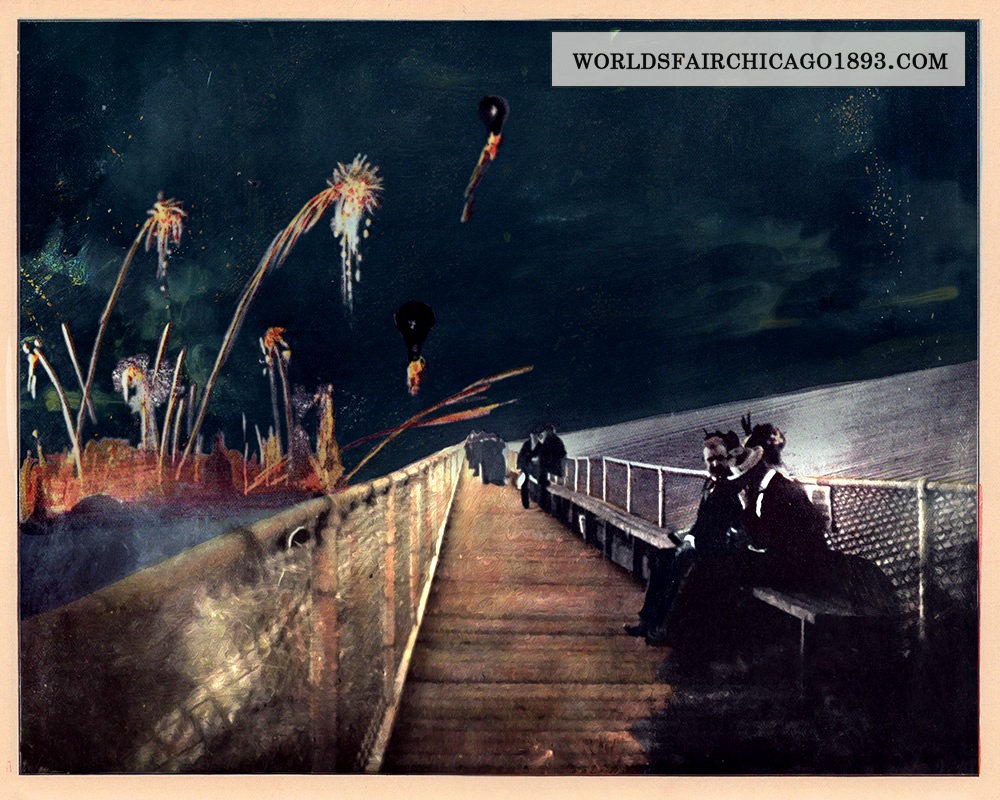
Spectacular views of the fireworks were afforded on the grand rooftop promenade of the Manufactures and Liberal Arts Building. [Image from Picturesque World’s Fair. W.B. Conkey, 1894; digitally edited.]
“You are killing women and babies!”
The sea of humanity trying to flow out of the fairgrounds had few paths to follow. The Chicago Evening Post explained that “the transportation managers and their lines were smothered by the mass of 300,000 people that fell on them within a moment after the last skyrocket of the pyrotechnic display had flashed in polychrome beauty and annihilation in the sky.”
The rising tide of visitors departing Jackson Park quickly overwhelmed the Chicago elevated trains when some 90,000 passengers tried to get on the “Alley L.” Stations for both the city’s elevated train and Fair’s elevated Intramural Railway were located on the roof of the Transportation Building. In a matter of minutes, the space between the stairs to the platform, the Transportation Building and the Hygeia water plant filled with people. “Women and children swooned by the score,” the Chicago Record reported. The paper described the chaos at the turnstiles:
The wildest efforts of husbands, brothers and escorts to carry the stricken ones away were futile. All they could do was to support the unconscious sufferers and call for help. Their hoarse shouts came above the angry roar of men calling upon other angry men in front to tear down the ticket booths. Again and again the fearful surge crushed the breath and senses out of the unfortunates held against the unyielding boards.
More than fifteen women fainted and were trampled by the crowd. Rescuers stretched out their unconscious bodies in a haven of refuge. As panic spread, others pushed to save themselves from catastrophe. A train conductor shouted: “For the love of God and the women down there, stop your crushing. You are killing women and babies. Back up! Back up!” It worked; the shoving subsided. The injured were carried by ambulances running continuously between Jackson Park and a nearby hospital.

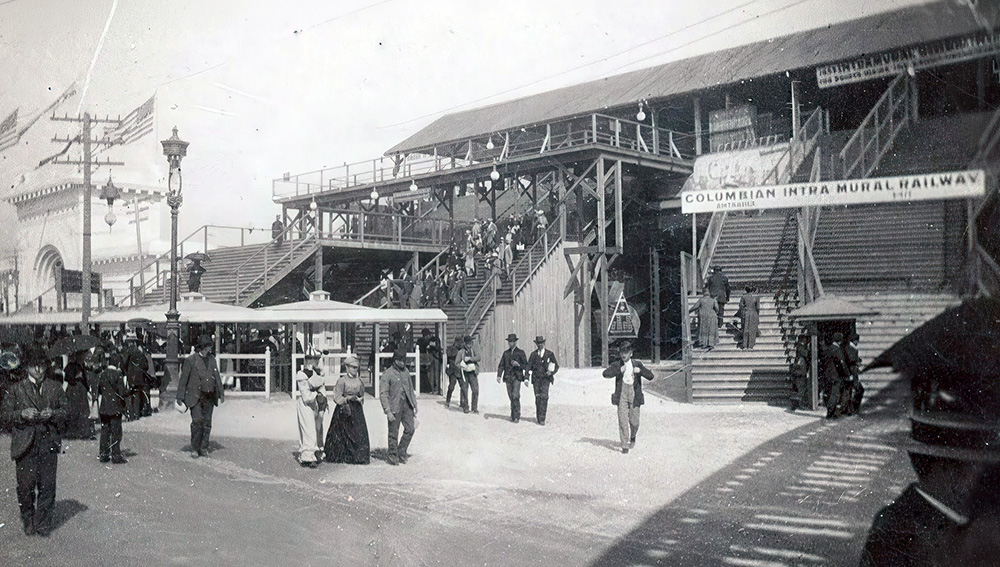
On the roof of the Transportation Building were stations for the Columbian Intramural Railway and for the city’s elevated train line, the “Alley L.”
The Chicago Daily News told the story of Chicago Chief of Police Robert McClaughry (1839–1920), who brought his family to the fairgrounds on July 4th. While the fireworks were still exploding, he thought to quietly slip away and escape the crowds. He got on the Intramural Railway and rode to the Alley L station only to see the ground about the gates black with people. He gave a despairing look while sitting still in his seat and then decided that he might as well ride around the grounds to wait it out. Another train halted next to his for a moment, and a young man appeared over the edge. The chief recognized his son!
“Say, Arthur, you would better go home,” he shouted to him, “or you’ll get caught in the jam.”
“Yes, that is good advice, but I don’t think I’ll go now,” replied the son, casting another look at the surging mob below. “I guess I want to see a little more of the Fair. Say, why don’t you go home?”
“Because I want to see some more of the Fair myself,” replied the police chief with a chuckle. The trains separated and rolled on.

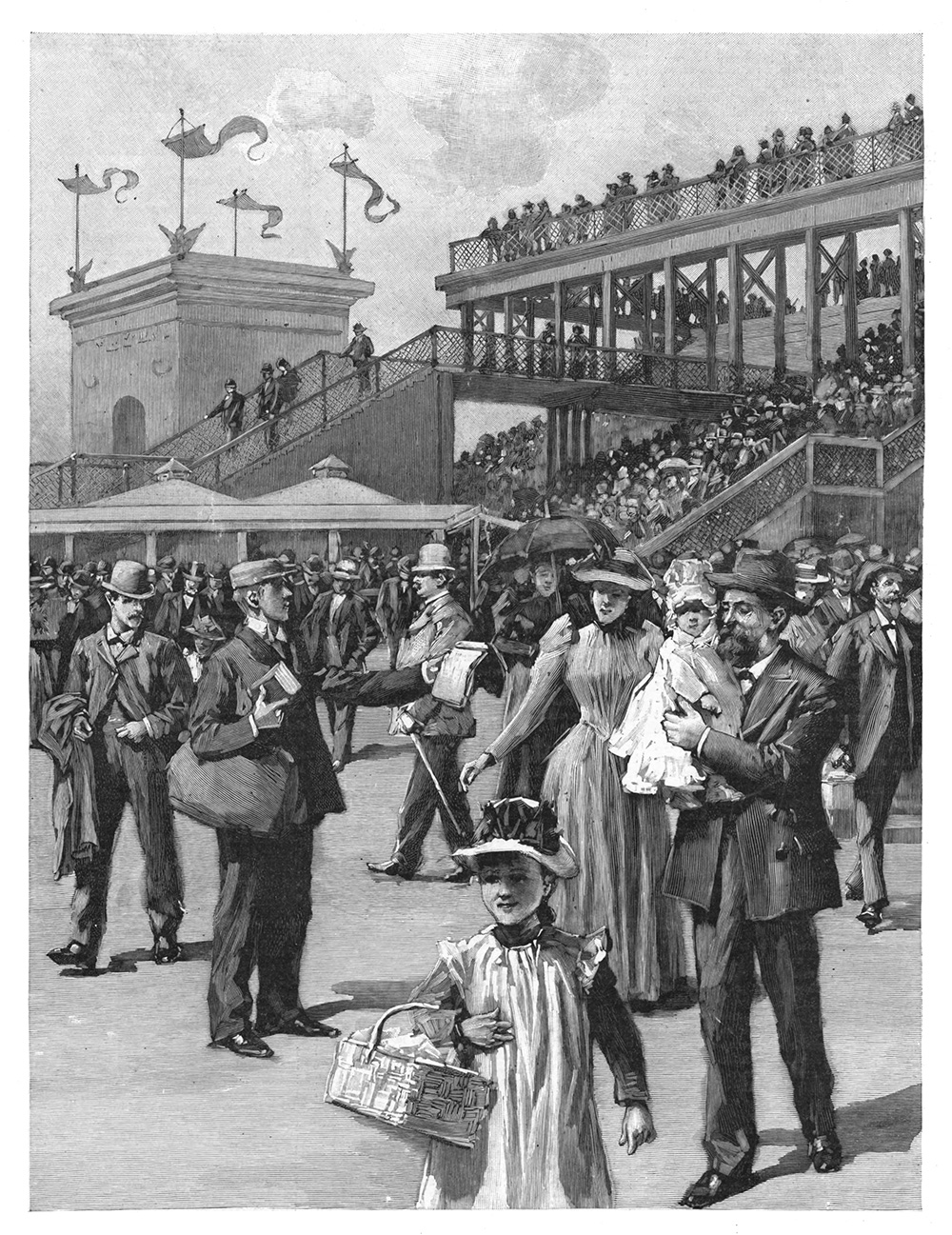
An illustration of crowds pouring into the fairgrounds from the elevated train station. [Image from Harper’s Weekly Jun. 10, 1893.]
“Totally inadequate to the needs of the world’s fair crowds”
Another 150,000 passengers headed to the Illinois Central trains, which handled the crush slightly better. The Illinois Central had twelve trains waiting at Terminal Station and twelve more at the 67th Street gate. Passengers packed into cars and many brave riders covered the tops of coaches and hung on for dear life. Another 30,000 passengers jumped on Northern Pacific and Pennsylvania excursion trains.
An estimated 90,000 passengers took a cable car home. The Chicago Evening Post described the fine service they experienced, at least at first:
The South Side cable lines rendered splendid service. When the crowd rushed through the western gate of the Midway Plaisance, it found a string of cars a mile or so long waiting. As quickly as each train was loaded—and it did not take long—the gripman pulled his lever and the train started north. Without confusion or delay thousands were thus brought home comfortably and in good time.
Problems arose when passengers reached downtown and tried to transfer onto Charles Yerkes’ lines, which failed to handle the crowds. “The North and West Side cable lines were totally inadequate to the needs of the World’s Fair crowds,” the Evening Post asserted. Thousands of North Sider residents found themselves stranded downtown for the night when the cable cars stopped running shortly after 1 am. “People who were compelled to work today and who were unable to come in cabs laid along the street,” reported the Chicago Record the next morning “Some were asleep; others talked about waiting for the horse cars.” The Chicago Herald described angry riders whose “language was as lurid as the fireworks.”

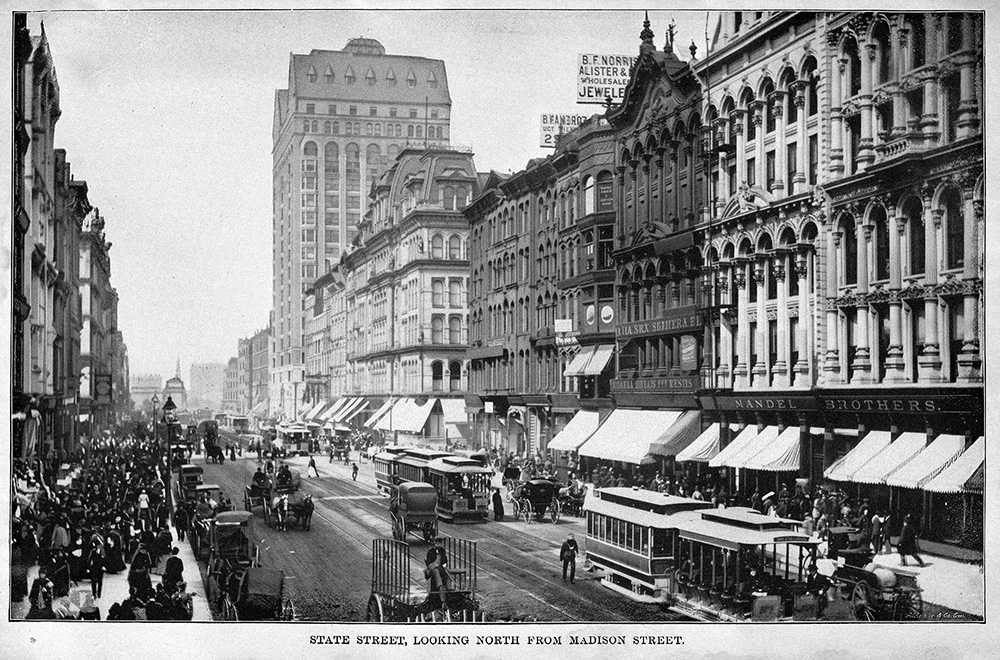
Cable cars on State Street, looking north from Madison Street in downtown Chicago. [Image from Banks, Charles Eugene The Artistic Guide to Chicago and the World’s Columbian Exposition (Columbian Art Co., 1893).]
“The odor of a large-sized rat”
The water route was also a dreadful experience for those trying to get home. All day long, the World’s Fair Steamship Company’s four boats carried around 25,000 passengers from the downtown pier at Van Buren Street to Jackson Park. Most purchased round-trip tickets. Once the fireworks ended, the fairgoers headed to either the Casino Pier or North Pier to catch a return boat to the city. After exiting through the fairground turnstiles, some 6,000 people ended up imprisoned on the piers for hours. The company’s fleet of boats were already packed with spectators who had purchased special excursion tickets to view the fireworks from onboard, thereby not needing to pay to enter the Fair. Those stranded on the pier could not re-enter the fairgrounds, now closed, nor could they find a boat back to the city. The angry crowd felt that they had been tricked. The Chicago Times explained that “the odor of a large-sized rat began to fill the nostrils” of the thousands of trapped sightseers. Gatekeepers eventually allowed them to re-enter the park to seek other ways home. Their story of being abandoned by the World’s Fair Steamship Company sparked outrage in the press and accusations of fraud. A report in the Times claimed that the company tricksters netted around $600 [around $20,000 today] in profit from the scheme.

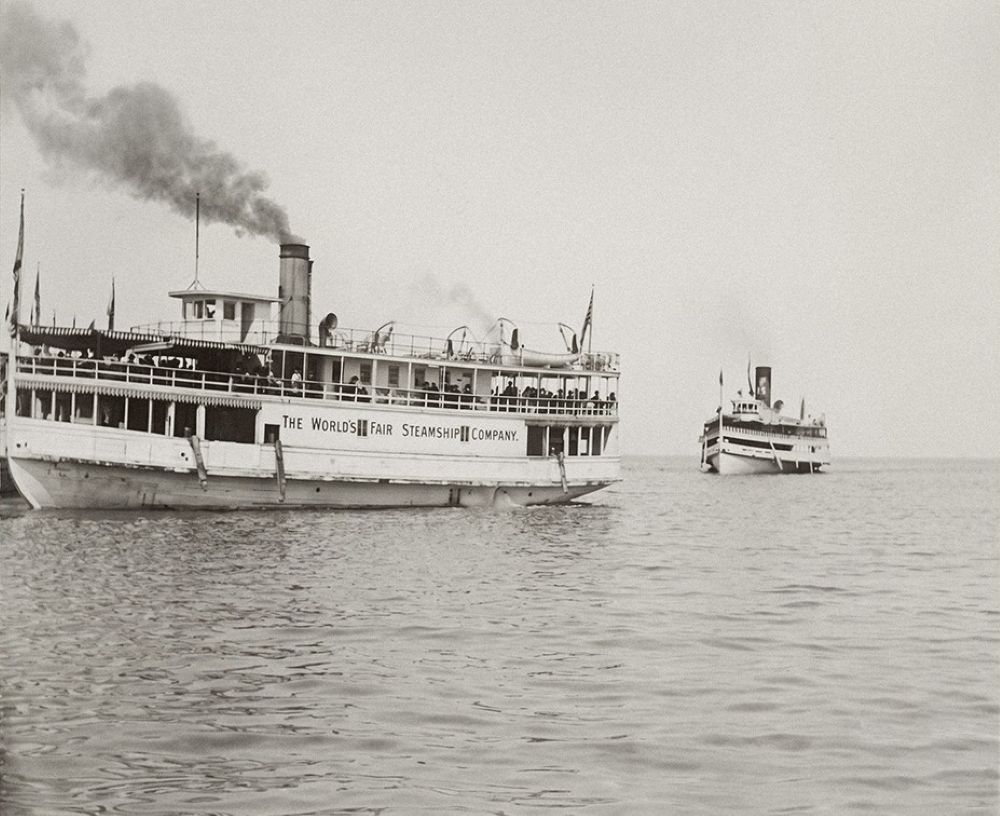
The World’s Fair Steamship Company ran four boats between the fairgrounds and the Van Buren Street pier in downtown Chicago. [Image from Keystone View Company stereoscope card; private collection.]
“The severest test they have yet experienced”
The mess involved in getting home was a frustrating end to an otherwise festive day. The Evening Post described visitors’ anger:
The crowds … put the transportation facilities to the severest test they have yet experienced, and the result was a certain amount of delay to the public and consequent vexation and disappointment on the part of those who were belated and who complained bitterly of the inadequacy of the transportation lines to the needs of the occasion.
The paper also offered this praise of resilience of the transportation systems:
The exposition managers deserve a lot of commendation for the skillful way in which they managed the flood, and the officers of the Illinois Central Railway, the elevated railway, and the South Side streetcar line should be thanked for their vigorous attempts to get the people to and from the grounds promptly. That there was a jam at the stations was not their fault. It would have taken a miracle of railway management to have prevented a crush with 300,000 men and women all starting from home at the same way, at the same time, and with the same notion that there was only one train and that it was just enough to leave.
The record-breaking attendance on the Fourth of July offered a valuable test of the transportation systems managed by the Exposition, civic agencies, and private companies. A crowd almost two-and-a-half times larger would descend on Jackson Park three months later.

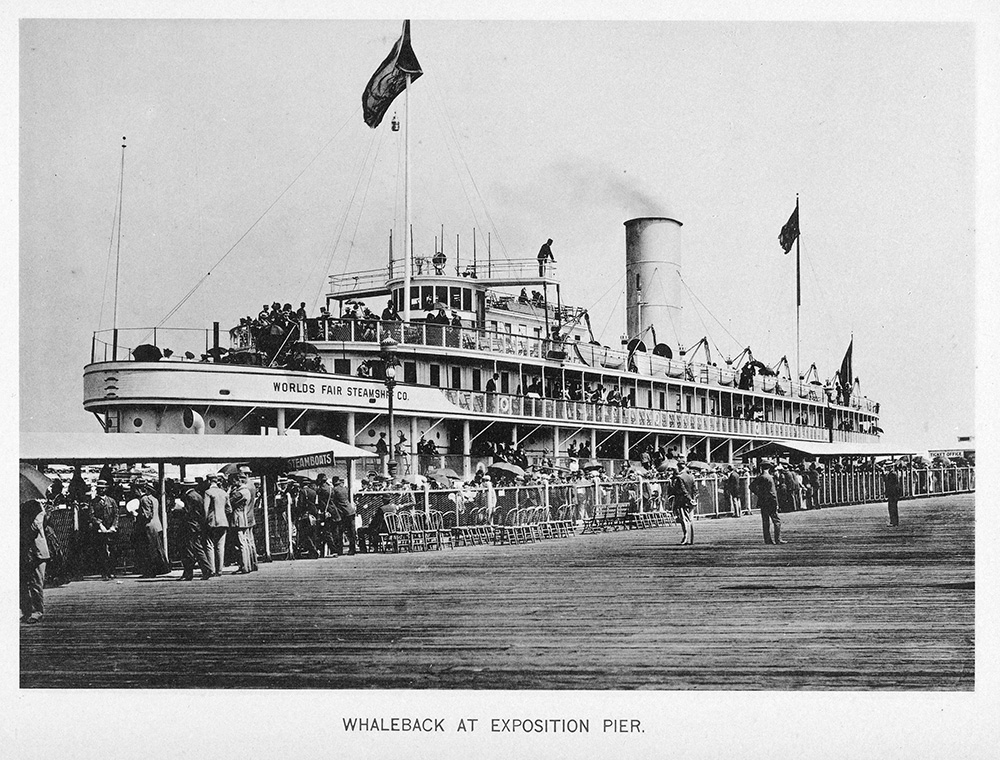
Unlike the boats run by the World’s Fair Steamship Company, the whaleback Christopher Columbus did not strand passengers in Jackson Park on July 4th. [Image from Arnold, C. D.; Higinbotham, H. D. Official Views of the World’s Columbian Exposition (Press Chicago Photo-gravure Co., 1893).]
“Everything was in order”
By the morning of July 5th, most signs of the enormous Fourth of July crowd had been erased. The Chicago Evening Post described the scene:
… the grounds and buildings had been thoroughly cleaned, the trampled grass had been sprinkled and the Wooded Island looked as fresh and green as ever. The drives had been rolled, temporary stands had been torn down, and benches scattered about the park put in their proper places. Everything was in order, and from one end of the grounds to the other there was nothing left to remind visitors of the great test that had so recently been made of the company’s resources.
Clean-up crews scoured the fairgrounds, sweeping away countless lunch bags and fishing “a great assortment of delicacies” out of the Lagoon, the Chicago Daily News noted. One crewman spent half an hour climbing onto Mary Lawrence’s statue of Christopher Columbus, which stood at the east entrance to the Administration Building, in order to dislodge a “soft and unattractive apple that had been lodged in his eye by some small boy whose aim was better than his intention.” A note discovered on the wall of the Administration Building rotunda read: “We came, we saw, but we could find no place to sit down.”

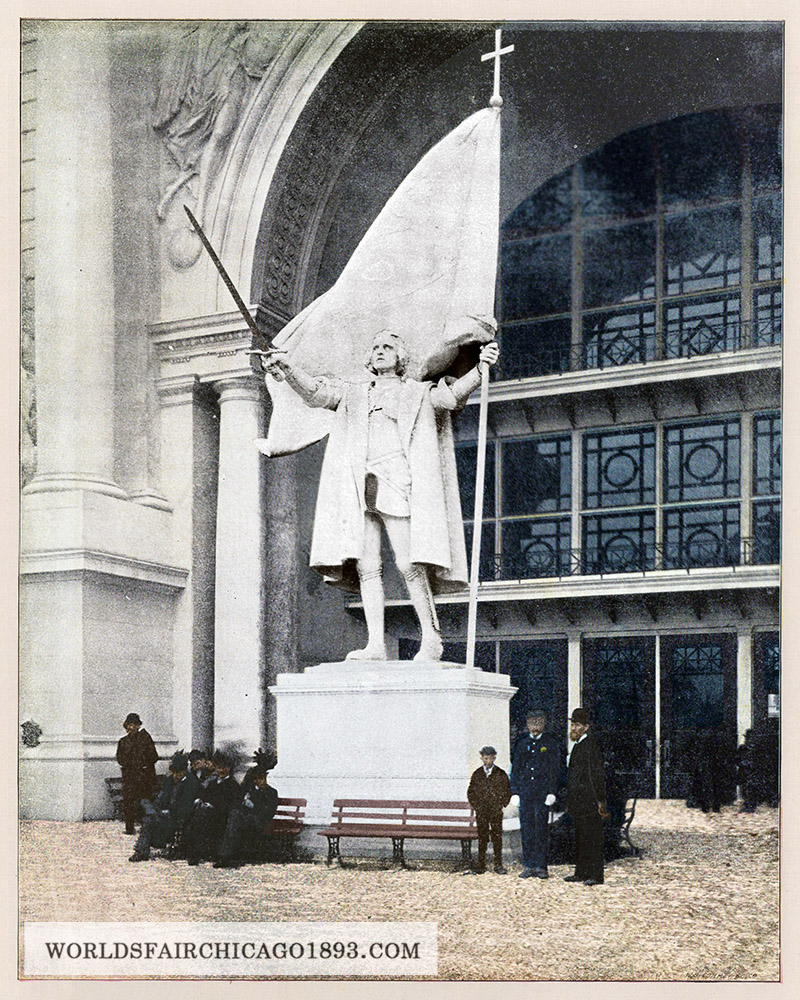
Mary Lawrence’s statue of Christopher Columbus needed some cleaning after the July 4th festivities. [Image from Picturesque World’s Fair. W.B. Conkey, 1894; digitally edited.]
“Simply incomprehensible”
On July 2, the Inter Ocean projected that an estimated 400,000 to 600,000 of a “mighty army” of locals and visitors would march into the fairgrounds. Had clear skies greeted Chicago on the morning of the Fourth, this expectation may have been met or surpassed. The official count from the Admissions Department was that 330,542 people (283,273 with tickets and 47,269 with free passes) entered the fairgrounds on July 4th, the first “overwhelming crowd” of the Exposition season. The Evening Post described the throng as “a larger crowd, perhaps, than has ever before gathered on one occasion in America.” The New York Times acknowledged that this was “away beyond the attendance at the Centennial Exposition on the Fourth of July, 1876.” Not until October 9 would more people pass through the Columbian Exposition turnstiles in a single day. “The crowd was simply incomprehensible,” announced the Chicago Herald with just a touch of hyperbole. “It ought to go down into history and mark an epoch as did the great assemblies of other days.”
“The attendance on July 4th was the largest yet experienced and some supposed it to be the greatest which the Exposition would have,” reported Exposition President Harlow Higinbotham. He conceded that “United States Day” had provided a bump—but not a jump—in attendance:
This prediction, like that as to the attendance on May 1st, was destined to be disproved later. Soon after July 4th the attendance again fell off, owing to the heat and the fact that many who had visited the Exposition en route for places of summer resort had gone away, while others were delaying their visits until more favorable weather should prevail.
“Soon after” meant July 5, when attendance plummeted to 120,864 admissions. Under a headline of “LIKE A DESERTED VILLAGE,” the Pittsburg Press that day announced that “the World’s Fair grounds appeared dull today.” Still, even the one-day attendance bump pleased nervous Exposition directors. Cash receipts from the July 4th ticket sales and concession percentages surpassed $200,000, more than double the net revenue of any single day so far.

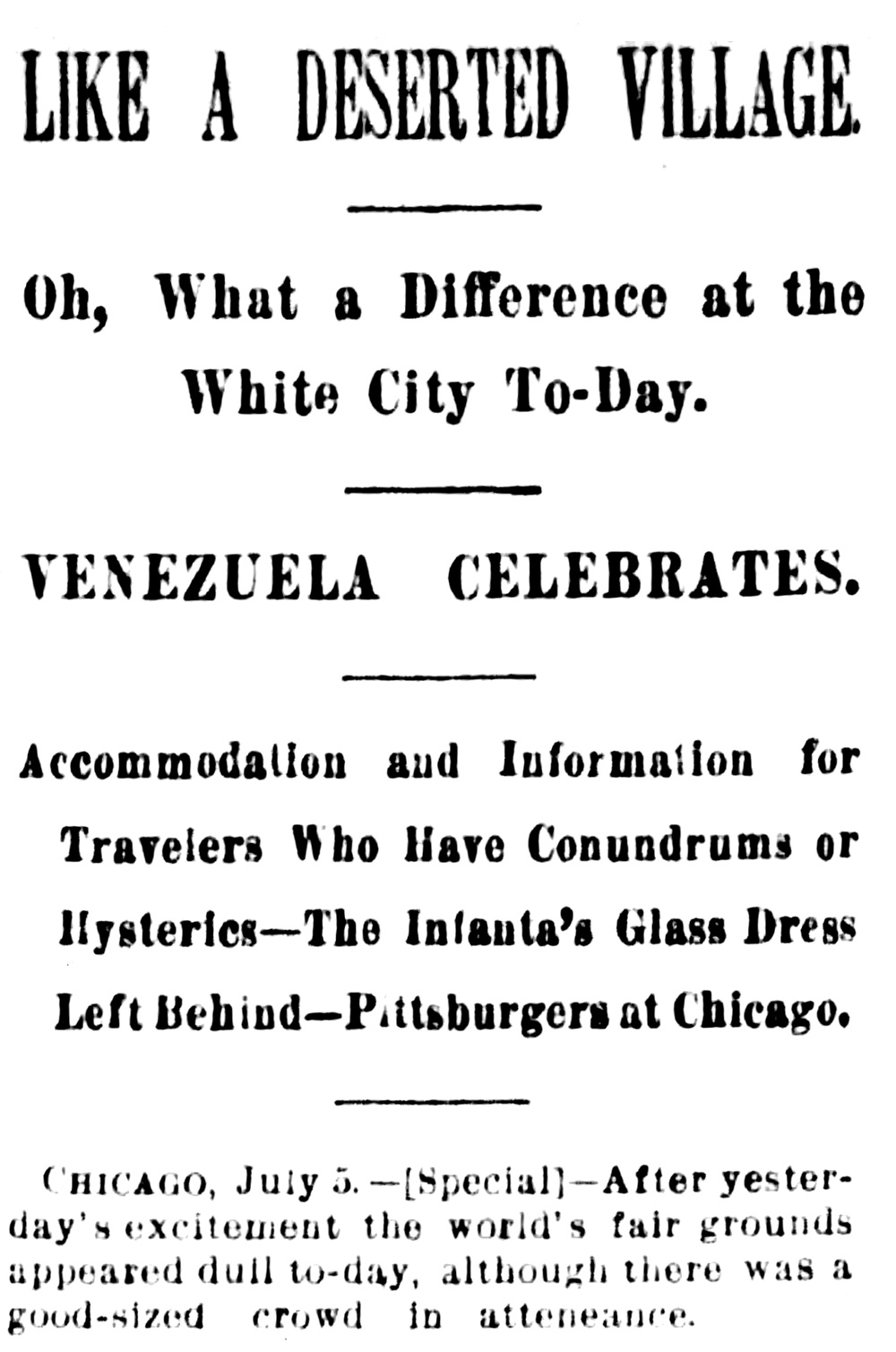
Despite record-breaking crowds on July 4th, attendance continued to lag in mid-July. This headline from the July 5, 1893, Pittsburg (PA) Press describes the fairgrounds as being “Like a Deserted Village.”
“Only happy, smiling faces”
Another source of good news came in the form of newspaper reports spreading across the country about commendable behavior of fairgoers. The Chicago Times boasted about the “exceptionally orderly multitude,” reporting that “there was no drunkenness. Everybody seemed too content to get full on patriotism.”
John Brisben Walker, owner and editor of The Cosmopolitan, was impressed with the comportment of World’s Fair visitors:
It was my good fortune to be present on the Fourth of July, when the number of people on the grounds exceeded three hundred and five thousand. It was most interesting to study the faces, to note the looks of appreciation, to hear the exclamations of admiration, to listen to comment which was intelligent even when the garb was homely. I walked through many miles of avenues on that day: everywhere unmistakable signs of enjoyment, everywhere the comment of intelligent appreciation, and above all, everywhere the utmost good-nature. That, to my mind, was the most marvellous exhibition of all, that in a crowd containing more than three hundred thousand souls there was not, so far as I was able to see, and I carefully searched for it, one ill-tempered face, one drunken man. What a change has come over our civilization in the past twenty-five years! Such a crowd, anywhere in the United States, before the sixties or seventies, would have been the scene of endless personal conflicts, of drunkenness, not of the hundreds, but of tens of thousands, and women and children could not have taken part ill such a gathering without the risk of personal injury. Yet here were only happy, smiling faces, women and children moving with perfect freedom, without even a thought that they were in the largest crowd of people ever brought together within a single enclosure upon the American continent, all feeling kindly toward each other, all taking part in the general joy and universal pride that this was the creation of their countrymen. The contrasts between the stage-coach and giant locomotive, between the birch-bark letter of the Indian and the telautograph message of Gray, the canoe of the Esquimaux and the electric railway, were not so great as that between the customs prevalent in my boyhood and this realization of hopes for a new civilization in the midst of which I walked on this Fourth of July, 1893.
Drunkenness was absent. Crimes were rare. James Merkie, from Iowa, attempted to scale a fence to avoid the fifty-cent admission fee; he was caught and tossed into a cell at the Woodlawn police station. A few accidents and several cases of fainting due to crowds and heat brought guests to the Exposition hospital during the afternoon; the ambulance corps logged 156 incidents by 6 pm. The first patient of the day was William Holt, conductor on the Illinois Central railroad. He was found lying on top of a train car, unconscious and bleeding from his head. He had a “frightful wound” and a fractured skull from having struck his head against the footbridge at 70th Street.
Of the twenty-six lost children brought to the Service Building, twelve were returned to their parents. Eleven more, who were considered old enough to care for themselves, were told to find their own way home. The remaining three unclaimed and sobbing young boys spent the night on the fairgrounds.

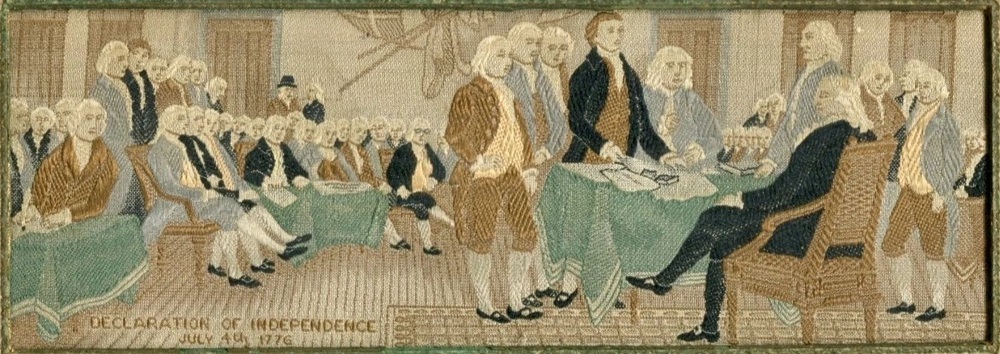
A Stevengraph silk depicting the signing of the Declaration of Independence, woven in Machinery Hall at the 1893 World’s Fair.
“A mighty rush, vim, bang, and hurrah”
When the Second Continental Congress issued the Declaration of Independence in 1776, John Adams famously wrote to his wife, Abigail, predicting that the date of July 2nd would become a national holiday:
I am apt to believe that it will be celebrated, by succeeding Generations, as the great anniversary Festival. It ought to be commemorated, as the Day of Deliverance by solemn Acts of Devotion to God Almighty. It ought to be solemnized with Pomp and Parade, with Shews, Games, Sports, Guns, Bells, Bonfires and Illuminations from one End of this Continent to the other from this Time forward forever more.
By 1777, the nation fighting for independence already had decided on July 4th as its birthday, but much else of Adams’ vision soon became part of the annual tradition. As the 1893 World’s Columbian Exposition planned its Fourth of July celebration, the Chicago Tribune (Jun. 22, 1893) commented that:
Were old John Adams alive it would more than satisfy his idea of bells, music, fireworks, and popular rejoicing. … From early dawn until midnight indeed Chicago proposes to celebrate the Fourth of July with a mighty rush, vim, bang, and hurrah that can be felt and heard even in New York. … It intends to give the Nation an object lesson in Fourth of July celebrations.
On June 28, the Tribune predicted that the “America Day” festival would be
… an embarrassment of bell ringing, cannon firing, national anthem singing, rocket shooting, bomb bursting, flag flying. It will be a great popular holiday, an apotheosis of liberty, a celebration so elastic that all the cosmopolitan elements of Chicago … may join in with fervor and enthusiasm.
When the gunpowder, smoke, and patriotism that perfumed the air of Jackson Park faded, nearly all agreed that the Fair had delivered on this promise.

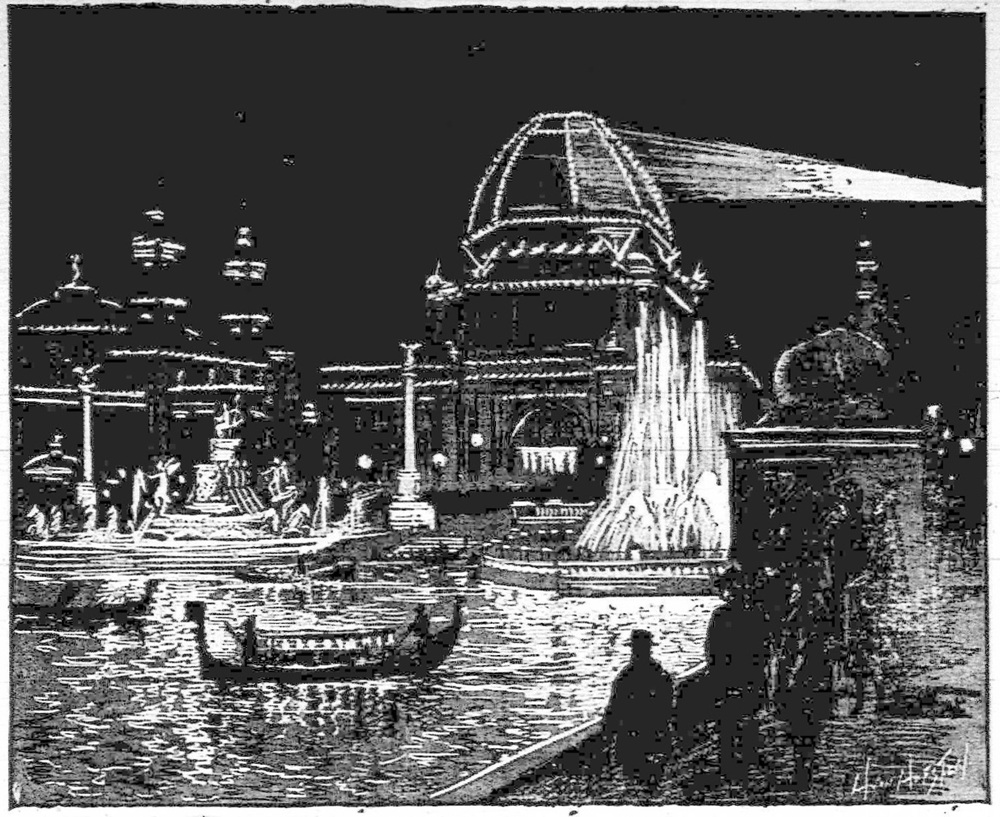
The illumination of the Administration Building and other palaces in the Court of Honor provided the final magical vision to guests departing on July 4th. [Image from the Chicago Evening Post Jul. 3, 1893.]
“It was the greatest Fourth of July celebration ever held”
Chicago newspapers on July 5 boasted about the fête day as only the Windy City could. “What a day yesterday was for the exposition and for America!” extoled the Chicago Evening Post. “Where in the peaceful history of our country can be found another celebration so majestic, so picturesque and so inspiring as the one of which over 300,000 men and women participated in Jackson Park last night?” The Chicago Tribune added that “the domes and spires of the city of dreams have looked down upon many a fair and goodly spectacle, but never on a more significant gathering or one more replete with hopeful promise for the future of the American people than that which responded to his summons.”
The Chicago Times claimed that “it was the greatest Fourth of July celebration ever held … in the presence of the largest crowd ever gathered in this country at one spot.” The editor of the Chicago Record concurred, writing: “It is doubtful that the Fourth of July has ever been more picturesquely celebrated than it was yesterday. The World’s Fair celebration was full of animation, but, like everything that occurs inside the grounds, it was dignified and without turmoil.” The unanimous participation by the international visitors in America’s birthday, the editor thought, demonstrated “the brotherhood that binds all men.” The thoughts of those international visitors went unrecorded.
Reporters from across the land heaped praise on the Columbian Fourth. A story in the Elkhart Weekly Truth claimed the Columbian Fourth was “the grandest celebration of Independence Day that was ever held.” A correspondent to the Los Angeles Evening Express wrote:
In fact, it was the biggest Fourth ever experienced in the United States, so far as known, and nothing to equal it is likely to materialize for many years to come. … Metaphorically, every man among the hundreds of thousands in or near the fairgrounds was a gilt-edged patriot, every woman a goddess of liberty, and every boy a walking torpedo, kept from exploding only by the stern interdiction of law.
The St. Louis Post-Dispatch described the fairgrounds as being “ablaze with patriotism” and “the center from which the patriotic pulse of the liberty-loving people, enjoying the manifold blessings of a land of the free and a home of the brave.”

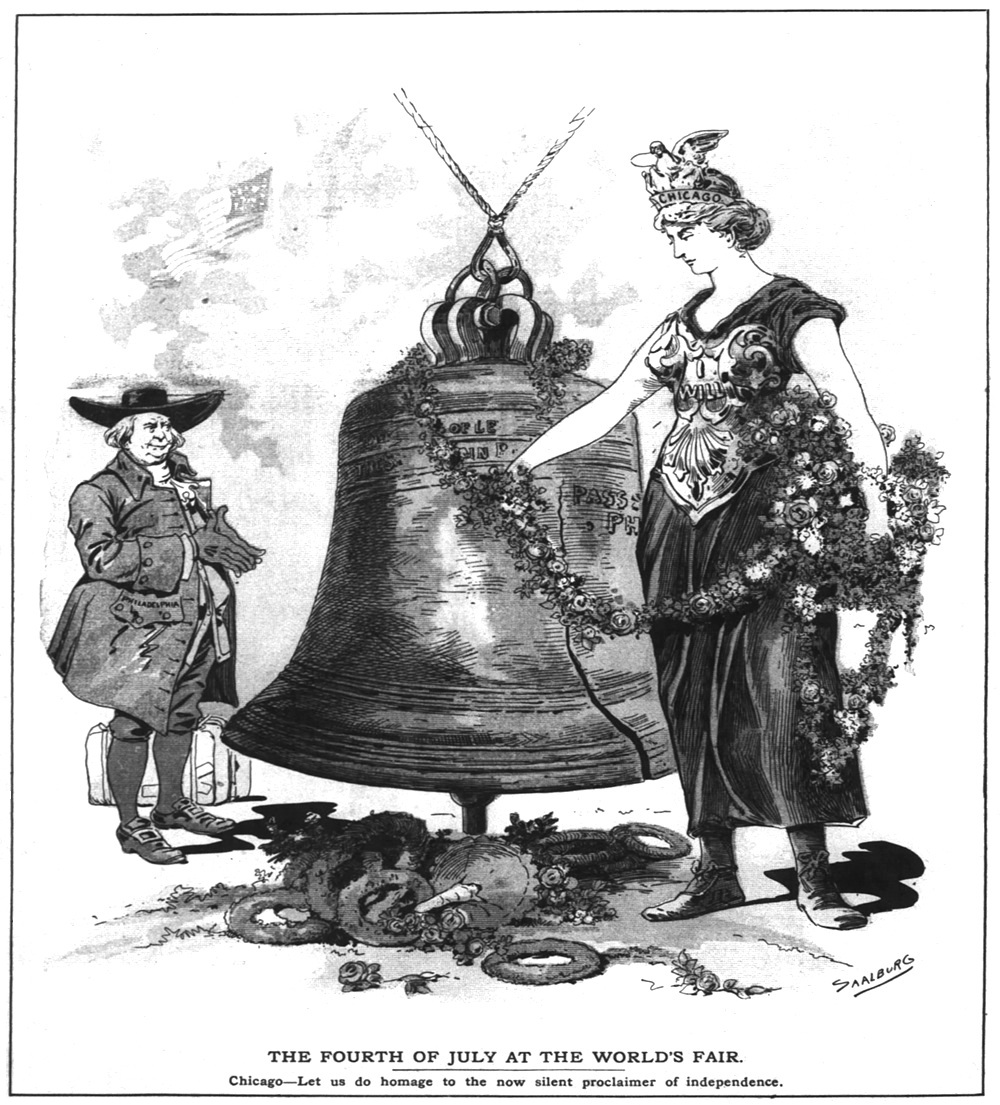
“The Fourth of July at the World’s Fair. Chicago—Let us do homage to the now silent proclaimer of independence” by Charles W. Saalburg. [Image from the Chicago Inter Ocean Supplement July 5, 1893.]
“A shrine of patriotism”
World’s Fair historian Rossiter Johnson characterized the Fourth at the Fair as “the most inspiring ever held,” adding that: “From the sunrise salute until midnight it was filled with stirring incidents and overflowing patriotism, and so varied were the proceedings that their details could be mastered only with difficulty.” William E. Cameron posited:
Certainly never before, and in all human probability never again, will the Natal day of American independence be glorified with such a gush and flood of enthusiasm as hailed its recurrence in the year 1893. … Every successive step in the progress of the Columbian Celebration has contributed to the tide of patriotism swelling and rising in the great heart of the multitude; and its culmination was found on the Fourth of July, when the admiration, pride, and prayer of a free people were voiced by the grand chorus which hymned forth at Jackson Park the National Anthem.
Cameron added that “nothing on the earth nor under it nor anywhere in the universe was ever seen that could even compare to it,” but then offers a comparison:
It crowded into a single day all the glories of all the wars and all the pomp of all the parades, and built a shrine of patriotism as long as the country’s boundaries and as high as nature’s aspirations. It was the most auspicious day for loyal Americans since Bunker Hill and Concord; a day when all the world brought homage to Columbia; a day second in history only to the original it commemorates.
In a letter written on July 5 and published in The Graphic, visitor Katherine Norris shares her thoughts on the day:
Oh, the noise, the distraction, the confusion, the fire-works, speeches, poems, bands, music, songs, soldiers, and the glitter and glory of it all, too! … I never felt so patriotic before in all my life. I don’t believe I ever appreciated before that I had a country or that my country had a Fourth. But last night it had a Fourth with a vengence [sic]. The illumination and fire-works among those great white palaces, with the spangled skies above and the gleaming waters below—it is beyond words to describe.
“It was a glorious Fourth,” declared the Inter Ocean editorial page, “a day to be spoken of to your children, and to your children’s children.” While that oral tradition did not survive many more generations, we hope that this history can serve to document what people of the era considered one of the greatest Fourth of July celebrations ever held.

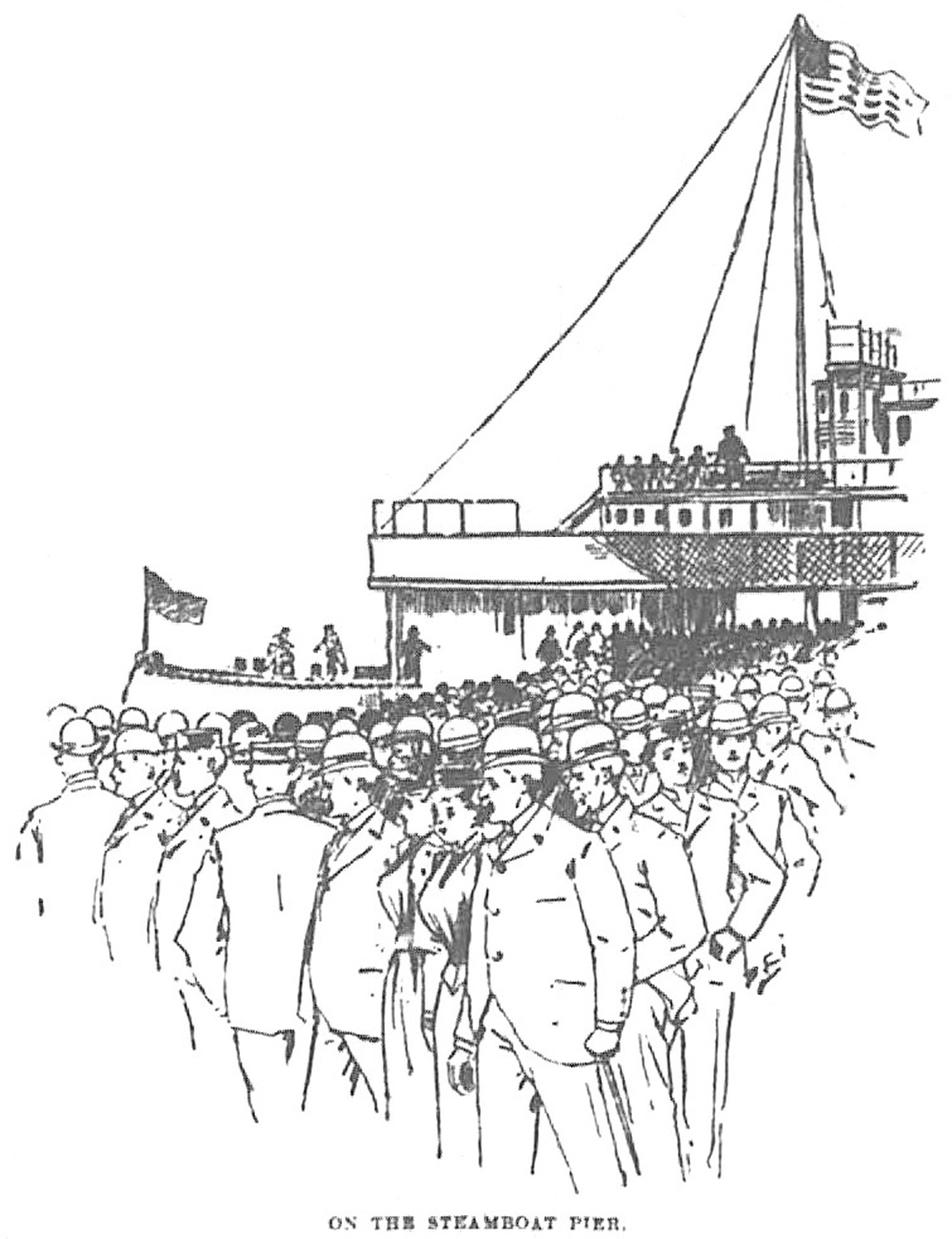
Several steamships ran between downtown Chicago and Jackson Park to bring visitors to and from the fairgrounds. [Image from Chicago Record July 5, 1893.]
SOURCES
“Big Crowd to Handle” Chicago Evening Post Jul. 5, 1893, p. 1.
“Biggest Day of All” Chicago Herald Jul. 5, 1893, p. 2.
Cameron, William E. The World’s Fair Being a Pictorial History of the Columbian Exposition. P.D. Farrell, 1893.
“Counted Up 302906” Chicago Record Jul. 5, 1893, p. 1.
“Crowd Behaves Well” Chicago Herald Jul. 5, 1893, p. 11.
“Crushed in the Mob” Chicago Record Jul. 5, 1893, p. 1.
“Fair Made Lots of Money” Chicago Evening Post Jul. 5, 1893, p. 2.
“Fair’s Best Day” Chicago Times Jul. 5, 1893, p. 1.
“Fourth at the Fair” Elkhart (IN) Weekly Truth Jul. 5, 1893, p. 10.
“Fourth of July at the Fair” Chicago Tribune Jun. 22, 1893, p. 4.
“Glorious in Spite of Everything” Chicago Evening Post Jul. 5, 1893, p. 4.
“A Great Celebration” Chicago Record Jul. 5, 1893, p. 4.
“The high-water mark…” New York Times Jul.7, 1893, p. 4.
Higinbotham, H. H. Report of the President to the Board of Directors of the World’s Columbian Exposition. Rand, McNally & Co., 1898.
“His Birthday Party” Chicago Tribune Jul. 5, 1893, p. 1.
Hoyt, Ralph E. “From the World’s Fair” Los Angeles Evening Express Jul. 15, 1893, p. 3.
Johnson, Rossiter A History of the World’s Columbian Exposition Held in Chicago in 1893, Volume 1: Narrative. D. Appleton and Co., 1897.
“Jubilee of Liberty” Chicago Inter Ocean Jul. 2, 1893, p. 2.
“Like a Deserted Village” Pittsburgh (PA) Press Jul. 5, 1893, p.2.
“News and Notes” Chicago Daily News Jul. 5, 1893, p. 8.
“The Night Display” Chicago Times Jul. 5, 1893, p. 1.
“Observance of the Fourth” Chicago Inter Ocean Jul. 5, 1893, p. 6.
“Old Glory” St. Louis Post-Dispatch Jul. 4, 1893, pp. 1–2.
“One Day for America” Chicago Tribune Jun. 28, 1893, p. 12.
“Some Liberty Letters” The Graphic Jul. 8, 1893, p. 20.
“Strewn With Lunch Bags” Chicago Daily News Jul. 5, 1893, p. 8.
“Tricked by Schemers” Chicago Times Jul. 5, 1893, p. 3.
“Will Live in History” Chicago Herald Jul. 5, 1893, p. 1.
“World’s Fair Fourth” Chicago Record Jul. 5, 1893, p. 1.