


[Continued from Part 14]
Several formal Fourth of July exercises—held in the Administration Plaza and the Woman’s Building in the morning, on the Midway Plaisance at noon, and in the Delaware and Pennsylvania buildings in the afternoon—offered visitors to the 1893 World’s Fair ample opportunities to experience patriotic speeches and songs. Those wishing to explore on their own could find many exhibits from the colonial and Revolutionary War era scattered around the fairgrounds. “No more fitting stage for the jubilee could be chosen than Jackson Park. On every side are priceless relics of colonial times,” offered the Chicago Inter Ocean (Jun. 21, 1893). “These exhibits, these carefully guarded treasures from the nursery of the Nation, make the blood of patriotism burn in the hearts and glow in the faces of true Americans.”

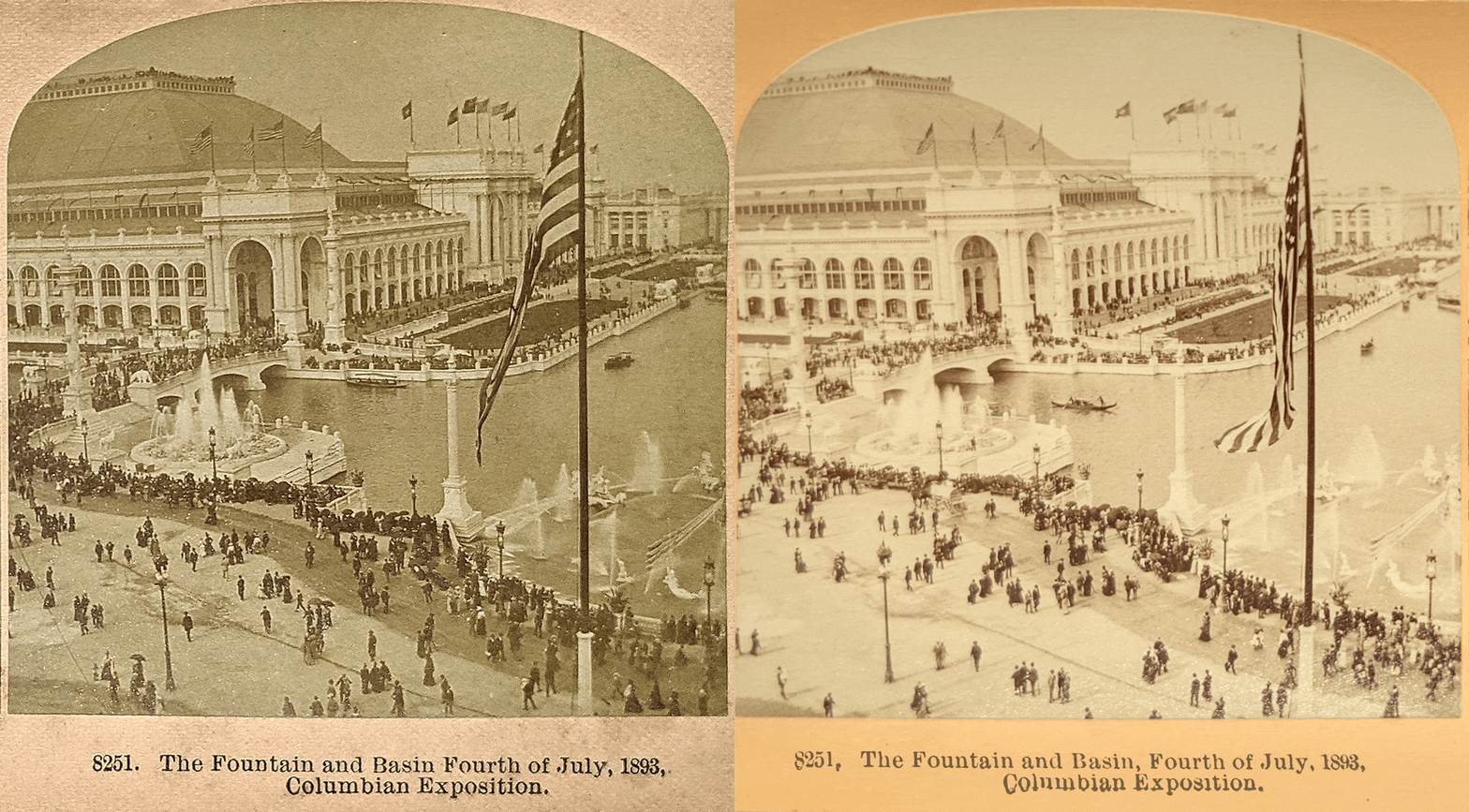
After the morning exercises, crowds dispersed across the fairgrounds. Many enjoyed band concerts and sightseeing in the Court of Honor. [Image from Kilburn stereoscope cards; private collection.]
“Faithful reproductions”
The state buildings, located on the north edge of the fairgrounds, swarmed with visitors all day. Some simply sought shelter under protective porch awnings during the midday rain, but others flocked inside to explore displays of Revolutionary War and early-American artifacts.
Simply walking through the campus could provide visitors with object lessons in American architectural history. Here stood five “faithful reproductions of structures cherished at home for historic memories and associated with events of undying honor in the national records,” according to Columbian Exposition historian Rossiter Johnson. In addition to the Pennsylvania State Building, which reproduced Philadelphia’s Independence Hall, several other state homes copied structures important to the Revolutionary War.

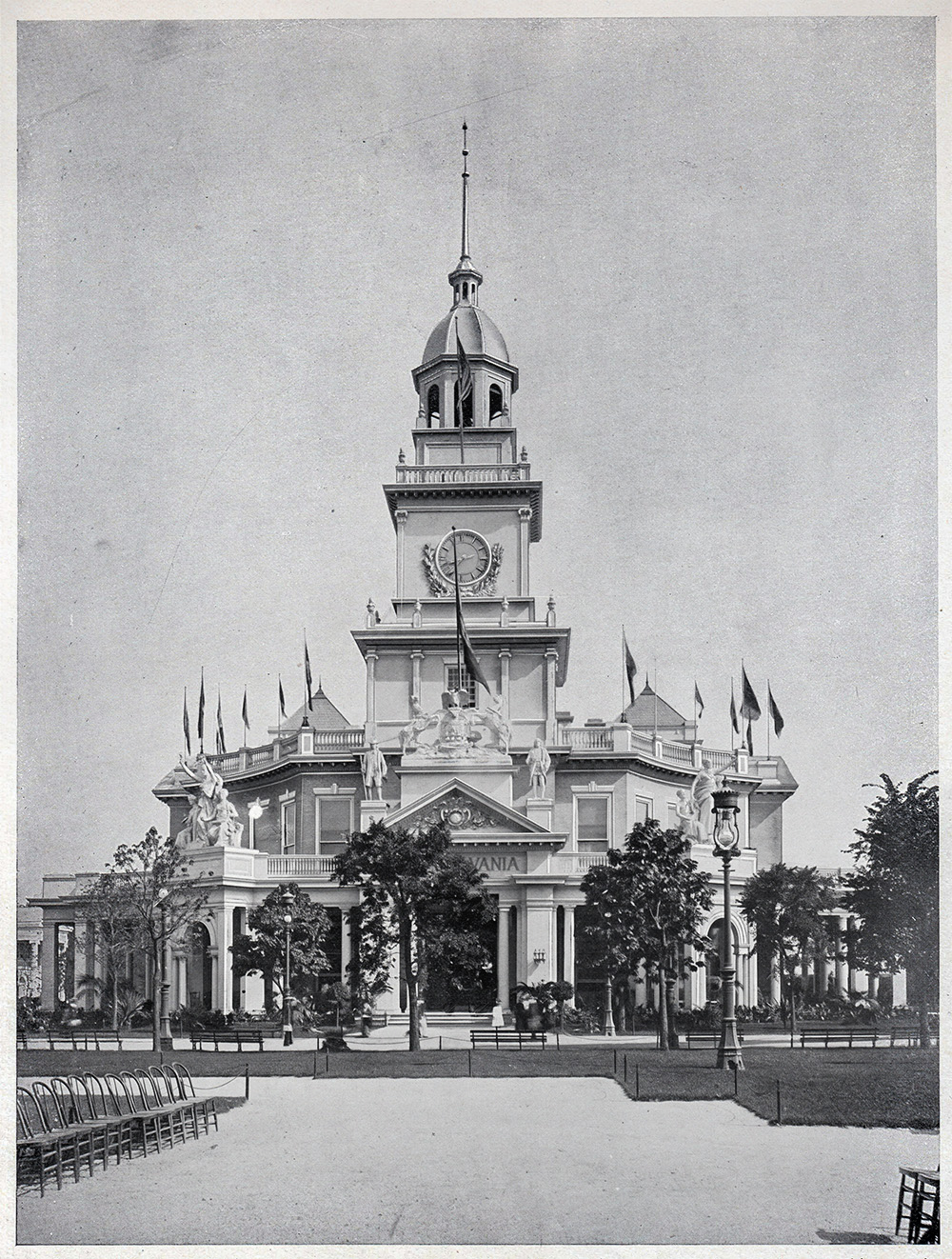
The Pennsylvania State Building was one of several state homes that reproduced historic American buildings. [Image from Rand, McNally & Co.’s Columbian Album: Containing Photographic Views of Buildings and Points of Interest about the Grounds of the World’s Columbian Exposition. Rand, McNally & Co., 1893.]

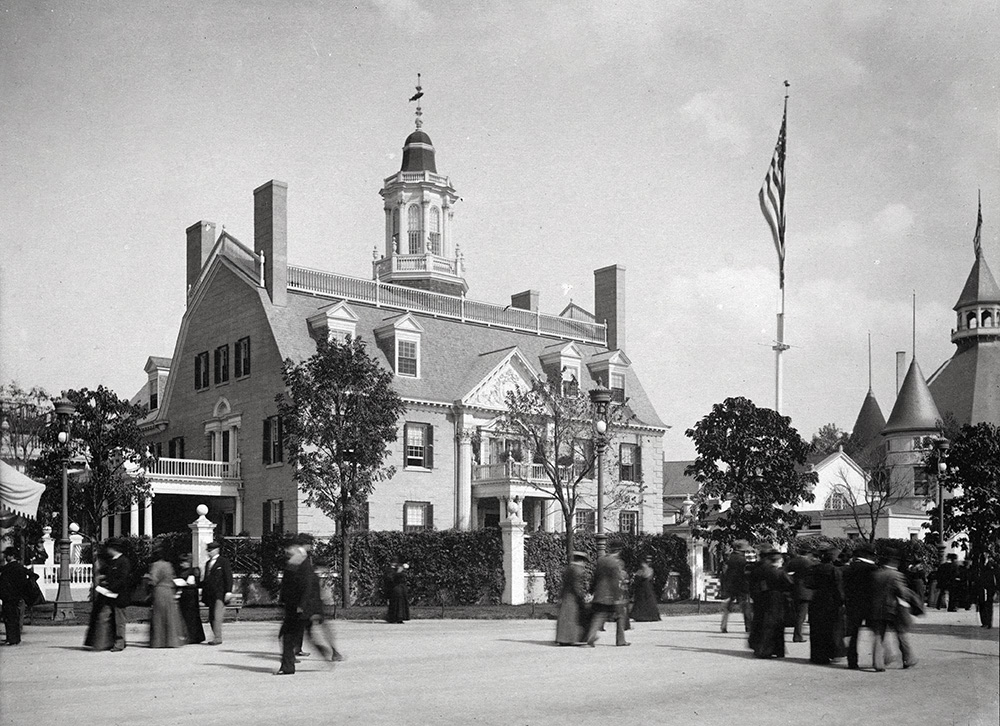
The Massachusetts State Building reproduced the John Hancock mansion in Boston. [Image from the United States National Museum Photographic Laboratory, Smithsonian Institution Archives.]

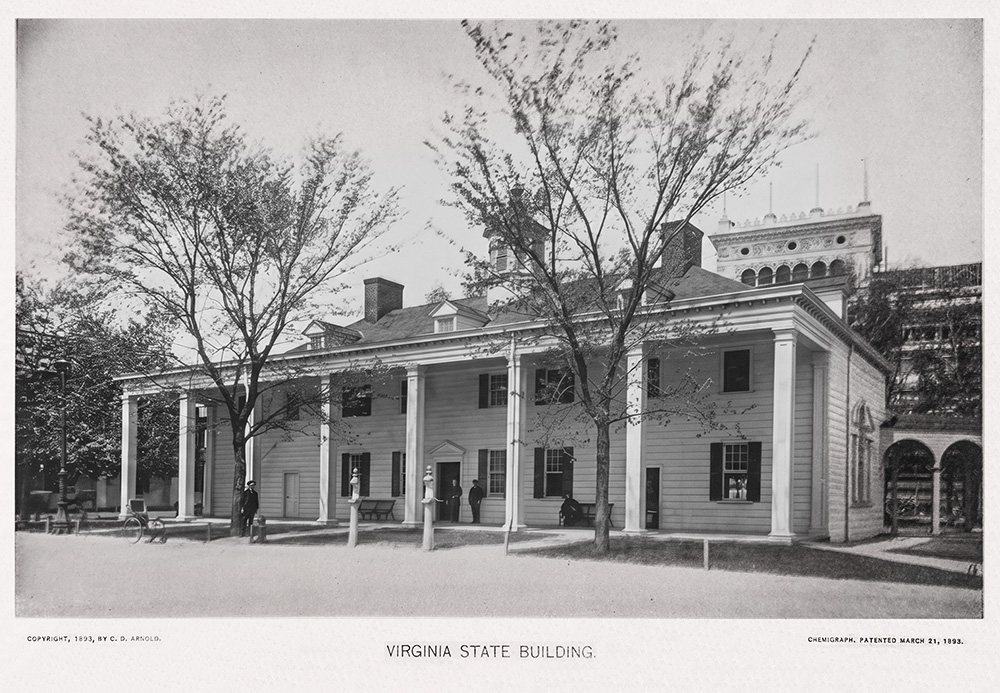
The Virginia State Building recreated George Washington’s Mount Vernon home. [Image from Arnold, C. D.; Higinbotham, H. D. World’s Columbian Exposition: State Buildings Portfolio of Views. National Chemigraph Company, 1893.]

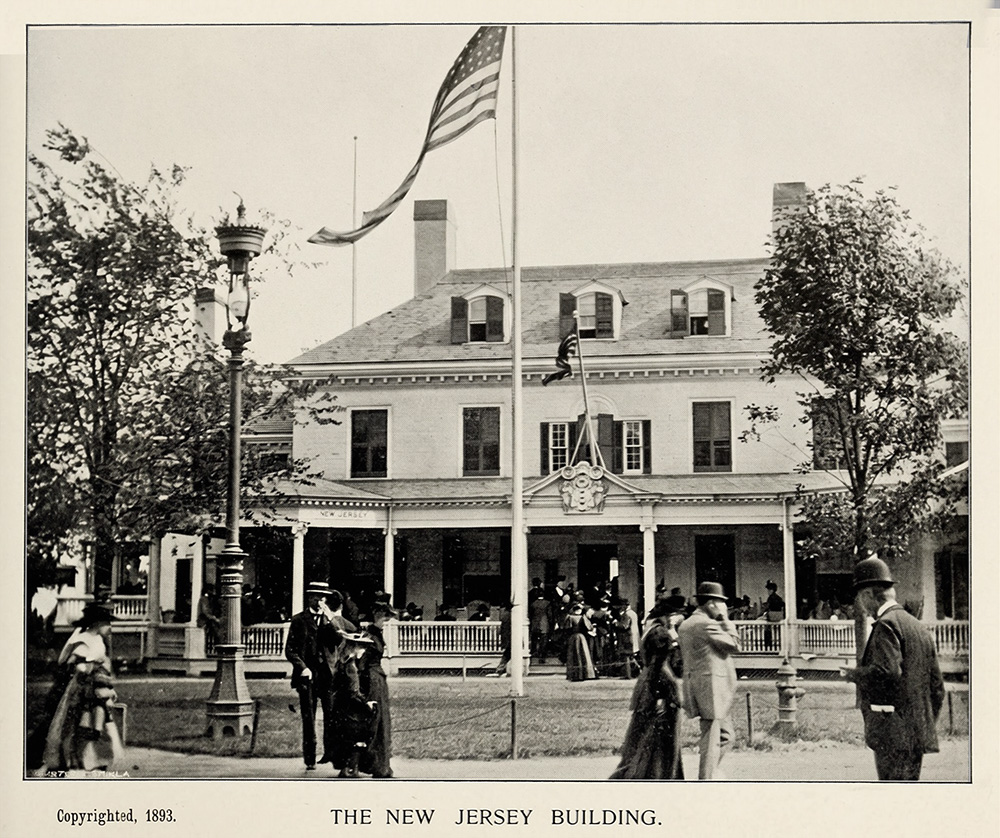
New Jersey State Building reproduced General Washington’s Revolutionary War headquarters in Morristown. [Image from Flower, Henry E. Glimpses of the World’s Fair. Henry E. Flower, 1893.]

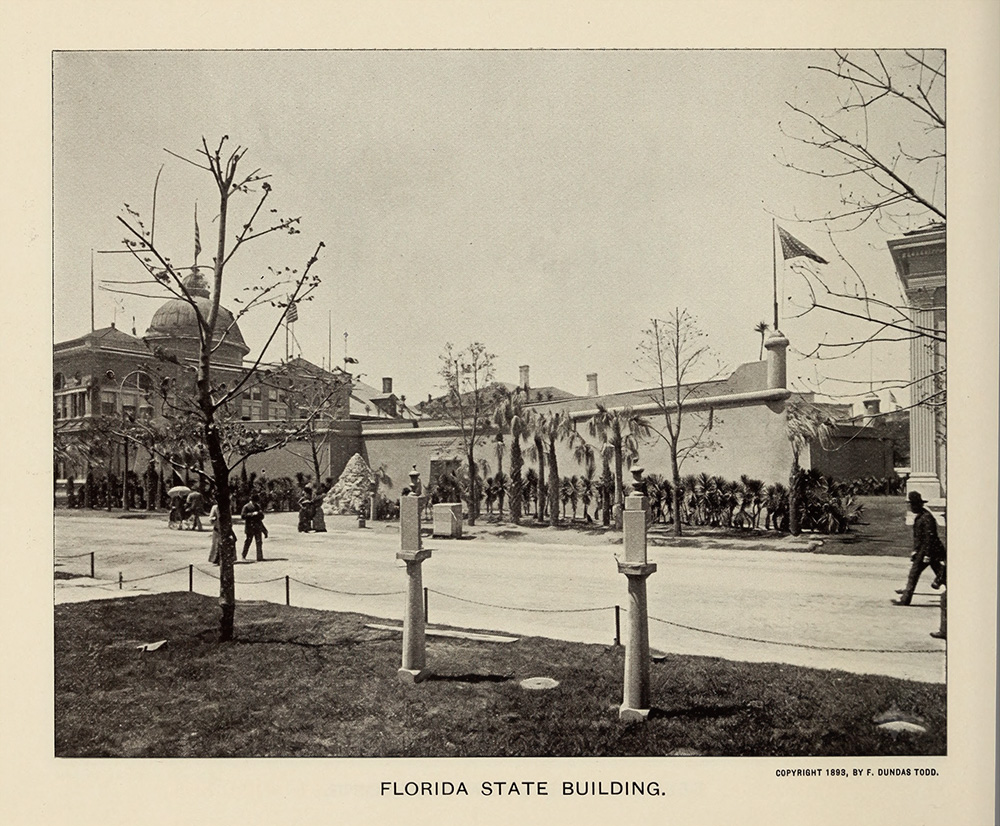
The only historical reproduction not (originally) associated with a British colony was the Florida State Building, a miniature of the Spanish fort in St. Augustine. [Image from Todd, Frederick Dundas World’s Fair Through a Camera: Snap Shots by an Artist. Woodward & Tiernan., 1983.]

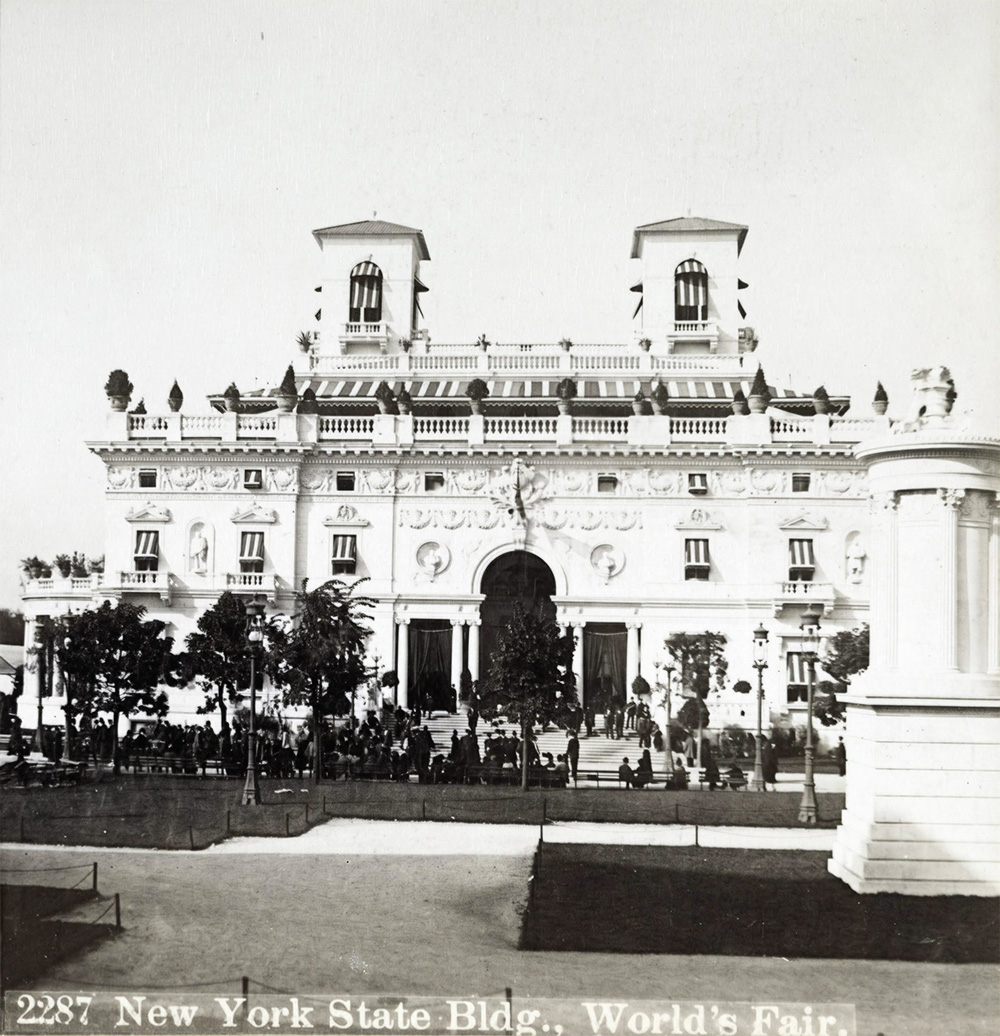
The New York State Building hosted its own Fourth of July exercises. [Image from Webster & Albee stereoscope card, Library of Congress.]
State pride and local boosterism was always on display at the Exposition, though “it was the general feeling that this day belonged to the nation and that everybody would observe it as individual Americans rather than as citizens of any particular states,” conceded the St. Louis Post-Dispatch (Jul. 4, 1893).

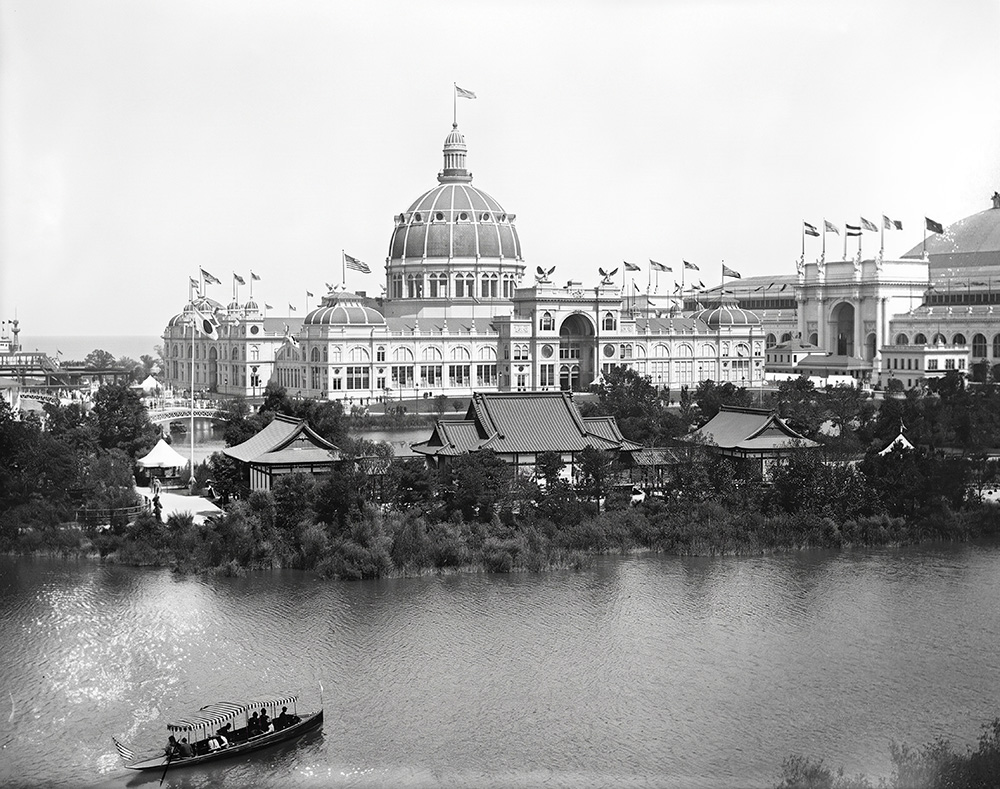
The United States Government Building, as seen from the Woman’s Building with the Wooded Island and Japanese Ho-o-den in the foreground. [Image from a glass slide; private collection.]
“They knew exactly where they wanted to go”
Of all the great exhibition palaces, the center of interest on the Fourth of July certainly was the U.S. Government Building, which housed exhibits by the official sponsor of the Columbian Exposition. Designed by Willoughby Edbrooke of Washington, D.C., the federal government’s hall was among the least admired from the outside but held many treasures within.
The Chicago Record (Jul. 5, 1893) reported that the government building was “crowded with patriotic visitors” all day. “Capt. Russell’s company of United States marines, in full dress uniform, were on guard and directed the strangers to points of interest. Most of the people, however, needed little guidance. They knew exactly where they wanted to go.” Visitors passed by the Smithsonian Institution exhibit, the Model Post Office, and its curious Dead Letter Office exhibit, and headed to the big dome at the center of the building. There, the mammoth California sequoia known as the “Big Tree” standing in the center of the vast rotunda always attracted visitors, but on July 4th crowds swarmed around the exhibit encircling the perimeter.

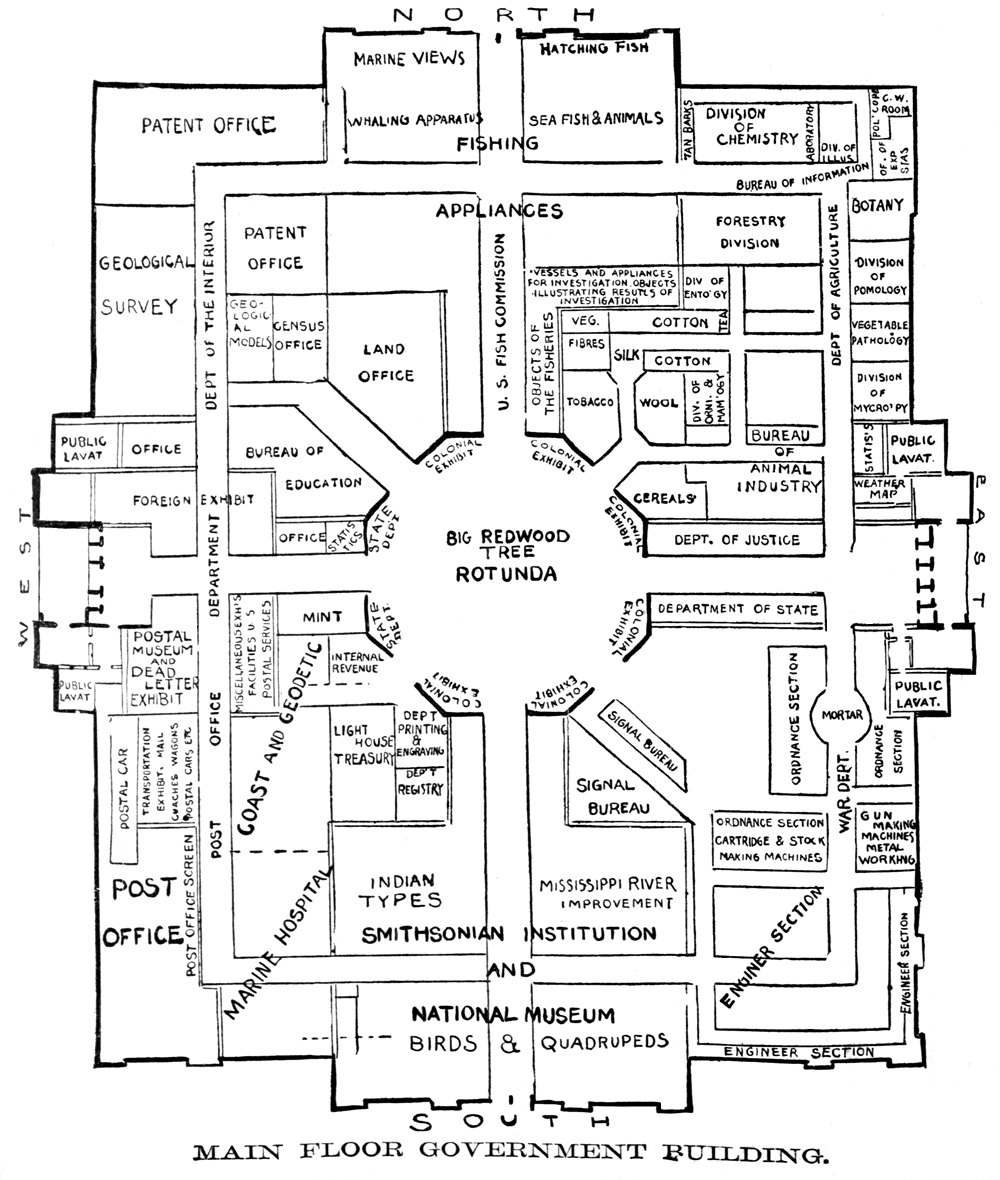
Floor plan of the main floor of the U.S. Government Building, showing the alcoves in the rotunda where the Colonial exhibit and the State Department exhibit were housed. [Image from the Chicago Tribune Aug. 27, 1893.]
“The most interesting historical features of the Exposition”
The Colonial Exhibit, housed in six of the eight arched alcoves of the rotunda, was the center of attraction. A sub-committee of the Board of Lady Managers organized the exhibit. Assisting them was Elizabeth Duane Gillespie (1821–1901), the great-granddaughter of Benjamin Franklin who established the Women’s Pavilion at the 1876 Centennial Exposition. The commissioners secured the aid of President Cleveland and the cabinet officials to secure space for their exhibit in the Government Building. The call for donations of items having both historic value and potential interest to visitors yielded contributions from nine of the original thirteen states—New York, North Carolina, New Jersey, Rhode Island, Pennsylvania, Delaware, Maryland, Connecticut, and Massachusetts. The Woman’s Columbian Exposition Committee of Massachusetts boasted the greatest collection, consisting of 138 numbered items for their display. Some of the artifacts had never before been exhibited.
Visitors on the Fourth of July inspected “original grants, ancient marriage licenses, old-fashioned dueling pistols and rusty sabers, intermingled with silver cups, spoons and snuff boxes, found many admirers, but the admiration was largely mixed with curiosity,” reported the Chicago Record (Jul. 5, 1893). Mrs. Mark Stevens commented on seeing the original copy of Francis Scott Key’s “Star-Spangled Banner.” Historian Henry Davenport Northrop recorded the display having “rare old laces, snuffboxes, miniature letters, books, swords, shoe-buckles, and silver plate,” while Hubert Howe Bancroft described an array of artifacts of American history:
Next to the pipe which Miles Standish loved to smoke, lie the spurs and epaulets of Burgoyne, and near them the fife of Benedict Arnold and the visiting card of Aaron Burr. There are also the proclamations of Governor Hancock, and the ring which he wore while signing the Declaration of Independence.
Object lessons of the American Revolution filled the rotunda walls, including:
- a lock of hair from the head of a young George Washington
- a copy of the Stamp Act of 1765
- tea, allegedly from the Boston Tea Party
- a cannon ball fired at the Battle of Lexington on April 19, 1775
- the sword of Col. James Barrett, commander of American forces at the Battle of Concord
- an old drum beaten at the battle of Bunker Hill on June 17, 1775
- part of the original flag that waved over the Liberty Tree on Boston Common in 1775
- the watch that lay on the table when the Declaration of Independence was signed
- a silver spoon brought from the Battle of Saratoga and thought to have belonged to General Burgoyne
“The Washington relics were surrounded by reverent crowds, and the weapons carried by the revolutionary heroes also attracted attention,” noted the Chicago Record (Jul. 5, 1893). Rossiter Johnson described the Colonial exhibit as “one of the most interesting historical features of the Exposition; and there was perhaps no other that so forcibly emphasized, by comparison and suggestion, the progress and development of the United States.”
In the two remaining alcoves of the rotunda, and a portion of the aisle adjacent, were exhibits sponsored by the State Department. One document, in particular, received great attention on America’s birthday.

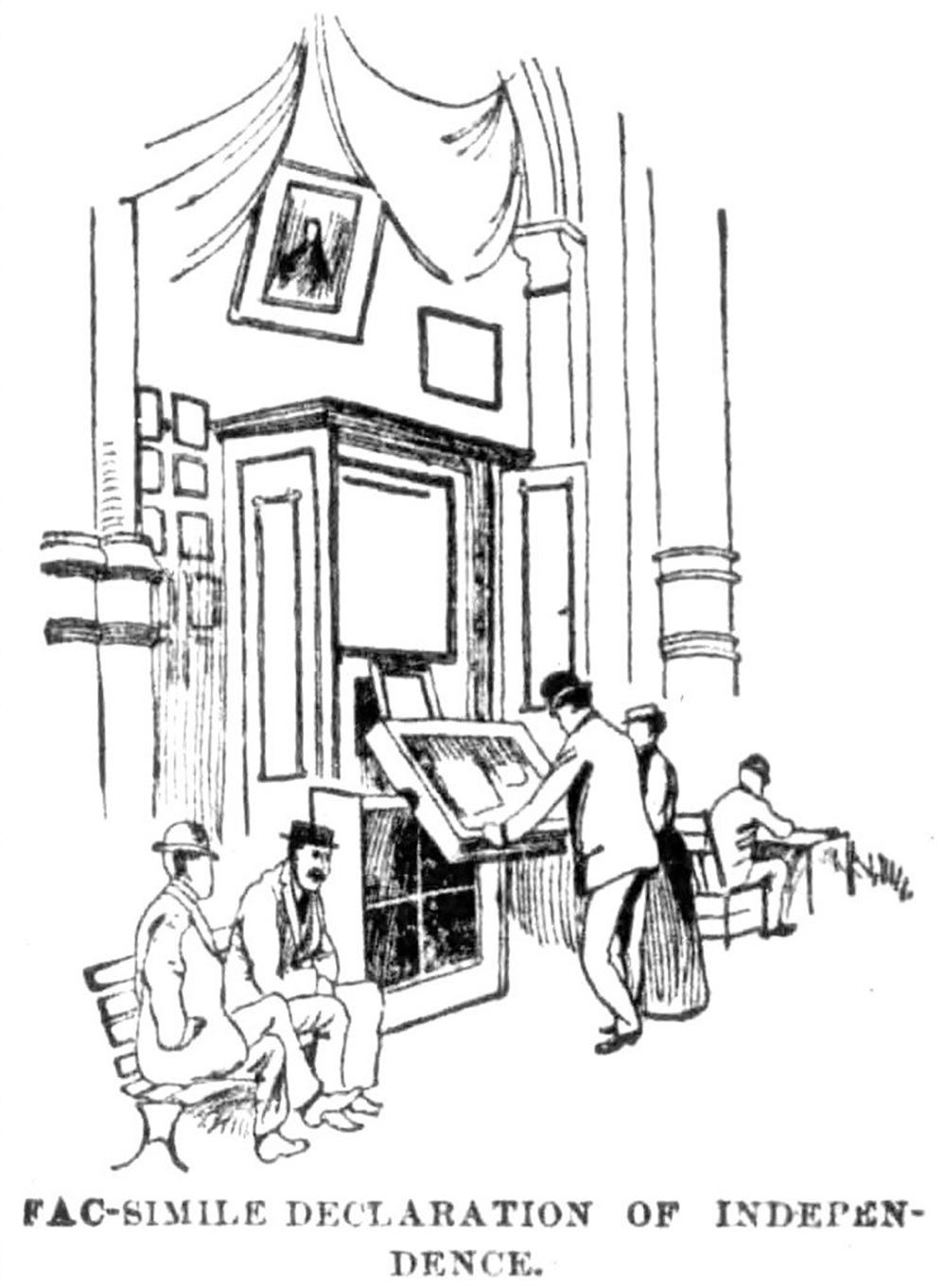
Visitors inspect the facsimile copy of the Declaration of Independence in the rotunda of the U.S. Government Building. [Image from the Downer’s Grove (IL) Press Sep. 21, 1893.]
“A patriotic pleasure”
The Chicago Record described the scene:
One exhibit conspicuously placed in a prominent part of the Rotunda attracted more attention than all the rest combined. There fathers led their sons and mothers their daughters. Little family parties stood for a half hour at a time, sometimes with uncovered heads, but always with awe and reverence, before this little glass case. Under the cover was a fine photographed reproduction of the Declaration of Independence, now on file in the archives of the nation. The faded parchment, browned, wrinkled and creased by age, is faithfully reproduced in the photograph. Few of the names are distinguishable, and the crowd seemed to take a patriotic pleasure in trying to decipher them, as well as the words in the body of the declaration. Letter by letter and word by word the liberty loving people read the words which dedicated their country to the cause of freedom.
Along with a photographic copy of the original Constitution of the United States, “no two objects within the Exposition attract more attention than these, nor are more closely guarded, consequently the owners of the Colonial relics may feel particularly assured that their treasures are under the government’s protection,” stated Conkey’s guidebook. Johnson records that the State Department’s exhibit included
… a collection of documentary mementoes of the birthday and youth of the republic—the petition to George III, the Declaration of Independence, the Articles of Confederation, and the Federal Constitution; relics, autographs, and portraits of the fathers, among them the diaries and other papers of George Washington, purchased by act of Congress, and letters of Benjamin Franklin; and many of the more important of the treaties entered into by this Government with foreign powers.
As early as January 1893, the State Department planned to bring to Chicago the original handwritten parchment copy of the Declaration, made by Timothy Matlack between July 19 and August 2, 1776. This national treasure, today on display in the National Archives, was widely known to be in poor condition, after years of neglect. With a change in administration in March, along with pressure from groups such as the Sons of the American Revolution, the new Secretary of State Walter Q. Gresham rescinded permission for the fragile document to travel. Instead, a photographic copy of the Declaration was exhibited. Many visitors to the World’s Fair did not seem to know, or care.

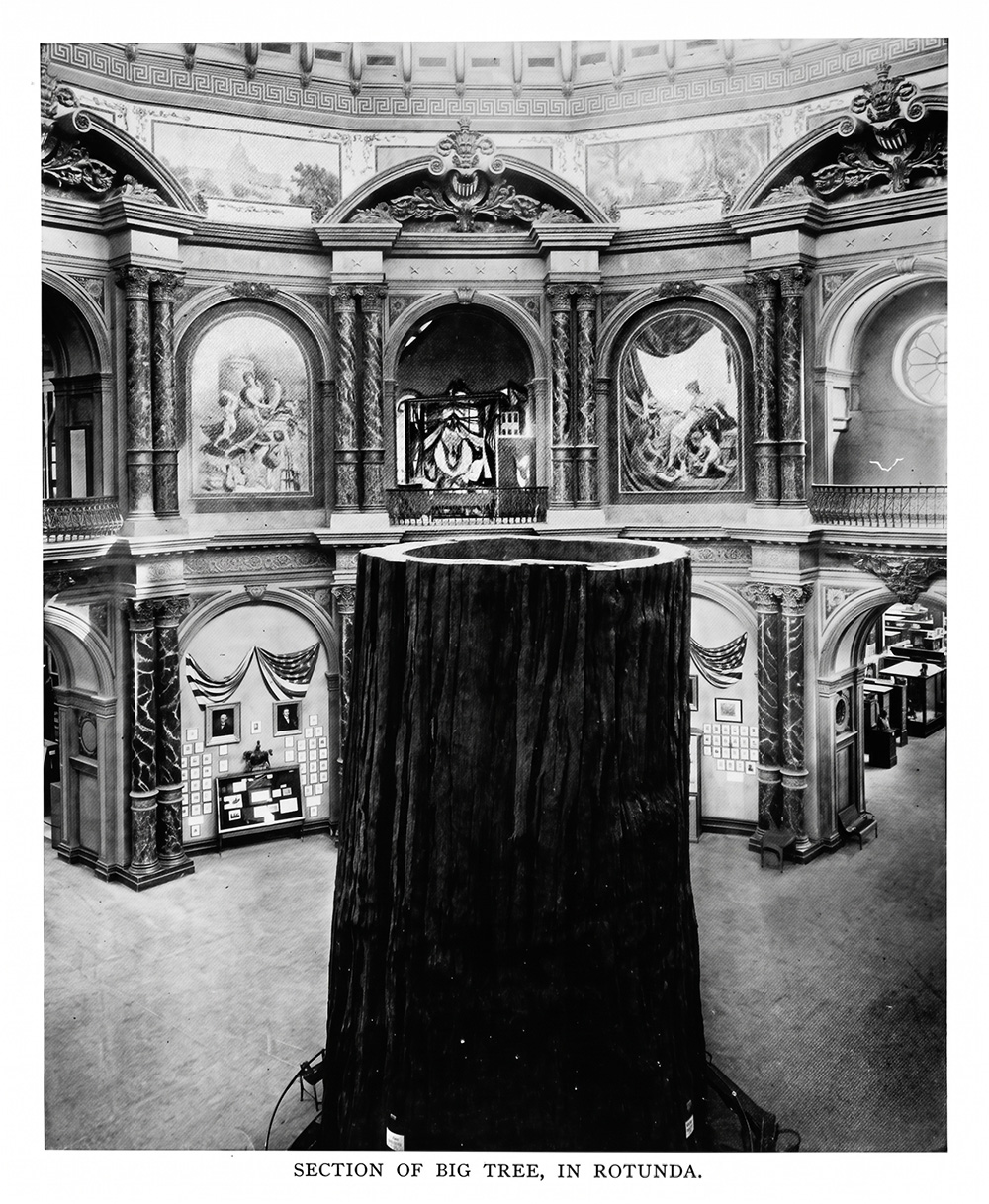
The Rotunda of the U.S. Government Building housed the Colonial Exhibit along with the “Big Tree” from California. [Image from Johnson, Rossiter A History of the World’s Columbian Exposition Held in Chicago in 1893, Volume 3: Exhibits. D. Appleton and Co., 1897.]
“All day long visitors were startled”
Tributes to American history could be found sprinkled about several other exhibit halls. Inside the Agricultural Building, visitors could see a creative and curious display at the Dreydoppel Soap pavilion—a sixteen-foot-tall, five-ton sculpture made of soap, depicting Betsy Ross sewing the original American flag.

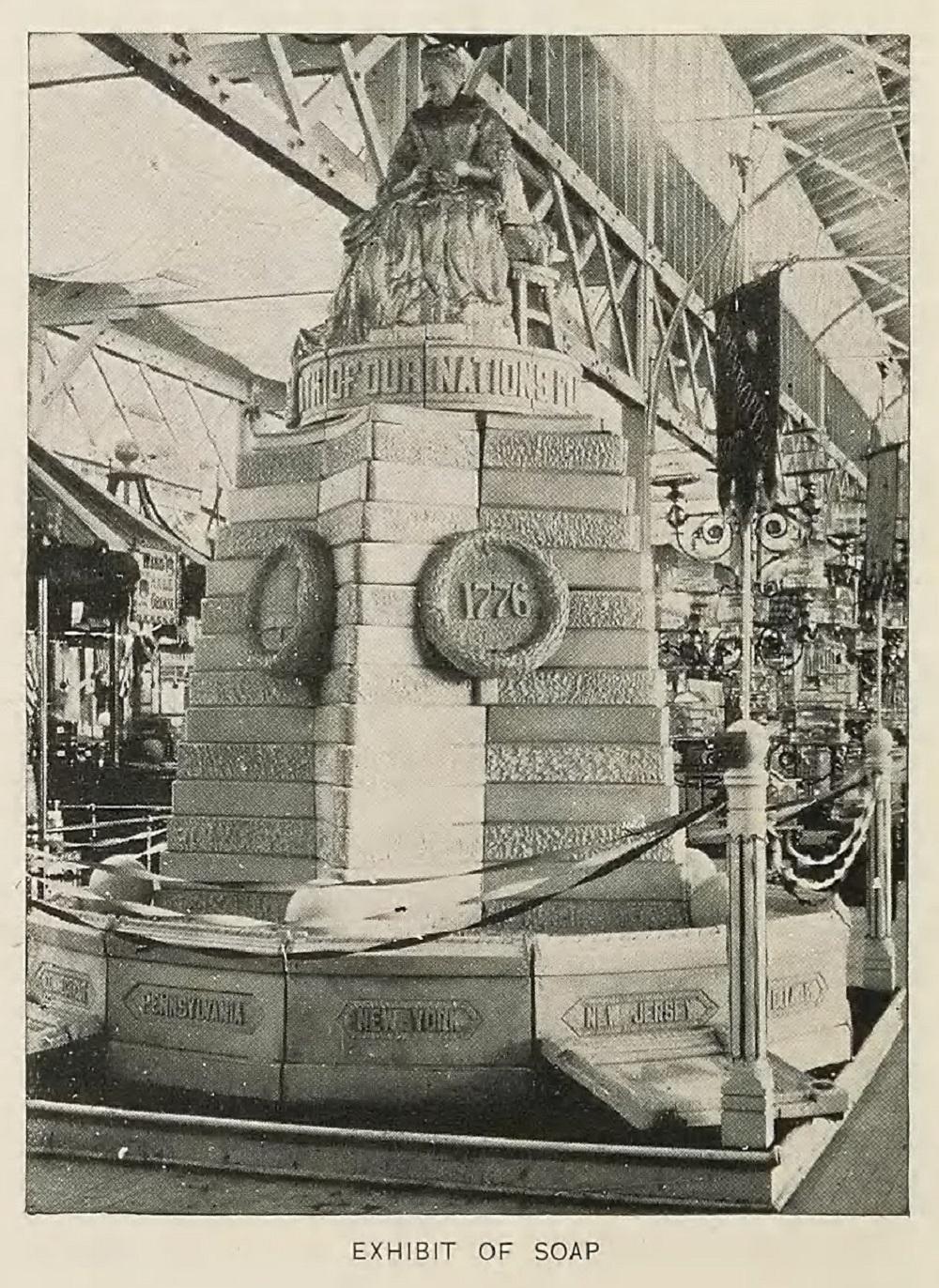
A photograph showing Dreydoppel’s Betsy Ross monument made of soap. [Image from Bancroft, Hubert Howe The Book of the Fair. The Bancroft Company, 1893.]

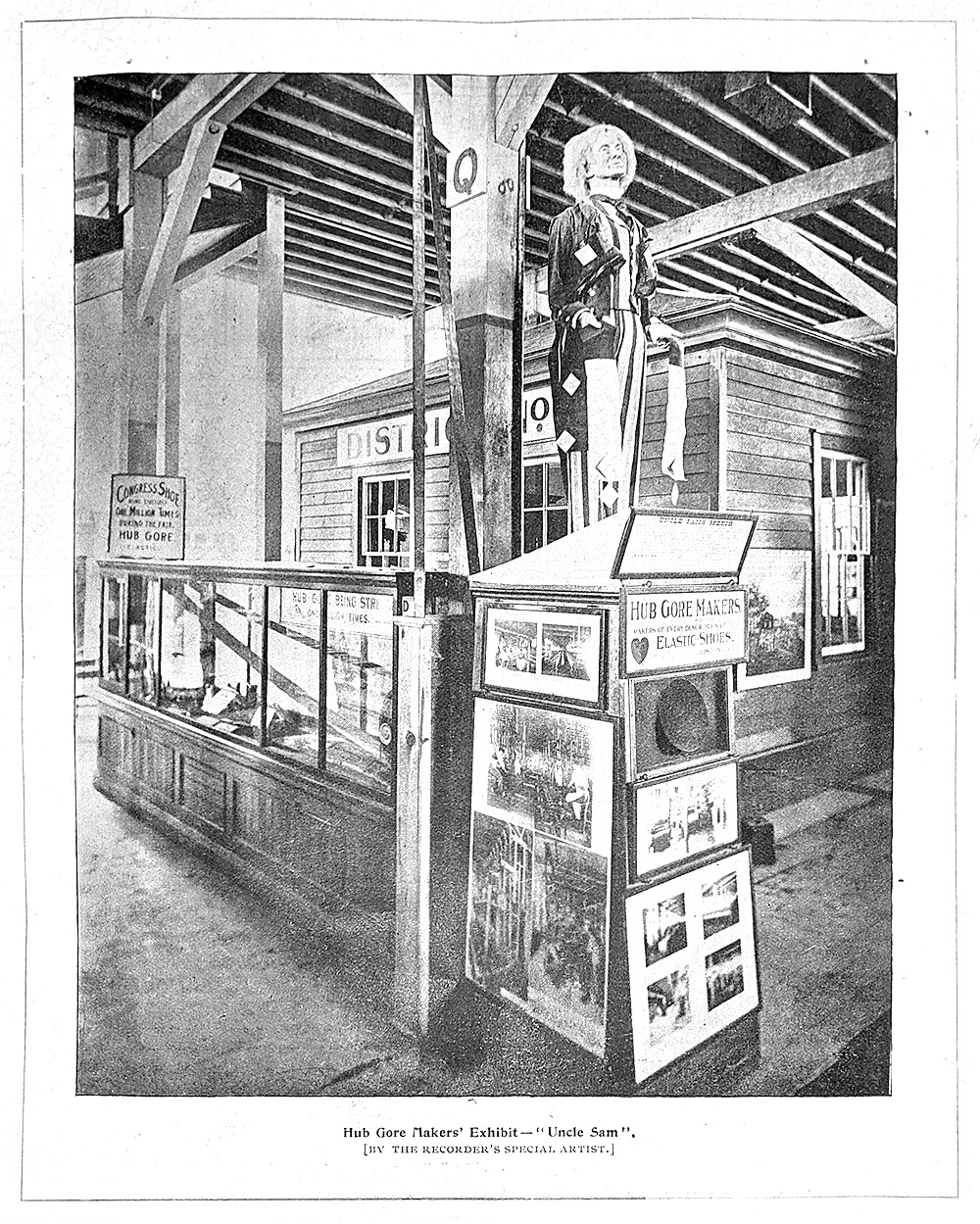
Hub Gore Makers’ exhibit in the Shoe and Leather Building featured a rather creepy looking Uncle Sam “talking” (via Edison phonograph) automaton. [Image from the Boot and Shoe Recorder Sep. 30, 1893.]
All day long visitors were startled by heavy discharges of electricity and the play of vivid lightning before the company’s exhibit. The effect was produced by means of a large electrical condenser suspended upon the front of the pavilion. It was a plate of glass 4 or 5 feet long and 2 feet wide, coated with tinfoil and connected with a transformer supplied with a low-tension current. When the plate was charged with electricity it was discharged as a Leyden jar, and the entire plate became luminous with jagged sparks much like summer lightning. Against this blaze of light in red letters was relieved the inscription, “JULY 4TH.” Crowds of people watched the phenomenal exhibit from morning until night and asked innumerable questions about it without learning anything tangible.
This electric experiment, attempted for the first time that day, “fairly split the ears of the multitude by the production of lightning,” reported the Chicago Herald (Jul. 5, 1893). The apparatus generated flashes fifteen-to-thirty-inches in length with crackling sounds and the smell of ozone. Spectators standing too close feared being struck by lightning. The illuminated sign was inscribed with four-inch letters reading “July 4th” cut out of tin and mounted to plate glass having a tin foil backing. When a current of 20,000 volts reached the plate, electrical discharges zig-zagged all over the glass with dazzling brilliance.

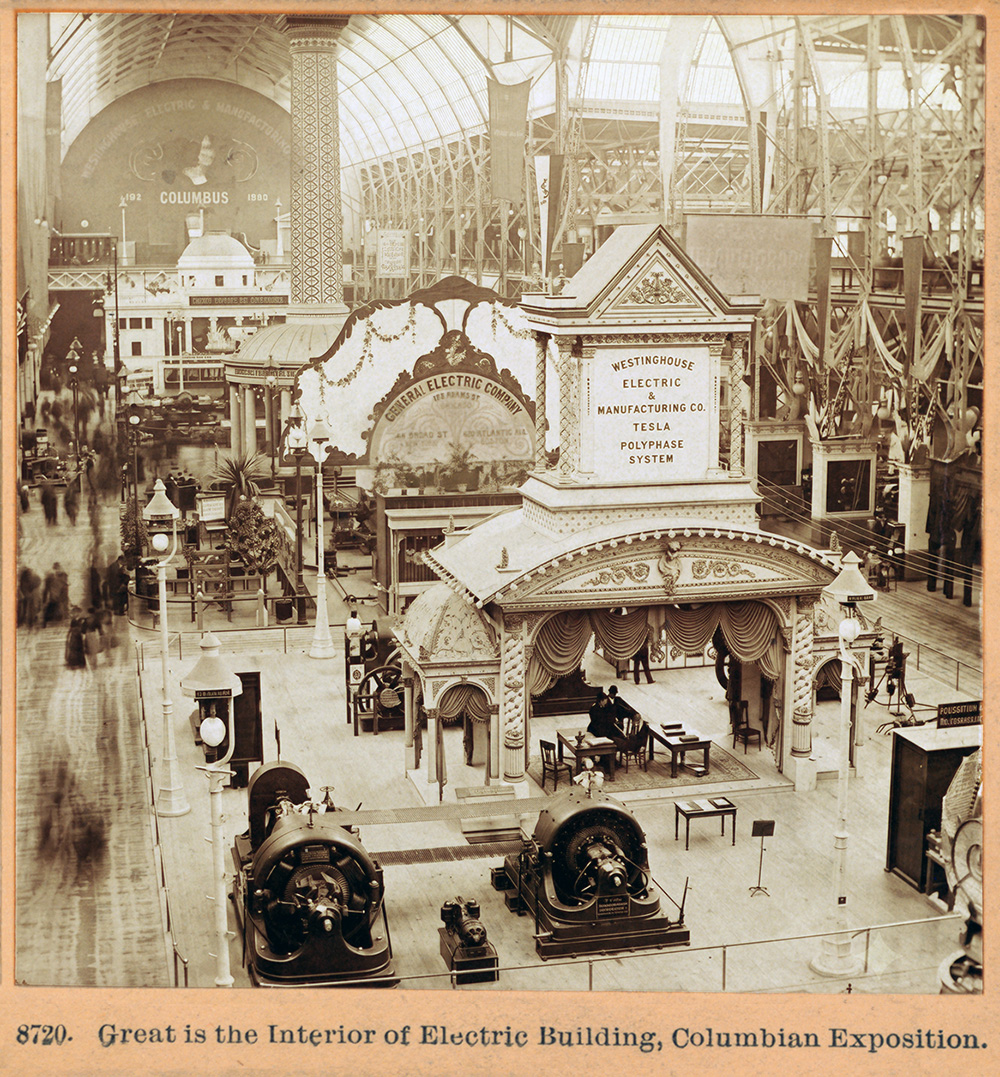
Inside the Electricity Building, the Westinghouse Electric & Manufacturing Company display dazzled visitors, especially on the Fourth of July. [Image from Kilburn stereoscope slide.]
[Continued in Part 16]

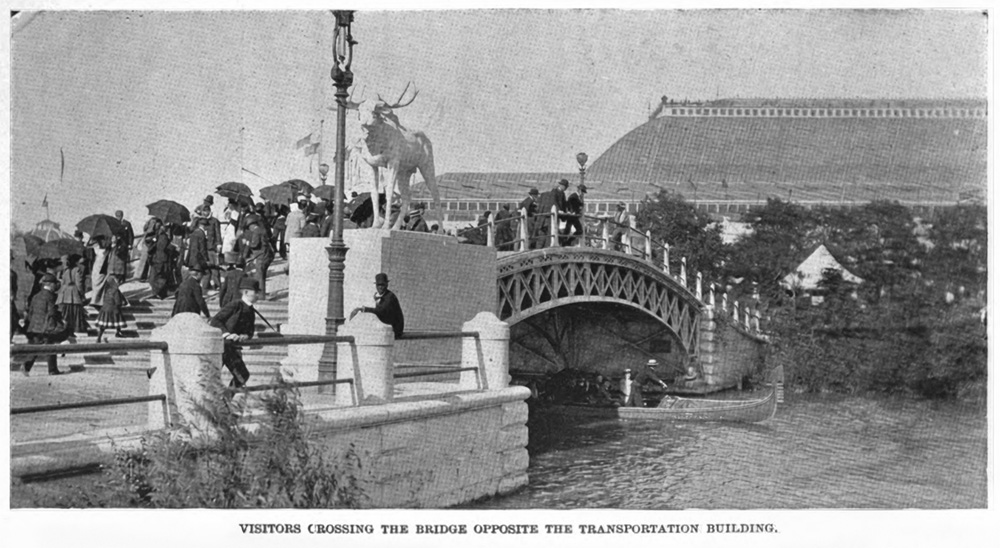
Visitors crossing the bridge opposite the Transportation Building on the 4th of July. [Image from Frank Leslie’s Weekly Jul. 20, 1893.]
NOTES
[1] To see the full transcript of the recording and read much more about the display, consult Allen Koenigsberg’s excellent research article “‘Rest 10 Seconds Between Speeches:’ 1893’s Uncle Sam Revisited” in the Antique Phonograph 2023.
SOURCES
“All Honor the Nation” Chicago Times Jul. 5, 1893, p. 2.
“All Nations Pay Respects” Chicago Record Jul. 5, 1893, p. 5.
“At State Headquarters” Chicago Record Jul. 5, 1893, p. 5.
Bancroft, Hubert Howe The Book of the Fair. The Bancroft Company, 1893.
Conkey’s Complete Guide to the World’s Columbian Exposition. W. B. Conley, 1893.
“Fourth at the Fair” Chicago Inter Ocean Jun. 21, 1893, p. 7.
Johnson, Rossiter A History of the World’s Columbian Exposition Held in Chicago in 1893, Volume 2: Departments. D. Appleton and Co., 1897.
Northrop, Henry Davenport The World’s Fair as Seen in One Hundred Days. Ariel Book Co., 1893.
“Old Glory” St. Louis Post-Dispatch Jul. 4, 1893, pp. 1–2.
Rand, McNally & Co.’s Handbook of the World’s Columbian Exposition. Rand, McNally & Co., 1893.
Stevens, Mrs. Mark Six Months at the World’s Fair. Detroit Free Press Printing Co. 1895.
“Will Live in History” Chicago Herald Jul. 5, 1893, p. 1.