


[Continued from Part 11]
The centerpiece of the 1893 World’s Fair Fourth of July celebration was absent, stuck in Troy, New York. When the Columbian Exposition’s Committee on Ceremonies learned on July 3rd that the Columbian Liberty Bell would not reach Chicago, organizers scrambled to repair the hole left in the morning exercises. Several members of the Columbian Liberty Bell Committee were pushed off the program. They decided to organize an impromptu dedication ceremony for the afternoon.

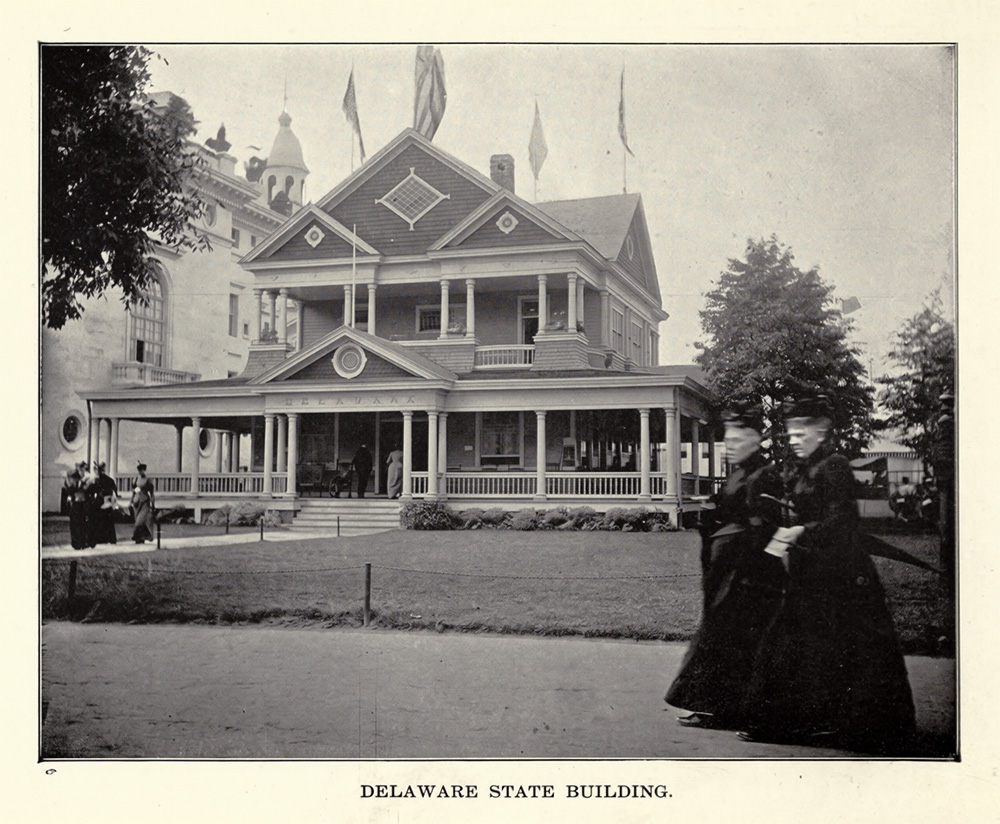
The neat but modest Delaware State Building hosted the ceremony to dedicate the Columbian Liberty Bell. [Image from Glimpses of the World’s Fair: A Selection of Gems of the White City Seen Through a Camera. Laird & Lee, 1893.]
The First State’s home
As the first of the original thirteen colonies to ratify the Constitution, Delaware had the honor of hosting the dedicatory exercises for the new Liberty Bell. The quaint Delaware State Building stood on the beautiful campus of the other state buildings, thirty-six in all, in the northernmost section of the fairgrounds. Delaware’s picturesque home was nestled between the Maryland State Building to the north and the impressive New York State Building to the south. Architect E. L. Rice, of Wilmington, designed the building in a Southern Colonial style. The two-story, sixty-by-fifty-eight-foot structure, constructed wholly of native woods and materials from the First State, possessed a gabled roof and Delaware cypress shingles. A wide wrap-around porch, with pillars and balustraded cornices, invited visitors on all four sides. The neat but modest structure held no exhibits for visitors. A large reception hall on the east side of the main floor served as the venue for the Columbian Liberty Bell dedication.
Mrs. Elizabeth Clark-Churchman of Wilmington, representing Delaware on the Columbian Liberty Bell Committee, extended the invitation to gather in the Delaware Building and served as hostess for the event. William O. McDowell, chairman of the Committee, conducted the dedication ceremony. He and a large group of state commissioners took a position on one side of the large reception room. Sons and Daughters of the American Revolution attended. Mrs. Harriet Rebecca Perry Stafford, holding her precious “John Paul Jones” flag in her lap, sat in a large armchair near the speakers’ table. The “Blue Hen’s Chickens” choir from Wilmington led the audience in inspiring patriotic airs, singing “Columbia, Gem of the Ocean” as the building filled to capacity with guests.

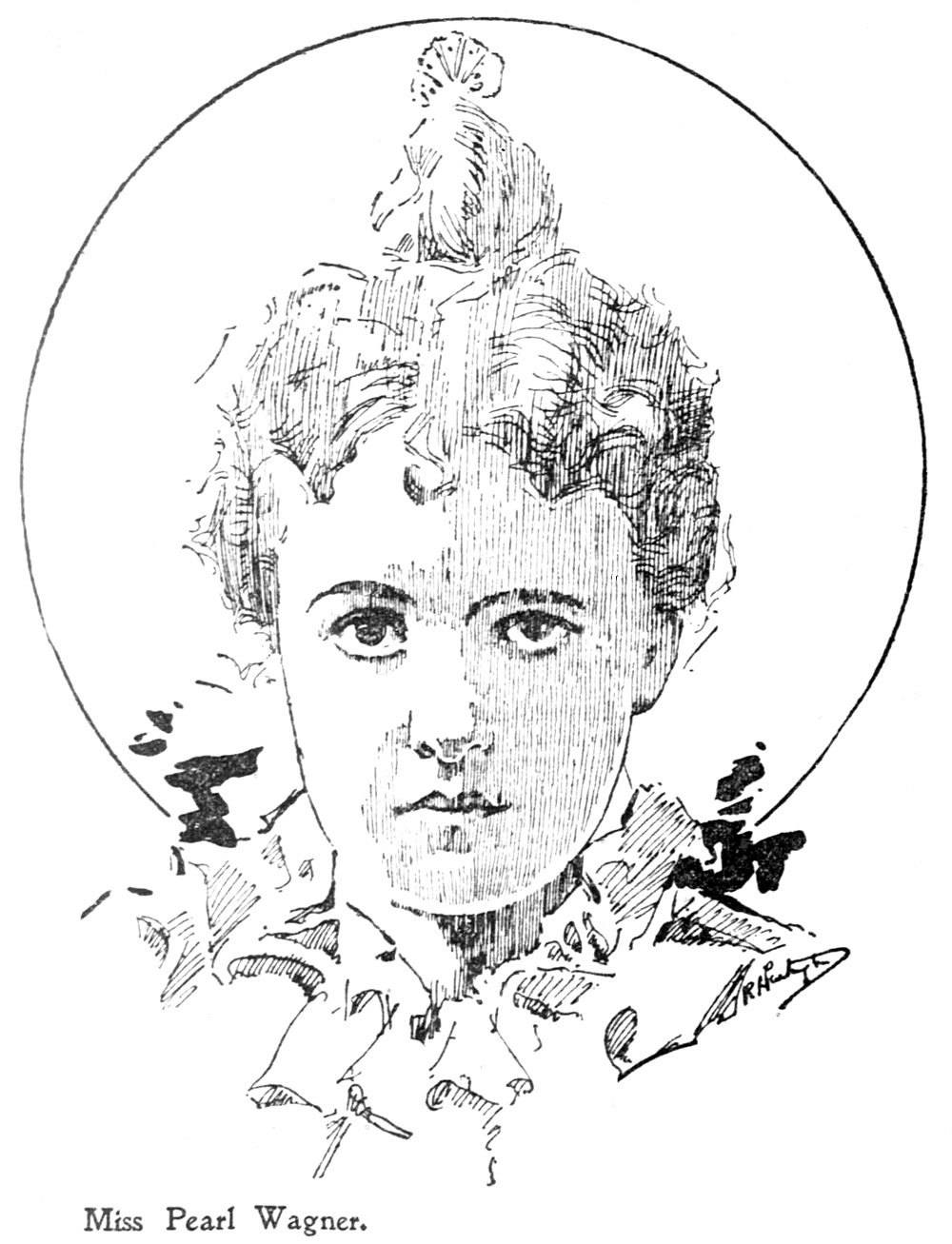
Mrs. Madge Morris Wagner’s poem “The Song of the Liberty Bell” was read by her daughter, Miss Pearl Wagner, for the Columbian Liberty Bell dedication on July 4, 1893. [Image from the San Francisco Call Jan. 1, 1897.]
Miss Pearl Wagner reads “The Song of the Liberty Bell”
Executive Commissioner Wyman of Rhode Island opened the exercises. An abolitionist who served as captain of a Massachusetts regiment in the Civil War, John C. Wyman (1822–1900) later accompanied the body of Abraham Lincoln on the train cortege from Washington to Springfield in 1865. Today, he made a brief speech welcoming the committee and their guests to the Delaware Building. He then introduced Miss Pearl Wagner of San Diego.
Pearl was the daughter of Mrs. Madge Morris Wagner, whose patriotic poem “The Liberty’s Bell” had inspired Mr. McDowell to have the Columbian Liberty Bell made for the 1893 World’s Fair. While several newspapers reported that this poem was read at the July 4th dedication ceremony, printed texts indicate that it was another poem, written by Mrs. Wagner for the occasion and titled “The Song of the Liberty Bell.”
THE SONG OF THE LIBERTY BELL
When spurred by the lash of oppression,
The nation arose in its might
To claim as its due and possession
Its manhood, its freedom, its right;
Men’s souls found the ordeal most trying,
The air with excitement was filled,
With great aspirations undying
The waking young nation was thrilled.
As stronger and stronger the feeling
Arose over mountain and dell,
The zenith was reached in the pealing
Aloft of the Liberty Bell.
It witnessed the rise of the nation,
Its tongue first did publish its birth;
It rang out the grand proclamation
Of liberty new to the earth.
Its peel to the battle went to rolling,
It rang in the ears of the brave,
In glorias for victory tolling,
The requiems over each grave.
And though it be still and riven,
Its echoes shall swell on for aye,
’Till the whole world had been given
The freedom it published that day.
Ye children, bring garlands to crown it;
Ye soldier, with bare blade salute;
Ye citizens, come, proudly own it,
Most eloquent when ’tis most mute.
Ye visitor, see the affection
The emblem of liberty claims;
And carry away to each section
Its lesson of faith and high aims.
While we and our children forever,
Just like our forefathers will stand,
And nothing our love can ever sever
From liberty and our fair land.
CHORUS
Then sing we a song of rejoicing,
That over the welkin shall swell,
The paean of progress full voicing,
The song of the Liberty Bell.

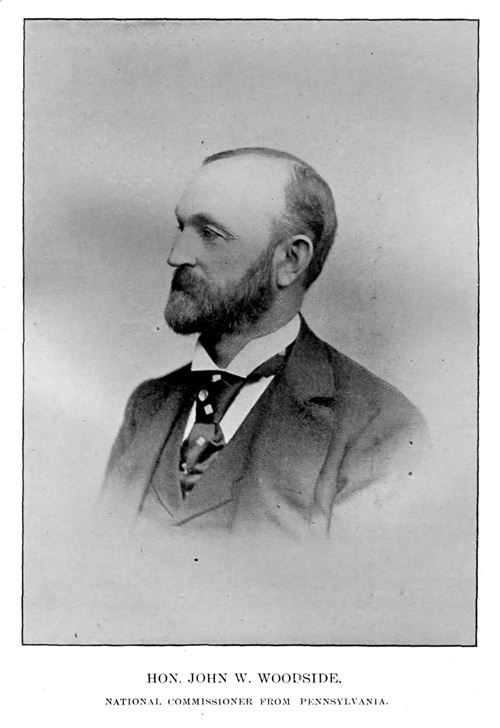
John W. Woodside, World’s Columbian Exposition National Commissioners for Pennsylvania. [Image from Campbell, James B. Campbell’s Illustrated History of the World’s Columbian Exposition, Volume I. M. Juul & Co., 1894.]
John M. Woodside’s address
Next to speak was John W. Woodside (1838–1907), one of the National Commissioners for Pennsylvania. He was a member of the manufacturing firm of Stewart, Ralph & Company of Philadelphia and secretary of the National Tobacco Association of the United States. He later served as president of the Valley Forge Association and died a multi-millionaire in 1907. His Fourth of July address praised his home state and the Columbian Exposition:
Ladies and gentlemen: I appreciate the high privilege of standing in the presence of such an audience on this patriotic occasion, as the representative of the great Commonwealth of Pennsylvania known to history,
As keystone of that glorious arch
Framed in that trying hour
When patriot sons were called to march
Against a foreign power.
Pennsylvania has just reason to be proud of herself; her great reservoirs of gas and oil; of her mountains of iron and coal; of her fruitful valleys, sweet with the fragrance of new mown hay; of her cities and towns, alive with the hum of her diversified industries, giving employment to her millions of industrious citizens who dwell in the model homes of her cities; but proud as she is of her natural resources and her material progress, she is prouder still of her history, of her long list of distinguished sons, of the hall of the Carpenters company, when Washington and the colonial Congress daily bowed the knee in prayer in famous Independence Hall, where, on the 7th of June, 117 years ago, Richard Henry Lee of Virginia offered the resolutions which culminated in the glorious document, whose birth we celebrate today.
Much as we love these historic buildings and the fragrant memories which cluster around them, we turn to this old Liberty Bell with a more fervent patriotic feeling, And in this we are joined by every citizen of this great Republic, for this bell rang the first glad notes of American independence on the 4th of July, 1776.
Pennsylvania has ever been in the front rank of every patriotic movement in this country. Her Centennial celebration in 1876 was a revolution to the American people. It was the vote of her representatives in Congress that largely settled the location of this Columbian Fair in Chicago. If the space she wanted had been granted she would certainly have been the largest exhibitor of any of the states at this exposition, and I venture the assertion that she will send more people to see it than any other state at the same distance from Chicago, and a wish that not every citizen of Pennsylvania, but every man, woman and child in this great country could come here to witness this crowning glory of the nineteenth century.
Three short years ago this part of Jackson Park was a howling wilderness, so to speak. Today we look out over a vista of architectural beauty, worthy the conception of the brains of Michelangelo. Michelangelo has long been dead but our Director of Works lives. And to him and his able assistants is due this architectural magnificence of which even Greece and Rome in their palmiest days never dreamed. All honor, then, to the people of Chicago, who poured out their money like water, that the world might witness this magnificent tribute to the genius of American institutions which it will become the duty of the new bell to ring to all the world.
And in closing I desire to pay this little tribute to the sons and daughters of the American Revolution and the new Columbian Liberty Bell.
Commissioner Woodside followed his address with a poetic tribute of his own to the Sons and Daughters of the American Revolution. Some lines of this doggerel show that the Quaker State tobacconist and financier was a supporter of women’s suffrage.
Hail, noble sons of patriot band,
Who dwelt of yore in this fair land,
And heard their country’s call;
Who pledged their lives in freedom’s cause,
Who framed our constitutional laws
In Independence Hall.
Hail daughters of those patriot sires,
Whose brave example still inspires
Your present glorious plan
To cast a bell whose tongue shall ring
And to the breeze one anthem fling,
“The brotherhood of man.”
And on this glorious Natal day
The lightning shall in tones convey
From Maine to the Golden Gate.
The echoes of its voice shall sound
Wherever patriot hearts are found,
In every sovereign state.
May this new Columbian bell
With notes of freedom proudly swell
Wherever that flag’s unfurled.
May millions hear its music chime
In every land, in every clime
Around and round the world.
May it ring loudest on that day
When women’s wrongs are cleared away
With ballot in her hand.
The women of this land can vote
Her choice of rulers thus denote
Her equal rights demand.
Old Liberty Bell will ring no more,
Its clarion notes of freedom o’er
To lands beyond the sea.
May this new bell ring freedom’s chime
Until in God’s appointed time,
Mankind shall be free.

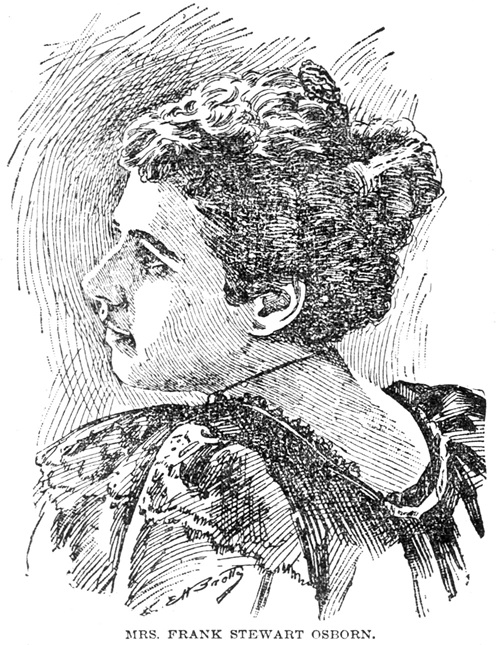
Mrs. Frank Stewart Osborn read “The New Liberty Bell” by Tennessee poet Howard Hawthorne McGee. [Image from the St. Louis Globe-Democrat Feb. 10, 1898.]
Mrs. Frank Stewart Osborn reads “The New Liberty Bell” by Howard Hawthorne McGee
Complementing Mr. Woodside’s poetic tribute to the old Liberty Bell was a poem in honor of the new Columbian Bell. Howard Hawthorne McGee (1867–1895) wrote “The New Liberty Bell” especially for the Fair’s Fourth of July ceremony. The twenty-six-year-old poet from Tennessee had served as the associate editor of the Memphis Appeal before moving to Chicago, where he became one of the prominent men in the Bohemian Guild. Although Mr. McGee had been invited to deliver his poem—and reportedly was in Chicago, and perhaps even on the fairgrounds on July 4th—he declined, perhaps for reasons of either fear or gallantry. Mrs. Frank Stewart Osborn of Chicago read his poem. Effie Reeme Osborn (1862–1921) founded the Illinois chapter of the D.A.R. and served as an Illinois representative on the Columbian Liberty Bell Committee.[2]
THE NEW LIBERTY BELL
It will ring in the mystical future, this Bell we shall consecrate,
And its tones will hold all of the noble, the royal and tender and great
That dwells in the past and the present, and all of its music shall be
The echo of greatness and glory, the paean and hymn of the free.
It shall ring, in its music of silver, the passions that gave to the swords
Of our fathers the infinite power to strike down their tyrants and lords;
It shall tell of the cradle of freedom, and then it shall herald and sing
The splendors of love that the manhood of Liberty surely shall bring.
For think not that tyrants and masters are dead, or that fetter and chain
No longer hold freemen in bondage, or prison the helpless in pain.
Think not that the rack and the dungeon are gone with the powers of kings,
Or that freedom’s sweet luster has fallen o’er all the old blackness of things—
Nay, still the dread image of power with Upas shade darkens the world—
And Tyranny’s victims in dungeons more foul than old Bastilles are hurled.
The proud and the brave and the gifted, the noble of heart and of will
Are enslaved and enchained in the bondage of hideous manacles still.
The throne and the scepter are perished, and the ploughshare is wrought of the sword;
The noble has yie1ded his title; we know not the king and the lord;
But lo, o’er the world the old sorrow—lo, still how the multitudes bleed
Neath the crush and the shame of the warfare and horror of hatred and greed!
For Freedom is Love, and Love only can break off our fetters and chains,
The love that will take up all sorrows and share in all tears and all pains
That will bring us the oneness of feeling to make the poor high as the rich,
And bring down the rich in compassion to lift up the poor in the ditch.
Yes, the bell that we build must bring tidings of the things that the future will show,
As well as to breathe us the memories of glories that died long ago.
It must give us new heart for new warfare, as well as new love for the old,
If its glory will copy the glory the first bell of Liberty told.
Ah yes, it must deal with the living as well as the brave who are dead;
It must bear the old watchword and warning it bore when men battled and bled.
The new bell must ring like the old one, in passionate music above
A waste of wild warfare and hatred, the peace and the freedom of love.
The freedom that makes of men brothers, the freedom that throws in the dust
All the base and the selfish ambitions that flourish from greed and from lust.
Be this then its message and tidings: A love for the brave of the past,
And the hope for a Future when freedom will reach to the lowest at last.

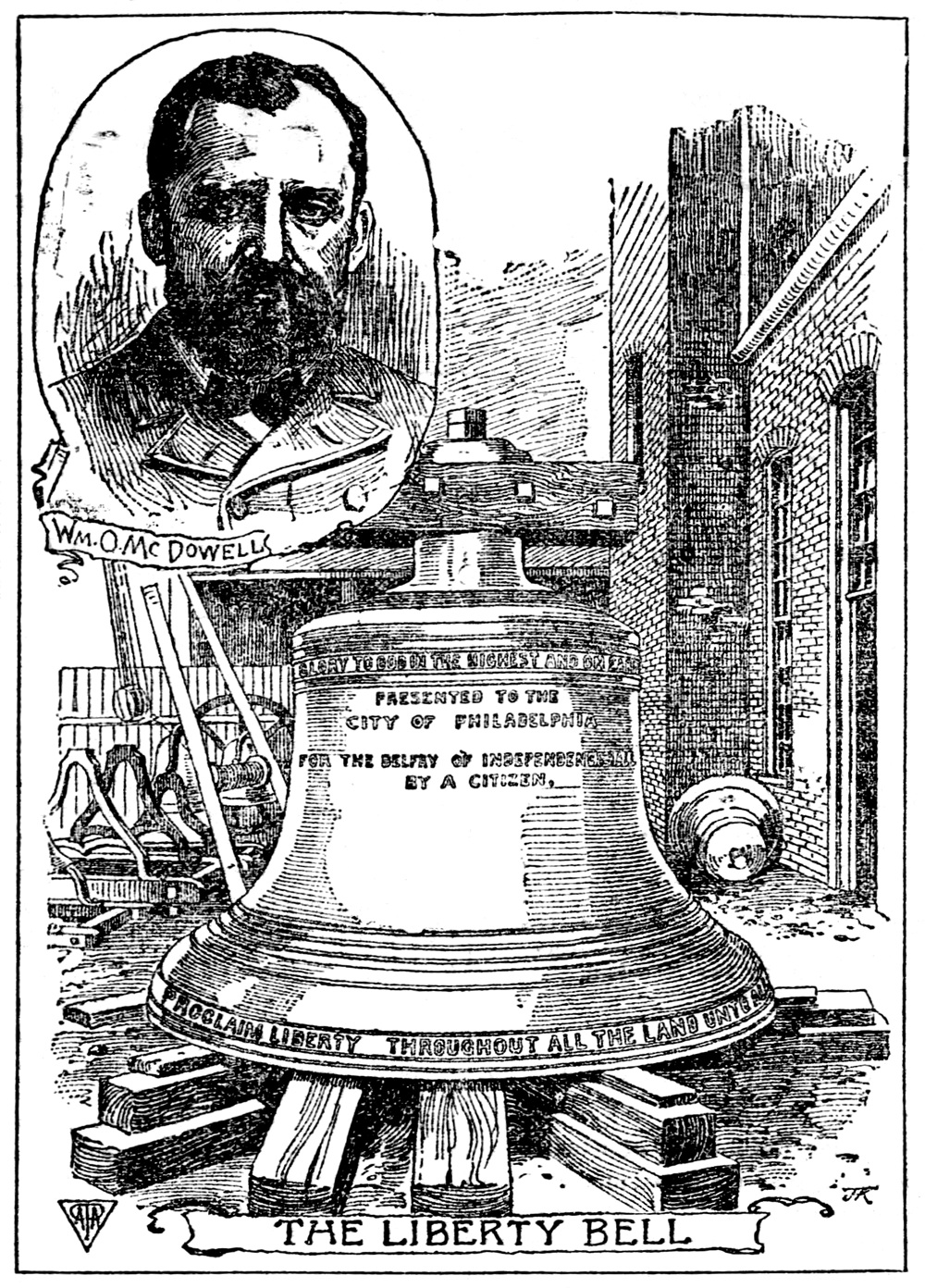
Chairman McDowell spoke about both bells and saw the “battle lines of the future” being “between autocracy and democracy.” [Image from the Akron Beacon Journal April 7, 1893.]
William McDowell’s address
The keynote speaker for the dedication exercises was Chairmen William O. McDowell, whose address the Chicago Tribune described as “patriotic in sentiment and lofty in thought.” [1]
Mr. Chairman, brothers and sisters all:
On Christmas Day, 1892, the question was asked of the presidents of the different republics of the world, of the governors of states and territories of the United States, of the leaders of our great liberty loving society and representative patriots throughout the land: “What was the most appropriate Christmas gift republican civilization could give to the world?” This was followed by a second question, “Was it not a liberty bell, created as a liberty bell, and to be rung only on the anniversaries of the great liberty events in the history of the different nations of the earth?” The letters that were received in response were so filled with cordial, earnest approval at the Columbian Liberty Bell committee was created, composed of one representative of each of the different republics, one representative of each state and territory in the union and a representative of the different great patriotic societies, and associated with these for certain representative lovers of liberty.
The bell was not a new thought. It had first taken form when the President of the United States headed a national subscription for the pedestal of the statue of Liberty Enlightening the World, which had been presented with fraternal greetings, as a monument to our centennial period by 400,000 citizens of France. The President limited his contribution by request to a silver dollar, and this medal was redeemed with another dollar in its place, so that it might in some other form take up the work so nobly typified by the statue. In the wisdom of Providence it has been given to a daughter of California, with the gift of poetry, to embody in verse the full, clear-cut thoughts around which the liberty bell crystallized. The success that has come has far exceeded in certain particulars our most daring hopes.
History written in the Bell
Every event in the history of what we mean in these United States when we use the word “liberty” is commemorated in the metal of the bell. Every statesman and hero, every martyr for the cause of government of, by and for the people, will have new voice in the tones of the bell. The old liberty bell of sacred memory will give new and welcome music to the eager in the ringing of the new. From battlefields and martyrs’ graves have come precious mementos that they may again do their part in the world effort for better conditions. Two hundred and fifty thousand pennies have come from that number of children in every part of the land. The mines of different states and territories have contributed of their metal and the Keystone state has sent the coal that she might furnish the fuel that fused the mass into a bell, that it might thus typify the union of today, united together, and then ringing out for liberty, universal liberty, peace and prosperity, an end to militarism and autocracy, announcing that the day of the people is here.
The hour is at hand for the dedication. It is the Fourth of July, 1893. The place is appropriate; it is the center point of the world’s exposition. Never has the human eye looked upon a grander scene or a stronger argument for everything that will, for all time, be embodied in and expressed by the Columbian Liberty Bell than that upon which our vision rests at this moment. We are in Chicago, the miracle city of our civilization, the greatest wonder of all the wonders of this wonderful age. With the ringing of this bell and the other bell we crown her the capital of civilization during the continuance of this great gathering. Circumstances are congenial. While the Columbian Liberty Bell is not within this enclosure, electricity has annihilated space, and the old bell will in distant Troy, call out the tones of the new, and thus it will ring again for liberty.
All nations honor the Declaration
We have gathered from every tribe of the earth on freedom’s national day to do honor to the principles embodied in the Declaration of Independence of the United States of America, to reiterate the fundamental principle that all are created free, to say “Let us have peace, universal peace.” Read the story of our first century, and then find its duplicate if you can upon the pages of history. We are not only the sons and daughters of the American Revolution, but the sons and daughters of every other revolution and evolution that has been a factor in building up to this day. We have come to dedicate a bell “built of the treasures of human hearts” to the cause of universal liberty and peace. More than this, to dedicate ourselves, our lives, our all to the cause represented by the bell. Old Glory lends his presence, and soon, for the first time in the history of the world, will float aloft by his side the flag of human freedom.
Be thy voice, O bell, ever be a protection against war, against bloodshed, against caste, against the privilege of one at the expense of another, against injustice of every kind and character. May thy ringing ever be in love and rejoicing on days that mark the stepping stones to the “to-day” in the record of human progress toward a higher, nobler condition of God’s children. If it shall become necessary that thy duty shall be enlarged to ringing out at midnight in protest on the anniversaries of events when we, forgetting our ancestry, our history and our destiny, fail temporarily from our high duty and make entries upon our statute books not in accord with our fundamental principles, may this duty quickly come to an end. O, bell, ringing as you do for the first time in these dawning hours of America’s fifth century, may you ring “with malice toward none, but charity for all,” and mark the beginning of a new era in accord with the texts cast in thy eternal bronze; “Proclaim liberty throughout all the land, to all the inhabitants thereof.” “Glory to God in the highest, and on earth peace and good will toward men,” “A new commandment I give unto you, that you love one another.”
Duty and mission of the Bell
You have a duty and a mission, and that is to send out with every tone one single word: purpose, purpose, purpose. A great writer has summed up the history of America’s 400 years in two words: drift, purpose. Four eras of purpose, all the rest drift. It will be your duty to make the fifth century in this country’s history one continued story of earnest, persistent, never ending purpose; to see to it that the seed of the Mayflower is returned and scattered over the fatherland. Patrick Henry embodied the spirit of purpose in a single sentence in ’76 when he said: “Give me liberty, or give me death.” And when the intelligent world shall appropriate these words as the expression of its purpose, before its determined purpose wrongs shall disappear as frost before the south wind. Universal liberty that’s the essential forerunner of eternal peace. “The sword shall be beaten into the plowshare, and the spear into the pruning-hook, and men shall learn the arts of war no more.”
Out of the Declaration of Independence, out of the great prosperity that in spite of all has come to the United States in their first century under free institutions, out of this great gathering from all the earth, in this Columbian year, there will come from thy tones a spirit of purpose that no ocean can bound, that no ocean range can circumvent. As the flint-rock musket, the hand printing press and the Santa Maria did their work four centuries ago in compelling progress, so must you now do your part. The battle lines of the future will not be between nations, races or creeds, but between the old and the new, between autocracy and democracy, between militarism and the conditions that built Chicago twice over in less than half a century. Before this progress, preparations for war will disappear as a useless waste and a tale that is told.
My friends, as we participate in this ceremony let us remember the Columbian text cast into the very fiber of this bell: “A new commandment I give unto you, that you love one another.” With this in our hearts let us ring the bell, run old glory aloft, and by its side the flag of human freedom, is having logged in there every fighting words “Love, purpose.” Purpose for what? For God, for liberty, for humanity and for right.
Other members of the Liberty Bell Committee offered brief words. The Chicago Tribune noted that Miss Mary Desha of Kentucky “brought a patriotic greeting to her sisters of the North,” and that Mrs. Lulu Gordon of Georgia “spoke of the universal bond of good feeling prevailing throughout the country.” Pennsylvania Commissioner Woodside invited those present to go to his state’s building to witness a meeting between the old Liberty Bell and the “John Paul Jones” flag, an arrangement Mrs. Stafford had previously agreed to.

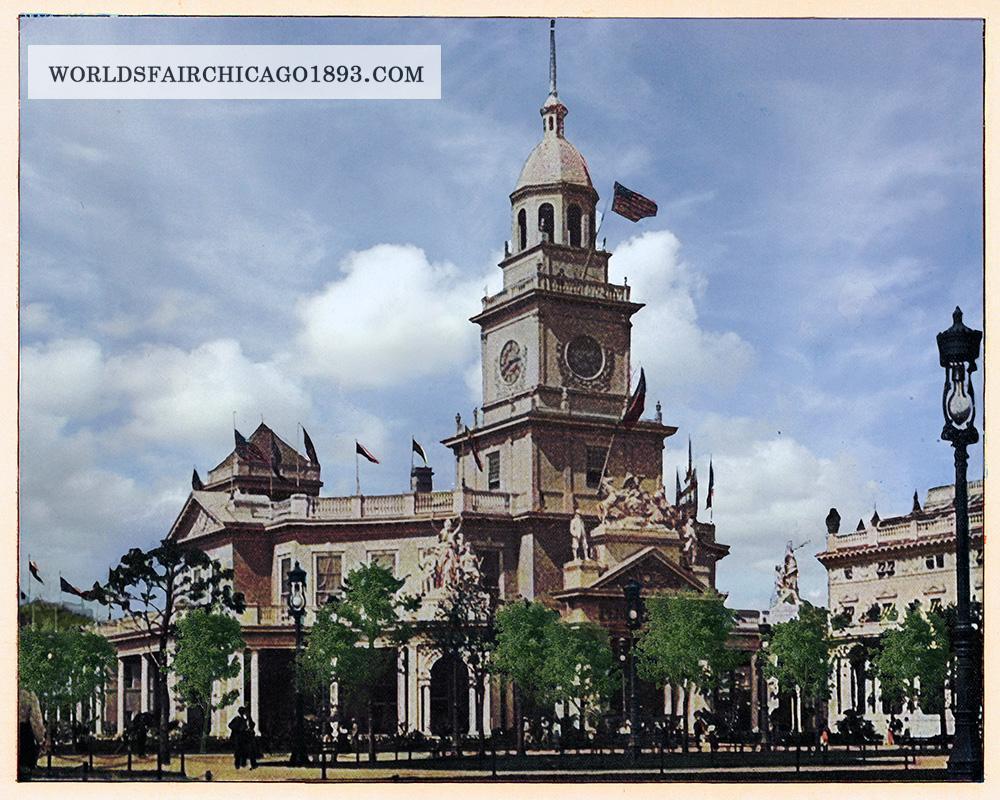
The Pennsylvania State Building was a reproduction of Philadelphia’s historic Independence Hall. [Image from Picturesque World’s Fair. W.B. Conkey, 1894; digitally edited.]
March to the old Liberty Bell
At 4 pm, Mrs. Stafford and her flag led a procession around the corner to continue the celebration. Along the short route, George S. Knapp carried aloft the “Exposition Flag,” the Board of Lady Managers’ great silk of which he was the custodian.
In designing the Pennsylvania State Building, architect Thomas P. Lonsdale of Philadelphia reproduced Independence Hall of that city, with its iconic bell tower and spire, though he added balconies to encircle the structure. World’s Fair historian Benjamin Cummings Truman described it as “a building which takes the mind back to the times when Philadelphia was the center of American struggle for liberty.” The first and second stories were constructed using Pennsylvania brick, and Philadelphia tin covered the roof. Above the main entrance was a sculpture of the Commonwealth coat-of-arms flanked by heroic-sized figures of William Penn and Benjamin Franklin by John J. Boyle, the sculptor who also decorated Louis Sullivan’s Transportation Building.
“The Pennsylvania Building was already crowded when the people came over from the Delaware Building,” reported the Chicago Herald. “The newcomers wedged themselves into the building as well as they could, but so great was the crush that it was found necessary to temporarily close the doors.” Guests arriving for the impromptu meeting of bell and flag entered a rotunda thirty feet in diameter and forty feet high. The space, finished in tile and slate, ran “far up into the clock tower, where it ends in a dome, richly frescoed and brilliantly lighted by electric lamps sunk in the ceiling,” described Truman. Two beautifully broad stairways wound their way to the upper floor, and the first landing featured the mammoth painting Birth of Our Nation’s Flag by Charles H. Weisgerber.

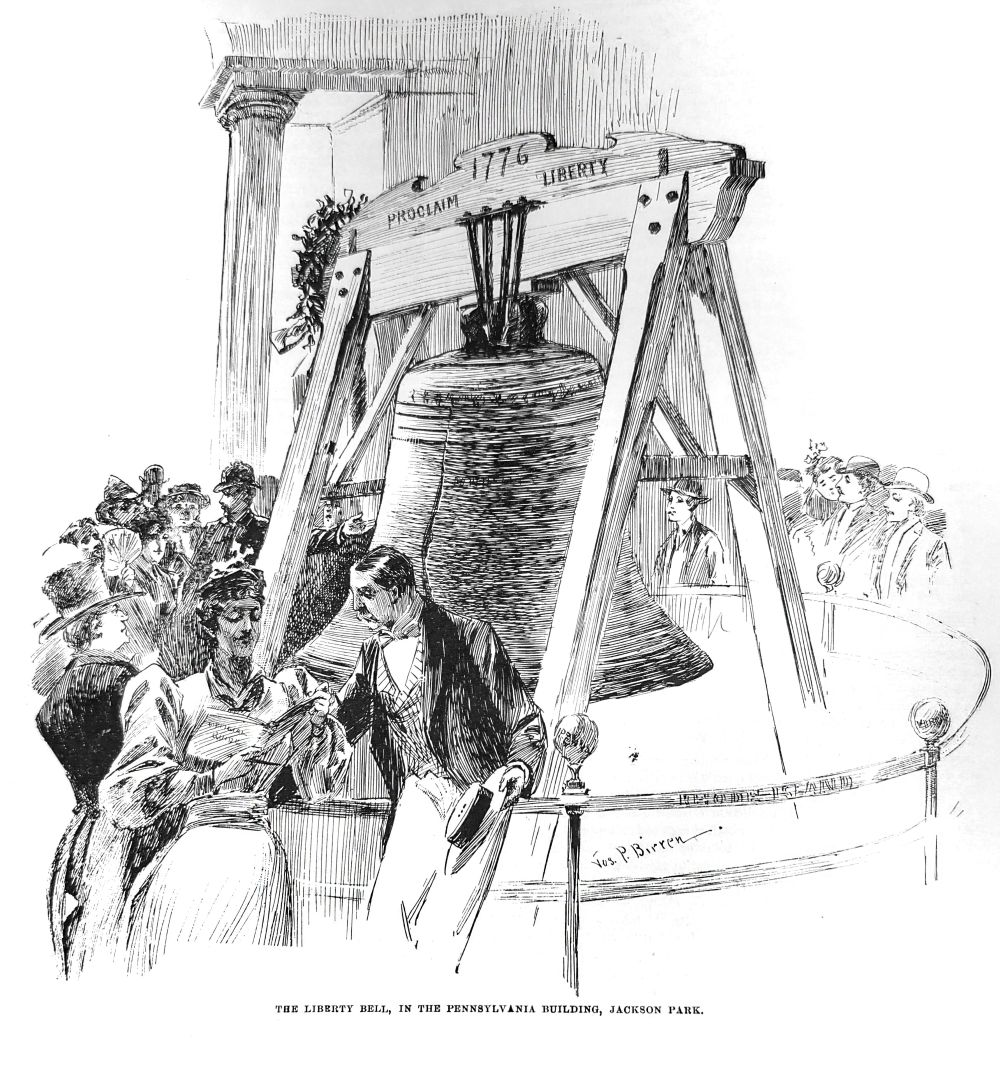
One of the biggest attractions of the 1893 World’s Fair, the Liberty Bell was displayed in the rotunda of the Pennsylvania State Building, protected by a brass railing and guards. [Image from The Graphic Jul. 8, 1893.]
“The apotheosis of patriotic landmarks”
“No building on the Exposition grounds held out more attractions [on July 4th] than Pennsylvania’s stately home, the shrine of the old liberty bell,” wrote the Inter Ocean. Thousands came to see the national treasure. The majestic Liberty Bell stood in the center of the rotunda. The valuable relic was surrounded by a brass railing and rested on a platform with wheels, for easy removal in case of a fire. The Philadelphia policemen standing guard were the proudest Americans on the grounds that day. The Chicago Herald reported that:
All day long old Liberty Bell had been surrounded by a throng four to six deep, that was with difficulty kept moving by the stalwart policemen. The old bell itself was decorated with a garland of roses from the Pennsylvania gardens, and American flags were streaming from the woodwork that serves the purpose of a railing.
For the Fourth of July, the Liberty Bell was wreathed around in roses and festooned with red, white, and blue banners. The guards had all they could do to keep back the crowd that pressed tightly against the railing.
One of the bell’s guardians standing inside the railing approached Mrs. Stafford. She placed the “John Paul Jones” flag tenderly in his hands, and he spread its folds gently on the old bell. Spectators applauded. A syndicated newspaper story published in the St. Joseph Herald reported that the meeting of flag and bell was “as distinct a feature of the day’s celebration as it was spontaneous, the promptings of patriotic hearts.” The Chicago Herald captured the excitement of the scene:
The crowd’s enthusiasm knew no bounds. Flags were waved, and the notes of “The Star-Spangled Banner” swelled into a diapason of patriotic melody. Not since the year of the birth of the republic had these two priceless relics come together before.[3] The one was cracked, and the other tattered and dingy, but there was not a man or woman in the audience who would not have laid down his or her life to defend either from harm. It was the apotheosis of patriotic landmarks that are dear to every American, and the climax of the greatest Fourth of July celebration in the nation’s history.

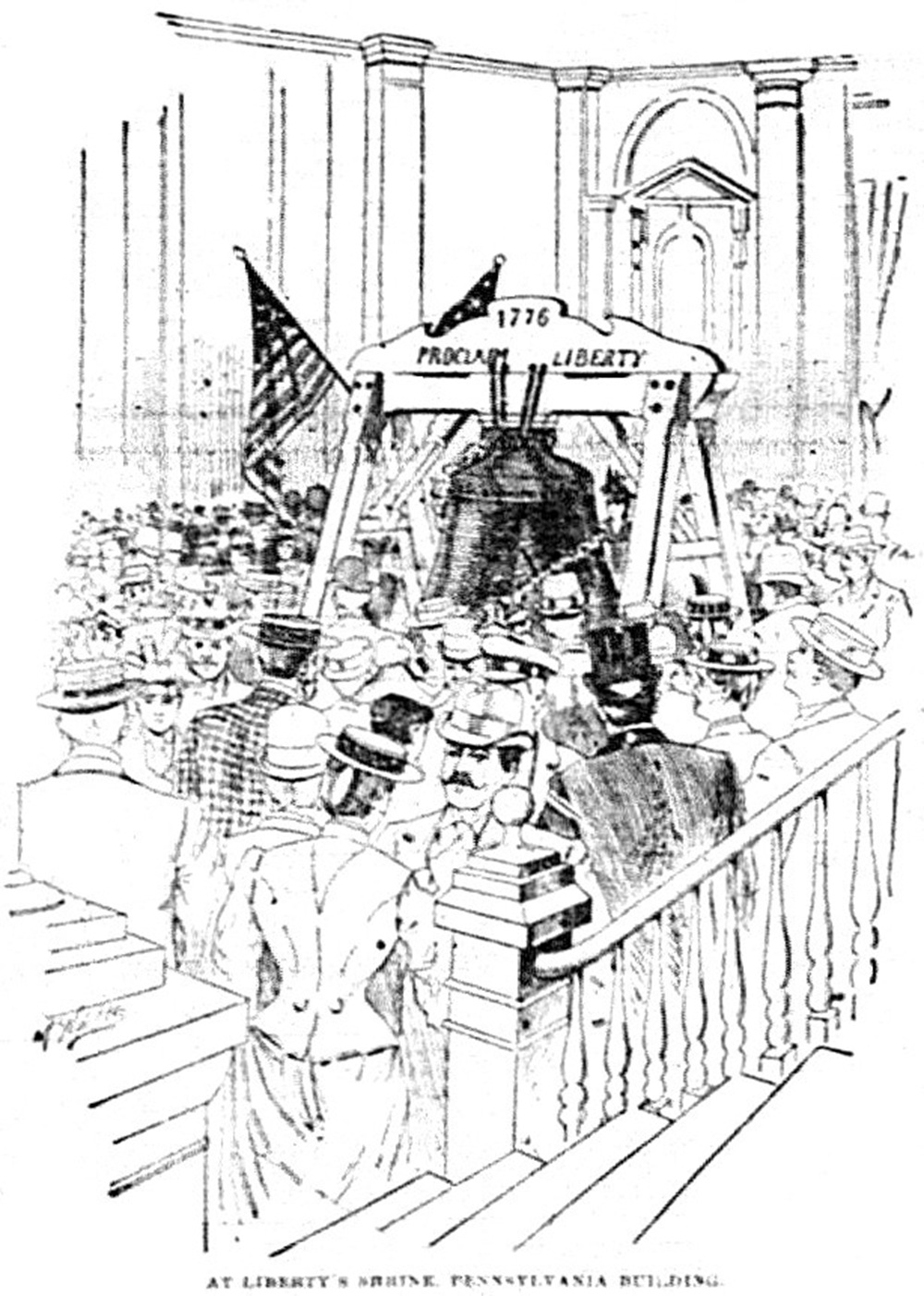
“At Liberty’s Shrine” depicts the Fourth of July crowd gathered to see the old Liberty Bell in the Pennsylvania State Building of the 1893 World’s Fair. [Image from the Chicago Herald July 5, 1893.]
“A wave of patriotic fervor”
As guests surrounded the bell, Pennsylvania Commissioner A. B. Farquhar opened the impromptu exercises by welcoming those assembled into his state’s home. Mr. Arthur B. Farquar (1838–1925) had recently announced his resignation as Executive Commissioner but would withdraw it the next day. He introduced his colleague, Pennsylvania Commissioner John M. Woodside, who called for three cheers for the old flag and the old bell. According to the Chicago Herald:
The crowd did not need a second invitation, and for several minutes a wave of patriotic fervor filled the building. Hats and handkerchiefs were waved until the crowd cheered itself hoarse. Mr. Woodside then told the story of the old flag and the old bell in an eloquent vein. He recounted the history of both since the memorable year when the bell rang out the beginning of universal independence and the flag was carried from the City of Philadelphia by its daring owner for conquests across the sea. Mr. Woodside closed his speech with stirring tribute to the Daughters of the Revolution, whose patriotism had led to the casting of a new Liberty Bell, which should hereafter be the mouthpiece of the old bell.
Chairman McDowell also offered an encore speech. The Chicago Herald reported that:
Mr. McDowell’s set speech had just been delivered in the Delaware Building, and his remarks were now impromptu, but nonetheless eloquent. He told something of the history of the new Liberty Bell, which would hereafter take up the burden of speaking for universal liberty. The new bell would speak for the old, whose silence as it stood before them was eloquent. He also spoke of “Old Glory,” in the possession of Mrs. Stafford, as the first flag that had ever gone aloft for the cause of human universal freedom. His hearers were now celebrating the event referred to by a noted prophetic writer, who said the English-speaking race would hereafter rule the world in the cause of liberty. They could also rejoice to-day that the cause of human liberty was spreading everywhere; that anti-military legislation was destined to be triumphant in Germany, and that the air in this community was sweetened by the news from Greece that a republic had been established.
At the close of the exercises, the doors of the Pennsylvania Building reopened, and a great crowd surged through the halls for the rest of the day.
[Continued in Part 13]
NOTES
[1] Chairmen McDowell had a place on the program of the general exercises on Administration Plaza, but was removed on July 3rd when it became known that the Columbian Liberty Bell would be absent. Lines from the printed text of his speech (“Old Glory lends his presence, and soon, for the first time in the history of the world, will float aloft by his side the flag of human freedom” and “let us ring the bell, run old glory aloft”) indicate he wrote it expecting the bell to be present.
[2] Mrs. Osborn’s husband, Frank Stewart Osborn, was a chief salesman for Marshall Field & Company and had served as the foreman on the jury that convicted eight alleged anarchists on murder charges in the Haymarket affair of 1886. He faced assassination threats for the rest of his life. The last name of Frank and his wife was commonly spelled “Osborne” in the press.
[3] Even based on its suspect history, the “John Paul Jones” flag would not have met the Liberty Bell in the early days of the United States.
SOURCES
“All Honor the Nation” Chicago Times Jul. 5, 1893, p. 2.
“At State Headquarters” Chicago Record Jul. 5, 1893, p. 5.
“Cheering the Flag” Chicago Herald Jul. 5, 1893, p. 9.
“The Columbian Bell” Chicago Tribune Jul. 5, 1893, p. 9.
“Flag and Bell Met” Chicago Herald Jul. 5, 1893, p. 2.
“The Glorious Fourth” Chicago Inter Ocean Jul. 5, 1893, p. 1.
“Hon. John W. Woodside, National Commissioner from Pennsylvania” World’s Columbian Exposition Illustrated Aug.-Sep. 1891, p. 4.
“Liberty’s Day” St. Joseph (MO) Herald Jul. 5, 1893, p. 1.
“Patriotism in Chicago” Philadelphia Times Jul. 5, 1893, p. 4.
Truman, Benjamin Cummings History of the World’s Fair. Mammoth, 1893.