


[Continued from Part 7]
With cannons firing, steam whistles screeching, chimes ringing, a mass chorus accompanied by tens of thousands of celebrants singing “The Star-Spangled Banner”, and two notable flags rising on their poles, it would have been easy to miss the two women who walked across the stage to the center table and pressed a telegraph key. This action served as a surrogate for the absent centerpiece of the Fourth of July celebration at the 1893 World’s Fair—the Columbian Liberty Bell.
Touching the electric button was Mrs. Madge Morris Wagner of California, whose patriotic poem “Liberty’s Bell” inspired the creation of the new bell. Accompanying her was Miss Minnie F. Mickley of Pennsylvania, who helped launch the project and served as secretary of the Columbian Liberty Bell Committee. Their simple action went “almost unnoticed amid the frenzy of enthusiasm,” according to the Philadelphia Times. The Morse key the women pressed formed a continuous circuit from the fairgrounds in Chicago to a telegraph station about 700 miles east, on the banks of the Hudson River.

The Fourth of July ceremony at the 1893 World’s Fair was centered around the absent Columbian Liberty Bell. [Image from Picturesque World’s Fair. W.B. Conkey, 1894; digitally edited.]
“Extremely melodious and powerful”
Hundreds of people gathered at the Meneely Bell Foundry in Troy, New York, to hear the voice of the new liberty bell.[1] When the electric signal reached there at 1 pm (noon Chicago time), two workmen lifted a sixty-pound clapper which Chester Meneely then guided toward the bell, which sat mouth upward. He struck six blows in the middle of the newly cast bell, which rang with a deep and melodious tone. The assembled crowd cheered and cheered again. Mr. Meneely explained that the clapper that would eventually be attached to the bell would be a hefty 360 pounds, making the bell’s tone “extremely melodious and powerful.” Following the bell ringing, national and patriotic airs were played on a chime set made by the Meneely Foundry for St. Patrick’s Cathedral in New York City.
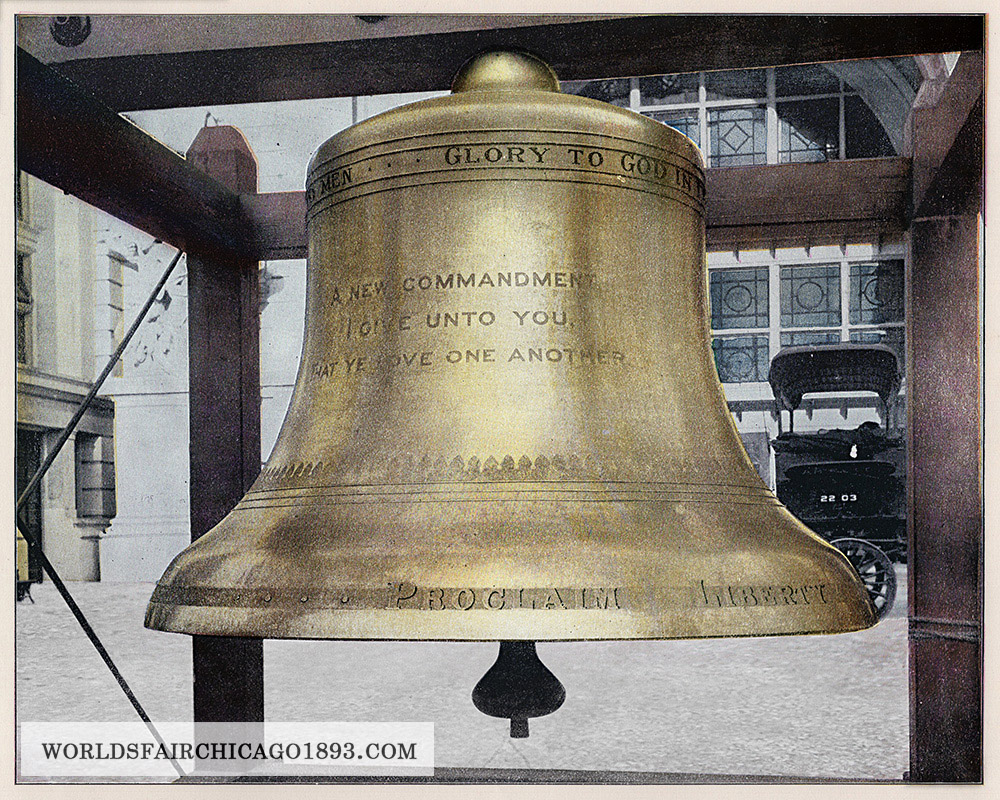
The 1893 Columbian Liberty Bell weighed 13,000 pounds, symbolic of the thirteen original states of the Union and 2,000 pounds greater than the weight of the original Liberty Bell. The new bell was six feet high, seven-and-a-half feet in diameter at the mouth, and five inches in thickness. Later, several inscriptions were added to the bell. Written about the mouth was: “PROCLAIM LIBERTY THROUGHOUT THE LAND, AND TO ALL INHABITANTS THEREOF” from Leviticus 25:10; the original Liberty Bell and 1876 Centennial Bell also bear this message. Encircling the top was written: “GLORY TO GOD IN THE HIGHEST, AND ON EARTH PEACE, GOOD WILL TO MEN” from Luke 2:14, a quote also used on the Centennial Bell. One side of the bell bore the inscription: “A NEW COMMANDMENT I GIVE UNTO YOU, THAT YE LOVE ONE ANOTHER” from John 13:34. Its most relevant characteristic, however, is that it currently was sitting 700 miles away from the World’s Fair.

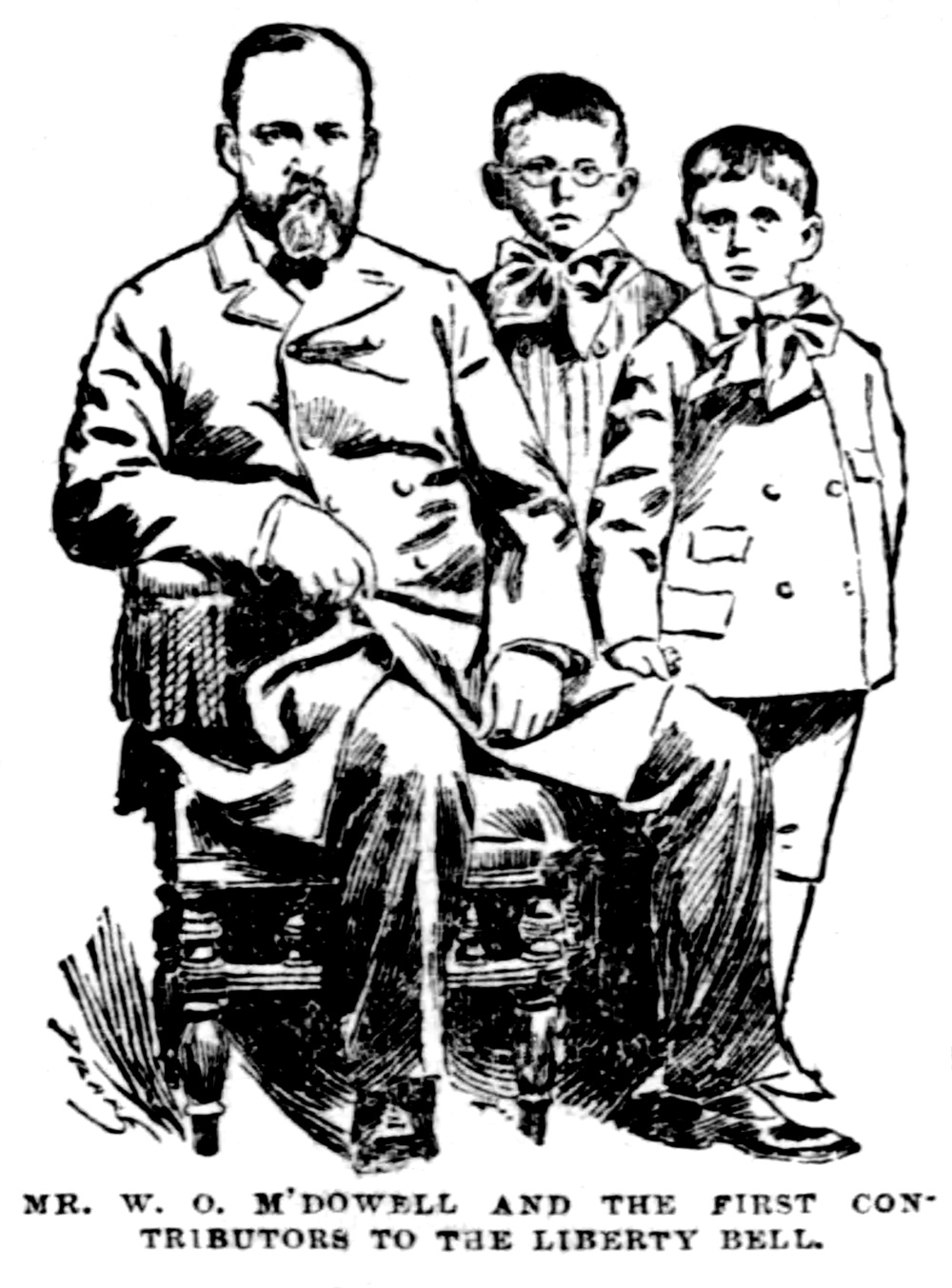
William O. McDowell, Chairman of the Columbian Liberty Bell Committee, and his sons. [Image from the Philadelphia Inquirer June 4, 1893.]
“A voice again”
William O. McDowell’s many months of planning, gathering of metal historical artifacts, and fundraising were aimed at having the Columbian Liberty Bell ready for its inaugural ringing on the Fourth. “By the terms of the contract,” the New York Times (Apr. 24, 1893) reported, the bell “must be delivered before July 4” to the fairgrounds in Chicago. To meet that goal, the casting originally was set for April 30, to celebrate the anniversary of the inauguration of George Washington. Soon after, the date was nudged to Monday, May 1, to coincide with Opening Day at the Exposition. Then, delays in receiving historical artifact contributions prompted Mr. McDowell to postpone the casting until June 8, which was the anniversary of the day in 1776 when the Continental Congress appointed a committee to draft the Declaration of Independence. Mr. McDowell could not resist these historic connections. Mr. Meneely had asked for “as near four weeks as possible” to complete the casting, so early June was pushing it for the bell to reach Chicago by July 4th.
The first crack in the plans developed on June 7, when the bell mold was accidentally damaged at the Meneely foundry after the oak beam supporting it broke. The casting planned for June 8 had to be cancelled, just as the Columbian Liberty Bell Committee arrived from Philadelphia. “A fortnight will probably be required to put everything in readiness again,” the Cleveland Leader reported on June 12. “This will not leave much margin for getting the bell to Chicago in time for the great Columbian Fourth of July celebration.” Despite a timeline that seemed impossibly compressed, officials continued to promise that the bell would be cast, cooled, prepared, and transported to the Fair by Independence Day. The casting rescheduled for June 22 went well, according to some reports. In the days that followed, the Committee remained optimistic about the Columbian Liberty Bell arriving in Chicago on time. Mr. McDowell, by then in Chicago, confirmed that the bell would ring for the first time as part of “the grandest celebration of the Fourth of July ever planned” having a program centered “around this bell and the old Liberty Bell.” On “Liberty Bell’s Day,” the old bell would have “a voice again in the tone of the new,” he promised in the pages of the Chicago Herald (Jun. 23, 1893).
With only hours to go before the big day, the guest of honor was forced to cancel. Exposition officials issued a statement on July 3 that the Columbian Liberty Bell would not be rung at the World’s Fair on the Fourth, nor rung at all until it had been melted and recast. Workers at the Meneely foundry allegedly had discovered a serious flaw in the bell when they removed it from the mold. Mr. Meneely sent a telegram to Mr. McDowell denying the report, stating that “the casting was a perfect success,” though he did not explain the cause of the delay in getting the bell to Chicago. He also arranged to have the new bell, “one of the finest ever made at the foundry,” rung remotely in Troy using an electrical telegraph signal that was to be sent from Chicago at noon during the Fourth of July ceremony on the fairgrounds. The Columbian Liberty Bell Committee met at the Palmer House “where details of the programme were explained,” reported the Chicago Daily News (Jul. 3, 1893). The relevant details had the Committee members, even after so much hard work, in greatly reduced roles in the exercises. Mrs. Wagner and Miss Mickley pushed the electric button as Mr. McDowell and the others watched in silence.

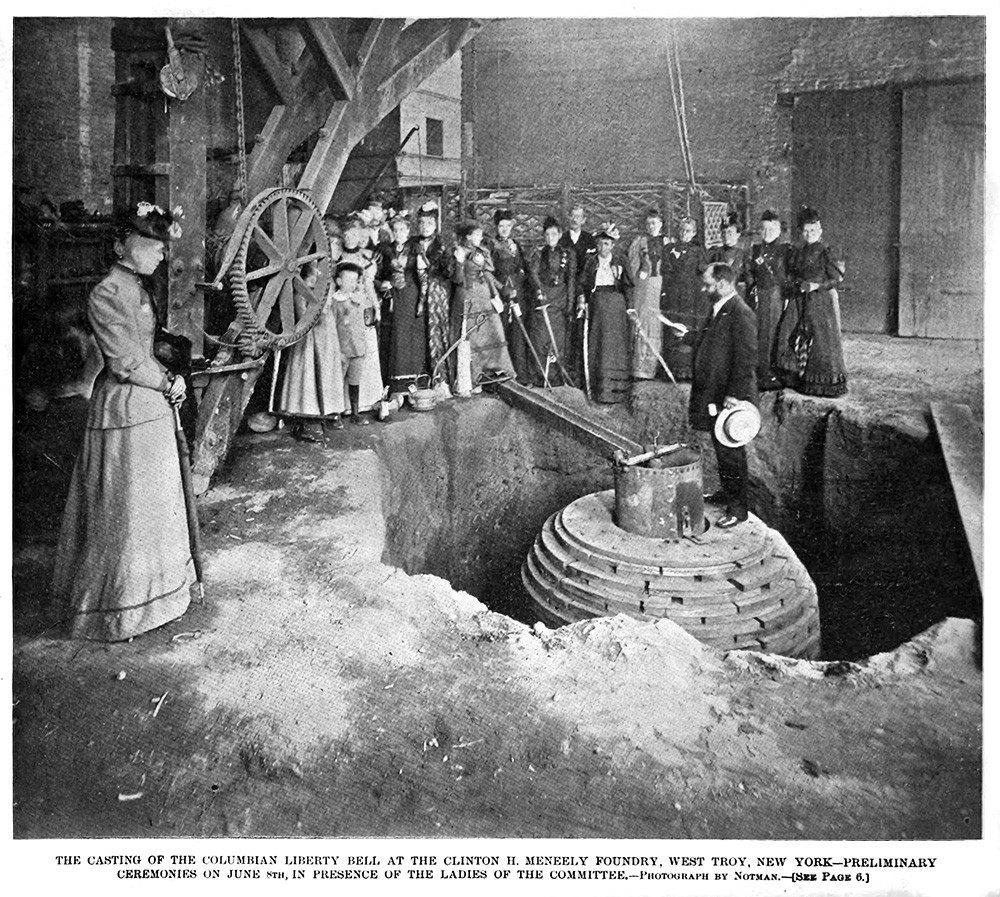
The casting of the Columbian Liberty Bell planned for June 8 had to be cancelled when the mold cracked in an accident. Members of the Columbian Liberty Bell Committee were already in Troy to witness the event, soon rescheduled for June 22. [Image from Frank Leslie’s Illustrated Weekly Jul. 6, 1893.]
“Bells throughout the land burst out in praise of freedom”
As the Columbian Liberty Bell rang in Troy, many other sounds filled the air of the Chicago fairgrounds and beyond. At noon, cannons on the USS Michigan fired a twenty-one-gun salute from the lake. The Chicago Record (Jul. 5, 1893) described the sonic scene:
The great black ball on the dome of the government building dropped. … As the ball glided down the rod that pierces its diameter a cloud of smoke, whiter than the hull of the Michigan, shot out from the side of the government’s old lake warship. A flash followed. Then the report of the cannon rolled across the water and up against the side of the big manufacturers building. The national salute was being fired. Then the white smoke rushed out from the black ports of the Andy Johnson. After that it was a race between the white and black government boats to see which could fire the guns the quicker. The wind blew the smoke toward the government pier until the gaily bedecked battleship Illinois was almost hidden from the view of the persons who thronged the lake shore.
Also at noon, “all over the country bells retold the tale which Liberty bell sounded,” reported the Chicago Herald (Jul. 5, 1893). The Chicago Record (Jul. 5, 1893) explained that:
Up to 12 o’clock the celebration was a World’s Fair event, but when the minute hand reached the highest point in its circle of the hours it leaped miles of space on the wings of electricity, and the brazen voices of bells throughout the land burst out in praise of freedom.
Although it is not clear how widely this sympathetic pealing occurred, the idea for a nation-wide response to the ringing of the Columbian Liberty Bell was one of Alderman Martin Madden’s earliest plans. Bells on the fairgrounds would ring, and then the triumphal paean would be taken up by church, school, municipal, and factory bells across Chicago.[2] He also called for every bell in the nation to ring at noon, Chicago time. This unison peal was inspired by William Stead’s fictional story “From the Old World to the New: A Christmas Story of the Chicago Exhibition,” published in the Christmas 1892 issue of the Review of Reviews. Ald. Madden told the Chicago Record (Jun. 2, 1893): “In recognition of Mr. Stead’s philosophy, the bells of the United States of freedom will join with the Liberty Bell of Chicago at 12 noon July 4, 1893, in making Chicago for the six months of the Exposition the capital of the world.” A local businessman replied (Jun. 22, 1893):
“Madden, when I saw the account of the new liberty bell ringing at noon and found that it was to be followed by all the bells in America, it struck me that it was the most unique and pleasing idea I ever heard of. I want to help you all I can, and I know plenty of others who will do the same.”
Sullen rainfall greeted the next speaker as he approached the dais to speak on “The Old and the New Liberty Bells.” The Chicago Tribune (Jul. 5, 1893) noted that the audience “stood and kept a firm hold on its temper.”
[Continued in Part 9]
NOTES
[1] The location of the foundry of the Clinton H. Meneely Bell Company was in the village of West Troy, on the west bank of the Hudson River. In 1896, this became the city of Watervliet. Although the foundry closed in 1952 and the building is gone, the city maintains many markers and bells on display. The company also produced the set of nine chimes for the grand clock tower of the Self-Winding Clock Company in the Manufactures and Liberal Arts Building at the 1893 World’s Fair.
[2] Bells rang in the pages of the July 4th issue of the Inter Ocean, which published Richard Lew Dawson’s poem “Ring the Bells!”
SOURCES
“Cheering the Flag” Chicago Herald Jul. 5, 1893, p. 9.
“Columbian Liberty Bell” Boston Globe Apr. 29, 1893, p. 8.
“The Columbian Liberty Bell Rung” New York Herald Jul. 5, 1893, p. 2.
“For a Big Liberty Bell” New York Times Mar. 24, 1893, p. 2.
“For the Fourth of July” Chicago Daily News Jul. 3, 1893, p. 2.
“Great Celebration Assured” Chicago Record Jun. 22, 1893, p. 1.
“His Birthday Party” Chicago Tribune Jul. 5, 1893, p. 1.
“Liberty Bell Cast” Chicago Herald Jun. 23, 1893, p. 2.
“Patriotism in Chicago” Philadelphia Times Jul. 5, 1893, p. 4.
“Plans for the Fourth” Chicago Record Jun. 2, 1893, p. 8.
“That Liberty Bell” Buffalo (NY) Post Jul. 3, 1893, p. 1.
“The New Liberty Bell” Cleveland Leader Jun. 12, 1893, p. 4.
“To Hear New Liberty Bell Ring” Chicago Herald Jul. 5, 1893, p. 2.
“A Vast Throng at the Fair” New-York Tribune Jul. 5, 1893, p. 7.
“Wonderful Liberty Bell” New York Times Apr. 24, 1893, p. 9.
“World’s Fair Fourth” Chicago Record Jul. 5, 1893, p. 1.