


[Continued from Part 4]
Everyone in the immense Fourth of July crowd recognized the bald man with a tiny American flag in his buttonhole as he stepped forward. Thunderous applause greeted the Illinois politician as he took the dais. Adlai E. Stevenson (1835–1914), a Democrat from Bloomington, had recently come into office as Grover Cleveland’s vice president. He previously served in the U.S. House of Representatives and as first assistant U. S. postmaster general during Cleveland’s first term. At this moment, his boss was recovering from a secret, and rather risky, oral surgery that had placed Stevenson—unbeknownst to him—on the threshold of becoming president.

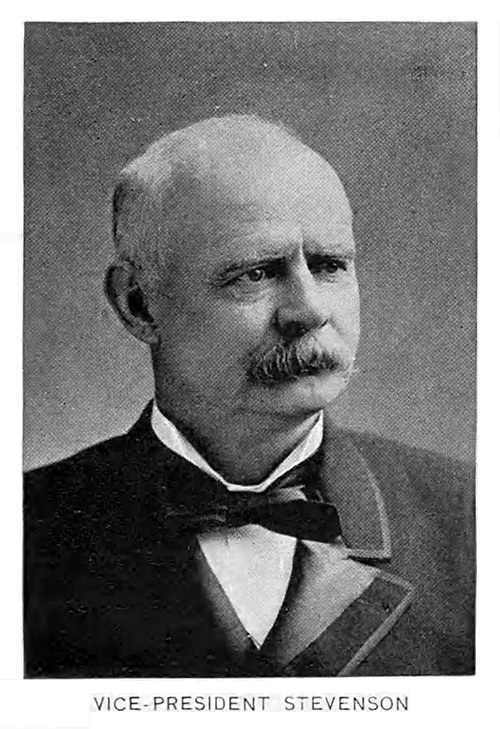
Vice President Adlai E. Stevenson. [Image from Bancroft, Hubert Howe The Book of the Fair. The Bancroft Company, 1893.]

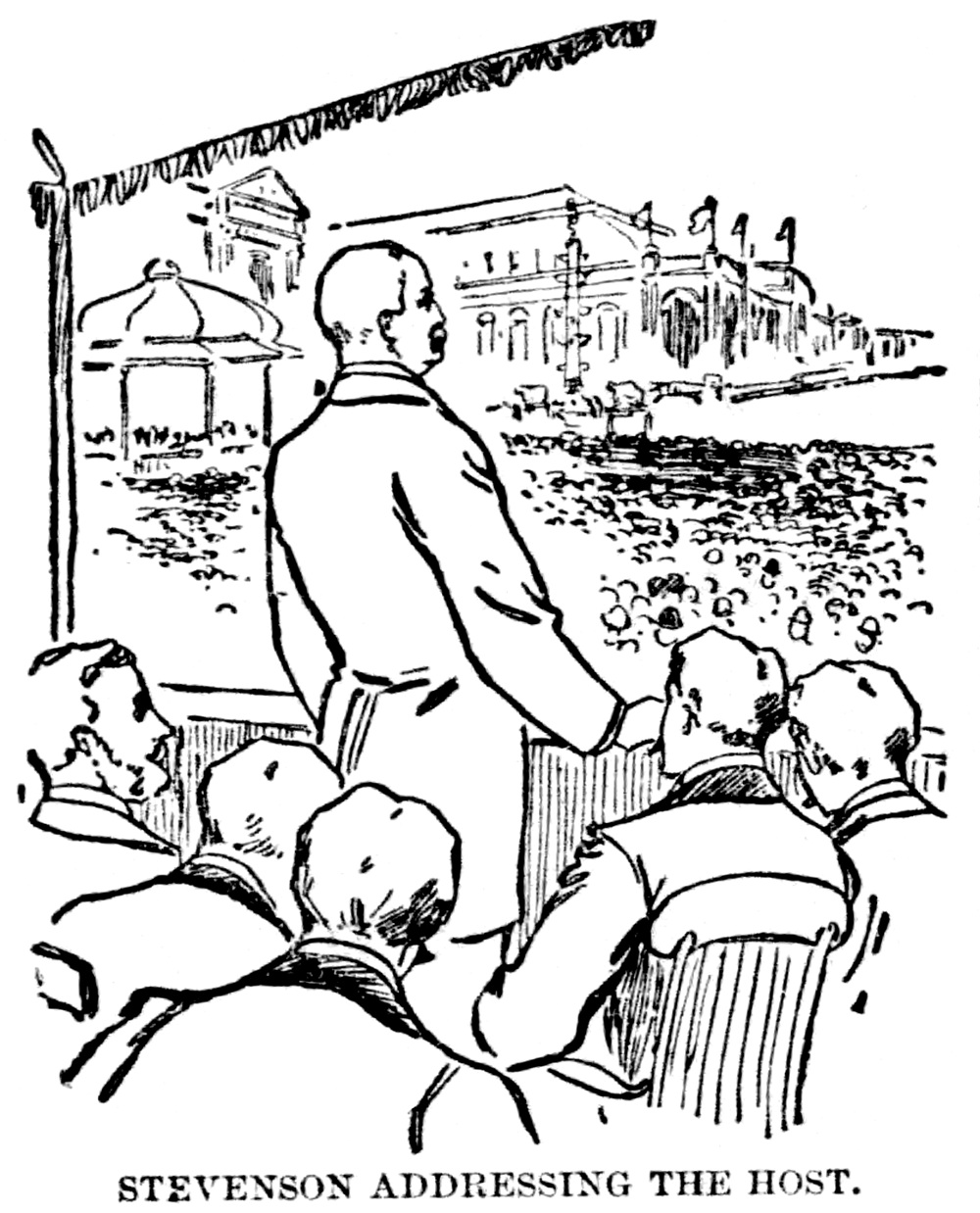
Vice President Stevenson provided the opening address at the Fourth of July exercises. [Image from the Kalamazoo (MI) Gazette Jul. 6, 1893.]
The Vice-President’s Opening Address
I am confident that at no time or place have human eyes beheld a grander assemblage. This is America’s day. Under the auspices of the great Exposition other days have been set apart to commemorate marked events in history. The individual states of the Union and the nations of the earth, each and all—wisely, too—have had a special day assigned them. In the great congresses which have here assembled representatives of all lands and of all pathways of human endeavor have been gathered. Science, agriculture and the arts have not been forgotten. All who toil with hand or brain, no matter whence they come or what they bring, have been welcomed to the great Exposition. All who could add to the sum of human learning, or lessen the sum of human woes, have been and are thrice-welcome guests.
But this, our day, comes unheralded by edict or proclamation. For more than 100 years it has been the day of days of America. Today we do honor to the memory of the signers of the Declaration of Independence. These ceremonies, this coming together of the people, notes the anniversary of the birth of our Republic. Prophet, as well as patriot, John Adams exclaimed: “We shall make this a glorious and immortal day. Our children will celebrate it with roar of cannon, with martial music, with songs of thanksgiving and with shouts of joy.” All of this multiplied a thousand fold our eyes now behold. One hundred and seventeen years from the hour this declaration was signed, upon the southern border of the great chain of lakes, midway between the oceans a city has sprung into life containing a population but little less than that of all the American states at the time the declaration was proclaimed.
I am honored by being called to preside this day over this assemblage. It is not mine, but the part of others to speak to you. Lips more eloquent than mine will tell something of the men who gave to the American colonies this charter of their liberties; something of the heroic struggle which, commencing at Lexington, culminated at Yorktown in the independence of the colonies; something of the men who in 1787, inspired by wisdom more than human, crystallized into our federal Constitution the deathless principles enunciated in the great Declaration.
I congratulate you, my countrymen, upon this auspicious celebration of the Fourth of July, upon the glories of the past and upon what yet remains sure for us and for our children. Self government is no longer an experiment. It has safely passed the crucial test of more than one hundred years’ trial. No period of our history has known a more steadfast determination to maintain and perpetuate the priceless heritage bequeathed us by our fathers, our Republic is “whole as the marble, founded as the rock. As broad and gentle as the casing air.”[1]
We have entered upon the second century of our national life. God grant that we, and those that succeed us, may not prove unworthy of those who have gone before; that we may not prove unmindful of the sublime lessons of the past. Then may we rest assured that the bright sun which ushers in each succeeding anniversary of the Declaration of Independence will look down upon a people who celebrate this day with hearts grateful to God that those who guarded and strengthened were counted worthy to be named with those who founded this Government.
“Columbia, the Gem of the Ocean”
The vice president’s words garnered applause lasting several minutes. During his speech, Silas G. Pratt prepared his mass chorus for the next event on the program. Standing on a chair, Mr. Pratt conducted using a flag as a baton. At his signal, the bands struck up “Columbia, the Gem of the Ocean,” one of the most popular patriotic songs of the nineteenth century and one of the unofficial national anthems of the United States. The 2,000 singers—divided into four sections, each with a leader—began the first verse with one voice.
O Columbia! the gem of the ocean,
The home of the brave and the free,
The shrine of each patriot’s devotion,
A world offers homage to thee.
Thy mandates make heroes assemble,
When Liberty’s form stands in view;
Thy banners make tyranny tremble,
When borne by the red, white, and blue.
When they reached the chorus of the song, the crowd boisterously joined in by cheering “Hurrah for the Red, White and Blue.”
Three cheers for the red, white, and blue!
Three cheers for the red, white, and blue!
The army and navy forever,
Three cheers for the red, white, and blue.
They sang another verse (one of several known variants of the piece) and repeated the chorus:
The wine cup, the wine cup, bring hither,
And fill you it true to the brim.
May the wreaths they have won never wither,
Nor the star of their glory grow dim.
May the service united ne’er sever,
But they to their colors prove true,
The army and navy forever,
Three cheers for the red, white, and blue.
Meanwhile, several forms of the red, white, and blue were being readied for their journey up the flagpoles.

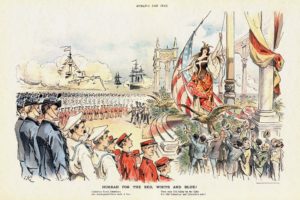
“Hurrah for the Red, White and Blue!” depicts an imaginative musical scene during the Fourth of July exercises. [Image from World’s Fair Puck, July 3, 1893.]
NOTES
[1] The passage beginning with “Self government is no longer an experiment …” was not printed in the Chicago newspapers but was included in the St. Louis Post-Dispatch. The quote at the end of the passage comes from Shakespeare’s Macbeth, Act 3, Scene 4.
SOURCES
“Cheering the Flag” Chicago Herald Jul. 5, 1893, p. 9.
“Fair’s Best Day” Chicago Times Jul. 5, 1893, p. 1.
“His Birthday Party” Chicago Tribune Jul. 5, 1893, p. 1.
“Old Glory” St. Louis Post-Dispatch Jul. 4, 1893, pp. 1–2.
“Patriotism in Chicago” Philadelphia Times Jul. 5, 1893, p. 4.
“Vice President Stevenson’s Speech” Chicago Tribune Jul. 5, 1893, p. 1.
“Within a Magic City” Chicago Inter Ocean Jul. 5, 1893, p. 2.
“World’s Fair Fourth” Chicago Record Jul. 5, 1893, p. 1.