


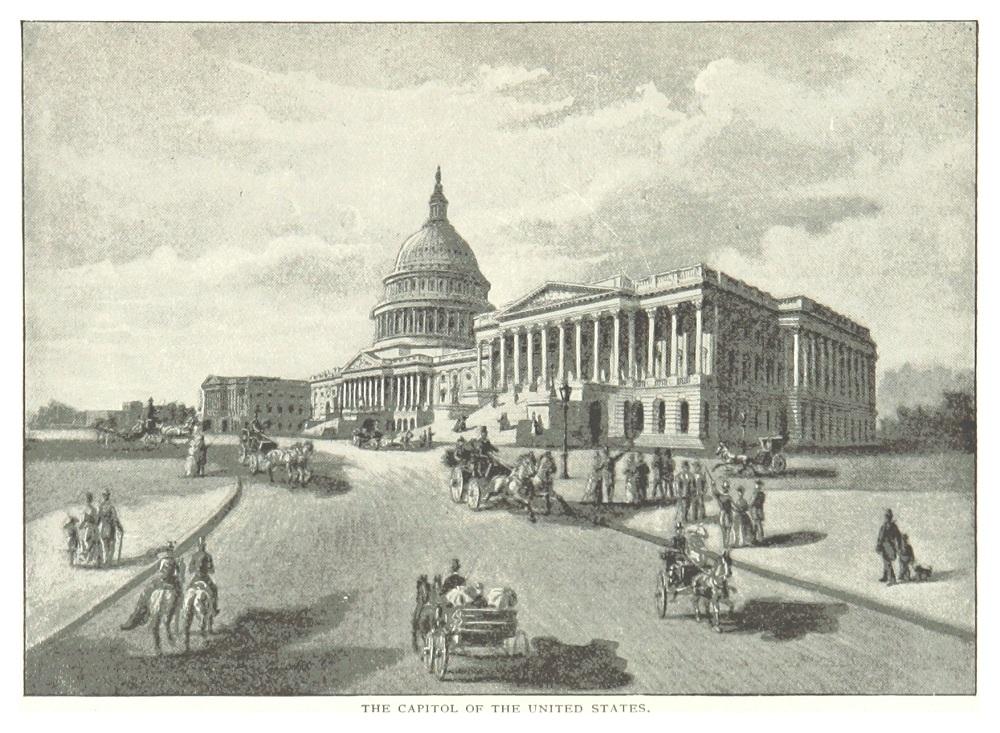
The United States Capitol almost became the home of a painting to commemorate the 1893 World’s Columbian Exposition. [Image from Pennsylvania Railroad to the Columbian Exposition (Pennsylvania Railroad Co., 1892).]
U.S. Capitol, Washington, D.C., February 24, 1890
“CHICAGO WINS,” headlines read across the country the next morning. The Midwest metropolis won the bid to host the upcoming World’s Fair on the eighth vote in the House of Representatives. After a six-hour battle on February 24, 1890, the city’s triumphant World’s Fair delegation exited the House chambers. As Mayor Dewitt Cregier, Colonel George R. Davis, the Hon. Adlai E. Stevenson and others passed through the Rotunda of the U.S. Capitol, they likely saw a spider-like structure clinging to the interior of the dome. This scaffolding made of rough pine pointed to a conspicuous gap in a decorative band of historical scenes encircling the inside of the dome. The men could never have imagined that, six years hence, the Dream City they were about to build in Chicago might be enshrined in this depiction of great moments in American history. Col. Davis—who would in the coming years be appointed Director-General of the World’s Columbian Exposition—might someday look up to see his own portrait there.

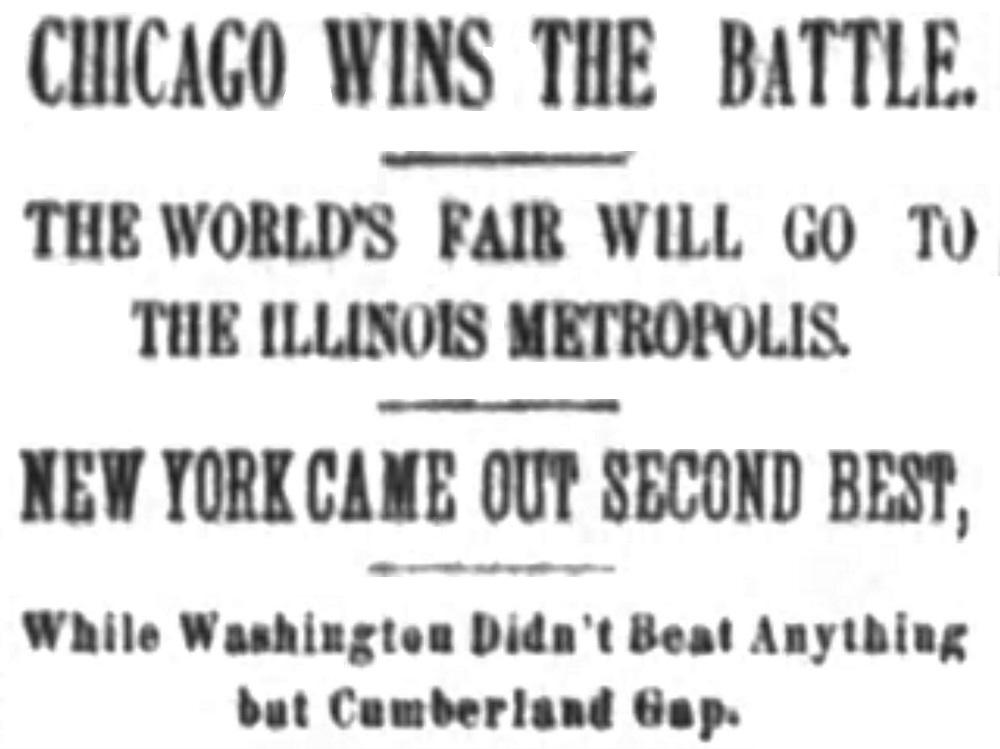
“Chicago Wins the Battle” read the front page of the Charlotte (NC) Observer on February 25, 1890. Chicago had beat New York, St. Louis, Washington (and Cumberland Gap) to win the vote in the House of Representatives for the honor of hosting the Columbian Exposition.
By the end of the century, the scaffolding had become a monument to an aborted project to decorate the Rotunda and an embarrassing failure of Congress. Three diagonal props of wood, each forty feet long, rested on the cornice of the great dome and supported a platform. Ropes and ladders gripped the rim of the upper gallery like fingers. For more than a decade, two foreign-born artists had toiled to paint the frieze, but work ceased in May of 1889 with the decorative band of historical scenes still incomplete. The ugly scaffolding remained, loitering in the Rotunda and calling attention to an embarrassing gap that greeted visitors for the next seventy-five years.
The Capitol’s cast-iron dome—considered one of the most iconic images of the nation and the greatest engineering feats of the nineteenth century—rises 287 feet above “the Hall of the People.” Fifty-eight feet above the Rotunda floor and immediately below the ring of thirty-six windows, a 300-foot-long decorative band wraps around the dome’s base. This Frieze of American History depicts nineteen scenes, from Christopher Columbus stepping onto the shore of a new world in 1492 to the Wright brothers’ first airplane flight in 1903. The fresco imitates sculpture. Painted shadows, as if created by light cast from the dome above, give the appearance of a carved-stone bas-relief. This optical illusion enhances how the figures are seen from the Rotunda floor.
As soon as the first brush-tips of paint hit wet plaster, the fresco was revered and reviled. A group of eminent artists working on decorations for the Library of Congress praised the frieze, stating: “We have nothing equal to this in the Library.” On the other hand, the Washington Post in 1884 called the work “a painful caricature which makes the lower part of the dome in the Capitol at Washington ridiculous,” and architect Peter Bonnett Wight in 1914 called it “a miserable sham” that should be completely dismantled. No opinions were more intense or debilitating, however, than those raised during the seven-decade battle to select the scenes to fill the conspicuous gap. This is the story of how a tribute to the 1893 World’s Fair in Chicago almost earned a place in the decorative band inside the U.S. Capitol.

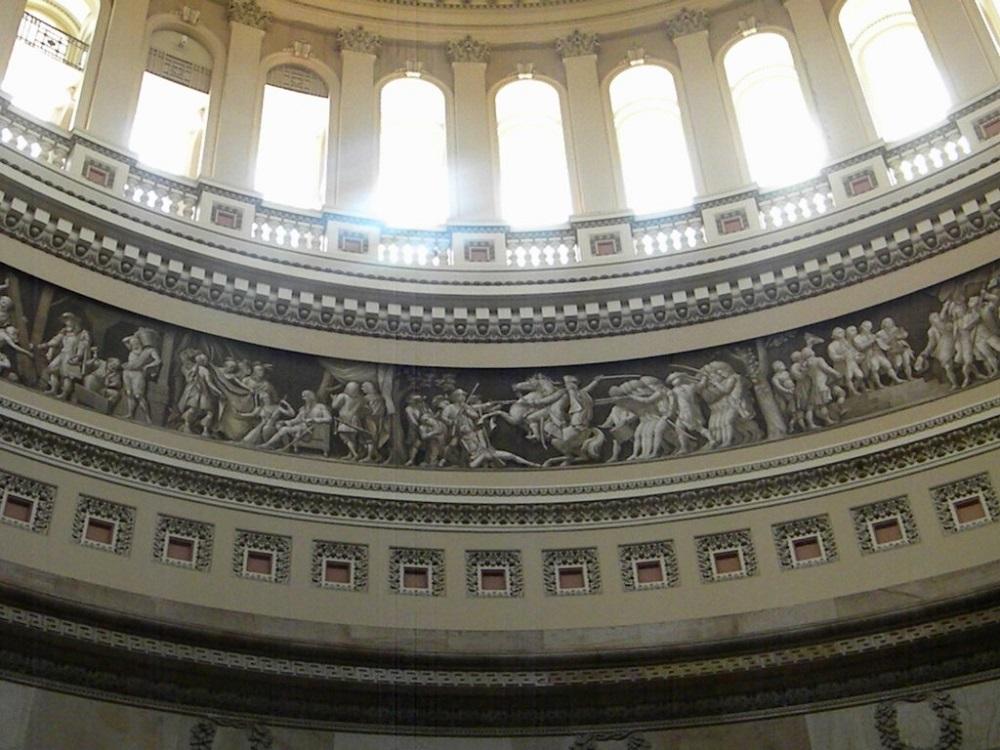
A portion of the Frieze of American History in the Rotunda of the U.S. Capitol Building, showing the panels for “Oglethorpe and the Indians” and the “Battle of Lexington.” [Photograph by ttarasiuk; image is available under Public License from Flickr.]
“Michelangelo of the Capitol”
An immigrant designed it. Constantino Brumidi, a refugee fleeing the Italian Revolution, came to the United States in 1852. Soon after, he began work on several decorative projects for the Capitol that occupied him for more than twenty-five years. His most notable contributions are The Apotheosis of Washington fresco inside the dome and ornate painted decorations in the hallways on the Senate side of the building that earned the name “The Brumidi Corridors.” Admirers have bestowed him with titles such as “the genius of the Capitol” and “Michelangelo of the Capitol.”
Brumidi’s design for the Frieze of American History, first sketched in 1859, depicts scenes in America’s story—originally sixteen panels—from the landing of Columbus to the discovery of gold in California. Brumidi began painting the frieze in 1878, at the age of seventy-three. On October 1, 1880, the artist “narrowly escapes a frightful death” when he partially fell from his wooden platform. The feeble man clung for dear life to avoid being dashed to pieces on the tile floor sixty feet below. After a rescue and rehabilitation, he continued working “until almost the last hours” of his life. By the time of his death on February 19, 1880, he had completed only half the work. Although the panels have no official titles, the Architect of the Capitol uses these names for the series that Brumidi executed:
1. “America and History” allegorical figures
2. “Landing of Columbus” (1492)
3. “Cortez and Montezuma at Mexican Temple” (1520)
4. “Pizarro Going to Peru” (1533)
5. “Burial of DeSoto” (1542)
6. “Captain Smith and Pocahontas” (1607)
7. “Landing of the Pilgrims” (1620)
8. “William Penn and the Indians” (1682)

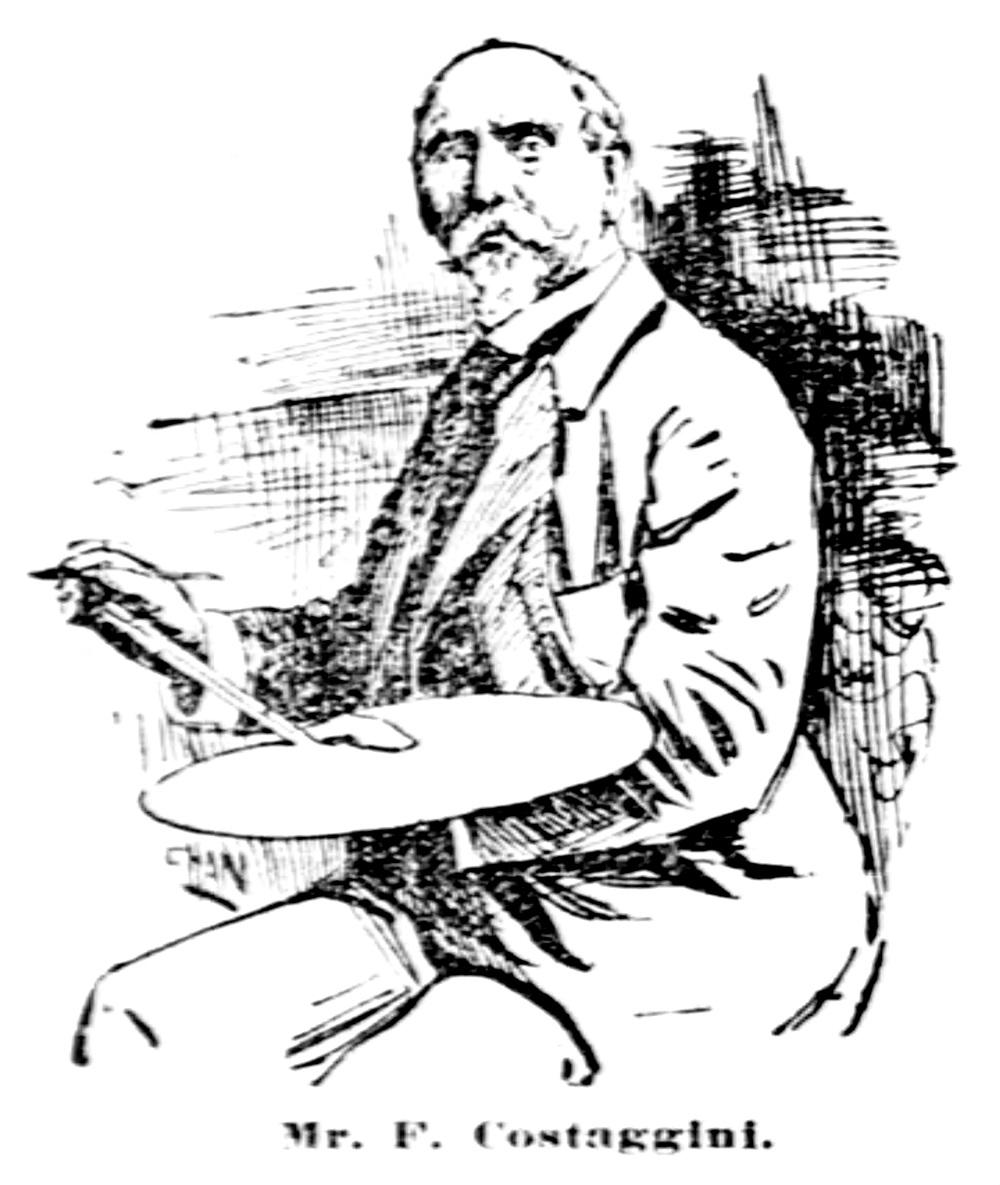
Filippo Costaggini, the artist who continued the work on Brumidi’s Frieze of American History.
“Short of history to go around”
Three months after Brumidi’s death, Congress selected Italian-American artist Filippo Costaggini—on Brumidi’s recommendation—to continue his countryman’s work. Born in Rome on August 13, 1837, Filippo Costaggini lost his mother when only one year old and his father at age fifteen. He attended the Academy of St. Luke in Rome, where Brumidi also studied, and in 1870 migrated to the U.S., where he became a naturalized citizen. In the decade before working on the Capitol project, Costaggini had painted numerous portraits and religious scenes for churches on the east coast. “I doubt if there is another artist who has done as much painting as I have in the United States,” he bragged.
By September 1880, Costaggini was climbing the Rotunda scaffolding. He began with the panel of William Penn’s treaty, left unfinished by Brumidi, by painting the three Indians on the right, then worked off-and-on for nine more years to complete the eight remaining scenes that had been approved by Congress:
9. “Colonization of New England”
10. “Oglethorpe and the Indians” (1732)
11. “Battle of Lexington” (1775)
12. “Declaration of Independence” (1776)
13. “Surrender of Cornwallis” (1781)
14. “Death of Tecumseh” (1813)
15. “American Army Entering the City of Mexico” (1847)
16. “Discovery of Gold in California” (1849)
Although many sources state that Costaggini used Brumidi’s sketches, the artist strenuously denied this, claiming that he had been provided only tracings “made by one who was not an artist.” Costaggini prepared his own cartoons for the eight panels he worked on, making alterations to details of Brumidi’s designs as he saw fit. When Costaggini completed the last panel and climbed down from the scaffolding in May of 1889, the decorative band inside the dome was still incomplete. A miscalculation of the dimensions of the frieze had resulted in a gap of over thirty-one feet! Brumidi had scaled down his designs to accommodate a band that was narrower than he had been told, and Costaggini continued in similar proportions. The U.S. Capitol needed another ten yards of American history.
During the winter and spring of 1890, as representatives from Chicago, New York, Washington, and St. Louis filed in and out of the Capitol during the legislative battle to determine which city would host the Columbian Exposition, the scaffolding remained standing. As the White City on Lake Michigan rose in 1891 and 1892, as Chicago welcomed the world to the Exposition in 1893, and as fires and wrecking crews razed almost all of the Dream City in Jackson Park during 1894 and 1895, the scaffolding under the Capitol dome remained standing.

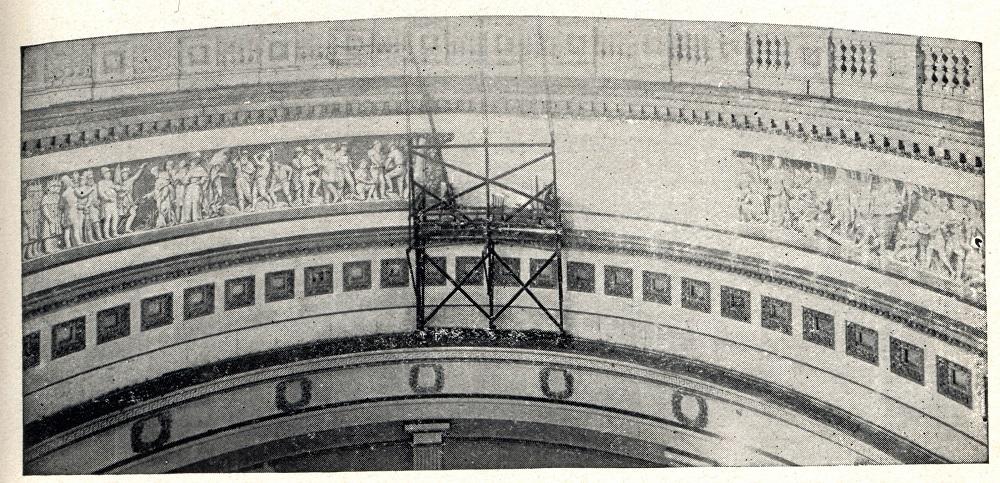
A photograph of the “Abandoned Fresco” circa 1902, showing the gap between Costaggini’s “Discovery of Gold in California” on the left and where Brumidi’s “America and History” begins on the right. [Image from Hazelton, George C. The National Capitol: Its Architecture, Art, and History (J. F. Taylor & Co., 1902).]
“Some of our people don’t like them”
The Philadelphia Times irreverently summarized the situation in 1894: “Now Costaggini finds that he has used up all the Indians, whipped England twice, killed all of the soldiers, discovered gold in California, and exhausted himself. … Poor Costaggini is short of history to go around.” He proposed filling the gap with scenes of his own design. (Contemporary reports usually indicated two additional panels, though three ultimately were added.) As early as 1884, while still working on the “Death of Tecumseh” panel for the frieze, the artist had suggested a scene depicting “Driving of the Last Spike in the Pacific Railroad.” When initially brought onto the project, Costaggini was surprised that George Washington was not represented in the frieze. The congressionally approved panels extended to the California gold rush of 1849, so already had closed out the founding father from the timeline. Congress tasked the Joint Committee on the Library with selecting the remaining scenes. Committee members thought it could be done in a few days. Years rolled by … then decades.
Thus began an excruciatingly protracted campaign on Capitol Hill. “The history of attempts to complete the frieze is long and agonizing,” acknowledges Capitol historian Barbara A. Wolanin. “Although cartoons by the dozen have been suggested,” reported the Chicago Chronicle in 1896, “the matter still remains in abeyance.” Costaggini would spend almost a quarter century proposing and being denied Congressional approval for a range of historical subjects to complete the frieze. Each historical depiction that he suggested sparked controversy. “Let but some method other than favoritism and political influence be devised for the selection of art and artists,” wrote Wisconsin Representative and Capitol historian George Hazelton, “and the walls of the National Capitol will become, as they long ago should have been, a marvel of beauty throughout.”
The Civil War was the subject most frequently suggested for inclusion in the procession of history, but this faced intense opposition. Brumidi himself had the war in mind and proposed several events to commemorate, but Congress refused to accept a topic that would perpetuate sectional animosity. “Scenes from the war of rebellion won’t do, for some of our people don’t like them,” explained the Philadelphia Times. “The Southern half of the country would not like to be depicted on the run, nor will a time ever come when such a scene must be painted.” Someone who clearly did not understand the halting effect of controversy subjects suggested panels depicting the assassinations of Presidents Lincoln (1865) and Garfield (1881).

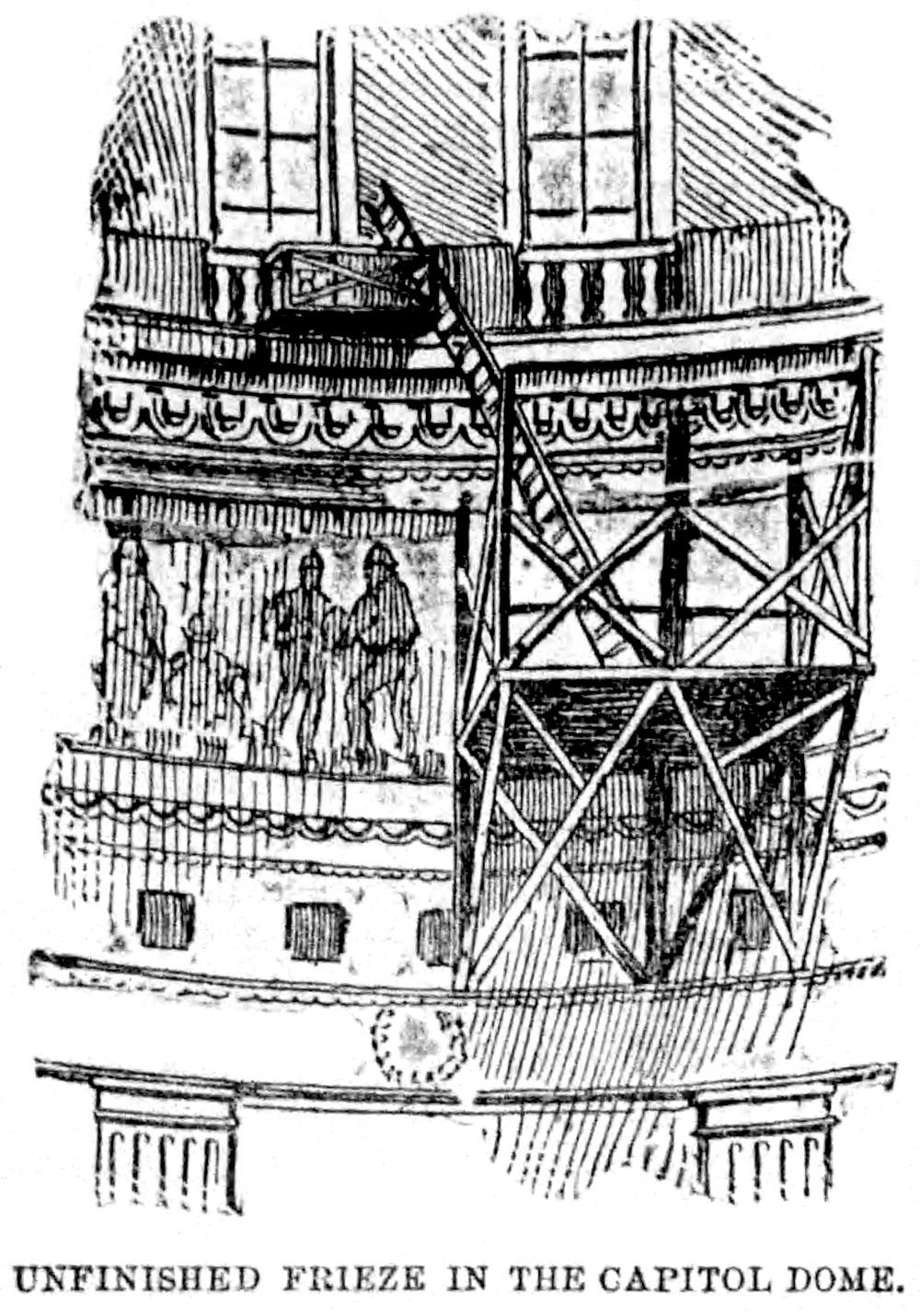
An illustration of the “Unfinished Frieze in the Capitol Dome” showing the last completed panel painted by Filippo Costaggini, that of Brumidi’s “Discovery of Gold in California.” [Image from the Sidney (OH) Daily News Sep. 5, 1899.]
“This picture should be a success”
Walter Wellman, a Washington correspondent for the Chicago Record, spent three months reporting on the 1893 World’s Fair in Chicago before returning back to the nation’s capital. On September 18, during a ceremony to commemorate the centennial of laying the Capitol cornerstone, Wellman found himself staring at the abandoned scaffolding in the Rotunda. Curious about the stalled project, he consulted the Architect of the Capitol, Edward Clark, who informed him that “but one cartoon is now needed to complete the frieze.” Wellman forwarded an idea:
“The historical climax worthy representation in this series of the centuries has made its appearance. It is, of course, the four hundredth anniversary of the discovery of America and the memorable manner in which that discovery has been celebrated by the World’s Columbian Exposition at Chicago. While it has not yet been officially decided to employ this topic in completion of the freize, little doubt remains that it will eventually you decided upon. Nothing could be more appropriate, and when the work shall have been finished there will be no finer cartoon in the series than that designed to show the meeting on the shores of the inland sea, in the very center of our wonderful western civilization, not only of the nations of the world in the rivalry of peace, but descendants of Ferdinand and Isabella, who sent Columbus forth on his voyage of discovery, and the descendants of Columbus himself. With sketches of the beautiful architecture of the White City at Chicago for a background, and with figures representing the assemblage of the nations and the descendants of the discoverer and of Aragon and Castile for the foreground. This picture should be a success not only from the artistic but from the allegorical point of view.”
This detailed description suggests that Wellman had seen a sketch of such a proposed Columbian Exposition panel in 1893. The author of the World’s Fair scene, however, seems to be someone other than Costaggini. Wellman writes: “What is better than this selection of topic is the probability that the great frieze begun by one Italian a quarter of a century ago, and continued by another Italian after the death of the first, may now be completed by the hand of an American artist.” Wellman did not divulge the identify of the American artist. Three years later, Costaggini was promoting a World’s Fair scene.

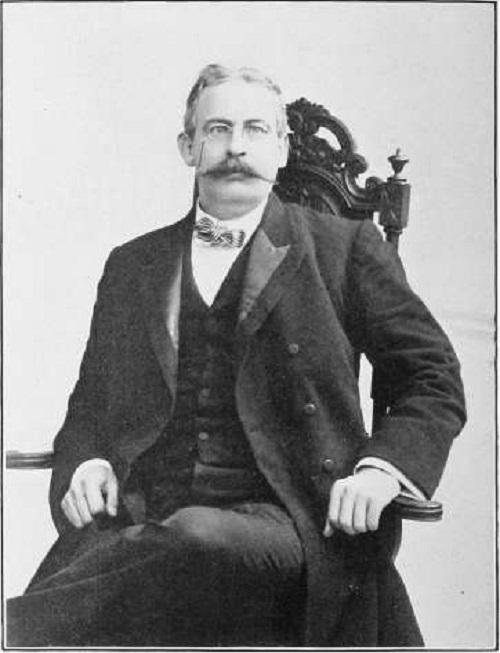
Walter E. Wellman (1858–1934), who served as a Washington correspondent for the Chicago Record, was also and explorer and aeronautic pioneer. He regularly wrote about the U.S. Capitol Frieze of American History and advocated for a panel commemorating the 1893 World’s Fair as the Exposition was running in Chicago. [Image from Kersting, Rudolf The White World, Life and Adventures Within the Arctic Circle Portrayed by Famous Living Explorers (Lewis, Scribner & Co., 1902)]
“The apotheosis of our greatness”
By 1896, the scaffolding—now brown and dusty with age—had been standing under the dome, unused, for seven years. Anyone visiting the Capitol Rotunda confronted the eyesore, even though few in the halls of Congress remembered why it was there in the first place. Some Congressmen argued to take it down, while fiscal watchdogs insisted that the enormous expense to erect it would then just be wasted. Getting the painting finished seemed more financially prudent. The renewed attention also brought out critics from among America’s artists, some of whom called for the entire frieze to be redone. “Uncle Sam has been shamefully imposed upon in the matter of pictures and statuary for the capitol,” wrote Walter Wellman. “He has paid the highest price for the poorest work.” In January 1896, Representative James Robinson Howe of New York introduced a resolution to instruct the joint Committee on the Library “to ascertain the cause of the delay” in completing the frieze and to decide “whether or not it would be advisable to remove the scaffolding.”

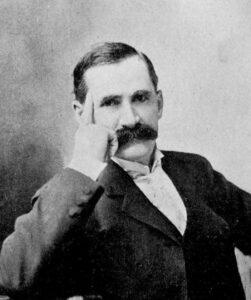
Senator Henry Clay Hansbrough of North Dakota championed the addition of a Columbian Exposition panel to the U.S. Capitol’s Frieze of American History. [Image from the North Dakota State Library.]
“Room is left for two more frescoes, and my choice would be the laying of the last spike on the Pacific Railroad, an event which bound the Atlantic with the Pacific, and the other ought, in all reason, to be commemorative of the World’s Fair. That event was the apotheosis of our greatness at the end of the nineteenth century, and its perpetuation on the walls of the Capitol would, I think, be most appropriate.”
Instead of a Civil War scene that would divide North and South, Hansbrough sought subjects that the whole nation could rally around. Maybe.

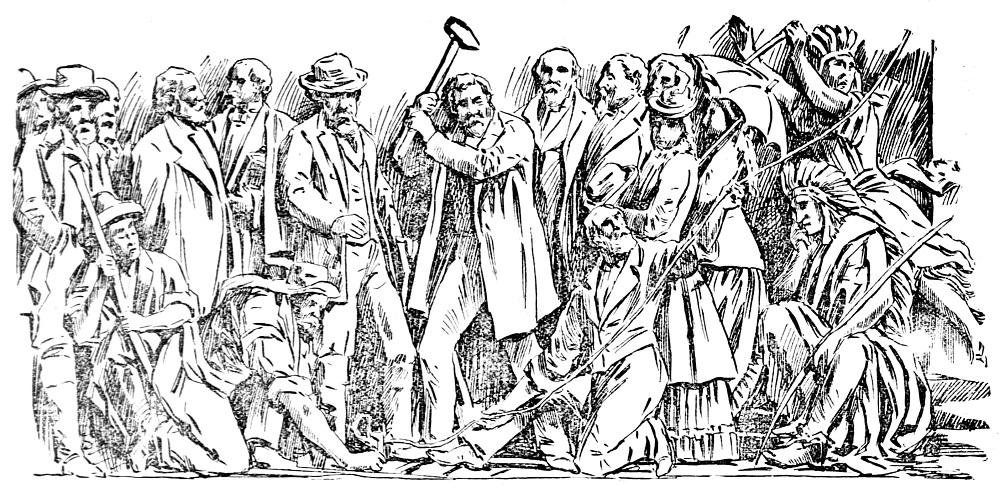
Filippo Costaggini’s cartoon depicting his proposed panel on “The Last Spike.” [Image from the Washington (DC) Evening Star May 30, 1896.]
“Nothing more appropriate could be designed”
Of the two proposed scenes, the first had been conceived by Costaggini more than a decade earlier—the driving of the “last spike” in the transcontinental railroad on May 10, 1869, at Promontory Summit, Utah Territory. This uniting of East and West certainly would not be controversial, right? Sen. Hansbrough suggested that Costaggini prepare a sketch. His drawing shows Leland Stanford, then the president of the Central Pacific Railroad, swinging a sledge hammer toward the golden spike to connect his line with the Union Pacific Railroad.
This proposed scene “nearly passed” the congressional committee but was brought down by opposition from various factions. Many senators and “virtuous opponents of corporations” objected because it brought up recollections of the Crédit Mobilier scandal. Leland Stanford himself objected. Then serving as a U.S. Senator from California, Stanford claimed that the painting “would bring him too great notoriety.” After he died in office on June 21, 1893, the proposed railroad scene was back on the table, though with renewed opposition. A report in 1896 noted that “the last spike scene will not go into the rotunda frieze if the people of California can prevent it.” Californians, who reportedly were “filling the mail of their senators and representatives with angry protests,” voiced violent opposition to what they saw as the glorification of the Central Pacific Railroad its present owner, Collis P. Huntington. Though surprised by such protest, the Library Committee did not yield to it and instead approved the “last spike” panel in early 1896. This left one more vacant space to fill.

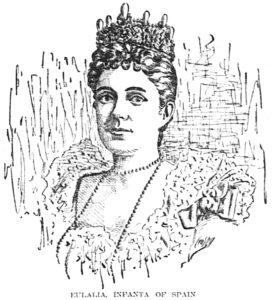
One of the Columbian Exposition’s most celebrated and controversial guests was the Infanta Eulalia, who visited the World’s Fair in June. Surprisingly, the Spanish princess was considered as a subject for a panel in the Frieze of American History in the U.S. Capitol on the eve of the Spanish-American War. [Image from the Chicago Evening Journal June 6, 1893.]
“That interesting and piquant woman”
The proposal for a Columbian Exposition panel had emerged at least a few weeks before Hansbrough’s comments in February. The Chicago Chronicle (Jan. 27, 1896) proudly announced that:
“The latest suggestion is that the space should be filled by a representation of the world’s fair. Nothing more appropriate could be designed, and it is felt that if the friends of Chicago in both House and Senate would concur in a resolution to that effect it would readily pass both houses.”
The Boston Globe (Feb. 24, 1896) soon reported that Costaggini had prepared a sketch of the proposed panel for Sen. Hansbrough. The design showed Princess Eulalia of Spain and her suite at the moment they were received by Exposition officials on June 8, 1893. A background of the Administration Building dome or other architectural fragments would help establish the location of the scene “as it lingers in the memory of the millions who witnessed its glories.”
The good news was that most members of the Library Committee reportedly desired to memorialize the Columbian Exposition. “It is practically settled that the world’s fair shall form the subject of one of the two remaining panels,” reported the Boston Globe. The main problem was the inclusion of yet another group of Spaniards in the American history frieze. Tensions between the U.S. and Spain were heading toward a declaration of war in April of 1898. Using an image of the Spanish Infanta, in particular, was expected to draw strong opposition. A. Maurice Low reported that:
“The royal house of Spain is not in high favor in congressional circles at the present moment, and there are objections, personal, rather than international, to the employment of the portrait of that Princess as the central figure of the historical panel. As soon as the contemplated glorification of Eulalie becomes known to the public, it is believed protests will pour in upon the committee.”
In 1896, the ink had dried on the narrative of the Infanta’s seemingly poor behavior during her eight-day visit to the Fair three years earlier. Her whimsical disregard for scheduled appearances and an alleged slight of Chicago society became enshrined in city history and likely meant she would not be enshrined in the Capitol. Other critics voiced a milder complaint that the event of the Princess receiving homage from the Exposition officials simply was not important enough to warrant inclusion. Growing opposition to Eulalia soon outweighed support. “If the friends of Eulalie carry the day,” wrote the Boston Globe, “that interesting and piquant woman will soon appear to visitors to the capitol in a figure eight feet high.”
Such friends were not to be found in the Chicago press nor the artist. The Times-Herald stirred up a row about the proposed painting of Princess Eulalia. “Protests from women came pouring in upon us,” reported Sen. Hansbrough, “so we did not dare carry out the plan.” Even Costaggini openly admitted that other scenes could better serve as a memorial to the Columbian Exposition. He suggested that “a mere architectural sketch in the court of honor … would be more satisfactory to the American people and give a permanent record of the distinguishing feature of the enterprise.” This posed a new problem, however. All of the other panels of the frieze portrayed human figures, so a scene of only buildings would be “a radical change in the character of the design,” according to the Library Committee.

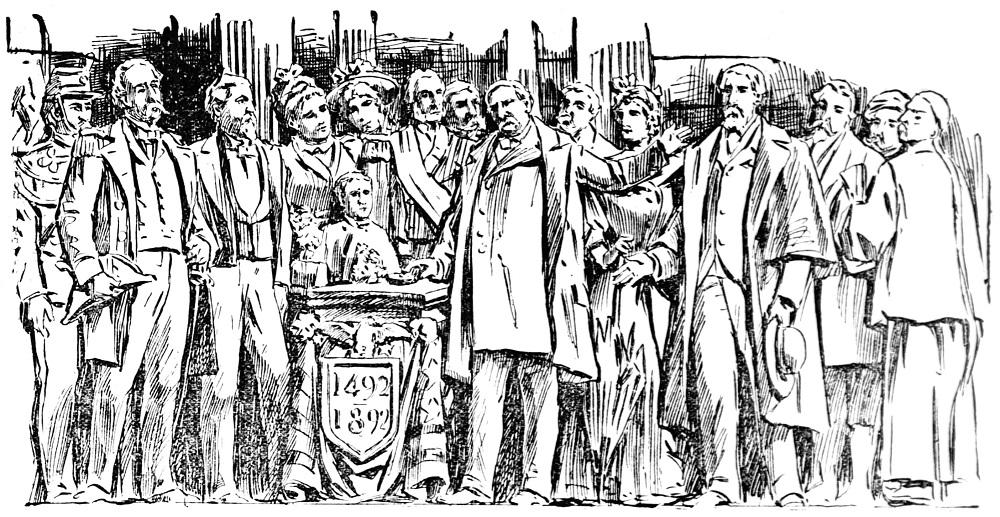
Costaggini’s depiction of the platform party on Opening Day of the Columbian Exposition. In the center of the scene is President Grover Cleveland in the act of pressing the button to set the machinery in motion. To the left and standing behind the table are the Duke of Veragua, lineal descendant of Christopher Columbus, and his family. Further left are Director-General George R. Davis and a Columbian Guard. On the right side of the President stands Mr. Potter Palmer and Mrs. Potter Palmer, President of the Board of Lady Managers; Harlow Higinbotham, President of the Exposition; William H. Milburn the “blind chaplain”; a Chinese man stands on the far right. [Image from the Washington (DC) Evening Star May 30, 1896.]
“A worthier topic for treatment”
This led to a second proposal for a World’s Fair panel, the depiction of the glorious “transformation scene” of Opening Day on May 1, 1893. Artist Costaggini prepared this description of his sketch commemorating the event, published in the Washington Evening Star (May 30, 1896):
“My idea of the matter is to present the fair and the opening as an international affair. The picture will show the leading participants present, including representatives of foreign nations. The figure in the center is President Cleveland in the act of pressing the electric button which set the machinery in motion. To the right of President Cleveland and at the center of the stand are the Duke of Veragua and his family, descendants of Columbus, consisting of his wife, son, daughter and brother. To the left of President Cleveland, standing foremost, is the president of the fair, [Harlow] Higinbotham.
“A little further back of President Cleveland, also at his left, are Mr. and Mrs. Potter Palmer, the latter president of the board of lady managers of the fair. Chaplain Milburn is represented at the left and back of President Higinbotham. To the right of the duke’s family is Director-General Davis. The other figures consist of a Columbian guard and representatives of foreign nations participating in the opening. If necessary, other figures not in the sketch can be placed in the fresco in order to make it historically accurate.
“The portraits are, of course, ideal in the sketch, in the fresco they will be correct likenesses in looks and style of dress. There is no pretense that the sketch accurately represents the style of dress used by the participants at the time, since this would only be material in the fresco. As a matter of fact, I have clothed the participants in winter garments, though the opening was held on May 1. I merely used this style of dress because May 1 was a very inclement day; but this, of course, will have to be verified, and the figures shown accurately in what kind of garments they were clothed. This proof merely gives my idea of what the fresco should be in order to properly convey to the beholder what it is intended to commemorate, viz., the opening of the world’s fair and the completion of the 400th anniversary of the discovery of this country.”

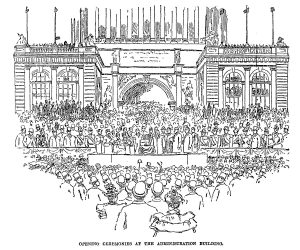
A contemporary illustration of the platform party at the Opening Ceremonies of the Columbian Exposition on May 1, 1893.[Image from the Chicago Tribune, May 2, 1893.]
“The ceremonies of the opening day have been selected as the scene, when President Cleveland is delivering his address. The director-general [Davis] stands at one side of him, President Palmer at the other, While in the group upon the platform may be easily distinguished President Higinbotham, Daniel H. Burnham, Lyman J. Gage, William T. Baker, Vice President Stevenson, Secretary Gresham, Secretary Carlisle, the Duke of Veragua, his brother, the Marquis of Barboles, and several other well-known gentlemen. The only ladies who appear are the Dutchess of Veragua, her daughter and Mrs. Potter Palmer. This sketch is almost an exact copy of a photograph taken by Mr. Arnold at the moment the president was speaking.”
Notable is the inclusion of President of the World’s Columbian Commission Thomas W. Palmer, the Exposition’s Director of Works Daniel H. Burnham, President Lyman J. Gage, President William T. Baker, U.S. Vice President Adlai Stevenson, U.S. Secretary of State Walter Q. Gresham, and U.S Secretary of the Treasury John G. Carlisle. C. D. Arnold was the official photographer of the Columbian Exposition. Whether this is a second version of a sketch or simply differences in description is not clear.
The proposed scene represented not only the opening of the great exposition but also “the progress of electricity which has been the marked feature of the close of the present century,” observed the Chicago Tribune (May 31, 1896). Best of all, Costaggini’s scene placed a lineal descendant of Christopher Columbus at the end of the frieze. This, many thought, provided a fitting connection to the scene of the explorer’s landing that begins the band.

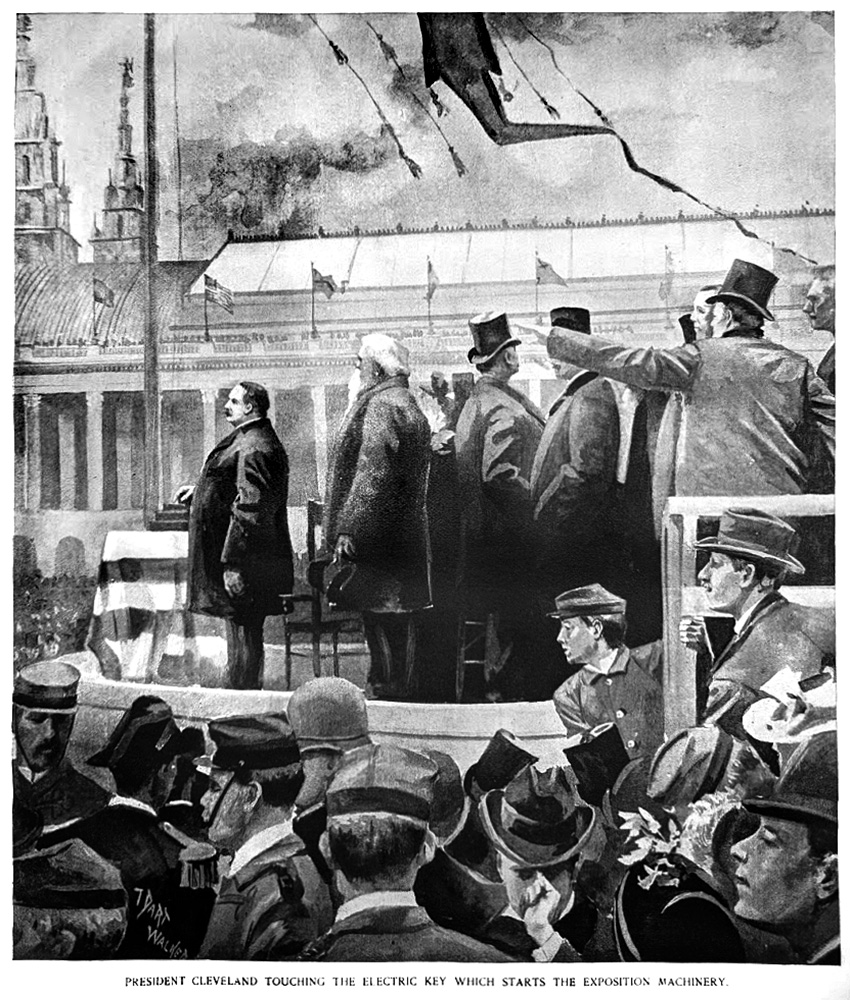
President Grover Cleveland, who pushed the button to open the Fair, was a highly controversial candidate to be enshrined in the Frieze of American History. [Image from The Graphic History of the Fair (Graphic Co., 1894).]
“An unprecedented honor”
Instead of a scene centered on a Spanish Princess, “the opening ceremonies in front of the administration building with Pres. Cleveland as the central figure would prove a worthier topic for treatment,” posited the Boston Globe. Certainly, enshrining the sitting U.S. president in the Capitol dome would not be controversial, would it?
“President Cleveland is to have an unprecedented honor,” wrote Walter Wellman in a Chicago Record report that ran in newspapers from coast to coast:
“His name is to be written higher than that of any of his predecessors in the executive chair. I do not speak of a third term, for few men outside of the White House coterie now believe the American people will ever elect any man a third term to the presidential office, no matter how willing he may be to receive such honors. The unprecedented distinction which waits Mr. Cleveland is that his portrait and figure are to appear in the great frieze of the rotunda of the capitol.”
Sketches of Costaggini’s proposed panels were exhibited in the marble room of the Senate in May of 1896. On June 1, Sen. Hansbrough reported to the Senate a joint resolution (S.R. 152) appropriating $6000 “for completing the painting of the frieze in the Rotunda of the United States Capitol by Filippo Costaggini, after designs to be furnished by him and approved by the Joint Committee on the Library.” Representative Charles A. Boutelle of Maine introduced a similar resolution in the House (H. Res. 199) on June 8, calling for:
“a suitable design by an American artist of national reputation that shall symbolize the great events in the national life since the close of the Mexican war and appropriately commemorate the preservation of the Union and the establishment of universal freedom by the heroic valor and sacrifice of the citizens of the Republic under the leadership of Abraham Lincoln.”

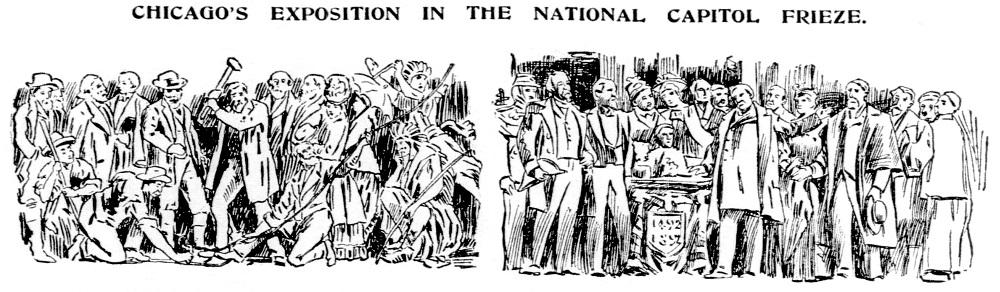
In 1896, the host city of the 1893 World’s Fair held out hope that the momentous event would appear (along with the “last spike” scene) in the U.S. Capitol frieze. [Image from the Chicago Tribune June 3, 1896.]
“What else could we do?”
Opposition to the proposed World’s Fair scene—centered around Grover Cleveland—quickly mounted, with the most strenuous objections coming from within his own political party. “The Democratic and Populist senators who hate Mr. Cleveland so intensely are expected to put in a vigorous protest,” wrote Mr. Wellman. “A few of them who have heard of the plan have sworn to kick up such a row as was never before seen in the capitol.” Cleveland supporters did not appear to be insulted by the questionable likeness in Costaggini’s cartoon of their Grover pushing the button. President Cleveland may have opened the 1893 World’s Fair, but now he stood in the way of the planned tribute to it on Capitol Hill.
Other opposition focused not so much on President Cleveland, but on the broader issue of portraying any living people in the painting. The Washington Evening Star (May 30, 1896) advised:
“The opening of the world’s fair is of more modern interest, and its depiction in a historical panel is, therefore, much more difficult, as practically all the persons represented are living and have great prominence in the nation. But it has been urged that this freeze is not for the men of today, but for posterity to witness, and that it would be useless to wait until all the participants in the affair have passed away before completing the great historical circle in the Rotunda.”
Sen. Hansbrough conceded that he, too, had concerns about enshrining President Cleveland in the Frieze of American History. “But what else could we do?” he asked, continuing:
“There was a general sentiment that we had to use the World’s Fair as the subject for the last of the panels. It would never do to leave it out. … there is something very appropriate in this idea. The first historical panel in the frieze is that of Columbus discovering America. Here we are able to complete the series with the opening of the great exposition given in honor of Columbus, with his descendant, the Duke of Veragua, assisting at the ceremonies. That is appropriate and satisfactory. But we could not depict the opening scene without putting Mr. Cleveland in, for he was the central figure of it. It would be like the old joke of Hamlet with Hamlet left out, you know. … So, against the inclination of many of us, President Cleveland will have to go into the picture a size and a half larger than life.”
The Evening Star (May 30, 1896) reported that “the committee felt considerable embarrassment, it is understood, owing to the political delicacy of the situation with respect to President Cleveland, but the matter has been viewed, it is thought, in a non-partisan light, and for the sake of finishing the work all scruples have been laid aside.”
The committee’s non-partisan light did not shine brightly inside the Senate chambers. During debate of the funding bill on June 1, 1896, General Joseph R. Hawley, a senator from Connecticut, raised “quite a breeze” in the chamber over the proposed World’s Fair panel. The “intense patriot” and Civil War veteran thought that Pres. Cleveland was not nearly as important a figure in U.S. history as were Washington, Lincoln, or Grant—none of whom had been included in the frieze. “I do not object to the Senator’s idea of giving a hint of the great exhibition at Chicago,” Sen. Hawley stated, “but I object to the utter absence of the greatest historical event since the War of the Revolution—one of the greatest in all history.” He called for the proposed World’s Fair panel to be replaced with one commemorating the Civil War, or else doom the resolution to fail. Despite his objection, it passed the Senate. A contract for the artist to get started was expected soon after.

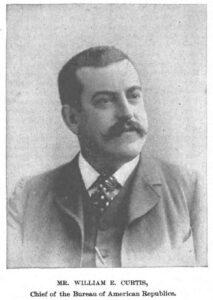
William Eleroy Curtis served as head of the Bureau of the American Republics for the State Department and chief of the Latin-America Bureau for the World’s Columbian Exposition. He worked behind the scenes to orchestrate a Columbian Exposition panel for the Frieze. [Image from The Review of Reviews July 1892.]
“Familiar faces of several Chicago people”
Chicagoans expressed mixed reactions to the proposed Opening Day scene. “This picture, if painted as the artist has sketched it, will place the familiar faces of several Chicago people conspicuously in the great frieze,” reported the Chicago Inter Ocean. The paper also conceded that this portrayal of the city’s greatest moment may also cause “many heart-burnings” for those in the platform party who were not included in Costaggini’s sketch. Notable faces missing from the cartoon (in contrast to the alternate version described above) included those of the Daniel H. Burnham, Lyman J. Gage William T. Baker, and First Vice-President Ferdinand W. Peck. This sketch, not yet accepted, could be revised “if these prominent Chicagoans take exceptions to a picture which they may think is like the play of Hamlet without Hamlet himself,” the newspaper wrote, echoing Sen. Hansbrough’s comments about Grover Cleveland. Alternatively, the missing Chicago luminaries would simply “be left to the imagination of the beholder,” offered the Chicago Tribune.
Working quietly behind the scenes to devise the Columbian Exposition panel was William E. Curtis (1850–1911). Mr. Curtis had worked for many years in the Washington bureau of the Chicago Record. In his role as Director of the Bureau of the American Republics, Curtis had played a significant role in the years before the Columbian Exposition to procure countless Columbus artifacts for the display in the Convent of La Rabida exhibit on the fairgrounds. Curtis sent this letter to Chicago industrialist, Union National Bank president, and former Exposition Director James W. Ellsworth on June 4, 1896:
“You have doubtless seen that the opening of the fair is to be commemorated as an epoch in the history of the United States in the freeze of the dome of the capitol. This is my suggestion, and confidentially I am selecting the figures to go in it. Therefore I want your photograph in a standing posture for the use of the artist, but don’t say anything to anybody about it.”
Curtis, it appears, was actively editing the composition of Costaggini’s World’s Fair painting.

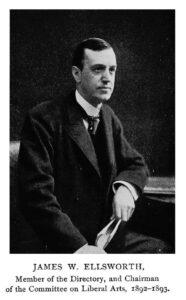
James W. Ellsworth served on the Board of Directors of the World’s Columbian Exposition and was being considered for inclusion in the proposed World’s Fair Opening Day scene of the Frieze. [Image from Johnson, Rossiter A History of the World’s Columbian Exposition Held in Chicago in 1893, Volume 1: Narrative. (D. Appleton and Co., 1897).]
“The jig is up”
Mr. Ellsworth may not have had enough time to supply the requested photograph before Mr. Curtis sent a follow-up note three days later:
“The jig is up concerning that world’s fair picture in the freeze of the capitol, as you have doubtless noticed by the newspapers. The fight was made against President Cleveland, however, and not against the fair, and as a rule has been established that the pictures of the living men shall not appear in any of the decorations of the capitol. It is probable that a glimpse of the Court of Honor or of some of the buildings will be given in one of the pictures as a recognition of the historical epoch.
The Chicago Record (June 6, 1896) lamented the lost opportunity to glorify the Chicago fair:
“The objection to a view of the world’s fair is that the picture … contains, among other portraits, the likeness of Grover Cleveland. The congressman denounced indignantly the effort to corrupt the country’s morals and betray the nation by having the picture of a man whose example they aver is so insidiously wicked.”
The editorial notes that many other public paintings include images of British officers in Revolutionary War scenes, Gen. Lee in Civil War scenes, and a Mexican soldier firing upon the U.S. flag. “This picture has been placed on exhibition in public places where the eyes of youth may rest upon it and innocent minds drink in its mischievous lessons,” the paper offers sarcastically. Congressmen “should start a bureau of sensors and sweep the Washington art galleries free from the handiwork of treachery.” My how times have changed!
With strong opposition to both proposed panels, the Library Committee felt compelled to abandon the project. The joint resolution slept in committee, was “passed over” on February 7, 1897, and eventually died when the Fifty-fourth Congress closed a month later. The scaffolding in the Rotunda gathered more dust.
Sen. Hansbrough continued campaigning for a World’s Fair panel, but instead of using portraits of the President and prominent Chicagoans, he proposed “a sketch of the Administration building in the background, suggesting the architectural glories of the fair, and in the foreground allegorical figures bespeaking the assemblage of the nations,” reported Walter Wellman in 1896. “This would not be objectionable, it is thought, and will be ultimately adopted.” It wasn’t. No glimpse of the Chicago fairgrounds ever made it into the Frieze of American History. For eight years, suggestion after suggestion for how to fill the gap of history had been rejected.

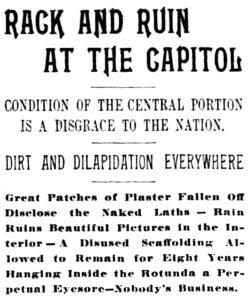
A headline in the Philadelphia Times on June 6, 1897, decries the sorry state of the U.S. Capitol and notes “disused scaffolding allowed to remain for eight years hanging inside the Rotunda a perpetual eyesore.”
“Warts on the face of history”
Thousands of guests attended the grand opening of the Corcoran Gallery of Art near the White House on February 22, 1897, including President Cleveland and Mr. Costaggini, who had a painting going on exhibit there. The artist once again took the opportunity to urge members of the Library Committee to approve his proposed artwork and finish the frieze. Reports a year later stated optimistically that the frieze “should be completed as soon as possible.”
Proposals for Civil War panels reemerged, the passing years having made the subject a seemingly acceptable choice. Senator John L. Wilson of Washington State asserted that “the completion of the Pacific railroad and the opening of the world’s fair, important events as they were, are mere warts on the face of history, while the civil war is history’s living soul.” Calls to have the entire frieze redone also returned, with one critic calling the existing sixteen panels “not a very successful attempt to picture the history of America.” The Philadelphia Press called for their complete removal, writing that “even whitewash would be less offensive.”
In 1898, United Press photographer George Grantham Bain, hoping to help the congressional committee take action, attempted to form a consensus among leading men and women of the day. He forwarded four suggestions with sketches by Costaggini. These included the already-debated “Last Spike” and “World’s Fair” scenes along with two Civil War era scenes the artist had prepared a year earlier, but which had been given no consideration by the Library Committee. One cartoon depicted “The Emancipation Proclamation by Lincoln” (January 1, 1863), with the president reading the declaration to his cabinet, and the other showed General Sherman’s Union Army passing the review stand of President Johnson (May 1865).
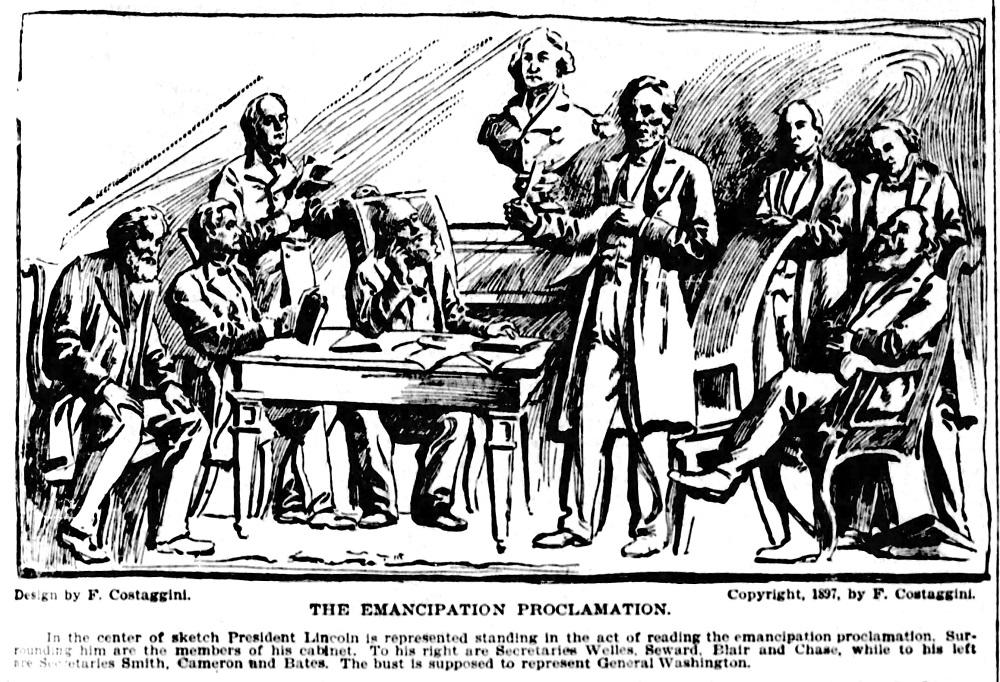


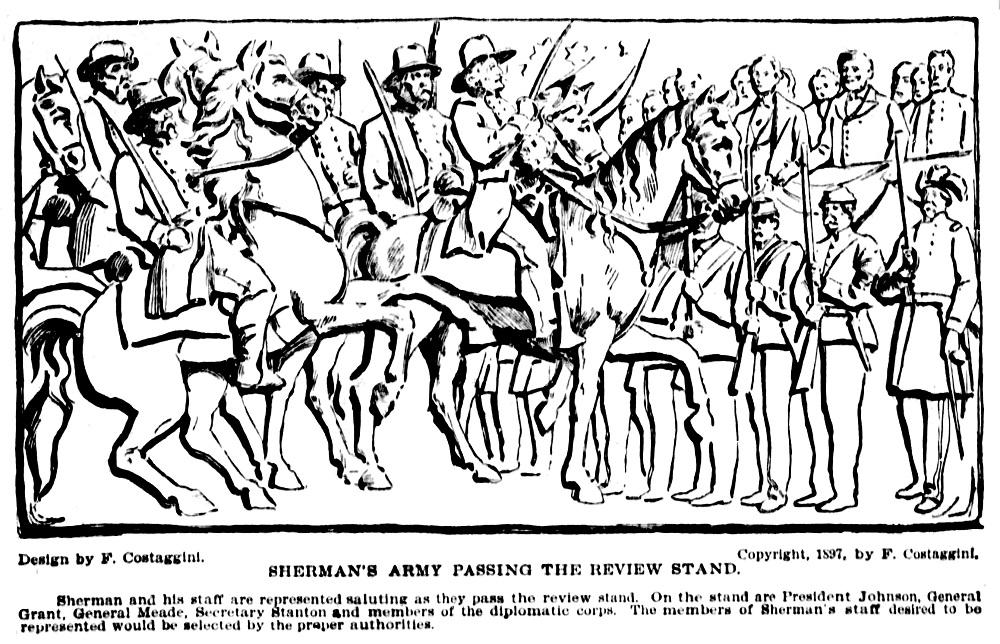
Depictions of any Civil War events within the frieze faced strong opposition from parts of the country. Shown here are Costaggini’s cartoons for a proposed panel depicting Lincoln’s Emancipation Proclamation in 1863 (top) and one showing General Sherman in the Grand Review of the Armies in 1865 (bottom). [Images from the Waco (TX) Times Herald Jan. 23, 1898.]
More ideas rolled in. Just months after Commodore George Dewey led the U.S. Navy to victory over the Spanish Pacific Squadron in the Battle of Manila on May 1, 1898, voices called for the Spanish–American War hero to be added to frieze. This subject would be “an incongruity so startling as to lead to a repainting by a backward process of the whole procession of historical events.”

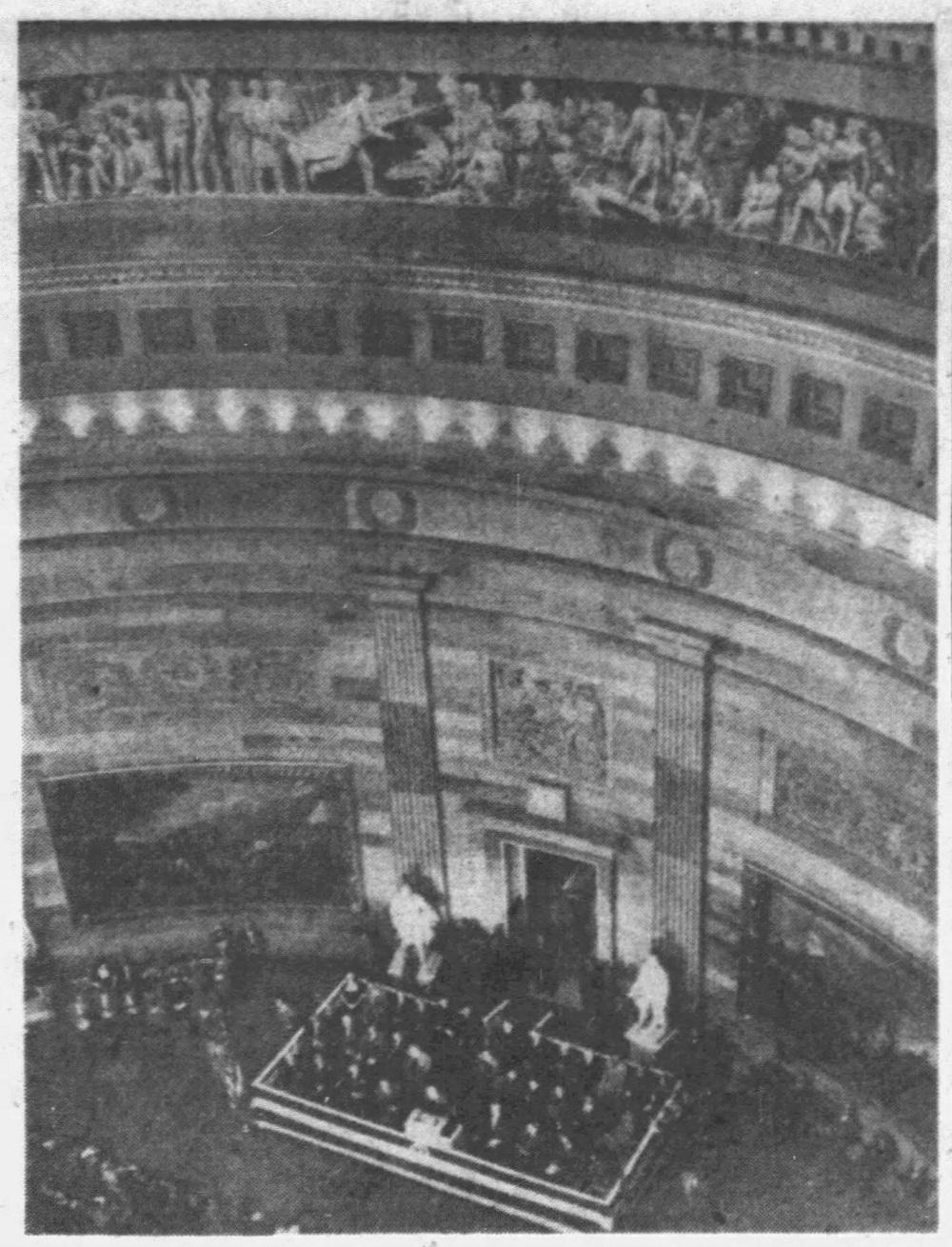
An AP photo showing the May 11, 1954, dedication of the Frieze of American History—completed seventy-five years after it was begun. [Image from the Pomona (CA) Progress-Bulletin May 11, 1954.]
“The hideous scaffolding may remain there forever”
The Rotunda artwork suffered from inaction and neglect. Chief of the U.S. Capitol Guide Service Howard F. “Jake” Kennedy likened the abandoned scaffolding to “a huge, ungainly spider on the walls of the rotunda.” Time and the elements took their toll on the painting. “Brumidi would turn over in his coffin if he could see the manner in which his splendid work is being destroyed by the neglect of the Nobody in charge of the capitol building,” the Philadelphia Times wrote on June 6, 1897. “Unless the Great American people shall delegate Somebody to compel this conspicuous Nobody in charge of the Capitol to complete this work, the hideous scaffolding may remain there forever.” (The “Nobody” the paper criticized likely is Architect of the Capitol Edward Clark.) As the century came to an end, the scaffolding remained in place but appears to have been removed before the body of President William McKinley Jr., who has been the assassinated at the 1901 World’s Fair in Buffalo, was laid in state on September 17, 1901.
Memories of the 1893 World’s Fair receded further as the nation prepared to open the Louisiana Purchase Exposition in St. Louis on April 30, 1904. Just fifteen days earlier, Filippo Costaggini died at age sixty-six. Congress had failed to approve any of his designs while the “Abandoned Fresco” suffered damage from the elements. “Finish the Frieze,” implored the Evening Star a few days after Costaggini’s death. “The gap in the frieze should be a constant reminder to all members of Congress who pass through the rotunda of a neglected item of good governmental housekeeping, the care of which must at once be undertaken.” A report the following year shared optimism that the congressional Library Committee “speaks confidently of its ability to reconcile all divergent views.” No reconciliation came. As more years passed, additional suggestions for historical subjects to complete the decorative band rolled in, including scenes commemorating the opening of the Panama Canal in 1914 and Charles Lindbergh’s trans-Atlantic flight in 1927. Journalist Frederic J. Haskin summed up the situation in 1933: “That blank is Brumidi’s monument.”
Not until 1953—seventy-five years after Constantino Brumidi climbed the scaffolding to begin his work—was the Capitol dome frieze finally completed. Allyn Cox, son of Columbian Exposition muralist Kenyon Cox, painted three additional panels depicting these events:
17. “Peace at the End of the Civil War” (1865)
18. “Naval Gun Crew in the Spanish-American War” (1898)
19. “The Birth of Aviation” (1903)
After decades of opposition to anything commemorating the Civil War, Cox’s first panel shows a Confederate soldier and a Union soldier shaking hands. Reconciliation had finally come. “The thought does not cross the mind that the history of America has been completed,” said President Eisenhower at the dedication of the frieze on May 11, 1954.
The 1893 World’s Fair, however, had not made it into the remaining space. Although Grover Cleveland and everyone else depicted on the Opening Day platform scene had passed from this world long before this time, the great Columbian Exposition held sixty years earlier failed to earn a spot in the Frieze of American History. Back in Chicago, residents shared memories of attending the Columbian Exposition at a sixtieth anniversary tea held at the Chicago Historical Society on May 1, 1953. Children of Harlow Higinbotham and Mrs. Potter Palmer were there, perhaps unaware of the missed opportunity to have their parents painted inside the United States Capitol.
[Resources about the history of the Capitol and its artwork can be obtained from the U.S. Capitol Historical Society, a nonpartisan, educational 501(c)3 nonprofit organization that works to preserve and share the history of the Capitol, the Congress, and the people who work therein.]
SOURCES
“The Abandoned Fresco of the Capitol” Washington (DC) Evening Star Feb. 16, 1913, p. 53.
American Architect and Building News Oct. 18, 1884, p. 181.
“Capital Chat” Washington (DC) Post May 28, 1896, p. 6.
Congressional Record 54th Congress. https://www.congress.gov/congressional-record/54th-congress/browse-by-date
Curtis, Willam E. Letters to James Ellsworth, June 4 and June 7, 1896. Chicago Public Library James W. Ellsworth Collection.
“Death of a Great Artist” Washington Post, Feb. 20, 1880, p. 1.
“Dewey’s Victory and the Bermudi Frescoes” Rochester (NY) Democrat and Chronicle Aug. 25, 1899, p. 6.
“Eisenhower Leads Dedication of Capitol Rotunda Frieze” Washington (DC) Evening Star May 11, 1954, p. 17.
“Gath’s Letter” Cincinnati Enquirer Jan. 21, 1878, p. 5.
“Glorified in Fresco” Chicago Inter Ocean May 31, 1896, p. 1.
“Gossip from Washington” Chicago Chronicle Jan. 27, 1896, p. 9.
Hazelton, George C. The National Capitol: Its Architecture, Art, and History. J. F. Taylor & Co., 1902.
“Historical Frieze” Washington (DC) Evening Star May 30, 1896, p. 16.
“In the Capitol Dome” Louisville (KY) Courier Journal May 17, 1896, p. 24.
“Live Washington Topics” New York Sun Feb. 13, 1896, p. 5.
Low, A. Maurice “Swinging Around” Boston Daily Globe Feb. 24, 1896, p. 5.
“Narrow Escape of Signor Brumidi” Washington (DC) Evening Star Oct. 2, 1879, p. 4.
“New Historic Frieze at the Capitol” Waco (TX) Times-Herald Jan. 23, 1898, p. 3.
“News from Washington” Chicago Tribune May 31, 1896, p. 10.
“Rack and Ruin at the Capitol” Philadelphia Times Jun. 6, 1897, p. 10.
“Stories of Prominent Men” Philadelphia Times Feb. 25, 1894, p. 6.
“$30,000 Yearly Repairs” Anaconda (MT) Standard Feb. 6, 1898, p. 14.
“Those Wicked Pictures” Chicago Record Jun. 6, 1896, p. 4.
“The Unfinished Frieze” Washington (DC) Times Oct. 27, 1901, p. 19.
Wellman, Walter “An Unprecedented Honor” Marion (IN) Chronicle Tribune May 12, 1896, p. 4.
Wellman, Walter “The Capitol Frieze” Marion (OH) Star Jun. 10, 1896, p. 2.
Wellman, Walter “Collis P. Huntington” Saginaw (MI) News Mar. 11, 1896, p. 2.
Wellman, Walter “In Light and Shade” Rome (NY) Daily Sentinel Sep. 28, 1893, p. 4.
Wight, Peter B. “The Decorations in the Capitol Dome: A Protest Against the Proposed Method of Completing Them” Journal of the American Institute of Architects, Vol. 2, No. 9, Sept. 1914, p. 434.
Wolanin, Barbara A. Constantino Brumidi, Artist of the Capitol. Prepared under the Direction of the Architect of the Capitol. Featured Senate Publications, Senate Document 103-27, 2000.