


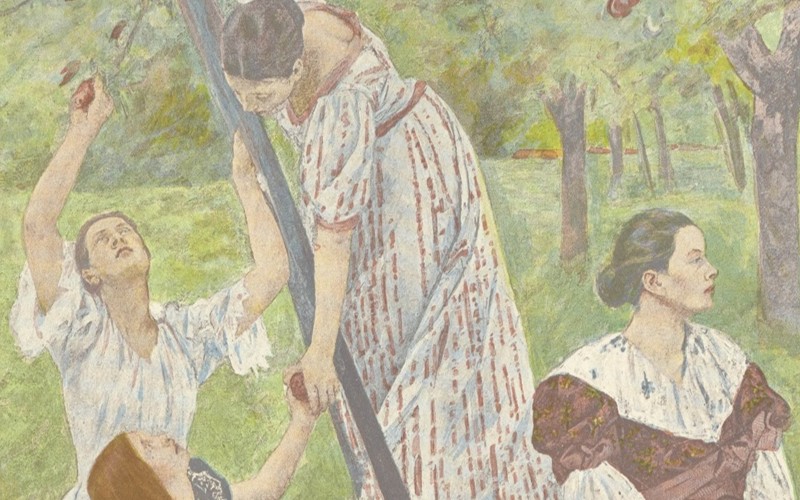
Few works of art exhibited at the 1893 World’s Fair have generated as much scholarly interest, controversy, and speculation as Mary Cassatt’s lost mural Modern Woman. The Art Institute of Chicago centers the absent painting inside the new exhibition, Mary Cassatt: After Impressionism.

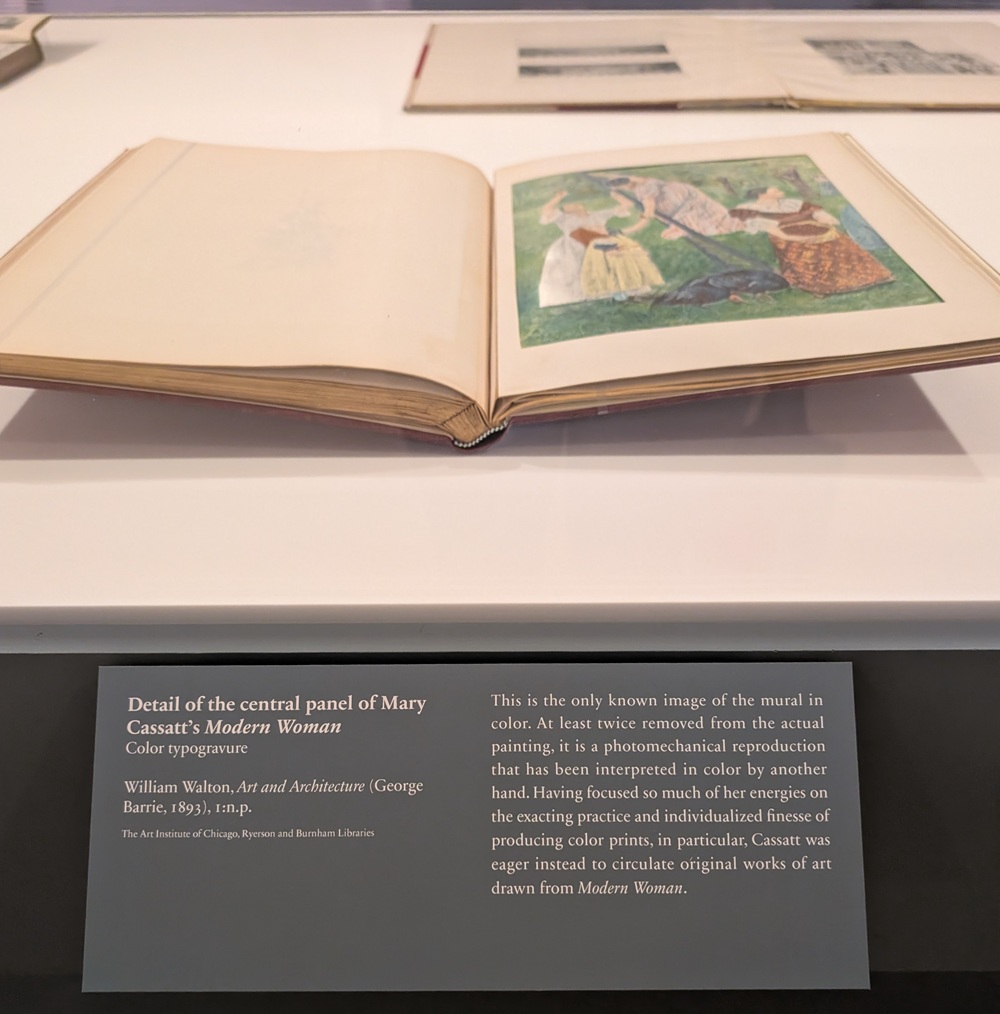
The only known surviving color image of Mary Cassatt’s monumental mural Modern Woman is a reproduction in William Walton’s Art and Architecture of the World’s Fair, on display at the exhibition Mary Cassatt: After Impressionism.
Columbian Commission
Modern Woman “remains one of Cassatt’s greatest works of art,” writes Annelise K. Madsen, Gilda and Henry Buchbinder Curator, Arts of the Americas, at the Art Institute. The story of the painting begins with Bertha Honoré Palmer, President of the Exposition’s Board of Lady Managers, offering Mary Cassatt a commission in 1892 to prepare a mural for the Woman’s Building. “At first I was horrified,” Cassatt wrote of her decision to take on the huge project, “but gradually I began to think it would be great fun to do something I had never done before.” In her studio near Paris, Cassatt created a masterwork in which she intended to show the “charm of womanhood.”

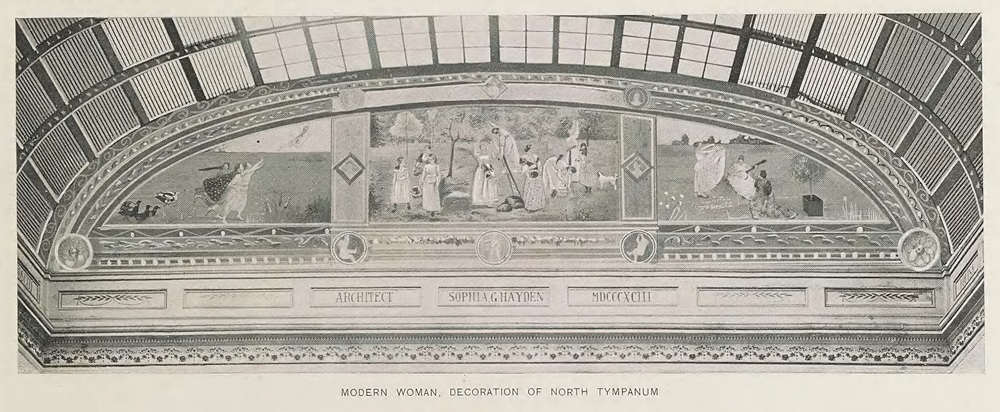
Cassatt’s sixty-foot-wide mural occupied the tympanum on the south (not north, as indicated in the caption) wall of the central “hall of honor” in the Woman’s Building. [Image from Bancroft, Hubert Howe The Book of the Fair. The Bancroft Company, 1893.]

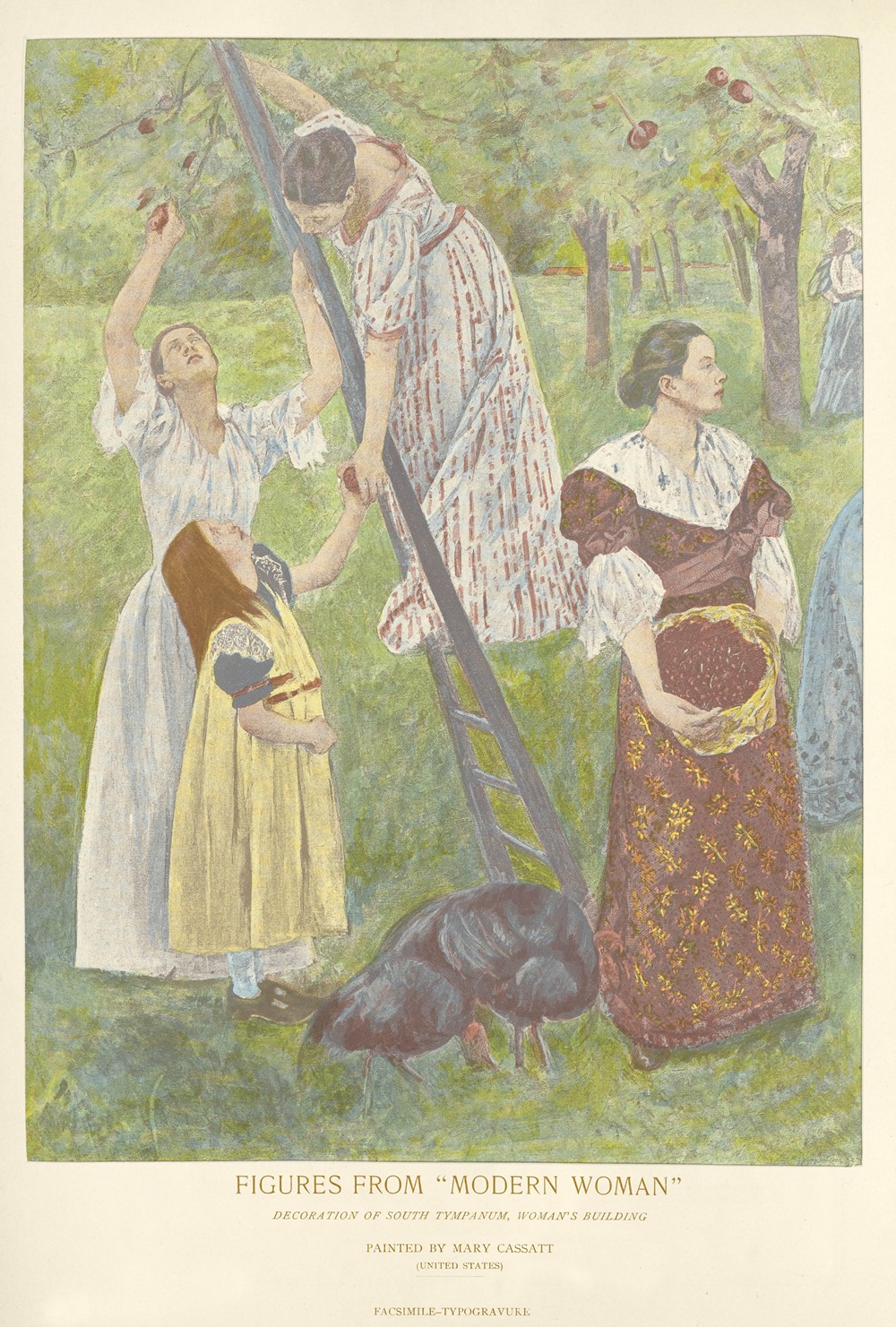
A color reproduction of a scene from Modern Woman is included as a plate in William Walton’s Art and Architecture of the World’s Fair. The accompanying description notes that Mrs. MacMonnies and Miss Mary Cassatt both “chose, naturally, to celebrate the graces and the influence of their own sex. Both also naturally placed their figures in long pleasant green landscapes, though by so doing Miss Cassatt seems rather to have missed the point of her symbolism, as the occupation in which she has represented her ‘modern women’—gathering fruit—is scarcely that which best corresponds to the high claims put forth for their share in modern civilization.”
Cassatt’s monumental canvas, sixty-feet long and around fourteen-feet high, was mounted in the tympanum in the central hall of the Woman’s Building, above the gallery level and beneath a richly ornamented skylight. A nearly continuous landscape runs through the triptych composition, which depicts girls chasing a figure of “Fame” on the left, women and girls “plucking the fruits of knowledge or science” (according to Cassatt) in the center, and a trio of women engaged in music and dance on the right. The feminist allegory was lost on most contemporary critics. “Miss Cassatt does not address the eye at all—she assaults it,” wrote one reviewer. Candace Wheeler, who coined the moniker “Dream City” to describe the 1893 World’s Fair, wrote that Miss Cassatt “has a place among painters who sit in high places,” and that her Woman’s Building mural “enriches not only Chicago, but the whole country. It is sufficient justification for the separate existence of the building that it has called out such a work from the hand of a woman for its adornment.”

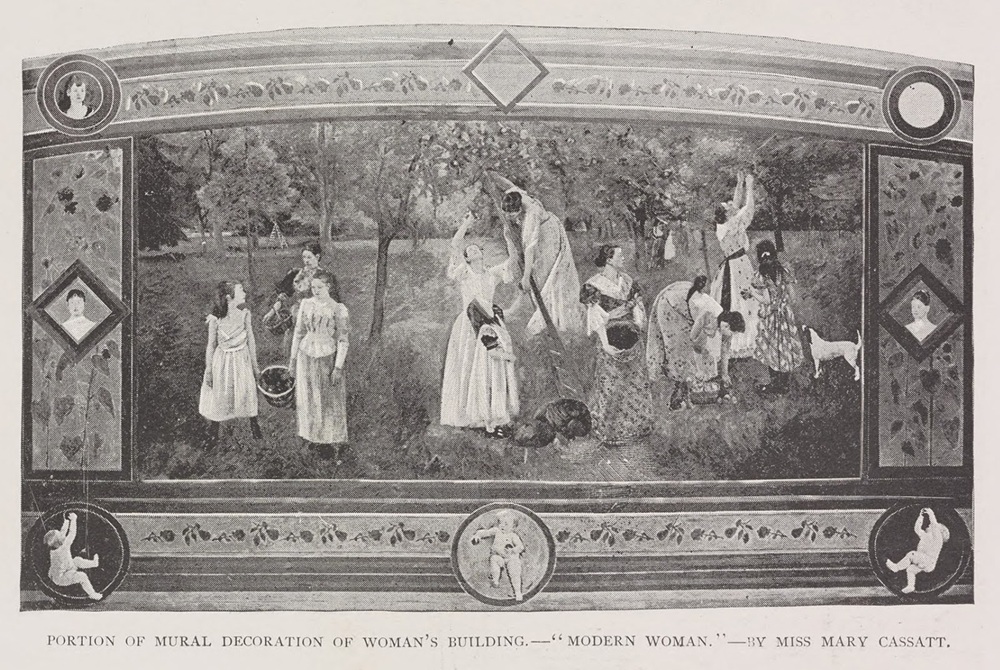
The central panel of Modern Woman depicts women in an orchard passing fruit/knowledge to girls. [Image from The Graphic History of the Fair. Graphic Co., 1894.]

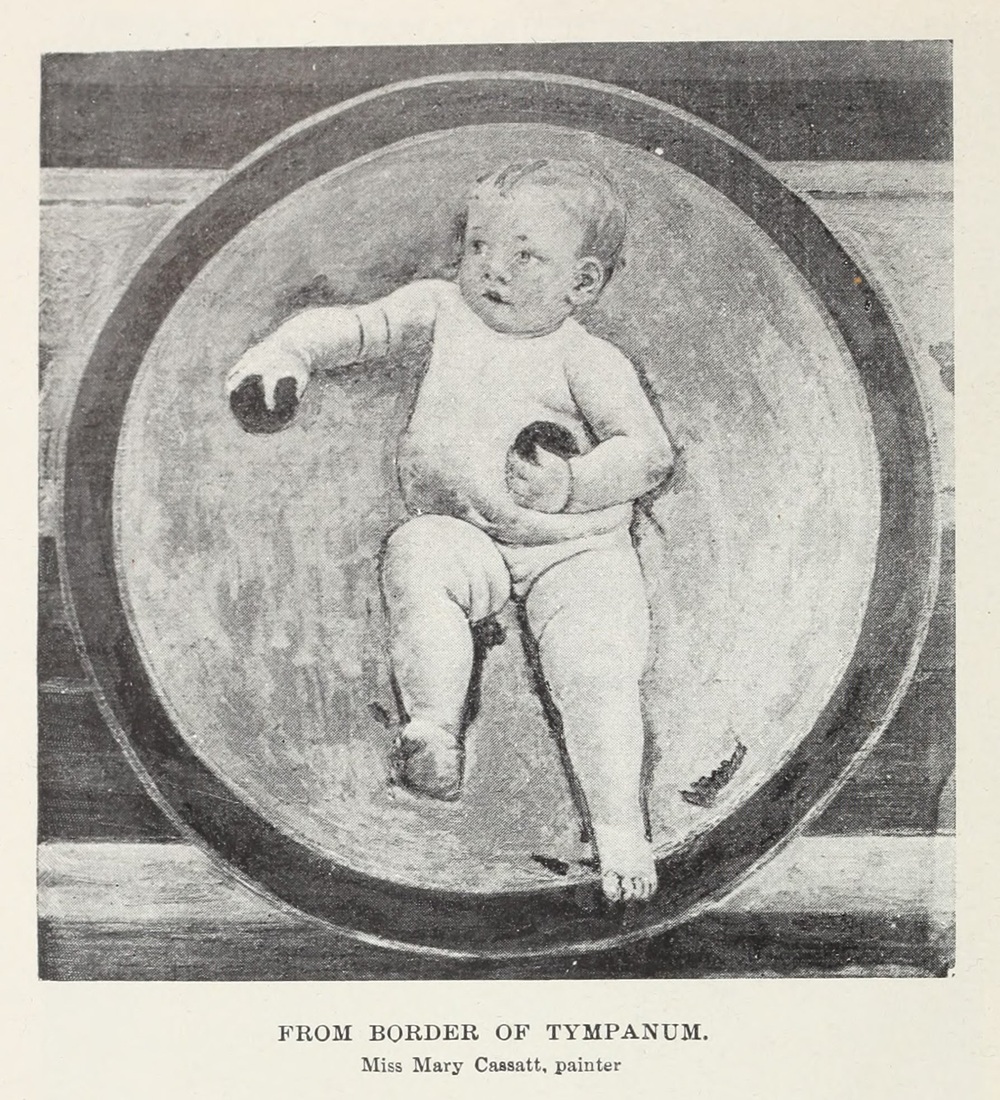
A detail from the decorative border of Modern Woman shows a baby holding fruit from the orchard scene above. [Image from Harper’s New Monthly Magazine May 1893.]

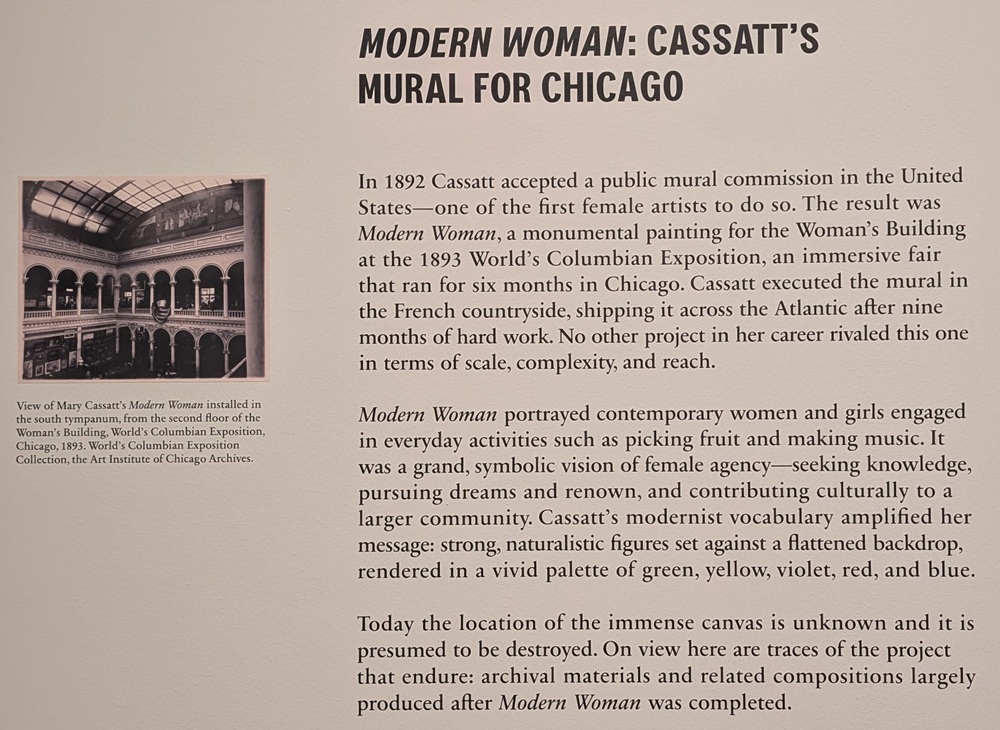
A description for the exhibit space devoted to Modern Woman.
A room for the ghost mural
Within the second gallery of Mary Cassatt: After Impressionism is constructed a central space devoted to the absent painting of Modern Woman. A looped video introduces the 1893 World’s Columbian Exposition, outlines the history of Cassatt’s commission for the Woman’s Building, and describes the composition.

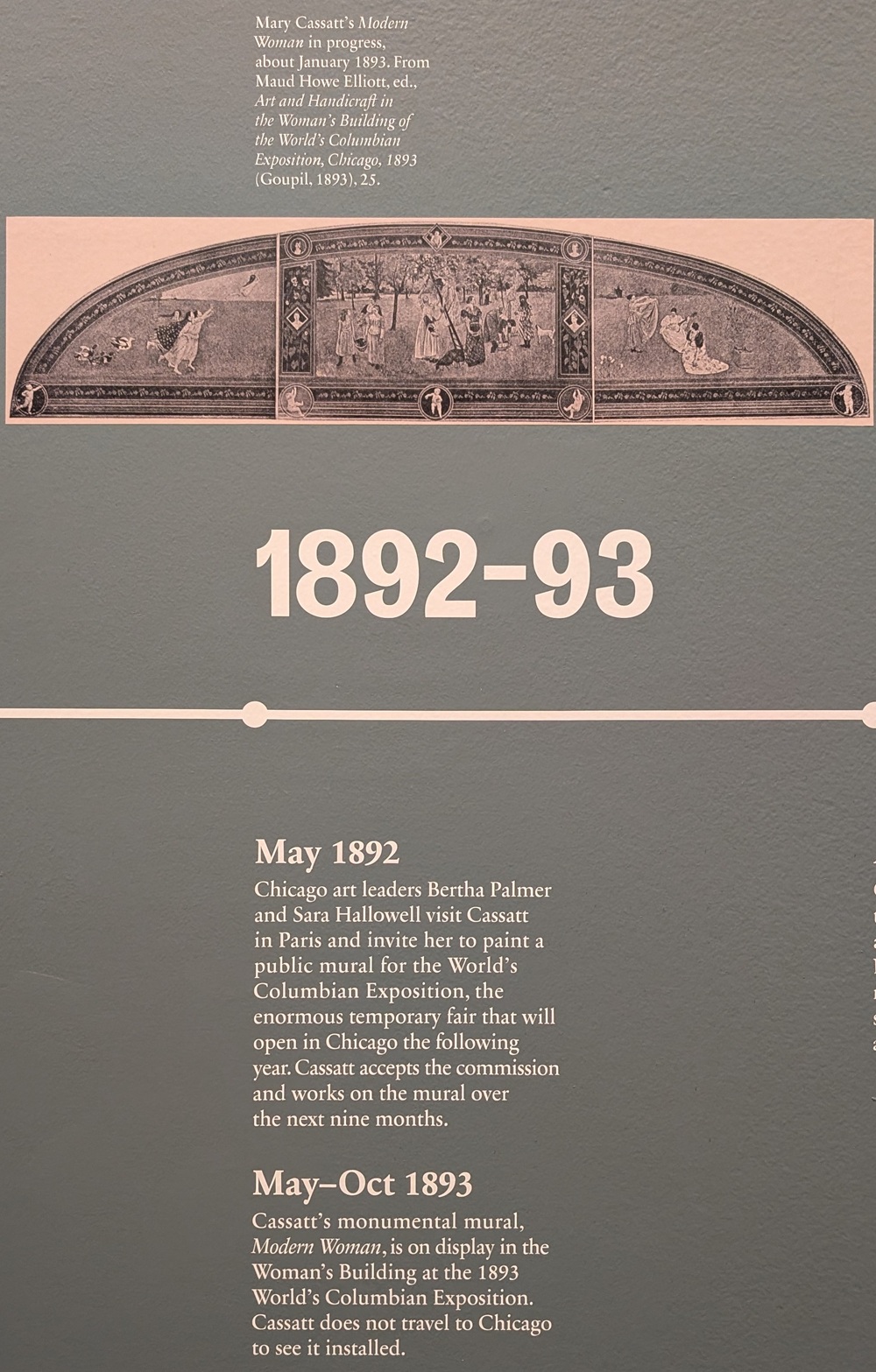
A portion of a timeline for Mary Cassatt’s artistic output “after impressionism.”
A center display case holds the few examples of historical documentation of the mural, including copies of Maud Howe Elliott’s Art and Handicraft in the Woman’s Building of the World’s Columbian Exposition, Chicago, 1893 (Goupil, 1893); Hubert Howe Bancroft’s The Book of the Fair (The Bancroft Company, 1893), and William Walton’s Art and Architecture of the World’s Fair (George Barrie & Son, 1893, which includes the only known color reproduction of a section of the central panel. Also displayed is a letter from Cassatt to Bertha Palmer, dated October 11, [1892], and providing an update on the artist’s progress, and another to Mary MacMonnies, who worked independently on her own companion mural nearby in France.

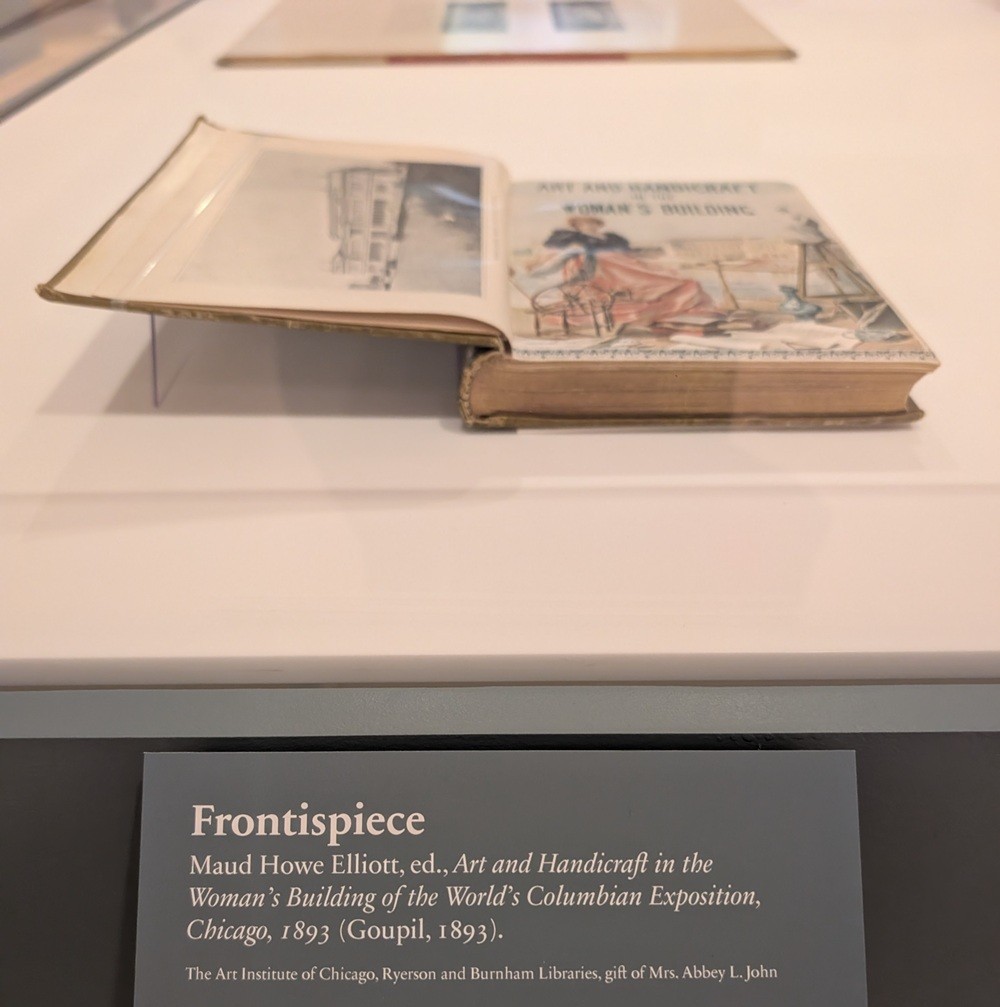
Maud Howe Elliott’s Art and Handicraft in the Woman’s Building of the World’s Columbian Exposition, Chicago, 1893 notes that “the border of the tympanum is very charming; the children quite beautifully painted.”
Surrounding these historical documents are a selection of paintings and prints that complement the absent mural. Child Picking a Fruit (1893), The Banjo Lesson (1894), and several versions of the print Gathering Fruit (c. 1893) each extend themes from Modern Woman and may offer clues to Cassatt’s color palette.
Modern Woman was last accounted for in a Chicago storage facility in 1912. Attendees of a members’ preview day audibly gasped when the docent described the mural as having been lost and “presumably destroyed.” While the fate of the canvas remains one of the biggest mysteries of the 1893 World’s Fair, the ghost of this treasure haunts the central room created in the current exhibition gallery.
Mary Cassatt: After Impressionism runs from September 6, 2026, through January 3, 2027, at the Art Institute of Chicago.
Curator Annelise K. Madsen will offer a lecture on “Modern Woman—Mary Cassatt’s 1893 Mural for Chicago” on Thursday, October 29, at 6 pm in the Rubloff Auditorium of the Art Institute. Advance registration is required.
Further Reading
Hutton, John “Picking Fruit: Mary Cassatt’s Modern Woman and the Woman’s Building of 1893” Feminist Studies Summer, 1994, Vol. 20, No. 2 1994, pp. 318–48.
Kysela, John D. “Mary Cassatt’s Mystery Mural and the World Fair of 1893” Art Quarterly 1966, Vol. 29, pp. 129–45.
Madsen, Annelise K. “Going Big for Chicago: Mary Cassatt’s Mural, Modern Woman” September 1, 2026. https://www.artic.edu/articles/1276/going-big-for-chicago-mary-cassatts-mural-imodern-womani
Webster, Sally “Mary Cassatt’s Allegory of Modern Woman” Helicon Nine, a Journal of Women’s Arts and Letters Fall/Winter 1979, pp. 39–47.
Webster, Sally Eve’s Daughter/Modern Woman: A Mural by Mary Cassatt. University of Illinois Press, 2004.
Weimann, Jeanne Madeline “A Temple to Women’s Genius: The Woman’s Building of 1893” Chicago History Spring 1977, pp. 23–33.
Wheeler, Candace “A Dream City” Harper’s New Monthly Magazine May 1893 pp. 830–46.