


[Continued from Part 5]
As Vice President Adlai Stevenson returned to his seat, Director-General George R. Davis announced: “The next order of the program is an address by the Mayor of Chicago. I introduce …” His words were drowned out by the wild cheers from the crowd. The crowd knew Carter Harrison. Their tumultuous greeting showed without doubt that a mayor outranked a vice president in popularity.
This text of Carter Harrison’s speech appeared in largely similar versions published by the Chicago Herald, Chicago Times, and Chicago Tribune; the Chicago Record printed a substantially different version. Earlier that morning, Corporation Counsel Adolf Kraus had asked the mayor if his speech was ready. Carter confessed that he hadn’t a thought in his head! If true, he may have delivered most or all of this speech extemporaneously.

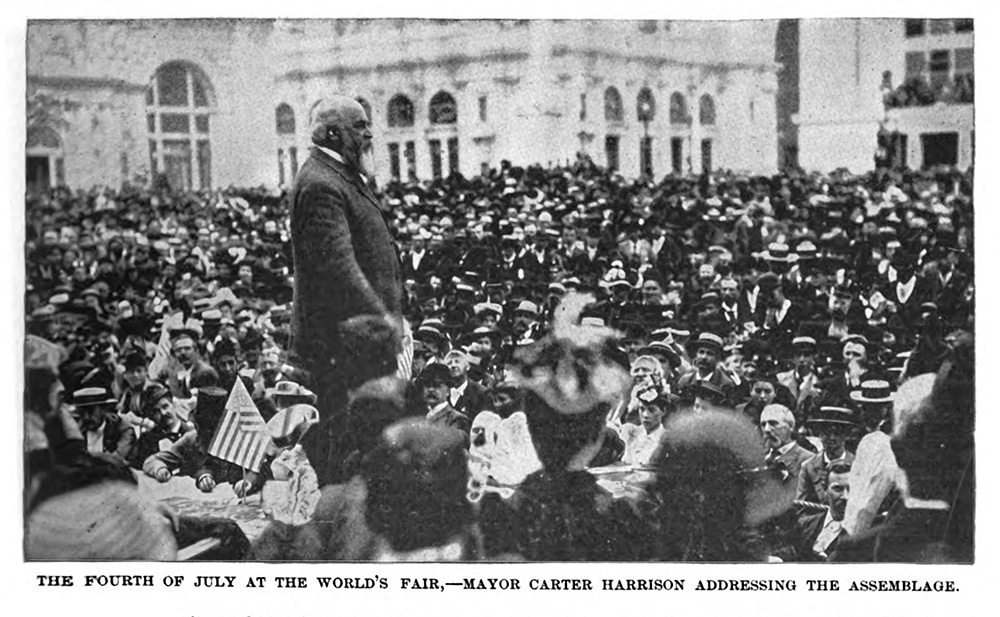
Chicago Mayor Carter Harrison brought the Fourth of July exercises to a climax when he waved Andrew Jackson’s sword. [Image from the Review of Reviews Aug. 1893.]
Mayor Carter Harrison’s Address
Mr. Chairman, Mr. President, fellow-citizens of the United States, and friends from over the world: We greet you here to-day, one of the most momentous days in the history of America. If there be a time, or has been a time, when the people of the United States should glory in celebrating the natal day of our land, the Fourth of July, it is this day, when, surrounded by this magnificent White City erected in honor of the discoverer of America, we meet here, and at this hour, throughout the United States, all Americans are rejoicing that they have lived until this Fourth of July. [applause]
All men love their homes. Some think this is but sentiment, but it is an instinct sprung from our very animal nature, a common and natural instinct among all animals. That is an animal of low degree which loves not his home. The tiger loves its lair, the bear seeks its den, and the hare rushes to the farm where it was born. The bird that skims across the sky, going from the very south, goes to the very north to find the spot on which it was hatched. For this is a feeling common to all, and it is a feeling which may be exercised out of the heart by the lack of proper education. It is, therefore, but proper that the people of America should gather on the fourth day of July, aye, should commence at the early morn and, like John Adams who declared that that day should be celebrated by bombs, firecrackers and everything that makes a noise [applause and laughter] for all mankind gives voice in making a noise to what it likes. We are the sons of America and let us pay all possible glory to this day. We are prone to run after material wealth, we are all fond of the daddy dollar. We have allowed our pursuit of money to take the place of something that appeals to the heart and memory.
In a few minutes the lightning will carry to the utmost bounds of America that this is high noon, 12 o’clock, and at that very moment will be hoisted that flag [pointing to Paul Jones’ flag], the first flag that America ever had, the one that was given by the United States when he manned our little navy of three ships. That flag floated from the Bon Homme Richard when the Serapis was sent to the bottom of the sea. In the engagement that flag fell from Paul Jones’ boat into the sea when an ancestor of that woman sitting there [pointing to Mrs. Stafford] sprang from the ship into the sea and saved that flag, and for that act it was granted to him and his descendants by the United States Congress. I wanted to bring it up on this platform. “No,” she said. “That is ours, and no one but myself can touch it.” It is hers—the bunting is hers, but that flag belongs to America, from the lakes to the Gulf of Mexico, from the Atlantic to the mighty Pacific. [applause]
What a history has been ours. One hundred and seventeen years have passed since America had her birth. On that day 117 years ago today, this city, of which we are now so proud, this city that we have to show to the world to make our grandest boasts, was terra incognita. But now look at this beautiful White City. Springing like an emanation from the morass, it offers to the world a vision unknown, never seen in the past, and I believe will not be in the future.
Four hundred years ago last year three little caravels, models of which will arrive on the 12th, sailed from Spain.[1] It was a mighty achievement, and now Chicago and the people of Chicago have erected this mighty city. We will hoist the flag—we have something else besides that flag. [picking up a small bunch of red-and-white carnations] These are flowers brought from the tomb of Thomas Jefferson, the man who wrote the Declaration of Independence and who gave the feeling of patriotism which will leave it as long as time shall last. Here is a sword that belonged to another of the great defenders of America. It is the sword of Andrew Jackson, who never knew how to draw it but in the defense of liberty and his native land.
My friends, it is going to rain. Do you think that your forefathers, who fought and bled for you and who died for you, cared for the rain? [applause] I am myself a young man. Let us turn our brows to the sky and, like Ajax, dare the lightning of the heavens. We are speaking for American liberty.

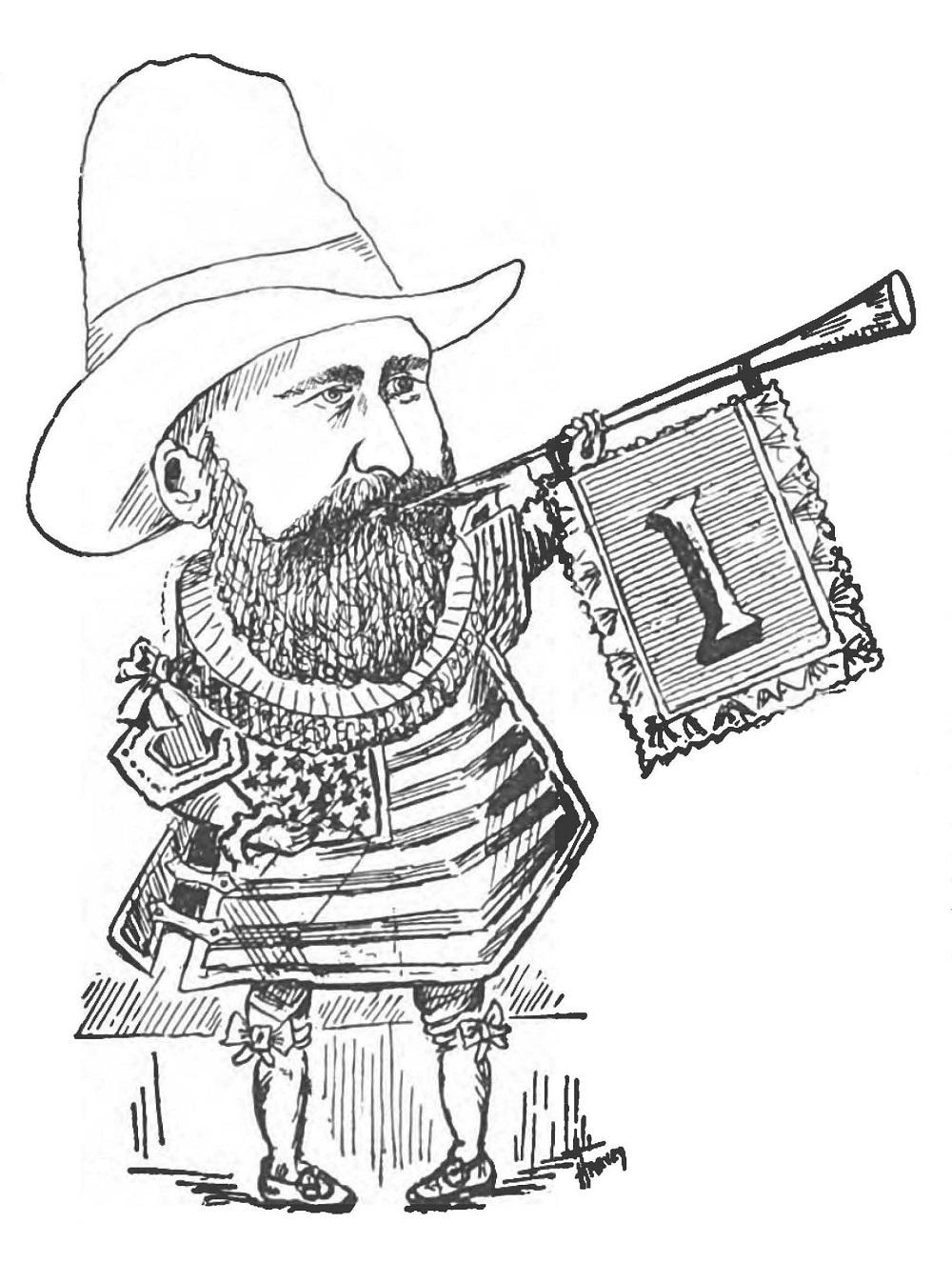
A cartoon depicting Mayor Carter Harrison wearing “Old Glory.” [Image from Figaro Mar. 2, 1893.]
“Everybody fairly went wild”
Hotter and hotter grew the enthusiasm of the crowd as the mayor neared the end of his Fourth of July address. Suddenly, Director-General Davis interrupted him. The time had come. The mayor glanced at his watch for dramatic effect. It was almost noon. Drizzling rain began to fall onto the celebrants, but all attention remained focused on actions unfolding on the platform. The mayor continued:
Now, my friends, comes the peroration or ending of my speech that will be eloquent indeed. Listen to it [whistles blow, etc.]. The sounds of liberty have invaded our midst from the Atlantic and are spreading over all this broad land.
Carter Harrison seized the old sword and pointed it skyward. The relic had belonged to the 7th U.S. President, for which the city grounds that served as the temporary home of the Columbian Exposition was named—Jackson Park. The historic blade still shined brightly, though there was little sunlight to prove it as Carter swung the sword over his head. He announced:
It is now 12 o’clock, and the word comes, every bell in America rings, the cannons roar, and the tugs whistle—now shout! It is in commemoration of the birth of American liberty. Now about! Shout! Shout! [Wild cheering and applause]. There is Paul Jones’ flag and here is Andrew Jackson’s sword. Let every American swear at this moment that he will be ready at any time to draw his sword in defense of that dear old American flag [Cries of “We do,” and tremendous applause].
With the Mayor’s final words, many things happened simultaneously at the noon hour. The pinnacle of this Fourth of July celebration reminded many of how President Cleveland had pushed the button on Opening Day to begin the great transformation scene in the Court of Honor. For the Columbian Fourth, the crowd erupted in a storm of voices stirred by the Mayor’s appeal. Mrs. Stafford clasped the halyards and hoisted up one flagpole the John Paul Jones’ flag, thought to be America’s first ensign. The Flag of Universal Peace rose simultaneously from the other staff. As cannons fired, conductor Silas G. Pratt led the mass chorus in “The Star-Spangled Banner.” Instantaneous with this Salute of the Flags, two women stepped up to the table, held onto the telegraph key and pressed it. Sitting on the platform at the noon hour was Ralph E. Hoyt, visiting from Los Angeles. He reported home that “everybody fairly went wild over the climax reached.”

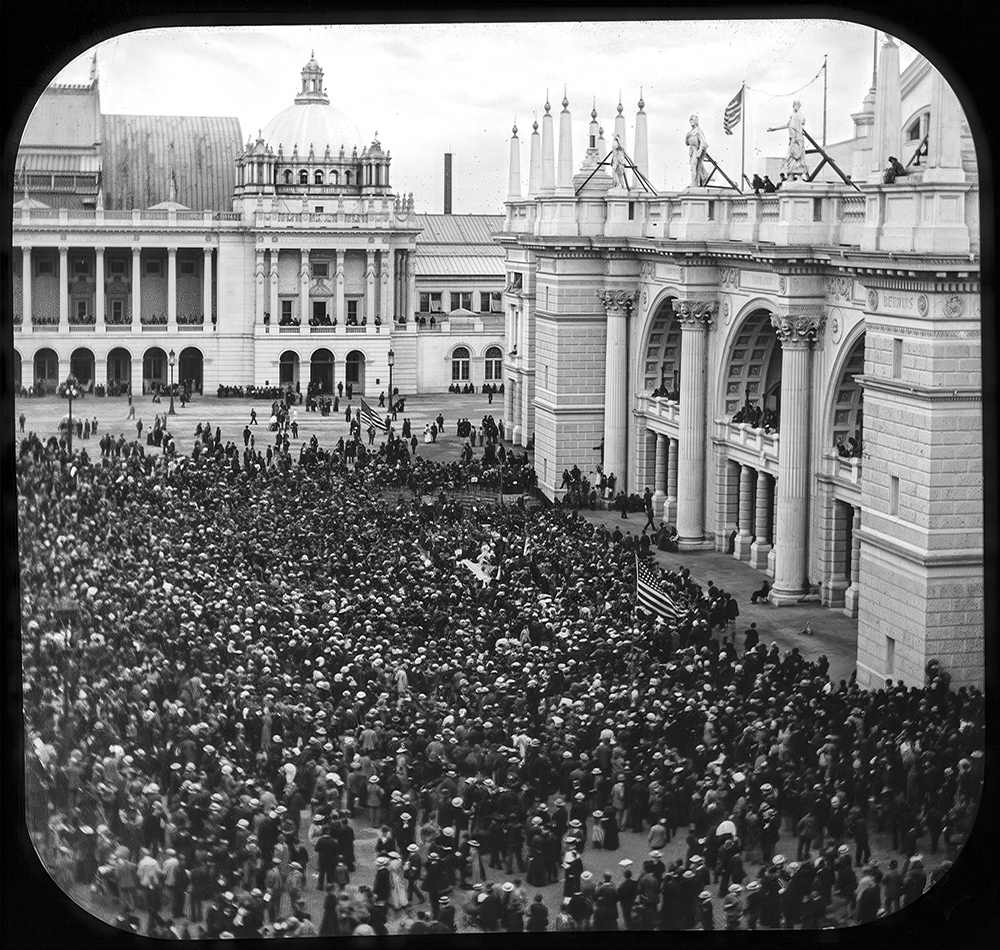
A magic lantern slide showing the crowd on July 4th in front of Terminal Station. [Image from the Brooklyn Museum, S03i2186l01_SL1.jpg]
NOTES
[1] The Columbus caravels arrived at the Fair on July 8.
SOURCES
Hoyt, Ralph E. “From the World’s Fair” Los Angeles Evening Express Jul. 15, 1893, p. 3.
“Cheering the Flag” Chicago Herald Jul. 5, 1893, p. 9.
“Fair’s Best Day” Chicago Times Jul. 5, 1893, p. 1.
“His Birthday Party” Chicago Tribune Jul. 5, 1893, p. 1.
“Within a Magic City” Chicago Inter Ocean Jul. 5, 1893, p. 2.