


Last call for Schlitz beer! After 177 years, production of the iconic Milwaukee brew has come to an end. Founded in 1849, the Joseph Schlitz Brewing Company ceased operations in 1982, though since 1999 the Pabst Brewing Company continued produced the Schlitz brand. Schlitz beer received valuable attention at the 1893 World’s Fair in Chicago, as much for its handsome display as its beer. The Joseph Schlitz Brewing Company was one of twenty-two exhibitors in Group 12 (Malt Liquors) of the Agriculture Department and one of only two Cream City brewers—the other being Pabst Brewery—to display their product in the Agricultural Building.

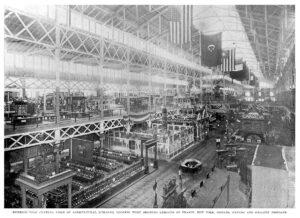
Beer brewers were among the many hundreds of exhibitors in the Agricultural Building of the 1893 World’s Fair. [Image from Campbell, James B. Campbell’s Illustrated History of the World’s Columbian Exposition, Volume II. M. Juul & Co., 1894.]
“A magnificent display”
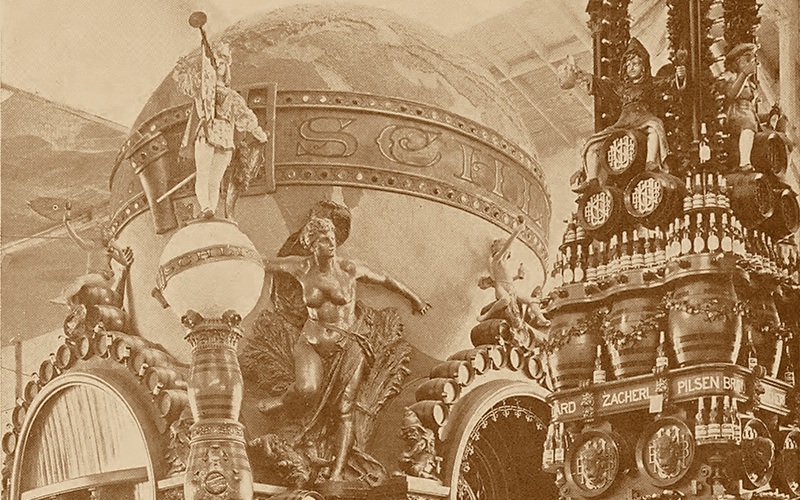
Schlitz hired a professional architectural firm to design their World’s Fair exhibit and spent $20,000 on the display. By early February 1893, construction of the Schlitz booth was underway. The company constructed its handsome pavilion in the west gallery of main floor of the Agricultural Building. The structure was made from two immense mash tuns (vessels used to mix malted grains with water at a controlled temperature in the mashing process) turned on their sides. Visitors could pass in and out of the interior through huge entrances shaped from hogsheads.
Ornate and whimsical sculptural details decorated the pavilion. Forming an arch over each entrance was a string of small beer barrels supported by the backs of a seated gnome on each end. A cherub, holding a bottle of beer in one hand and raising a glass to toast in the other, sat above the apex of each arch. Resting on the roof of the structure was a magnificent sculpture consisting of four heroic-sized figures supporting an enormous globe. The nearly nude females each displayed a unique pose and stood in front of a sheaf of grain. At their feet danced small gnome figures, possibly representing Gambrinus, a mythical Germanic beer icon. A Schlitz company banner encircled the globe. This band was rimmed by strings of colored glass jewels having prismatic faces. Electric lights shining through them from the interior of the globe produced a brilliant effect. Glass jewels employed throughout the pavilion lent brilliancy to the design.
At the corners of the main pavilion stood four pedestals, each constructed from two upright beer barrels resting on a highly decorative base. Topping each pedestal was a smaller banner-belted globe surmounted by a unique caped herald figure blowing a trumpet.


Two versions of a photograph of the Schlitz pavilion in the Agricultural Building. In the bottom version, the name of the company and products have been blackened out and the image labeled as a “Display of Western Brewers.” [Images from two editions of Hubert Howe Bancroft’s The Book of the Fair (The Bancroft Company, 1893).]
Richard Bock, sculptor
The artist who created this sculptural work was a twenty-two-year-old German American with a most appropriate name for the beer commission. Richard W. Bock contributed sculptures for two of the grand exhibit palaces of the Columbian Exposition being built by contractor Phillipson and Company, the Mines and Mining Building and the Electricity Building. Before working on the Schlitz commission, he also had completed interior bas reliefs for Louis Sullivan’s Schiller Building in downtown Chicago. During his work on this architectural gem, he met Frank Lloyd Wright and later worked with the renowned architect on numerous projects, including sculptures for Wright’s home and studio in Oak Park.
For the beer commission, Bock recalls in his memoir:
“There was the exhibition piece I was to do for the Manufacturers’ Building [sic], the Schlitz Brewery trademark of a huge globe with a buckled belt around it. This globe was supported by four female figures in playful poses representing the four hemispheres. At their feet were gnomes. Flanking this centerpiece were four pedestals constructed of beer kegs, three to a pedestal, and on top of each a herald blowing a trumpet. This work was in charge of an assistant named Franz Rugiska with whom I had made a partnership agreement. He had come to me from Mr. Sullivan’s sculptor, Mr. Boyle [https://worldsfairchicago1893.com/tag/john-j-boyle/], who had worked on the Transportation Building while I was doing the Schiller Theater.”
Art historian Donald P. Hallmark points out that the 1893 Schlitz sculpture was Bock’s first use of the motif of a globe and supporting figures that he would employ again in sculptures for Frank Lloyd Wright:
“The ideas used in the exhibit for the Joseph Schlitz Brewing Company remained in Bock’s mind for many years and did not disappear as quickly as the actual sculpture did upon the completion of the fair’s run in late 1893. The reappearance of the globe motif occurred at least twice more in Bock’s work of the nineties and three times in the architectural sculpture for Frank Lloyd Wright in the early years of the twentieth century. Whereas his work on the Mining Building was more important at the time of the fair, in the end the Schlitz globe motif proved to be immeasurably more influential on his future sculpture.”


The ornate entrance to the Schlitz pavilion. [Image from the Schlitz Brewing Company archives.]
“A Grecian temple”
Visitors tempted inside the pavilion could learn more about the Joseph Schlitz Brewing Company and its products. One Exposition guidebook describes the room:
“The interior of the pavilion would resemble in appearance a Grecian temple more than anything else, were it not for the dispelling effect of several things suggestive of the brewing business. Through the top of the white dome which rises into the globe a circular opening admits the light by day and affords a means of illumination by night. The entire floor space, of course, is devoted to an exhibition of various grades of beer.”
Historian Frank A. Cassell adds:
“The interior of the tuns, each twenty feet high, boasted twelve large paintings representing the major departments of the firm. There was a particularly big mural of the Milwaukee skyline from the lake with the location of the brewery emphasized. In addition, the display included many bottles of the different beers produced by Schlitz.”
A visitor from Milwaukee boasted that the Schlitz pavilion “makes a magnificent display and divides the honors with the Anheuser-Busch and Pabst exhibits.”


Visitors entering the Schlitz pavilion. [Image from the Milwaukee Sentinel Sep. 10, 1893.]
Schlitz swag
World’s Fair visitors could not grab a cold one at the Schlitz pavilion, but they could leave the Agricultural Building with some corporate “swag.” Cassell notes that “souvenirs were distributed to guests including sets of twenty-five pictures of the various parts of the brewery. Some guests received a model of the Schlitz globe ‘containing a dozen comic views to show the extent to which Schlitz beer is drunk.’” A fan-like booklet, shaped in the trademark globe, consisted of several leaves with color illustrations on one side. Capitalizing on the international spirit of the Exposition, these images portrayed fanciful scenes of discovering Schlitz beer in far-away places such as the African interior, north pole, or a South American post. The rear page features a lovely color bird’s-eye-view of the fairgrounds. Black-and-white illustrations on the verso pages depicted scenes in their brewery and the city of Milwaukee.


An 1893 advertisement for Joseph Schlitz Brewery. [Image from the Chicago Eagle Jan. 7, 1893.]
“The beer that made Milwaukee famous”
Exposition judges awarded three medals to Joseph Schlitz. Anheuser-Busch received six, Pabst took five medals, and W. J. Lemp of St. Louis also earned three. Schlitz, however, received the highest ratings for purity, as judged by a United States government chemist, for any beer—domestic or foreign—at the World’s Fair. The company proudly touted this honor in their advertising for many years.
Richard Bock realized the brewery’s iconic belted globe logo, first introduced in 1892, as a three-dimensional sculpture Chicago fair. The trademark design element also found its way into many of the Schlitz taverns built starting in the 1890s. The company’s memorable slogan of “The beer that made Milwaukee famous” emerged in advertising the year after its impressive show at the Columbian Exposition. “Like all other commodities dealt out at the fair, there is good beer and bad and indifferent,” wrote a correspondent at the 1893 World’s Fair to the Milwaukee Sentinel. “As our own people know pretty well, good beer is made in Milwaukee.”
Just not as much of it.


A decorative Schlitz belted glob bas relief on the handsome exterior of Schubas in Chicago, which originally was a Schlitz tied house.
SOURCES
“Beer at the World’s Fair” Milwaukee Sentinel Sep. 10, 1893, p. 9.
Bock, Richard W. Memoirs of an American Artist, Sculptor. C.C. Publishing Co, 1989.
Casey, Constance K. “Culture and Commerce” Chicago History Nov. 1993.
Cassell, Frank A. “Milwaukee and the Columbian Exposition of 1893” in Milwaukee Stories. Thomas J. Jablonsky (Ed.), Marquette University Press, 2005.
“Fair Awards for Beer and Ale” Chicago Tribune Oct. 30, 1893, p. 7.
Flinn, John J. The Best Things to Be Seen at the World’s Fair. Columbian Guide Company, 1893.
Hallmark, Donald P. “Richard W. Bock, Sculptor. Part I: The Early Work” The Prairie School Review Vol. VIII, No. 1, 1971, pp. 5–18.
“Preparing for Farm Products” Chicago Tribune Feb 8, 1893, p. 2.
“Schlitz Brewing Company” Encyclopedia of Milwaukee https://emke.uwm.edu/entry/schlitz-brewing-company/