

Long before the United States Mint killed the penny on November 12, 2025, the diminutive copper coin was pressed, squashed, and otherwise elongated. Long before.
Numismatists hold that the first elongated coins appeared in the United States at the 1893 World’s Columbian Exposition in Chicago. At an event offering countless souvenirs, these were strange ones. Vendors used mechanical coin-rolling machines to press pennies into an elongated shape while a design on the roller created an impression on it. Most of the souvenirs simply had text of “Columbian Exposition 1893” as the image. It is thought that customers supplied their own coin (and many chose to crush nickels and even higher denominations) and paid a fee of perhaps five cents for their Columbian trinket. Numerous variant designs of these pressed pennies suggest either multiple vendors operated booths or at least that multiple steel dies were in operation.

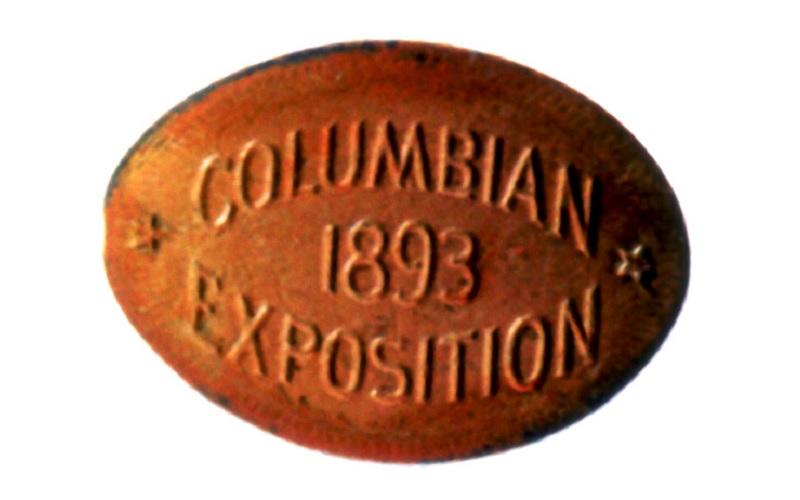
An example of an elongated penny fomr the 1893 World’s Columbian Exposition. [Public Domain image from Wikipredia.]
The monster gun, nicknamed “Krupp’s Baby,” required a special train to carry it to Chicago from Baltimore Harbor, where it arrived on April 7. While being transported along the Pennsylvania Railroad, Krupp’s Gun rode on two iron trucks, each weighing 64,000 pounds and having sixteen wheels. “As the journey was made westward toward the Fair,” records historian Hubert Bancroft, “the bridges and culverts over which the train was to pass were carefully inspected, and in some cases strengthened, for the gross weight of car and gun was 225 tons.” Eric Larson writes in The Devil in the White City that “from Baltimore came a long dark train that chilled the hearts of the men and women who monitored its passage across the prairie but delighted the innumerable small boys who raced open-jawed to the railbed.” Crowds gathered all along the route to Jackson Park, where it arrived on April 16.

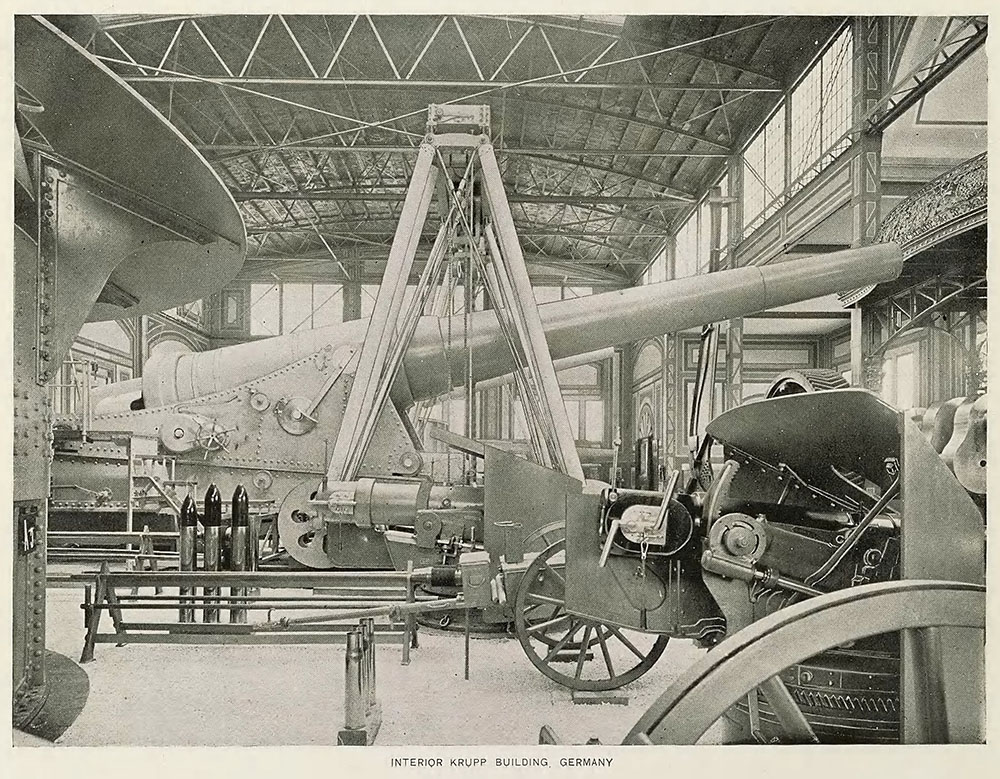
The massive Krupp gun was an elaborate way to crush a penny. [Image from Bancroft, Hubert Howe The Book of the Fair. The Bancroft Company, 1893.]
It is quite the thing now, and a really select thing too, to have a coin that the big 120-ton Krupp gun ran over. The coins do not resemble the everyday piece very much after the operation, but they are quite a curiosity among the people who live near the line of the Pennsylvania railroad from the Union depot in Pittsburgh over into the Fort Wayne yards in Allegheny. As soon as the big train hauling the gun started slowly out of the Union depot last Wednesday morning a big, heavy-set man stooped down in front of the engine and put a 25-cent piece on the rail. A lot of people saw him, and made a rush to get in front of the train to do likewise with pennies, 5 and 10 cent pieces. The train went slowly over the coins, and the way they did smash was wonderful. The pennies flattened out almost as thin as paper when the big gun bridge-car passed over them. The 25-cent pieces were flattened out so that they looked like half dollars. All along the line from the depot to the railroad bridge, crowds of people put coins and pins on the tracks. The pins could not be found after the big gun passed. There was many a scramble to get the coins, and many persons couldn’t tell their own pieces from some other fellow’s. As high as 50-cent pieces were used as relics. Often the money stuck to the wheels, and one young man got a long stick and poked a lot of them from the 16-wheel trucks, and was at once besieged by schoolgirls and boys who wanted a flattened penny to keep to remember the great gun by.
SOURCES
Bancroft, Hubert Howe The Book of the Fair. The Bancroft Company, 1893.
“Krupp Gun Coins” Pittsburgh Post Apr. 16, 1893, p. 4.
Larson, Erik The Devil in the White City: Murder, Magic, and Madness at the Fair that Changed America. Crown, 2003.