


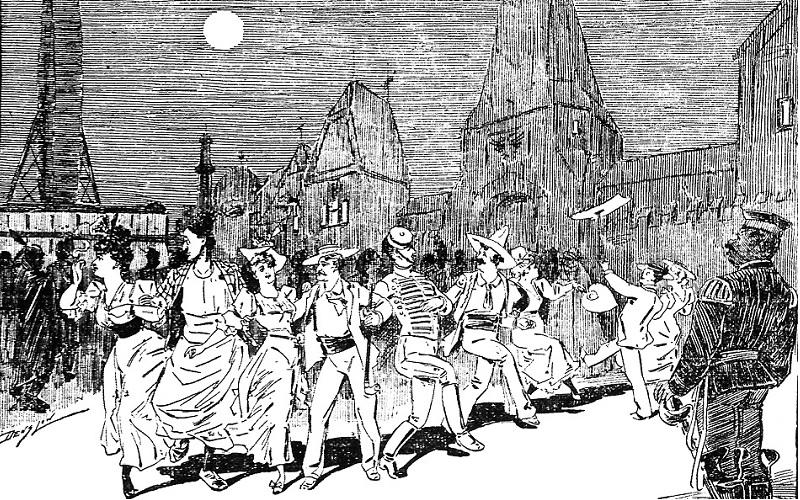
Chicagoans rioted in the street—looting shops, destroying property, and attacking law enforcement. They were drunk, lascivious, and did not stop their mayhem until morning. The year was 1893. The place was the Midway Plaisance, the entertainment district of the World’s Columbian Exposition.
Just two nights earlier, an assassin had gunned down Chicago’s colorful and beloved mayor, Carter Harrison, Sr., at his front door. With the pageant planned for the Columbian Exposition Closing Day ceremonies cancelled out of respect for the city’s tragic loss, crowds flooded into the Midway for the final night of the six-month World’s Fair—set to end officially on Monday, October 30 (one day before the end of the month, for reasons never made clear). Grief and anger over the killing of the mayor, mixed with mourning for the end of the Exposition and anticipation of Halloween, may have sparked the unruly conduct—shockingly different than the sober and orderly comportment guests had displayed for most of the fair season.
Percolating underneath the rowdy visitors’ outburst was lingering tension between Midway concessionaires and the Exposition’s Board of Directors about whether the Midway attraction could remain open after October 30. The mayhem of Monday night settled it.
Articles or excerpts from several Chicago newspapers that reported on the Midway bedlam, along with one syndicated news story that circulated nationally, are reprinted below.

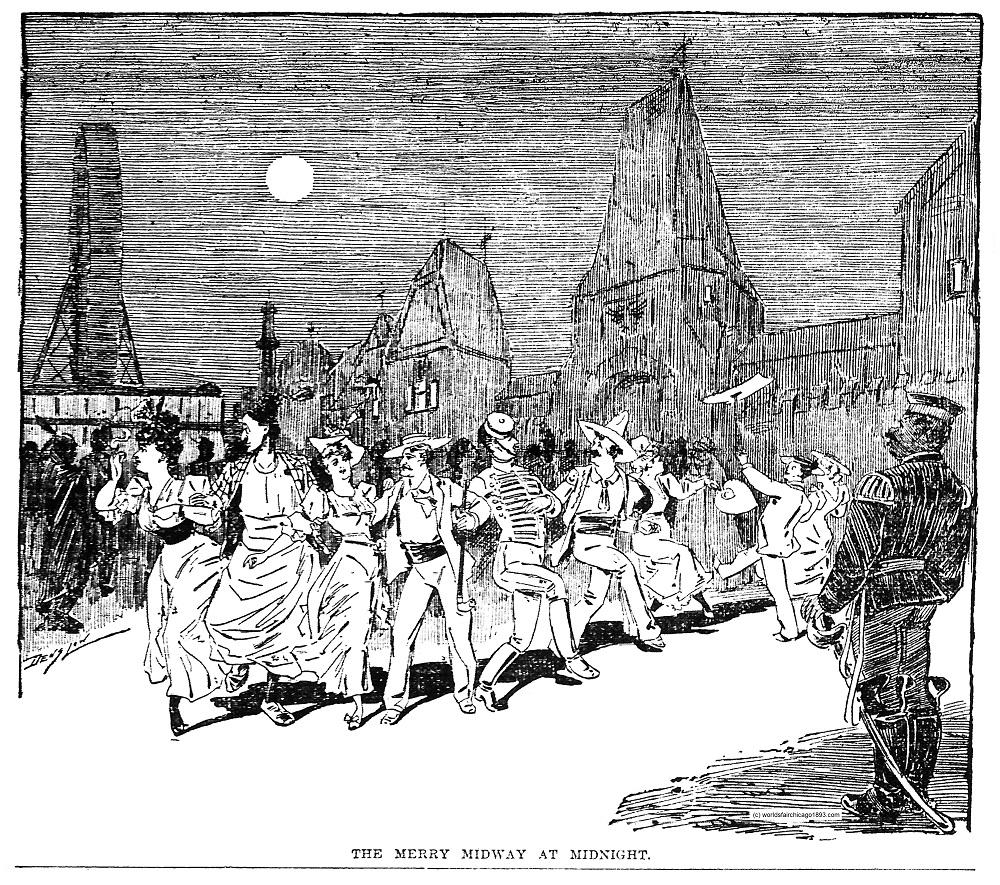
“The Merry Midway at Midnight” by W. W. Denslow. [Image from the Chicago Herald Aug. 13, 1893.]
Wild Night on the Midway
(from the Inter Ocean, Oct. 31, 1893)
The barriers were broken down in Midway plaisance last night. Men and women alike seemed unmindful of decorum; bedlam was let loose and riot ran unlicensed from one end of the thoroughfare to the other. It was mad carnival.
Regiments of men were formed and marched up and down the plaisance, every man tweeting a tin horn or shouting. Women grouped, tooted horns, and did high kicking to the delight of the spectators. Men and women mixed swept everything before them. They took people off their feet and tramped over them unconcernedly. Protestations were met with laughter and were drowned in the blast of horns. Squads of revelers ran over the plaisance, surrounding groups of people sedately viewing the sights and, circling around them, danced, shouted and deafened them with the noise of horns, horse rattles and the beating of improvised gongs and cymbals.
Rolling chairs were appropriated and rushed along on a gallop. Wheelbarrows were secured from somewhere, and half a dozen women were wheeled around in the crowds by their escorts. A portly woman trotted along, tagged on each side by boys in knee pants. She blew a tin horn lustily, and the infants kept their mamma company with two baby’s crying balloons.
As the night grew the fun became more furious. Signs were torn down and used as banners. Awnings were ripped from rafters and formed into robes, with which men and women draped themselves. The red, white, and blue paper that decorated the buildings was torn down and women made bows and scarfs of their plunder. The horns were tooted frantically all the time. The men shouted and the women screamed. From end to end of Midway the tumult was the wildest ever known there.
The shows closed early, as the crowd afforded in its saturnalia a greater sight than any housed freak on the street. All the shows closed at the Oriental dancing academies. The Nauch girls became imbued with the abandoned of American women and men, threw aside a lot of their clothes, and came out in front of the theater to lure patrons in by their contortions. The girls danced as they never have dared to before, and the crowd cheered and chanted Chinese refrains and beat on tin pans and coffee coolers taken from some looted refreshment stand.
The Columbian guards had been cautioned to let the crowd have its fling and not to interfere with the amusement, however boisterous it became, unless life became endangered. At last, about 11 o’clock, the riot alarm was sounded from the Chinese theater. The crowd had begun a raid on the theater. The great gong was pulled down and set going. Idols and grim figures were pulled from their pedestals and carried aloft amid shouts and a grand fanfare of tin trumpets. Then the guards interfered and the fight came on. Guard Spencer ordered the rioters to disperse. They drowned his words with toots of their horns and shouts and then took him off his feet. Recovering as the crowd good-naturedly left him without further molestation, he whistled an alarm and fifty or more guards rushed out of the station next to the Ferris wheel and pitched into the crowd. Soon they began bringing prisoners into the station. The patrol wagons were called and twenty men promiscuously seized out of the crowd were driven over to Woodlawn station. This ended the riotous phase of the affair, but hurrahing and noise were kept up until midnight, by which time the guards had forcibly cleared the street.
While all this hullaboo was in progress on Midway an alarm was sounded from the treasurer’s office. It was at once thought that the jollification in Midway plaisance had been taken advantage of to rob the treasury. Guards and clerks rushed out armed, but for the second time within two days the alarm proved to be a cry of wolf. An electric alarm button had been accidentally touched.
The last day didn’t close without the fire departments being called out to Midway plaisance. At midnight the call came, and the fire department put out a blaze in the Bedouin camp.

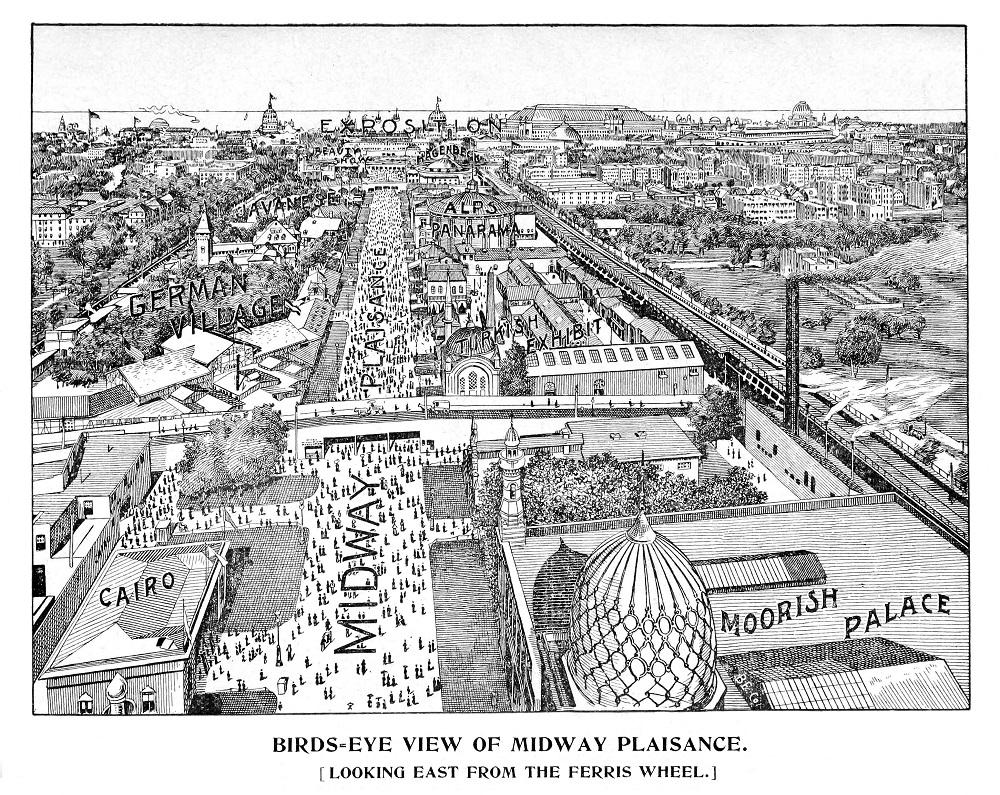
Birds-Eye View of the Midway Plaisance Looking East from Ferris Wheel. [Image from Flinn, John J. Official Guide to Midway Plaisance. Columbian Guide Co., 1893.]
(excerpt from Chicago Tribune, Oct. 31, 1893)
Bedlam in Midway
______
ROLLICKING NIGHT SCENES ALONG THE STREET OF NATIONS
______
Signs Torn from Their Moorings and Born Tumultuously Aloft by a Crowd of Horn-Blowers—Tin Pans Used by the Drum Corps—Colombian Guard and the Celebrators Have a Brush at the Ferris Wheel—Several Arrests Made—Plaisance May Continue Business.
Midway Plaisance last night presented a scene more like a court-yard of an insane asylum, with the visitors as maniacs, then part of a great exposition. The entire length of the street from Cottage Grove avenue to the Irish village was filled with a mob whose utmost aim seemed to be to make as much noise as possible. Men, boys, and women were blowing horns. Signs were torn from the fronts of the various concessions and carried in a procession, which marched up and down the street. The signs certainly looked funny, considering the circumstances, “Free Concert. Everybody Welcome,” “Sandwiches Five Cents,” “The Only Genuine Turkish Dancers,” and so on were carried by those in the procession. Halloween was celebrated in advance in Midway.
Men carried barrels and pans which they tapped with sticks. Every tin pan, bell, or anything which would make a noise was brought into use. Scores of men turned their overcoats inside out and yelled and worked harder last night than they have probably for six months previous. The chair-pushers were out in a body. They carried a mammoth horn whose tone was like that of the foghorn.
Many side shows closed their doors in fear of a general riot. On one of the marches the leaders made a dash for a Turkish girl who stood on a platform in front of the Turkish Theater and would have carried her off on their shoulders had not an alarm been answered by a number of Turks, and the mob was driven off. As the marching crowd grew larger some of the individuals tore down large wooden signs, which required four men to carry in the line of march.
Two young girls, unattended, were met on the way and a canvas lunch sign was placed around their necks and they were born alone for several hundred feet by the mob.
A squad of Columbian Guards ran down the Midway at double-quick pace and met the procession below the Ferris wheel. There was a short scrimmage and then the crowd fled, leaving a dozen or more of the leaders prisoners. The guards engaged in many hand-to-hand conflicts, in which some blood flowed. The leaders and sometimes innocent spectators were pounced upon by guards, who would strike the victims whenever resistance was shown. The guards became excited and some of them lost their heads. One guard, it is said, struck an intoxicated man in the face while the man was in the guard station just because he would not sit down. Those arrested at first were carried through the mob. The guards carried the culprits by the legs and arms or as best they could. The Chinese Theater was looted of its copper drums and a call for aid was turned in. A dozen men were arrested and locked up at Woodlawn Station.
While excitement reigned high in Midway a riot alarm was turned in at 10 o’clock from the Service Building from the Department of Collections. Some one again had accidentally touched the burglar alarm and secret servicemen armed with Winchesters, together with 400 guards, ran to the scene of supposed distress.
Long into the night the marauders continued to make midway a howling thoroughfare.

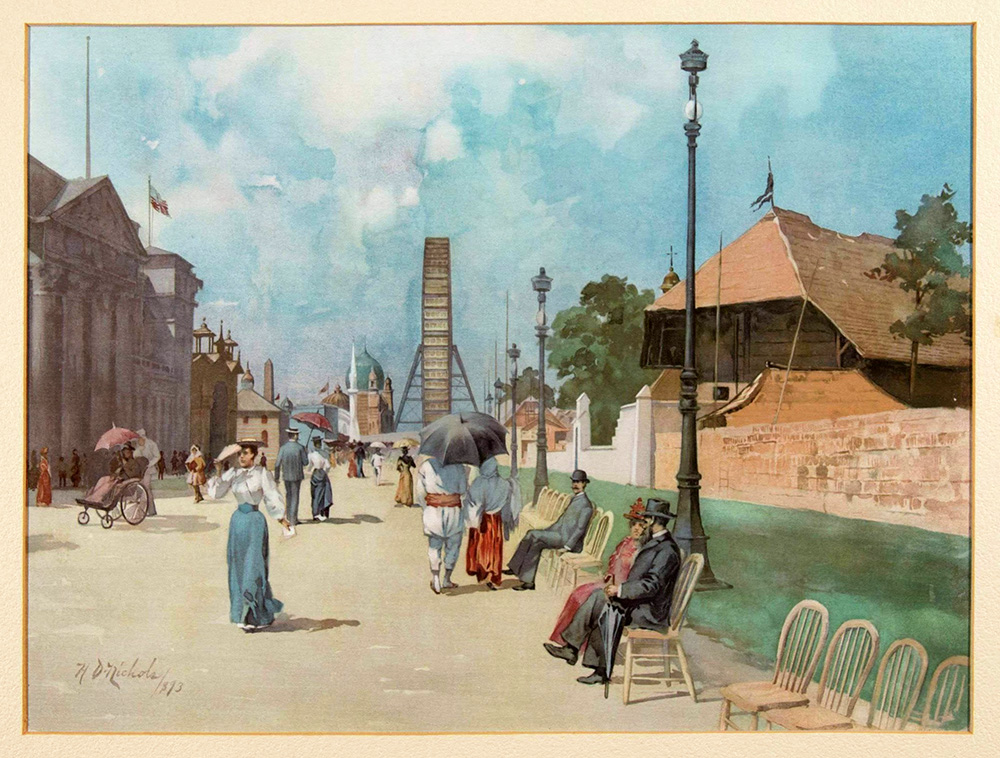
A watercolor by Harley DeWitt Nichols depicts a peaceful day on the Midway Plaisance at the 1893 World’s Columbian Exposition. [Image from Bancroft, Hubert Howe The Book of the Fair. The Bancroft Company, 1893.]
(syndicated news story; excerpt from Buffalo Courier Express Oct. 31, 1893)
Midway Is Mad
Pandemonium rained tonight in the Midway Plaisance. Nothing like it was ever seen or rather heard in Chicago. It was a concentrated celebration of New Year’s Eve, repeated 100-fold. Everybody celebrated the closing hours of the Exposition and even the Columbian Guards relaxed their frigid dignity. The midway, street of all nations from the Woman’s Building to Cottage Grove Avenue, was a mass of noisy humanity. Thousands of tin horns and every conceivable instrument which could create a noise were used by the visitors, by the guides, by the chair-pushers, by the concessionaires and by their employees without any regard for those who preferred to enjoy themselves in a quieter way.
Processions of men carrying all kinds of signs marched up and down the Midway to the screeching music of the tin horn in various sizes until it seemed as if Bedlam had broken loose. There was no restraint placed upon the conduct of the multitude which passed up and down the thoroughfare. No person cared to go home, evidently bent upon a reckless enjoyment of the last of the World’s Fair.

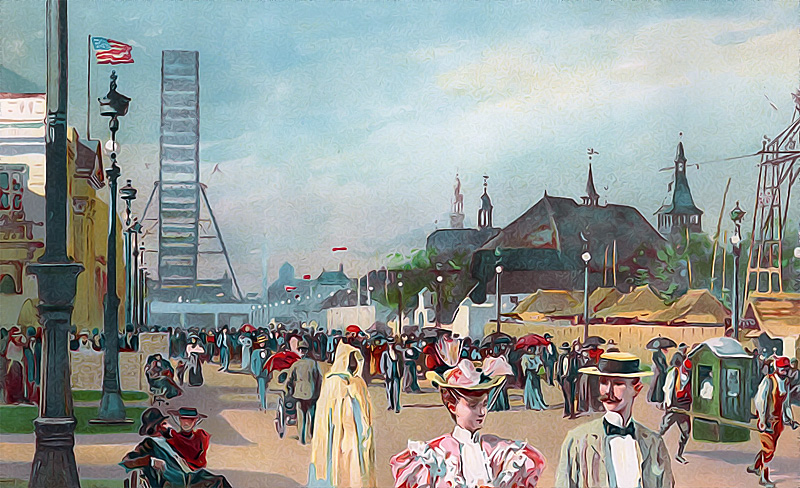
The Midway Plaisance by T. de Thulstrup shows the international thoroughfare without all the “hullaboo” of October 30. [Image from Burnham, Daniel Hudson; Millet, Francis Davis The Book of the Builders Vol 1. No 3, May 5, 1894.]
(excerpt from Chicago Record Nov. 1, 1893)
Midway Under Guard
______
CLOSED BY EXECUTIVE ORDER
______
World’s Fair Directors Determined to Allow No Further Riotous License in the International Strip
Midway plaisance is closed. The entrances along both sides and at either end are barred and Columbian guards are stationed at the viaduct passage connecting with the main grounds under instructions to allow no one to enter without a pass from the proper authority.
The order was issued by the director-general last night, with the approval of the executive committee, which was called together by President Higinbotham with a view to prolonging the life of the plaisance. The question was thoroughly canvassed by the directors. Some of them thought with the president that the concessionaires should be allowed to do business as long as there was any profit in it for the Exposition. The director-general called their attention to the disgraceful scenes on the plaisance the last few evenings. In his opinion the directory had no legal or moral right to extend any of the concessions for revenue purposes.
Riotous Scenes in the Plaisance
The executive committee was largely influenced by the reports of what happened in the plaisance in the dark hours of yesterday morning. The plaisance has seen many lively nights, but never before has there been such riotous scenes. The drinking places ignored all regulations Monday night and kept open, most of them boldly, until far into the morning. There had never been so much drunkenness in the street. The night was cold and sharp. The crowd drank whiskey instead of beer. From early evening crowds of men, women and boys had been marching, blowing tin horns, carrying banners and beating drums. Those who remained after midnight made things livelier still. Women who appeared in the street were surrounded by shouting men and boys who joined hands in a circle and did Indian dances. Nearly every man carried a beer sign, a restaurant placard or a “keep off the grass” board. They began playfully tapping one another over the head.
… The Columbian guards, who were present in the extra squads, lost their heads in the general excitement.
Trouble with the Guards
They were armed with heavy clubs and in some instances seemed ready to provoke trouble. In front of the Brazilian concert hall a big guard seized a man who was accompanied by his wife. The man resisted and several guards went at him. The woman fainted and was hauled away in a patrol wagon. In front of the German village an Egyptian laid open a Turk’s head with a heavy case. When the Turk was put in the ambulance he was covered with blood. In walking through the plaisance at 12:30 o’clock a visitor saw five men assaulted by guards and put under arrest. Many of the women were more or less intoxicated. The larger and first-class places were closed, but the smaller drinking places were filled with shouting and singing crowds.
About 1 o’clock someone turned in an alarm of fire at the west end of the plaisance, and all of the engines, trucks and hose carts came down through the noisy crowd. Soon after that the guards received orders to clear the plaisance of all hazards. They joined hands, making a wall across the street, and crowded the revelers down toward the west gate. This maneuver resulted in several more fights and arrests. It was almost daybreak when the last of the gay crowd was sent home. The street was littered with broken signs, tin cans, branches of trees, papers, boards and torn flags.
Open Violence Apprehended
Paul Blackmar, the superintendent of collections, said that he thought it would be impossible to close the plaisance without closing the whole Exposition. He believed the concessionaires would regard it as unfair and would tear down the fence, admitting the public free of charge. Col. Davis thought that the concessioners would have an interesting time of it if they attempted anything as lawless as was suggested. The guard, under Col. Rice, had its instructions and would see to it that they were carried out.

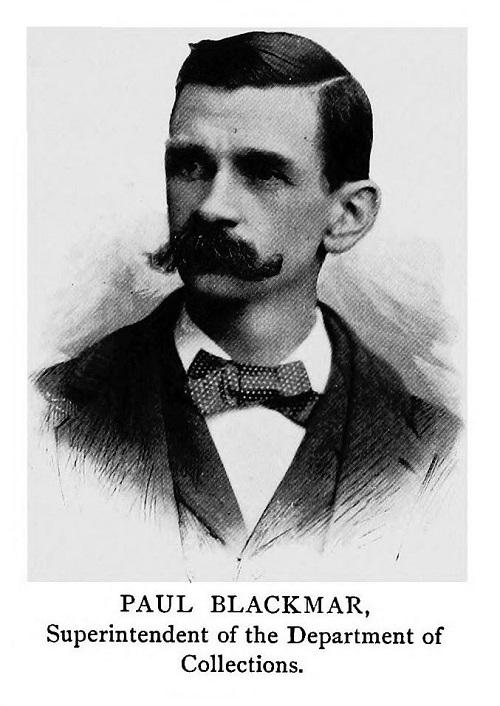
Paul Blackmar, the Superintendent of Collections for the World’s Columbian Exposition. [Image from Johnson, Rossiter A History of the World’s Columbian Exposition Held in Chicago in 1893, Volume 1: Narrative. D. Appleton and Co., 1897.]
SOURCES
“Bedlam in Midway” Chicago Tribune Oct. 31, 1893, p. 4.
“Midway Is Mad” Buffalo (NY) Courier Express Oct. 31, 1893, p. 2.
“Midway Under Guard” Chicago Record Nov. 1, 1893, p. 2.
“Wild Night on the Midway” Chicago Inter Ocean Oct. 31, 1893, p. 2.