


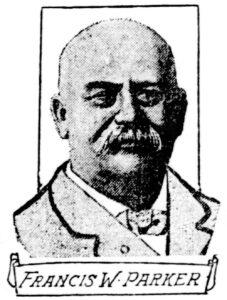
Educational reformer Francis W. Parker (1837–1902) advocated for the mental, physical, and moral development of children in public schools. “There is, perhaps, no name more widely known among the teachers of this country, than that of Col. Francis W. Parker,” wrote Lelia E. Patridge in 1883. During the 1893 World’s Columbian Exposition, Colonel Parker served as the principal of the Cook County Normal School in Chicago. He participated in the World’s Congress of Education held in July, presenting a paper in the general session held on July 24 on the topic of “What Shall be Taught in the Public Schools?” Earlier in the month, the Journal of Education published his article below promoting attendance by educators at the World’s Fair in Chicago.

TEACHERS OF AMERICA!
COME TO THE WORLD’S COLUMBIAN EXPOSITION!
Fellow-teachers of America, four-hundred thousand strong, I cannot urge you too earnestly, nor too strongly, to make a close protracted study of the Fair. As Kate Field writes in Washington: “The men of the Directory have builded even better than they knew. In the presence of their beautiful dream city, I stand with reverence and thank God for the rhythm of its ‘frozen music.’ Thus was architecture called by a woman,—Mme. de Staël,—and now I, another woman, dare to say that were there nothing at Jackson Park but this symphony in white, created by the best architects of the United States, the melodious spectacle would be worth a journey round the world. There never was its peer. We shall not look upon its like again. From it will date the era of a new architecture for this country, which will transform our towns end make this Republic literally the home of art.”

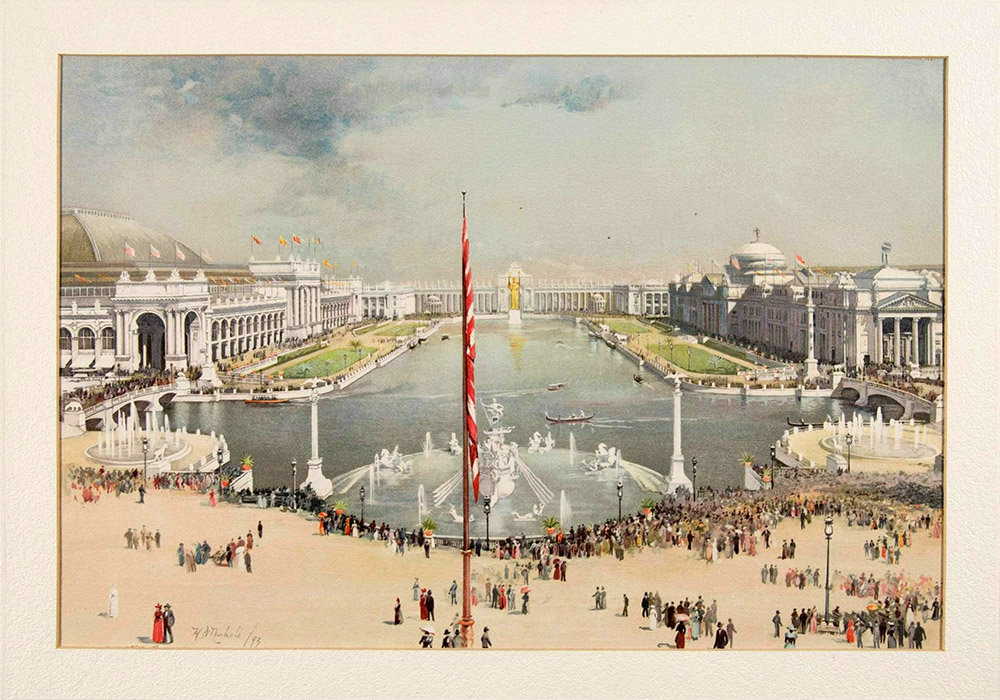
Journalist Kate Field described the architecture of the Columbian Exposition as a “symphony in white.” [Image from Bancroft, Hubert Howe The Book of the Fair (The Bancroft Company, 1893).]
Probably never again will be gathered together so many magnificent illustrations of science, art, history, manufactures, and commerce. It is an object lesson par excellence. It will be the regret and mistake of a lifetime if you do not make every effort to study the greatest educational exhibit on earth. Whatever a teacher’s taste or special direction in teaching, it finds here ample means of gratification.
School boards might act with great wisdom and foresight by sending their teachers to the Fair and paying their expenses; the outcome would be extremely beneficial to the pupils.
I am led to write this because many letters of inquiry bear witness to the widespread and false impression in regard to the actual expense attending a trip to Chicago at this time. I can say to you, positively, that anyone can get good board and lodging in Chicago, near the Fair grounds, for $10 per week, or one dollar and forty-three cents per day. You may reckon expenses per day as follows:
Board and lodging, $1.43
Car fare, .20
Admission, .50
Lunch on the Grounds, .30
______
$2.43
Per week, of six days each, $14.58.
This includes everything but the incidentals, such as rides upon the lagoon, and the many interesting shows in the Midway Plaisance.
By sending two dollars to J. M. Greenwood, Kansas City, Mo., yon will become a member of the National Educational Association, and at the same time put yourself in the hands of your friends in Chicago. By written request you will be found a comfortable boarding place, and will be met at the station and guided to your temporary abode.
Come if you have to beg or borrow the money. Come and stay just as long as possible. To again quote Kate Field: “Come one, come all. You cannot come too soon or stay too long. Whoever tells you the Fair is not ready has about as much appreciation of its wonders as an ant has of differential calculus. I do not expect to see one-thousandth part of the Exposition if I remain all summer. Americans who go Europe this season show as little patriotism as appreciation of this exposition of the brains of all nations that well nigh appalls by its magnitude. Jules Verne journeyed round the world in eighty days. Come to Jackson Park, and, like Puck, you can ‘put a girdle round the earth in forty minutes,’ and then sit down and choose the country in which you will spend the day.”
This is written in the interest of the school children of America.
SOURCES
Parker, Francis W. “Teachers of America! Come to the World’s Columbian Exposition!” Journal of Education Jul. 6, 1893, p. 52.
Parker, Francis W.; Patridge, Lelia Ellen Notes of Talks on Teaching: Given by Francis W. Parker, at the Martha’s Vineyard Summer Institute, July 17 to August 19, 1882. E.L. Kellogg & Company, 1891.