


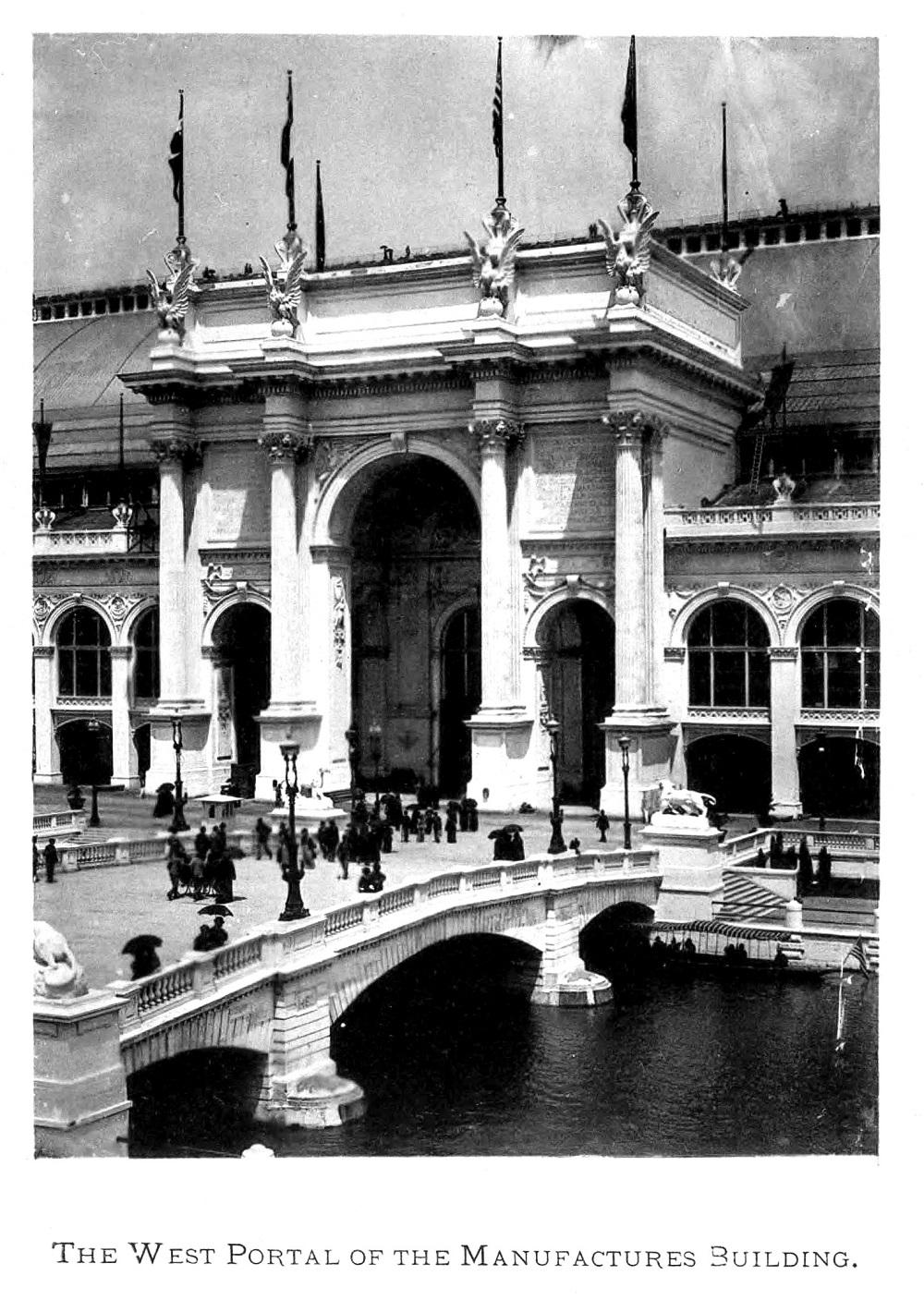

Visitors to the 1893 World’s Fair who entered the west portal of the Manufactures and Liberal Arts Building encountered a remarkable scene on their right. The striking display left no doubt that they had arrived in the exhibition space of Great Britain. A handsome art gallery wore a fanciful crown—a detailed miniature of Windsor Castle, forty-five feet long and eighteen feet wide. This intricate roof-top model enticed visitors to enter the Sunlight Soap pavilion sponsored by Messrs. Lever Brothers of England.

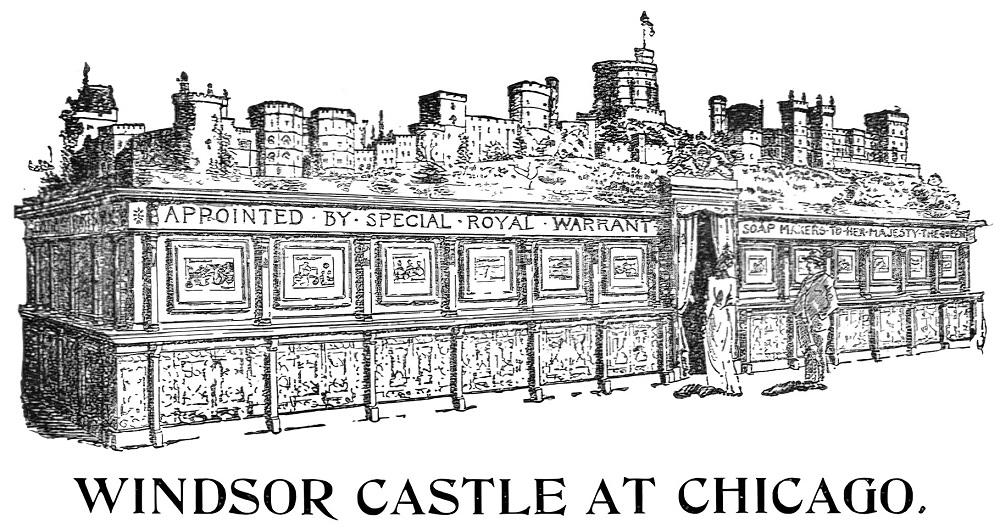
A grand model of Windsor Castle crowned the rooftop of the Sunlight Soap pavilion from Lever Brothers at the 1893 World’s Columbian Exposition in Chicago. [Image from Windsor Castle at Chicago (Lever Brothers, 1893).]
Lever Brothers’ Sunlight Soap
Founded in 1885 by William Hesketh Lever (1851–1925) and his brother James Darcy Lever (1854–1916), Lever Brothers, Ltd., produced Sunlight Soap, the world’s first packaged and branded laundry soap. From their rapidly growing factories in Port Sunlight near Birkenhead, England, the company distributed their popular product across Britain and its colonies. Most importantly, the royal laundry at Windsor Castle used Sunlight Soap. As the company prepared to showcase their product to an even wider audience at the upcoming 1893 World’s Columbian Exposition in Chicago, a creative advertising scheme developed. Having recently been appointed Soap Makers to Her Majesty Queen Victoria, Lever Brothers choose to celebrate the honor by topping their World’s Fair exhibit booth with the huge model of the Queen’s principal state residence. This fitting tribute would be an eye-popping display but also “very graceful and dignified,” according to one British newspaper.

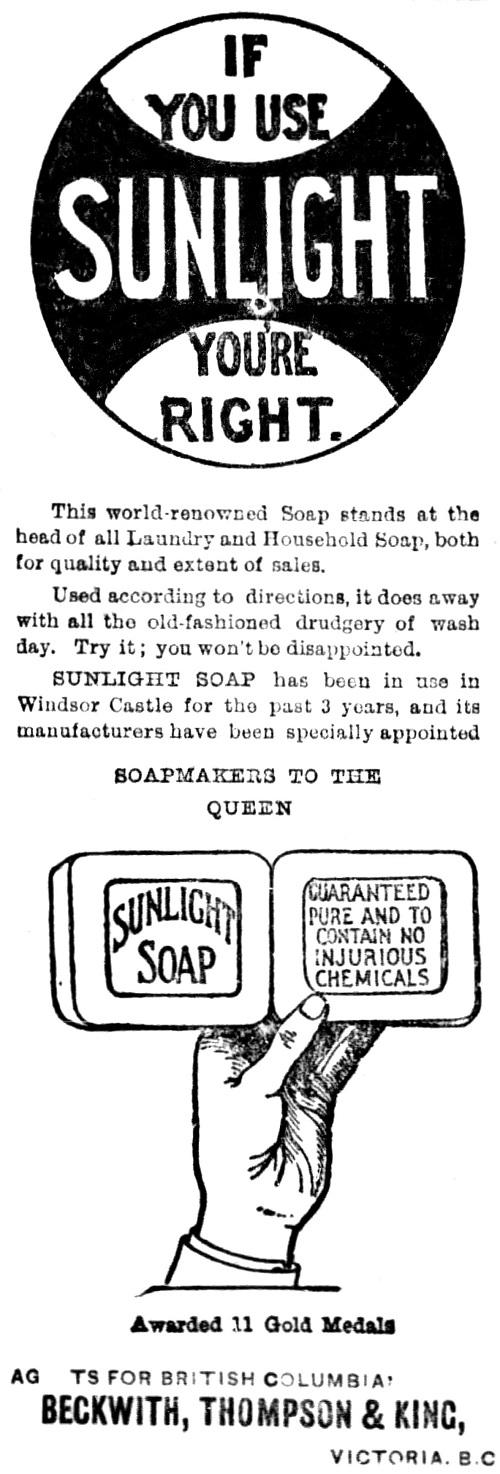
An 1893 advertisement for Sunlight Soap boasted that the product “has been in use in Windsor Castle for the past 3 years” and that Messrs. Lever Brothers have been “specially appointed soapmakers to the Queen.” [Image from the Victoria (BC) Daily Times, Mar. 25, 1893.]
Architect Maximilian Clarke
The Lever Brothers commissioned well-known London architect Max Clarke with the task of preparing the necessary plans and drawings for the Windsor Castle model. Born in Germany, Mr. Maximilian Clarke (1851–1938) was a member of the Royal Institute of British Architects. His distinctive designs for cabmen’s shelters—quaint-looking and characteristically green ornamental structures used by cab drivers—had been popping up on London streets in the 1880s; several still stand today. Clarke later designed the Dollingstown War Memorial obelisk in Northern Ireland.
Executing a miniature castle brought numerous difficulties, however. Clarke felt that, because the length [circumference] of the castle was two-thirds of a mile, “any attempt to reproduce it was useless.” He made many visits to the Royal Borough and had hundreds of photographs taken from various angles. Searches of castle records unearthed long-forgotten documents. Mr. Clarke’s efforts to draw accurate architectural plans for the model are described in a Lever Brothers promotional booklet, Windsor Castle at Chicago:
“When the architect availed himself of the permits granted him to examine plans, etc., at the Castle, he found the only drawings existing were those of the Royal and State Apartments in the Upper Ward, prepared by Sir Jeffrey Wyattville [Jeffry Wyatville], K.A., in 1840. Measurements had to be taken of all the other buildings so far as they were within reach. These were supplemented by an extensive series of photographs, specially taken, some from the roofs of houses in proximity to the Castle, while other ‘snap-shots’ were aimed by the photographers from the roof of a lofty Brewery in the vicinity. While at Windsor, the lot of the photographers and other emissaries of the architect was not ‘a happy one,’ owing to the jealous eye kept upon their movements, as possible dynamitards or foreign spies, by the sentries and royal police on duty at the Castle. The permits of the operators were frequently called for, and they felt relieved when they were at length able to leave the zealous guardians of the palace to the even tenour of their way. With the aid of the material thus obtained, the cunning hand of the architect educed from comparative chaos correct-scaled drawings, from which the contractors have constructed the beautiful model crowning the exhibit of Messrs. Lever Brothers, Limited.”
The booklet also notes that “but for the assistance received from officials of the Castle, who kindly permitted access to such plans and drawings of parts of the Castle as existed, it is doubtful if the architect’s and builders’ labours would have been so successful.” This was but one small way in which Queen Victoria supported the 1893 World’s Fair.

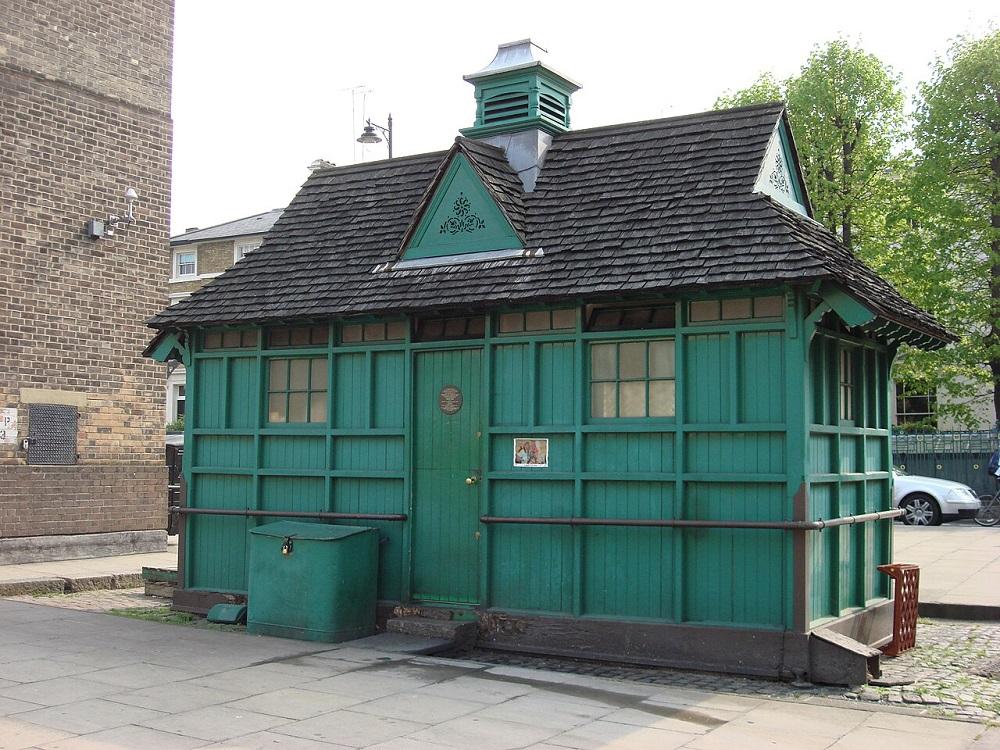
One of architect Max Clarke’s remaining cabmen’s shelters in London, 2007. [Photograph by “oyxman”; licensed under the Creative Commons]
Builders Campbell, Smith & Company
To construct the model, Lever Brothers turned to the renowned decorating firm Campbell, Smith & Company, Ltd., of London. Founded in 1873 by Charles Campbell and Frederick George Smith, it is still operating today. When the design company took on the job of building the Lever Brothers’ World’s Fair exhibit during the winter of 1892, it had just completed a renovation of St. James’s Hall on Piccadilly Circus in London. In addition to the Lever Brothers exhibit, the company received several other commissions for British displays at the Columbian Exposition. Campbell, Smith & Co. created a model of Brookfield Stud for Mr. W. Burdett-Couts, M.P. and a life-size section of a ruinous castle for the Bovril Company display (both in the Agricultural Building) as well as large coat-of-arms and badges to decorate the English Court and three painted-glass windows for Victoria House [https://worldsfairchicago1893.com/tag/victoria-house/]. Years earlier, Campbell, Smith & Co. had built a world-renowned model of “Old London” for the 1884 Health Exhibition and a full-size model of Nelson’s flagship HMS Victory for the 1891 Royal Naval Exhibition in Chelsea. Unlike those two full-sized reproductions, however, the proposed model of Windsor Castle was to be built on the scale of 3/8-inch to the foot. The firm was concerned that “on this tiny scale the detail of the buildings seemed almost impossible of reproduction.”
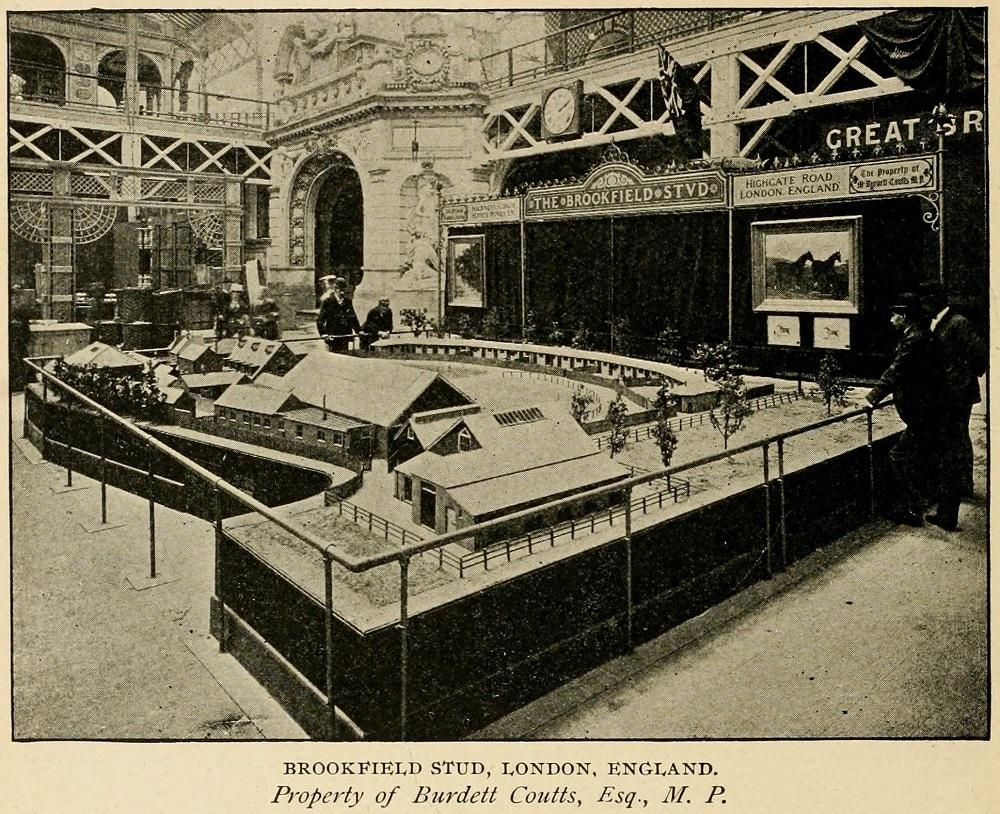


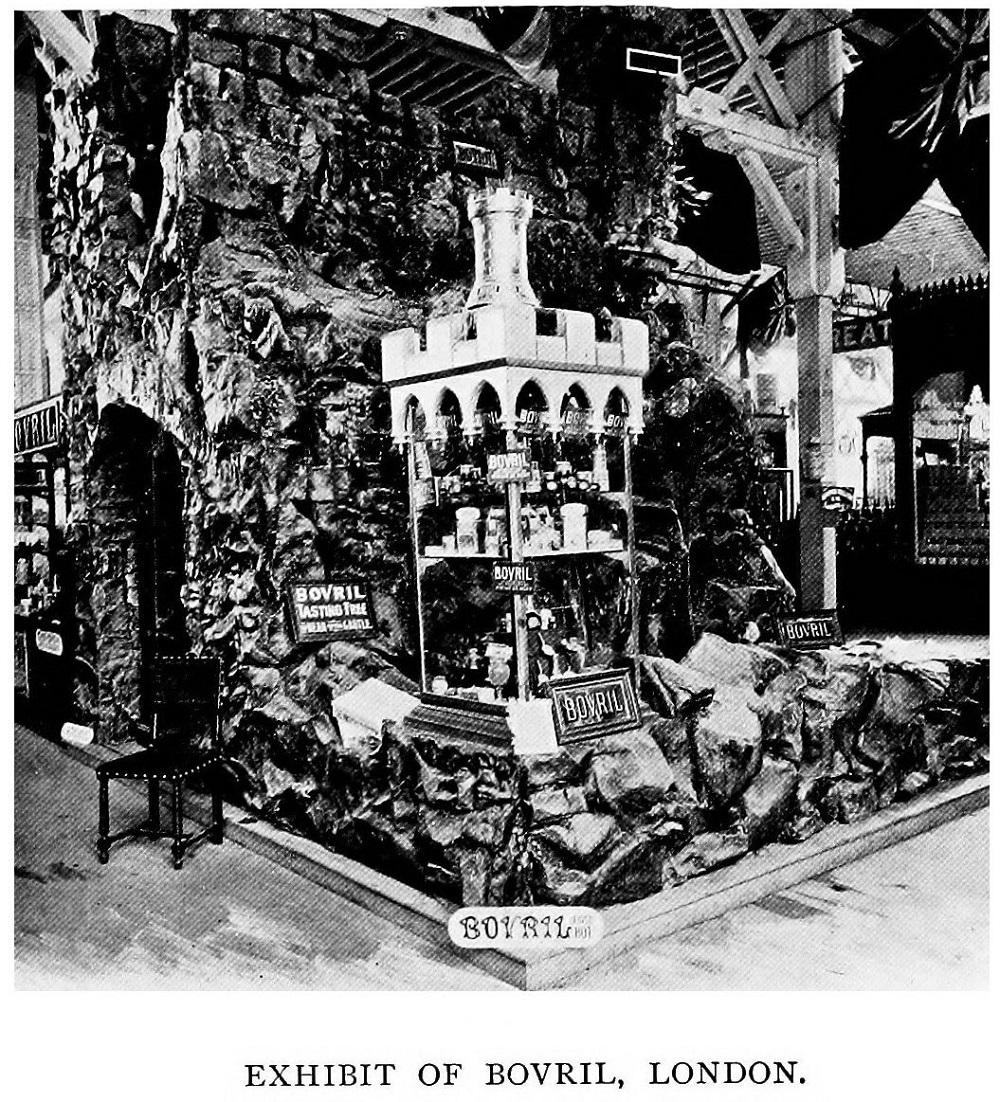
Photographs of two exhibits constructed by Campbell, Smith & Company, Ltd., of London that were displayed in the Agricultural Building of the 1893 World’s Fair. (Top) A model of Brookfield Stud of Old English horse breeds, located on Highgate Road, London, and owned by Mr. W. Burdett-Couts, M.P. [Image from White, Trumbull; Igleheart, William World’s Columbian Exposition Chicago, 1893. J. W. Ziegler, 1893.] (Bottom) A castle for the display of the Bovril Company’s condensed beef products. [Image from Johnson, Rossiter A History of the World’s Columbian Exposition Held in Chicago in 1893, Volume 3: Exhibits. D. Appleton and Co., 1897.]
On calling upon Messrs. Campbell, Smith & Co. we found that for the easy handling of this out-of-the-way kind of work their own crowded workshops were inadequate, and they had had to hire room for its execution in a large theatrical scene-painting ‘loft’ in Drury Lane, near to the London Theatre of that name. Here the model-makers were at work, but Windsor Castle was found ‘in ruins,’ scattered piece-meal about this huge artistic studio, where canvas is literally covered by the yard, with paint brushes replenished from Brobdingnagian colour-boxes, fearfully and wonderfully made after a fashion peculiarly the scene-painter’s own. In one corner lay ‘The Winchester Tower,’ in close proximity to a group of fiery dragons, and these monsters of the stage had a choice of quarters between historic Windsor and the ‘burning-steel castle’ for a provincial Christmas Pantomime. Hard by was the mimic ‘stage-set’ of a modern society drama, from which the scene painters were artfully reproducing the ‘acting edition’ of the same scenery, perhaps fifty times the size of the original. The situation was both interesting and ludicrous, and we began to think about ‘chaos’ again. In other rooms artists were busily engaged painting the beautiful friezes which decorate the dome and reception room of the Sunlight Soap exhibit.
Lever Brothers employees had supplied the timber used to build a skeleton frame, constructed in sections that could be disassembled for easy transport to Chicago. The whole consignment weighed nearly twenty tons, and all decorations of the stand were designed and executed by Messrs. Campbell, Smith & Co.

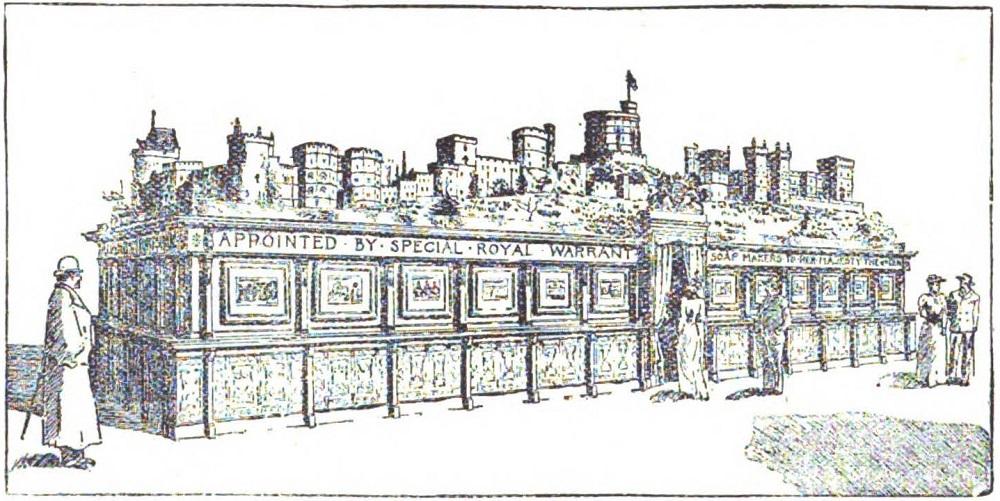
This promotional drawing of the Sunlight Soap exhibit was prepared for the preliminary press viewing in England. Unlike the actual exhibit stand, the frieze shown in this illustration has text that reads “APPOINTED BY SPECIAL ROYAL WARRANT SOAP MAKERS TO HER MAJESTY THE QUEEN.” The entrance to the vestibule shows draped curtains not used at the World’s Fair. [Image from Chemical Trade Journal Sep. 9, 1893.]
Press preview in Port Sunlight, England
Reporters gathered in Port Sunlight on February 17, 1893, for a press viewing of the Lever Brothers exhibition stand bound for the World’s Fair. James Darcy Lever presided, as his brother William was on a trip around the world (which had taken him to Chicago in October 1892 for a visit to the fairgrounds readying for the Columbian Exposition ). When a reporter asked the firm’s executive about the cost of the structure, Mr. J. D. Lever shook his head and smiled, replying: “I don’t really know. It will be very great, and I would rather not think about it.”
Those attending the viewing agreed that “the exhibit was one of the best of the kind ever manufactured.” Of course, the display also was being hailed as the only one of its kind ever manufactured. One reporter called it “one of the finest models I ever saw of Windsor Castle,” adding that “visitors from this country cannot but feel a national pride in seeing such a splendid example of British industrial enterprise and perseverance.” Another anticipated that the display would be “certainly one of the most original and artistic exhibits at the forthcoming Chicago Exhibition.”
One reporter mistakenly described the miniature Windsor Castle as “a magnificent model in soap.” The Runcorn Guardian was thinking along those lines, too, when it explained that “many of the visitors were surprised to find that no part of it was constructed of the now celebrated Sunlight Soap. Otherwise, beautiful and artistic as it is, it would have been more interesting.” Such a soap sculpture also would have had to compete for the limelight in Chicago with a model of the Brooklyn Bridge in the Manufacturers and Liberal Arts Building and a statue of Betsy Ross in the Agriculture Building—both truly made from soap!

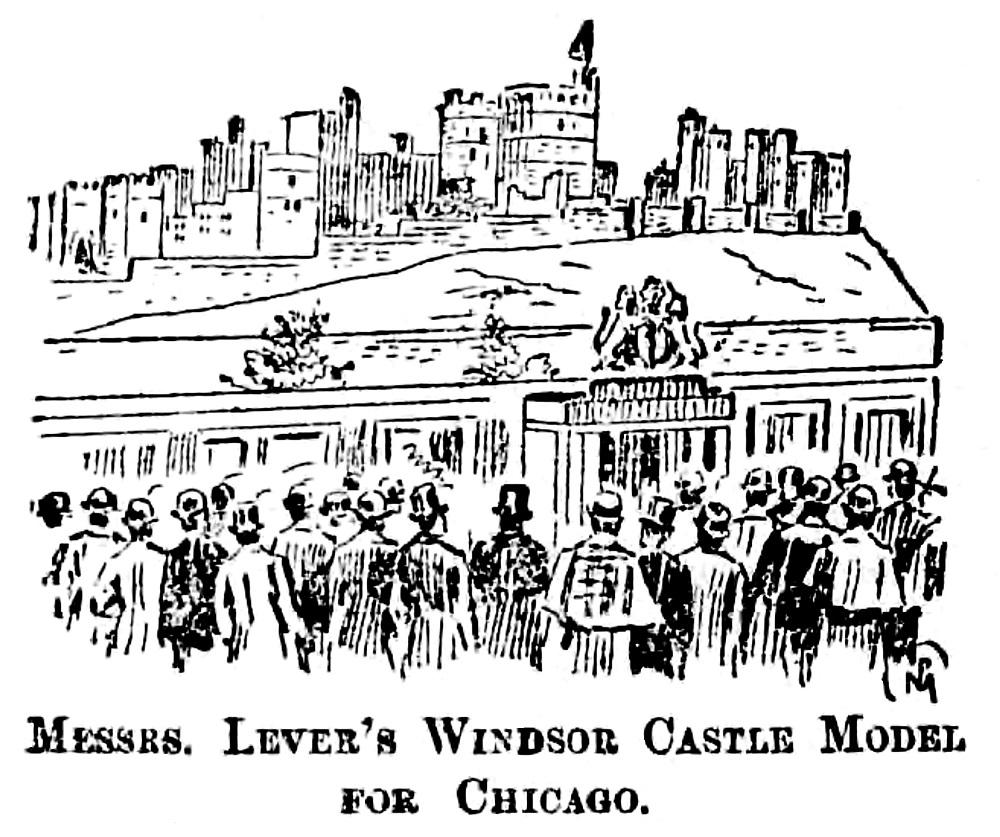
This newspaper illustration depicts the Lever Brothers World’s Fair booth being shown to the press on February 17, 1893, in Port Sunlight, England. [Image from the Newport (UK) South Wales Weekly Argus Feb. 25, 1893.]
Would it be a triumph in Chicago, also? “To the American visitors at the World’s Fair, it will, without doubt, be a source of intense interest,” anticipated the Birkenhead News (Feb. 18, 1893), “for their love of the old, romantic, and the historical in architecture is almost a national feature.” One may wonder if this reporter really knew the Yanks of 1893; Lever Brothers would find out soon enough.
The stand and model were taken entirely to pieces for shipment, and on March 8 the display departed Liverpool on the White Star Line’s RMS Majestic for its trip to America. Coincidentally on the same voyage was Mr. S. A. Buch, Commissioner of Fish and Fisheries for Norway at the Columbian Exposition. Passengers and crew were made anxious by news that the White Star Line’s SS Naronic had gone missing at sea. After departing Liverpool on February 11, that ship had failed to arrive in New York when expected. After the Majestic reached New York safely on March 15, evidence surfaced that the Naronic had gone down at sea. Along with the seventy-four souls lost, the mysterious sinking also took with it British displays intended for the Woman’s Building at the Fair.

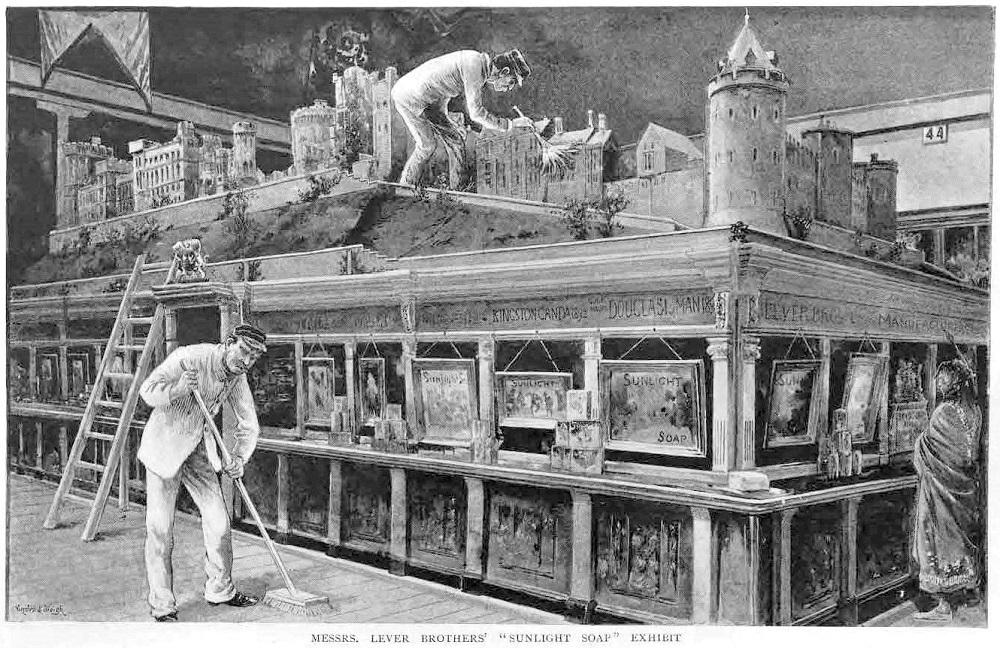
Workers clean the Lever Brothers Sunlight Soap exhibit at the 1893 World’s Fair in Chicago as a Native American inspects the artwork display. [Image from Black & White Aug. 19, 1893.]
Windsor Castle in Chicago
A few days before the shipment had departed England, the Chicago Inter Ocean reported that a “fine model of Windsor Castle,” the inside being “a work of art in saloon decoration,” was to be exhibited by Lever Brothers. Anticipation of the unique display grew as newspapers across the U.S. picked up the story. The Exposition placed the Lever Brothers exhibit in Group 87 (Chemical and Pharmaceutical Products), Classification No. 549 (flavoring extracts, essences, essential oils, toilet soap, perfumery, pomades, cosmetics, etc.). The company erected their booth in the British Section of the Manufacturers and Liberal Arts Building well before Opening Day on May 1. Two days earlier, in the midst of the chaotic scene of unboxing and assembling, a reporter spotted the British architectural icon and wrote that “the most notable feature now insight is Windsor Castle in miniature … which forms the top of a booth devoted to photographs and engravings.” Visitors approaching the Lever Brothers booth would see a structure forty-five feet long, eighteen feet wide and about sixteen feet tall. The main attraction, of course, was the castle topping the structure.

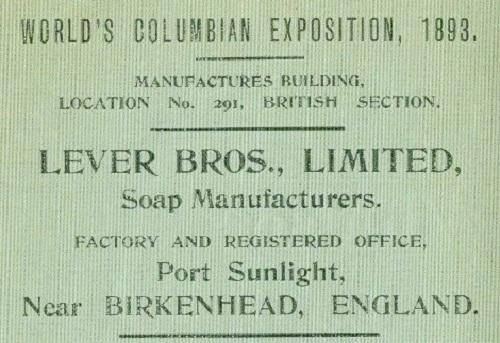
The location of the Lever Brothers display is noted on the verso of the half-title page for Windsor Castle at Chicago, a promotional booklet for the 1893 World’s Fair in Chicago.
The model, announced as “exact in all details,” covered the entire roof of the pavilion. The perfect facsimile in miniature, rising some twenty inches above the base, was constructed of seasoned wood and lined inside and outside with canvas to reproduce the colors of stone and “to defy the effects of even damp and excessive heat.” The Birkenhead News (Feb. 18, 1893) reported that “it is without a doubt the largest of its kind in the world and is the only existing model of the castle which is architecturally correct.” The paper also noted that “every door, window, buttress, battlement, and gargoyle is faithfully reproduced so that the visitor is afforded an idea of the vastness and beauty of this noble fabric such as no painting could afford.” The Hinckley Times wrote that “the colours and proportions are so true that one can almost fancy oneself in the presence of the glorious old home of our Sovereigns.”


A photograph of the Sunlight Soap exhibit in the British section of the Manufactures and Liberal Arts Building in Chicago. [Image from Campbell, James B. Campbell’s Illustrated History of the World’s Columbian Exposition, Volume II. M. Juul & Co., 1894.]
A report in the Chemical Trade Journal highlighted the veracity of the roof-top model:
“When looking at photographs of this portion of the exhibit, it is difficult to tell whether you are looking at photographs of the castle itself or not. Every tower, every window, every doorway, is accurately reproduced, even to the very weather stains. On the Round Tower floats a royal standard; on the Bell Tower there is a brazen weather vane. The sentries stand at their posts. The greensward ‘slopes’ look like veritable grassy banks, and trees appear to be shewing forth that vigorous strength for which the trees of Windsor are famed, ivy clinging to the walls here and there. Altogether, the effect is realistic in the extreme.”

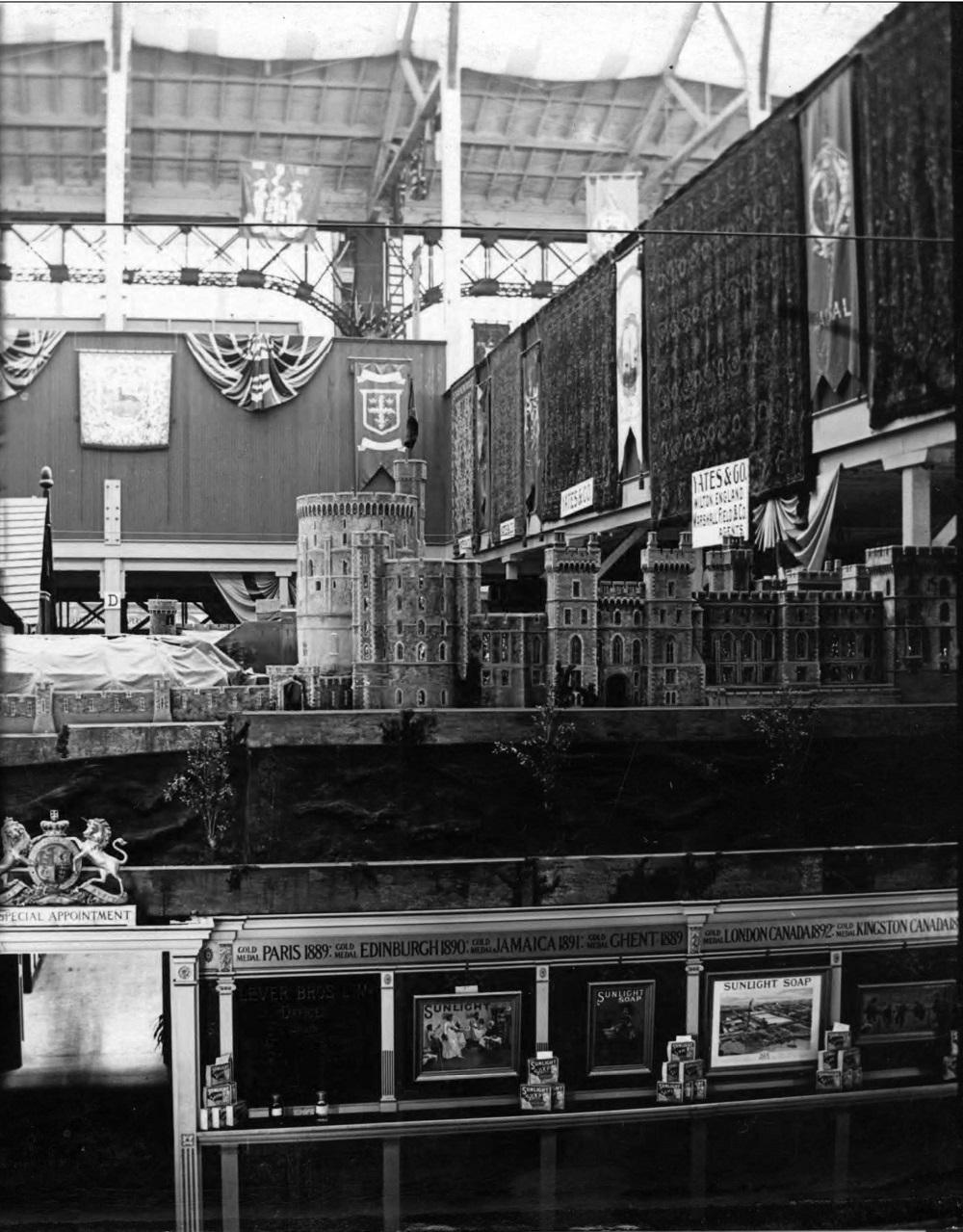
This photograph of the Lever Brothers display shows the right half of the Windsor Castle model, with the section depicting King Edward III Tower and the South Wing. [Image from B. W. Kilburn stereoscope card; private collection.]
The Sunlight Soap stand art gallery
There was much more to see under the roof-top castle. The Sunlight Soap stand served as a luxurious calling card for the company. Along the top, a richly molded ivory-and-gold cornice separated the base of the model and the top of the stand. Underneath ran a gold frieze with lettering in a warm-chocolate tint that listed the names of the gold medals and other important honors awarded to the firm at previous exhibitions, including: Brighton 1889, Sydney 1890, New Zealand 1889, Brantford, Canada 1890, Ottawa 1890, Cardiff 1888, Ottawa 1889, Kimberley 1892, Paris 1889; Edinburgh 1890, Jamaica 1891, Ghent 1889, London, Canada 1892, Kingston, Canada 1892. Below the frieze, on the upper half of the exterior walls, ran an arcade of panels colored in sienna and lemon cream with a beautiful scarlet design in relief. Pilasters enameled with ivory white and enriched with gold divided the panels. The effect was described as “an exquisite harmony of sunlight tints.”

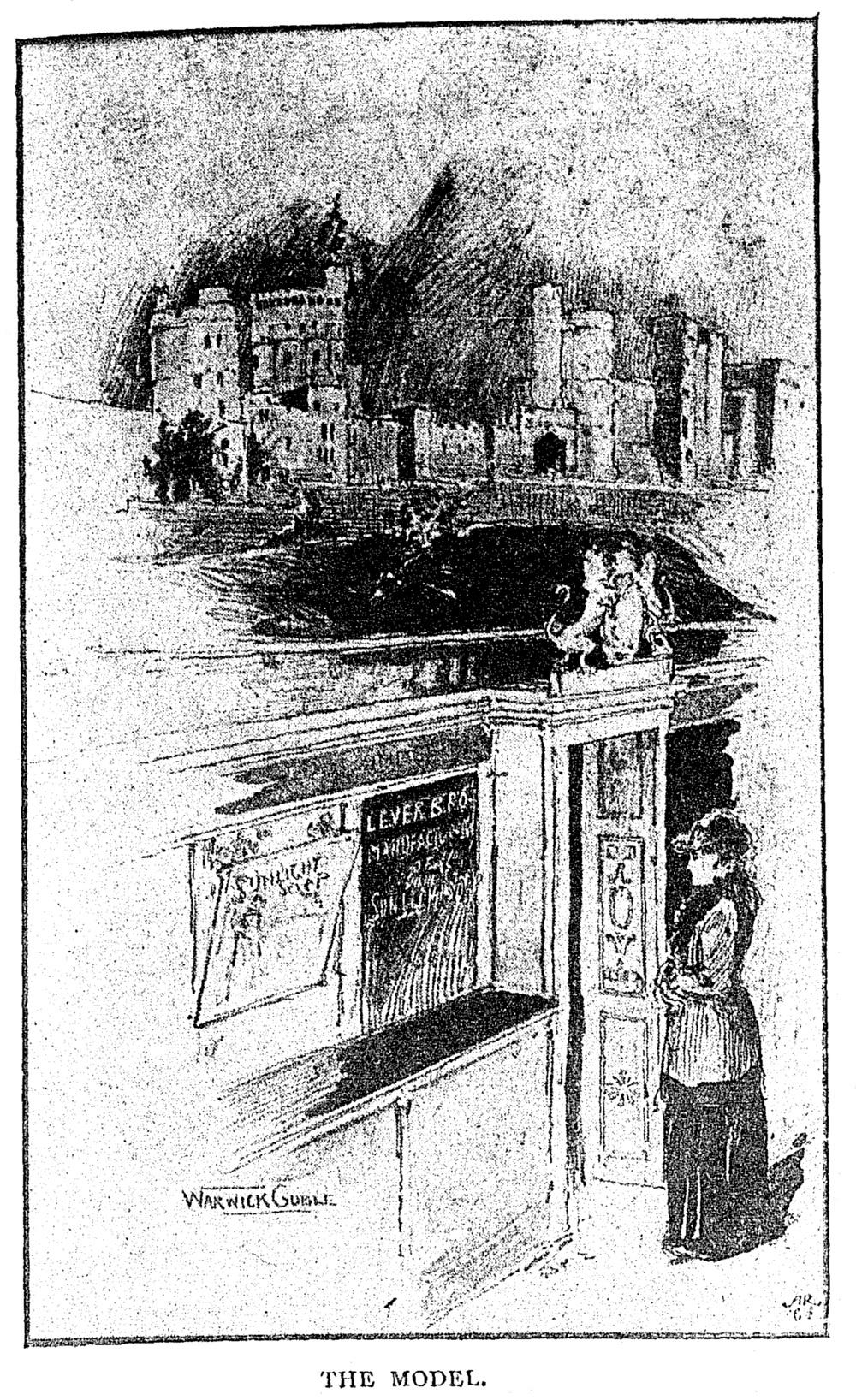
This illustration depicts the doorway leading into the vestibule of the stand. [Image from the Westminster Budget Mar. 3, 1893.]
- The Wedding Morning (1892) by John Henry Frederick Bacon
- Centre of Attraction (1891) by James Hayllar
- Street Arabs at Play or Heads Over Tails (1890) by Dorothy Tennant (Mrs. H. M. Stanley)
- This is the Way We Wash Our Clothes (1887) by George Dunlop Leslie; retitled This is the Way We Wash the Clothes for Sunlight Soap advertisements.
- The New Frock or Vanity of Vanities (1889) by William Powell Frith; retitled So Clean for Sunlight Soap advertisements.
- A Dress Rehearsal (1888) by Albert Chevallier Tayler; retitled The Wedding Dress for Sunlight Soap advertisements
(In 1983, Lever Brothers donated their original paintings to the Lady Lever Art Gallery of the National Museums Liverpool.)

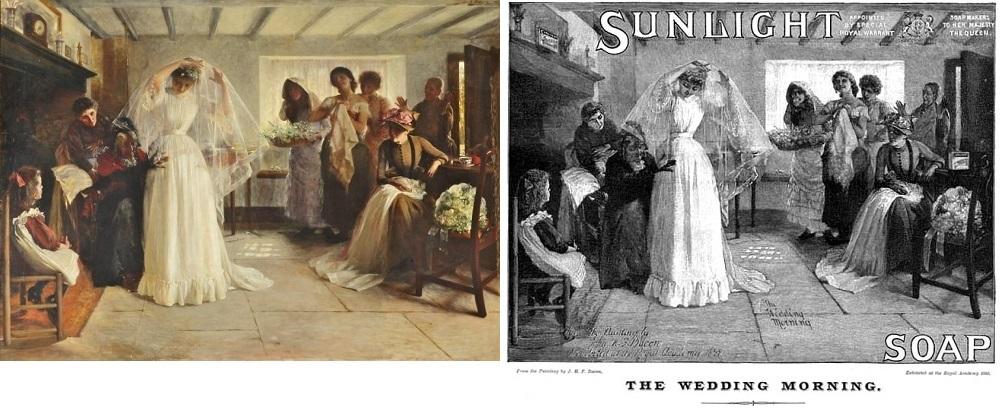
(Left) The Wedding Morning (1892) by John Henry Frederick Bacon and (right) the modified version used in Lever Brothers Sunlight Soap advertisements. [Image from the National Museums Liverpool.]

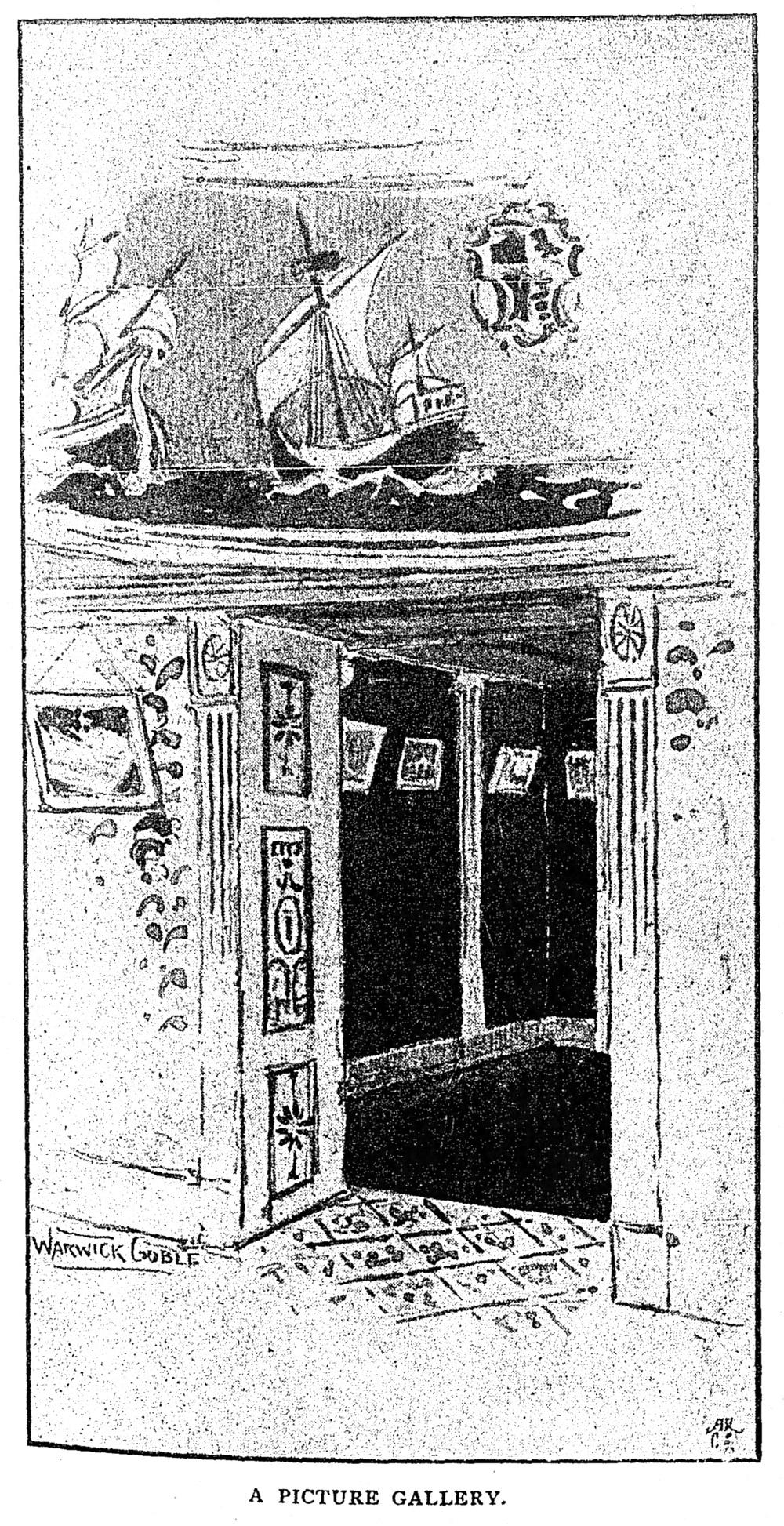
An illustration showing the entrance to the Reception Room from the vestibule, with its painted frieze depicting old ships. [Image from the Westminster Budget Mar. 3, 1893.]
Inside the Sunlight Soap stand
Two imposing entrances stood in the centers of either of the long sides of the stand, inviting guests inside. At the preliminary viewing in Port Sunlight, the doorways had been draped with curtains, but these were not used for the Chicago exhibition. Surmounting each entry was the Royal Arms of Great Britain emblazoned in heraldic colors. Terra cotta silk plush panels flanked each doorway and carried an inscription in raised gold letters: “Lever Brothers, Limited, Manufacturers of Sunlight Soap; Works, Port Sunlight, England” on the left and “Lever Brothers, Limited, principal offices London, Sydney, Toronto, Rotterdam, Brussels, Glasgow, Dublin, Liverpool, Manchester, Birmingham, Bristol, Southampton, and Plymouth” on the right.
Upon entering the stand from these side portals, visitors passed into a spacious vestibule nine-and-a-half-feet wide. The walls were lined with Japanese leather tinted bronze and richly embossed with floral patterns. The handsome wall decoration effectively complemented the ivory-and-gold color scheme of the stand. A frieze encircling the interior wall depicted the old ships of Columbus, Cabot, and other early explorers, artistically reproduced from contemporary books and manuscripts. Filling the sails of theses ocean vessels were the four winds of heaven, depicted as faces in a stained-glass panel light inside a vaulted dome ceiling. The effect was breathtaking.

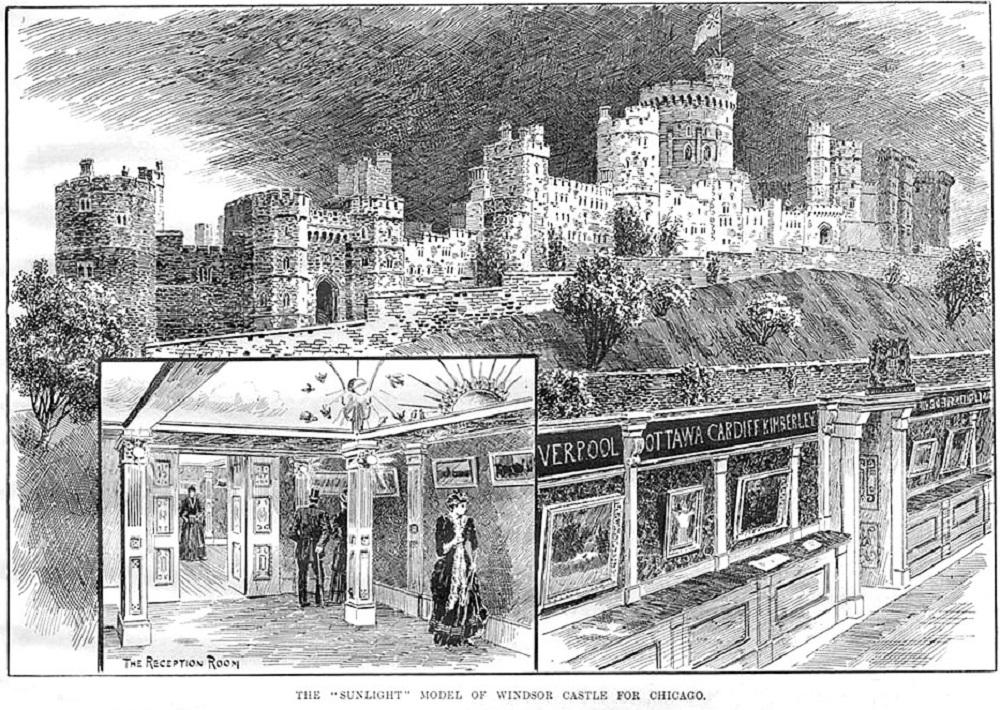
An illustration of the Sunlight Soap exhibit bound for the World’s Fair, showing the model and (as an inset) a scene of the interior Reception Room. [Image from Illustrated Sporting and Dramatic News Feb. 25, 1893.]
A handsome lantern light, supported by four fluted and gilt ivory pillars, rose above the center of the room. The sides were decorated with paintings of birds, butterflies, and bats in four scenes emblematic of Daybreak, Noon, Sunset, and Evening. “From the pale light of early dawn the eye passes to the blazing splendor of a noonday sun, thence to the softer hues of later afternoon, which finally deepens into the golden glories of the closing day,” wrote the Hinckley Times. Two of these paintings featured brilliant, gilded suns in high relief. The roof of the lantern light was stained glass, richly painted with figures representing the four seasons.
The walls of the vestibule and Reception Room displayed a series of beautiful platinotype photographs by Mr. Thomas Birtles (1832–1914) of Warrington, England. His photographic views captured scenes that traced the manufacturing of soap from the boiling vats to the packing room of the Sunlight Soap Works. Other photos featured the half-timbered workmen’s cottages and railway wharves of Port Sunlight, the company town erected by Messrs. Lever for their employees.
Six courteous boys served as attendants under the charge of an English manager. Clad in spotless linen costumes, they would gladly offer information about the company to visitors. A popular display in the Reception Room was a set of two miniature soap-stamping machines in continuous operation. They busily made souvenirs for guests, who could leave with a small soap tablet stamped as having come from the Sunlight Soap stand at the 1893 World’s Fair.

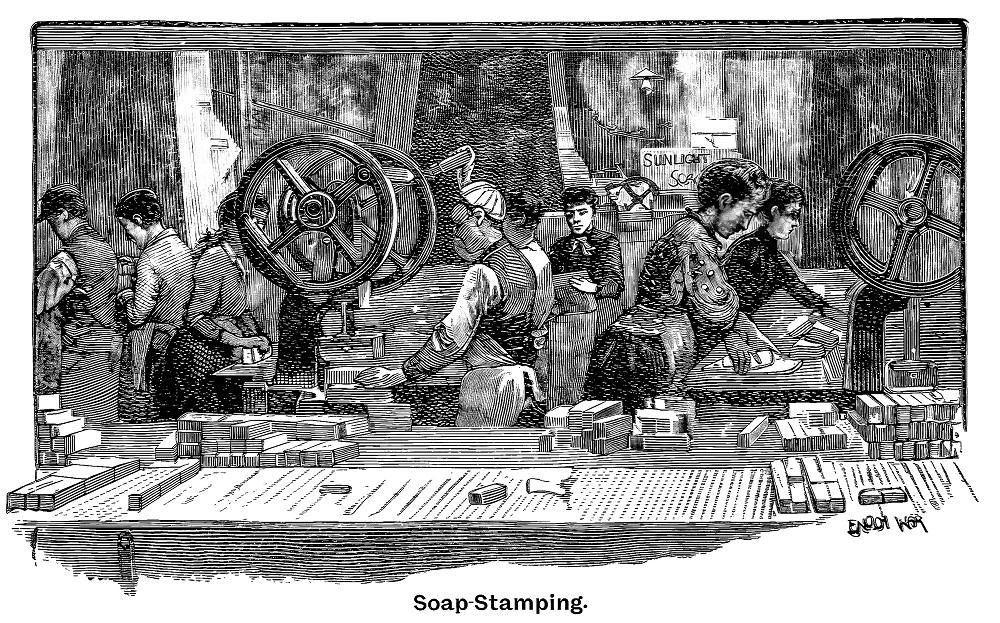
The soap-stamping machine at the Sunlight Soap Works in Port Sunlight, England. [Image from Windsor Castle at Chicago (Lever Brothers, 1893).]
Visitors’ impressions
Among the millions of exhibits at the Columbian Exposition, the Sunlight Soap booth caught the eye of World’s Fair visitors from both sides of the Atlantic. The Windsor Castle model reportedly was “of great interest to the English people who are attending the Fair.” A man visiting from Irvine, Scotland, wrote to his hometown newspaper that, although “Britain was poorly represented” in the Manufactures Building, there were two notable exceptions: a reproduction of the dining room at Hatfield House and the Sunlight Soap display with its Windsor Castle model. A correspondent for the London trade journal The Chemist and Druggist wrote that the Lever Brothers “take the cake” with their display in the British Court. While noting that “the structure is the feature which attracts most attention,” the report also conceded that not all fairgoers recognized the iconic British structure:
“Truth to tell, Americans are quite at sea as to what it is—e.g., one hapless woman described it to a companion as an English laundry, a suggestion as Philistinic as William Morris’s dream of the Houses of Parliament being turned into a manure depot in days far distant. Sunlight soap scores, nevertheless.”
Even those Americans who did recognize the royal residence gave British subject pause with their comments. A correspondent from Victoria, British Columbia, noted that:
“The Americans admitted that Victoria’s residence pretty nearly comes up to the White House. This bona fide remark reminded me of another which the Chicago papers credit to one of their leading citizens, ‘Heaven is fashioned after the Palmer House.’”
A visitor from Dunbarton, Scotland, worked his way through the soap displays of Atkinson and Pears before encountering the well-known “Why does a woman look old sooner than a man?” company, referring to a popular the Lever Brothers’ advertising campaign. “They have a couple of boys inside handing out little cakes of soap. We reached out our hand but were promptly informed—‘Ladies only.’” A man visiting from Sterling, Illinois, faced no such problem, reporting that “in the Sunlight Soap pavilion you are presented with a souvenir piece of soap and on getting on outside of the pavilion and looking at its top you see Windsor Castle reproduced.”

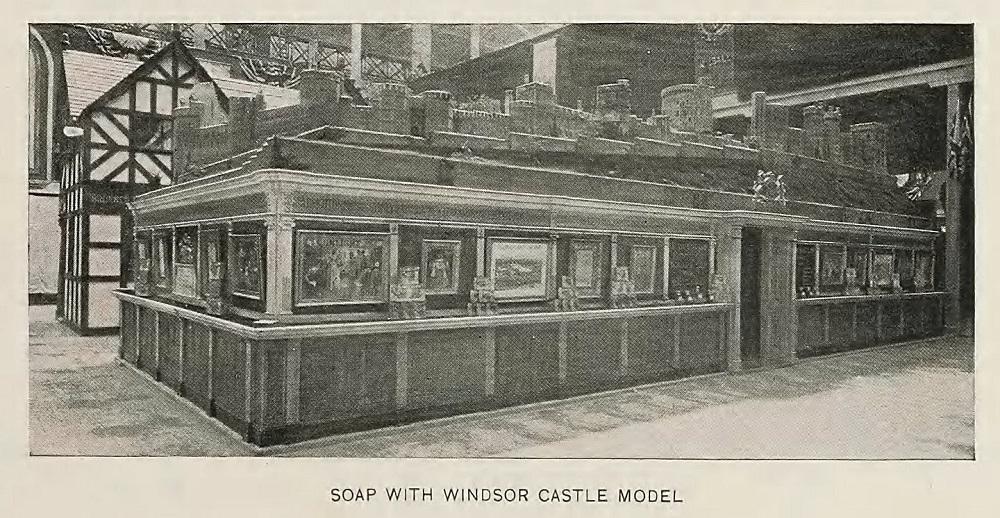
This photograph of the Sunlight Soap display shows changes in the background compared to the photo in Campbell’s Illustrated History (above). A Tudor-style cottage appears behind the left side of the Lever Brother stand, and flags and bunting hanging from the gallery have changed. [Image from Bancroft, Hubert Howe The Book of the Fair (The Bancroft Company, 1893).]
“It is a model as large as a small room of Windsor castle … It is a beautiful immense square stone palace, with many and noble turret and tower standing on sloping heights of brown rock and green verdure, most elegant and magnificent to behold—a realized picture one will never forget.”
The model also impressed Exposition judges, who awarded Lever Brothers for their “artistic display of Sunlight Soap” at the Fair.

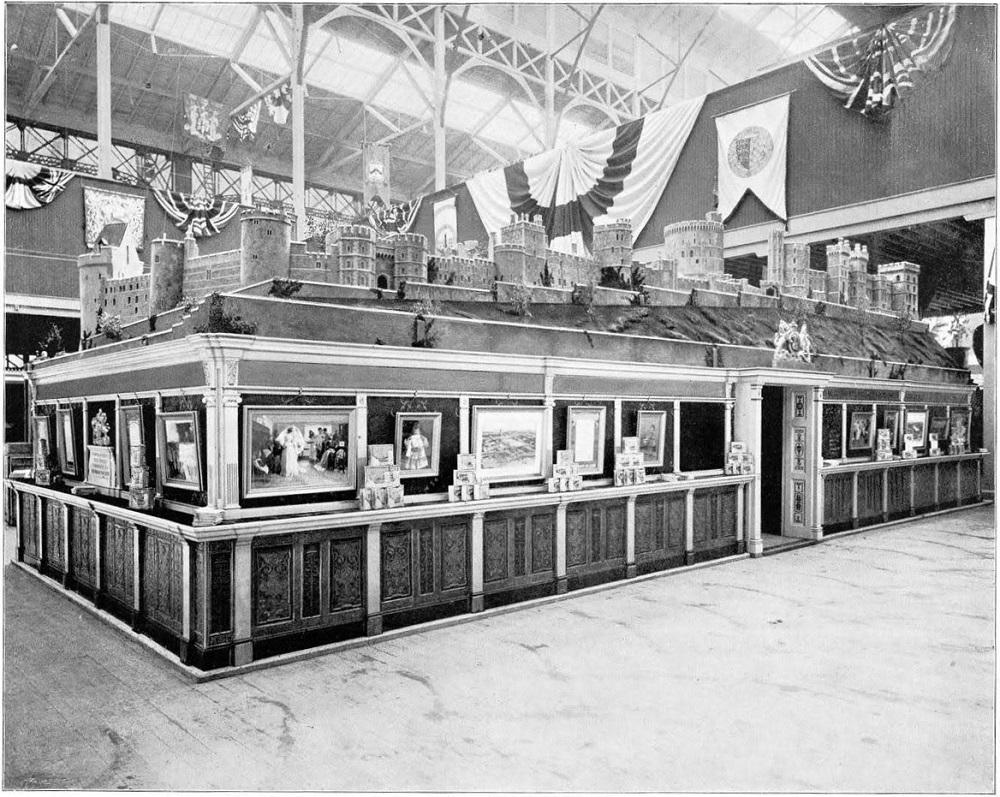
Although the same photograph as the one published in Campbell’s Illustrated History (above), this version published in The Dream City has been altered. The frieze listing the Gold Medal awards and the panels flanking the entrance door have been removed from the image for some reason. [Image from The Dream City. A Portfolio of Photographic Views of the World’s Columbian Exposition (N. D. Thompson, 1893).]
After the Fair
After the close of the Columbian Exposition on October 30, the millions of exhibits quickly scattered to the four corners of the Earth. What happened to the Windsor Castle model? The display seemed to be on its way back home to Port Sunlight, England, in December when a resident of nearby Birkenhead wrote to a local paper requesting that the Lever Brothers
“… arrange to have their model of Windsor Castle, now on its way from the World’s Fair, erected in, say the Town or some other Hall, for the inspection of the public at large, and that is small charge be made for admission, the proceeds to be devoted to that deserving institution, the Borough Hospital.”
No news of the model making it back home or being displayed at the Bootle Borough Hospital has been discovered, and the fate of the Windsor Castle model from the 1893 World’s Fair remains a mystery.*
* During Queen Victoria’s diamond jubilee in June of 1897, the Illustrated London News reportedly decorated their building on The Strand by placing a large model of Windsor Castle on the roof, but nothing suggests that this was the same as the Lever Brothers model from 1893.

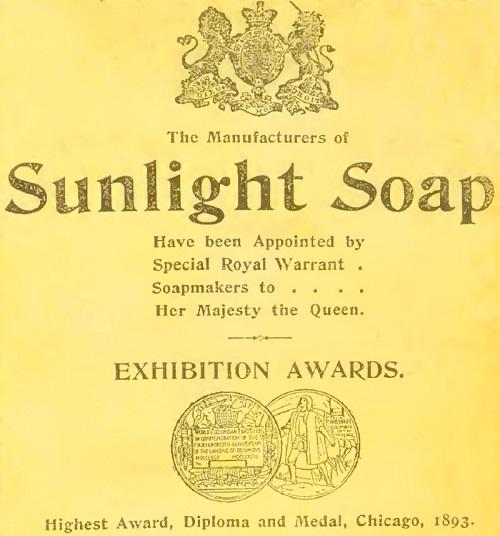
Sunlight Soap proudly advertised their success at the 1893 World’s Fair in advertising for years afterwards. “Highest Award, Diploma and Medal, Chicago 1893” such as in The Sunlight Year-book for 1898 (Lever Brothers, 1898).
ACKNOWLEDGEMENT
Dave Lay of the Port Sunlight Village History Group generously provided help with research for this article.
SOURCES
“Columbian Points” Chicago Inter Ocean Mar. 5, 1893, p. 5.
“Exhibitors at Chicago” Runcorn (UK) Guardian Feb. 22, 1893, p. 6.
“A Laudable Suggestion” Birkenhead (UK) News Dec. 20, 1893, p. 8.
“Lever Brothers and the Columbian Exposition” Liverpool (UK) Evening Express Feb. 18, 1893, p. 3.
Lever, W. H. Following the Flag: Jottings of a Jaunt Round the World. Simpkin Marshall & Co., 1893.
“Messrs. Lever Brothers and the ‘World’s Fair’” Birkenhead (UK) News Feb. 18, 1893, p. 5.
“Not Ready” Cleveland (OH) Plain Dealer May 1, 1893, p. 2.
“Notes from an Irvine Man in America” Irvine (UK) Herald Jul. 14, 1893, p. 5.
“An Original Exhibit” British Trade Journal Apr. 1, 1893, p. 195.
“Sunlight Soap Exhibit” World’s Columbian Exposition Illustrated Sep. 1893, p. 171.
“Trade Notes” British Architect Feb. 24, 1893, p. 144.
“A Trip to the World’s Fair” Dumbarton (UK) Herald Nov. 1, 1893, p. 2.
“Weekly London Letter” Hinckley (UK) Times Feb. 25, 1893, p. 3.
Wellman, Walter “Foreign Exhibits” Champaign (IL) Daily Gazette Jul. 6, 1893, p. 2.
“Wares of All the World” Victoria (BC) Daily Times Aug. 25, 1893, p. 4.
Windsor Castle at Chicago, To Which is Added the Home of Sunlight Soap by George Augustus Sala. Lever Brothers Limited, 1893.
“Windsor Castle at the Chicago Exhibition” Aberdeen (UK) Weekly Journal Mar. 1, 1893, p. 7.
“World’s Columbian Exposition Chicago: British Manufactures Exhibits” Chemist and Druggist Jul. 1, 1893, p. 22.
“The World’s Columbian Exposition: English Industries at Chicago” Chemical Trade Journal Sep. 9, 1893, p. 162.
“The World’s Fair, No. 10” Winston-Salem (NC) Union Republican Nov. 9, 1893, p. 1.
“The World’s Fair Sights, No. 13” Sterling (IL) Standard Sep. 14, 1893, p. 5.
“World’s Fair Letter” Carthage (MO) Democrat Sep. 28, 1893, p. 2.
“World’s Fair Notes” Newton County (MO) News Sep. 7, 1893, p. 2.